

Badanah for Major Violations: Rules, Cases, and How It Applies
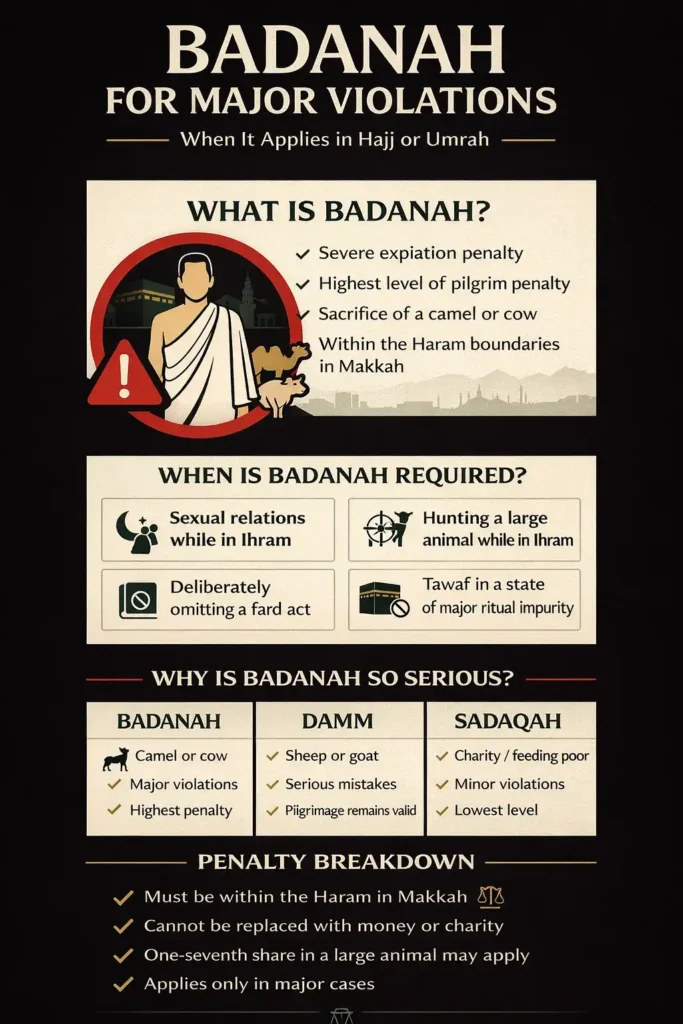
Badanah for major violations is the heaviest expiation linked to the most serious breaches during pilgrimage. In plain words, it means a large sacrificial offering—usually a camel or cow—when a grave violation happens in Hajj or Umrah.
It is not for ordinary mistakes. It is tied to cases scholars discuss as severe, such as sexual relations while in Ihram, performing tawaf in a state of major ritual impurity in certain major cases, or other acts that can reach the level of breaking the pilgrimage itself. For a broader foundation first, read dam in umrah.
If you remember one line from this article, remember this: badanah is a severe expiation penalty, and it is discussed for the most serious situations, not for every mistake in Ihram.
✅ TL;DR – badanah for major violations
Badanah is the highest level of pilgrim penalty discussed for the gravest breaches in Hajj or Umrah. It usually means a sacrifice of a camel or cow within the Haram boundaries. It is not replaced by money. In some cases, the pilgrim must still finish the rites, then repeat the pilgrimage later. Lesser mistakes usually fall under damm or sadaqah, not badanah.
What Is Badanah for Major Violations?
Badanah explained in simple words
What is badanah in Islam? Think of it like the heaviest warning light in the pilgrimage system. Small mistakes are one thing. Bigger mistakes are another. But when the violation hits the core of the ritual, the expiation discussed becomes much heavier. That is where badanah comes in.
It is a large sacrifice, not a small one.
And that difference matters.
Why badanah is the highest pilgrim penalty
Badanah in Islam is described by scholars as the top end of pilgrimage expiation because it is tied to grave violations, not everyday slip-ups. A pilgrim who used scented soap by mistake is not in the same category as someone whose act invalidates the pilgrimage.
That is why this penalty feels heavy. It is meant to feel heavy.
Why badanah applies only in grave situations
When is badanah required? It is discussed only in major cases. Not every breach of Ihram triggers it. Many violations during pilgrimage lead to damm or sadaqah instead. Badanah applies only when the issue reaches a grave situation, and scholars tie it to specific major cases, not to general carelessness.
📚 You Can Also Read: Different Categories of Damm
What Is Badanah in Islam?
Badanah meaning in Hajj and Umrah
Badanah for Hajj and badanah for Umrah refers to an expiatory sacrifice of a large animal for certain serious violations. The word itself points to a large sacrificial animal. In pilgrimage discussions, it is usually explained as a camel or cow offered as expiation.
Why badanah means a sacrifice of a camel or cow
The reason scholars describe badanah as a sacrifice of a camel or cow is simple: this is not the smaller level of sacrifice linked with ordinary damm. It is larger because the violation itself is larger. The size of the offering mirrors the weight of the breach.
Not a sheep. Not a casual payment.
What makes badanah different from ordinary fidyah
Fidyah is the wider umbrella word for expiation. Under that umbrella, scholars discuss forms such as sadaqah, damm, and fidyah badanah. So badanah is not separate from expiation. It is one of its heaviest forms.
📖 Qur’an box about pilgrimage sacrifice
وَأَتِمُّوا الْحَجَّ وَالْعُمْرَةَ لِلَّهِ ۚ فَإِنْ أُحْصِرْتُمْ فَمَا اسْتَيْسَرَ مِنَ الْهَدْيِ
Transliteration: Wa atimmul-hajja wal-‘umrata lillah, fa in uhsirtum fama istaysara minal-hady.
Translation: “Complete the Hajj and Umrah for Allah. But if you are prevented, then offer what can be obtained with ease of sacrificial animals.”
This verse establishes the wider principle that expiatory sacrifice belongs to the pilgrimage system. The exact penalty type depends on the violation.
📚 You Can Also Read: Dam in Hajj
When Is Badanah Required During Hajj or Umrah?
Badanah for sexual relations while in Ihram
Badanah for sexual relations while in Ihram is one of the clearest major cases discussed by jurists. This is not about a passing thought or mild affection. It is about actual sexual intercourse in a time and state where it can break the ritual itself.
Badanah for hunting a large animal while in Ihram
Badanah for hunting a large animal while in Ihram is also discussed in the major-violation category. The key idea here is not random harm in general, but hunting game while the pilgrim is in the sacred state of Ihram. Some juristic details vary by the type of animal and the school, so this ruling must be checked carefully in real cases.
Badanah for deliberately omitting a fard act
The phrase badanah for deliberately omitting a fard act appears in many summaries, but this needs careful wording. A pilgrim should not assume that every missed fard act automatically has the same ruling in every madhhab and every circumstance. Some core acts cannot simply be “paid off.” The exact case matters, and sometimes repeating the pilgrimage becomes part of the ruling.
Badanah for tawaf in a state of major ritual impurity
Badanah for tawaf in a state of major ritual impurity is one of the most discussed major cases, especially around Tawaf al-Ziyarah. In many fiqh discussions, doing this tawaf while in janabah, menstruation, or postpartum bleeding is treated far more seriously than an ordinary purity error.
📚 You Can Also Read: Tawaf al-Wida Dam
What Major Violations Can Invalidate the Pilgrimage?
What invalidates Umrah and requires badanah
What invalidates your Umrah and requires badanah? The clearest example mentioned in summary rulings is sexual intercourse before the Umrah is properly completed. In that case, the Umrah can be nullified, the pilgrim must continue outwardly, and then repeat the Umrah later according to the ruling discussed by scholars.
What invalidates Hajj and requires badanah
For Hajj, one of the gravest examples is intercourse before the stage after which the pilgrim exits the tightest restrictions, especially before key rites are completed. This is why you often see phrases such as before Tawaf al-Ziyarah or before cutting the hair in Hajj penalty discussions.
When repeating the pilgrimage becomes necessary
This is the part many pilgrims find shocking. In some major cases, badanah penalty does not mean the problem is “fixed and forgotten.” The pilgrim may have to finish the current rites outwardly, offer the required expiation, and then repeat the pilgrimage later.
That is how serious the breach can be.
Badanah for Sexual Relations While in Ihram
When intercourse invalidates the pilgrimage
Sexual intercourse is not treated like other prohibited acts in Ihram. It strikes at the heart of the sacred state. In major cases, especially before key stages of release from Ihram, scholars say it can nullify the pilgrimage or nullify the Umrah.
What happens if it occurs before Tawaf al-Ziyarah or before cutting the hair
In many classical summaries, the period between Wuquf in Arafat and full release through later rites is a danger zone for this ruling. That is why phrases like before Tawaf al-Ziyarah and before cutting the hair appear so often. They mark the point before full exit from the most serious restrictions.
Do you have to complete the pilgrimage and repeat it later
Yes, this is the ruling many people find hardest to hear. In major cases of intercourse, the pilgrim is generally told not to walk away from the rites. He or she continues the outward form of the pilgrimage, then handles the expiation, then repeats the pilgrimage later according to the ruling of scholars.
A student once asked me, “If it’s already broken, why finish it?” Because sacred acts are not treated casually. Even when a grave mistake happens, the pilgrim does not turn worship into chaos. He finishes what he is in, then repairs what must be repaired.
🕋 Hadith box on Hajj purity of conduct
مَنْ حَجَّ لِلَّهِ فَلَمْ يَرْفُثْ وَلَمْ يَفْسُقْ رَجَعَ كَيَوْمِ وَلَدَتْهُ أُمُّهُ
Transliteration: Man hajja lillahi فلم yarfuth wa lam yafsuq raja‘a kayawmi waladat-hu ummuh.
Translation: “Whoever performs Hajj for Allah and does not commit sexual indecency or sinful disobedience returns like the day his mother gave birth to him.”
This hadith shows why sexual misconduct during Hajj is treated with extreme seriousness.
📚 You Can Also Read: Ihram Rules Hajj
Badanah for Tawaf in a State of Major Ritual Impurity
Does major impurity during tawaf require badanah
This needs precision. Not every purity issue reaches the same level. But when the case is major ritual impurity linked to a core tawaf—especially Tawaf al-Ziyarah—many juristic summaries mention badanah expiation, not an ordinary smaller penalty.
What about menstruation during Tawaf al-Ziyarah
Badanah for menstruation during Tawaf al-Ziyarah appears in many fiqh discussions because this tawaf is not a minor extra. It is a central rite. Because of that, violating purity in this specific case is treated much more seriously than an ordinary mistake in a lesser tawaf.
What about postpartum bleeding during tawaf
Postpartum bleeding is discussed under the same major-purity heading. The point is not the label alone. The point is that the pilgrim is not in the state required for the rite. That is why scholars handle this issue with special care.
I used to see beginners treat all tawaf mistakes as one bucket. They are not one bucket. The type of tawaf matters. The state of purity matters. The timing matters.
📚 You Can Also Read: What Are Fard Wajib and Sunnah of Hajj
Badanah for Hunting While in Ihram
When hunting a large animal triggers badanah
When is badanah required during Hajj or Umrah? One major example is hunting game while in the sacred state of Ihram, especially when the case reaches the category of a sacrifice of a large animal. This is why you see the phrase big animals like cows or camels in many summaries.
Why this is treated as a grave violation
Because Ihram is a sacred restriction, and hunting directly breaks that sanctity. The pilgrim is not supposed to move through the sacred journey with the habits of ordinary travel. Hunting is not just “a bad moment.” It is a breach of the protected state itself.
What pilgrims should do immediately after this mistake
If a pilgrim falls into a case like this, the first step is not guessing. The first step is to stop, document what happened clearly, and ask a qualified scholar or mufti because the exact animal, exact act, and exact fiqh details affect the ruling. Real cases should never be solved by half-memory in a hotel room.
📚 You Can Also Read: Hajj Mistakes to Avoid
What Type of Sacrifice Is Required for Badanah?
Camel or cow for badanah explained
Camel or cow sacrifice for major Hajj violations is the standard explanation given for badanah. That is why the phrase sacrifice of a camel or cow appears in nearly every serious summary of this topic.
Can one-seventh share in a large animal count
Many fiqh summaries mention that one-seventh share in a large animal may count in the case of a cow or camel. But this is not a corner to cut on your own. It still has to be done correctly, in the right place, and with the right legal understanding.
Why badanah is a larger sacrifice than damm
Badanah vs damm becomes easy to remember like this: damm is the smaller sacrificial category, usually linked to serious but lower-level violations; badanah is the larger sacrificial category discussed for the gravest breaches.
Where Must Badanah Be Slaughtered?
Why the sacrifice must be within the Haram boundaries
Badanah must be slaughtered within the Haram boundaries because the expiatory sacrifice is tied to the sacred precincts of the pilgrimage. The place matters. This is not just an animal payment. It is a religious offering tied to the sanctity of Makkah.
Can badanah be done outside Makkah
As a rule, no. The expiatory sacrifice is discussed as an offering within the sacred area. That is why you see the wording must be slaughtered within the sacred precincts of the Haram in Makkah. Doing it outside that boundary does not serve the same ritual purpose.
Who should receive the meat of the sacrifice
The meat goes to the poor of the Haram area. The point is not private celebration. It is expiation tied to sacred law and benefit for those entitled to receive it.
📚 You Can Also Read: Udhiyah Qurbani in Islam Rules Meaning Distribution Guide
When Do You Pay Badanah?
Should badanah be paid immediately after the violation
When do I pay badanah? The practical rule given in many summaries is: once the grave violation is known and confirmed, the pilgrim should not delay without reason. Serious expiation should not be treated like a task for “sometime later.”
What if you realise the mistake after leaving Makkah
If a pilgrim only realizes the issue after leaving, the obligation does not disappear. The mistake still needs to be dealt with correctly. The expiation remains tied to the proper place.
Can you appoint someone to perform badanah on your behalf
Yes, appointing someone to arrange the sacrifice on your behalf is discussed as a practical solution when you are no longer there or cannot handle it yourself. What matters is that it is done correctly, in the right place, and under trustworthy supervision.
📦 Badanah payment box
What must be true for a valid badanah arrangement?
✅ Correct penalty confirmed by qualified knowledge
✅ Camel or cow, or valid large-animal share where accepted
✅ Done within the Haram boundaries
✅ Meat directed to the poor
✅ Trusted agent used if you cannot do it yourself
Can Badanah Be Replaced with Money or Charity?
Why money does not replace badanah
Can badanah be replaced with money or charity? No. The ruling discussed for badanah is a sacrificial animal, not a cash shortcut. The exact act is part of the ruling itself.
Why sadaqah is not enough for major violations
Badanah vs sadaqah is not just a size difference. It is a category difference. Sadaqah is tied to minor infractions. A grave violation cannot be repaired by stepping down into a smaller category because it feels easier.
What pilgrims must do instead
The pilgrim must do the expiation that matches the breach. For badanah, that means the proper sacrificial offering. Not cash. Not just food charity. Not a self-made replacement.
Badanah vs Damm vs Sadaqah: What Is the Difference?
Badanah vs damm for Hajj and Umrah violations
Badanah vs damm for Hajj and Umrah violations can be remembered like this: damm usually covers serious but lower-level mistakes, often with a sheep or goat; badanah covers the most severe breaches, with a camel or cow.
Badanah vs sadaqah for minor and major mistakes
Sadaqah is for minor mistakes. Damm is for more serious omissions or violations. Badanah is for the gravest cases. When people mix these categories, they either panic too much or become too casual. Both are bad.
Penalty breakdown for rule-breaking during pilgrimage
Here is the safe summary before the table below: not every broken rule means your Hajj or Umrah is gone. Many things are repaired by lower expiation. Badanah for major violations during Hajj or Umrah belongs only to the top tier of breaches.
What Is Fidyah and How Does Badanah Fit Into It?
Is badanah a type of fidyah
Yes. In broad usage, fidyah means expiation or compensation. Under that broad umbrella, scholars discuss smaller and larger forms. So badanah can be understood as one of the heavy forms of fidyah in pilgrimage matters.
How fidyah, damm, and sadaqah are connected
They are connected like branches on one tree. The tree is expiation. The branches are different because the mistakes are different. Minor issue? Smaller branch. Bigger issue? Heavier branch. That is the easiest way to keep the terms straight.
Why understanding these terms prevents confusion
Because a confused pilgrim can do real harm in either direction. Some think every violation means total collapse. Others think every mistake can be solved with a little charity. Neither is true. The ruling must match the act.
Common Mistakes That Do Not Require Badanah
Which violations require damm instead
Missing some mandatory acts, crossing the miqat wrongly without returning in some cases, or violating certain Ihram rules can trigger damm instead of badanah. These are serious, but they do not always reach the level of nullifying the entire pilgrimage.
Which violations require sadaqah instead
Minor adornment-related slips, brief covering issues, small grooming errors, and similar lesser violations may fall under sadaqah rather than sacrificial expiation. Exact details still depend on the act and the school.
Why not every Ihram violation invalidates Hajj or Umrah
This is the calming truth many beginners need. Major Ihram violations are one category. Ordinary Ihram violations are another. A pilgrim who clipped a nail or used fragrance has still sinned or erred if done knowingly, but that is not automatically the same as a violation that nullifies Umrah or breaks Hajj.
How to Avoid Major Violations During Hajj or Umrah
Key rules every pilgrim should know before entering Ihram
Learn the non-negotiables before you put on Ihram: what breaks sanctity, what does not, what is minor, what is major, and what needs immediate scholar guidance. Pilgrims often spend money on luggage and forget to spend time on fiqh.
What to double-check before tawaf and core rituals
Before a major tawaf, double-check purity, time, order, and your own physical state. Do not assume that because you are tired, the ruling becomes soft. Sacred acts still need their conditions.
Why learning the fard acts matters
If you do not know the fard acts, you cannot tell the difference between a dent and a collapse. A small mistake can be repaired. A broken pillar is different. That is why pre-Hajj learning is not decoration. It is protection.
- Learn the fard acts before travel
- Memorize major prohibitions of Ihram
- Check purity carefully before key tawaf
- Ask a scholar early when something serious happens
- Do not guess penalties from group chat messages
📚 You Can Also Read: Niyyah for Hajj and Umrah
📊 badanah vs damm vs sadaqah: penalty breakdown for pilgrimage mistakes
Use this table as a beginner-safe filter. It does not replace a scholar for real cases, but it helps you see why badanah belongs only to the gravest category.
🕋 Show Penalty Comparison Table
| Penalty type | Usual level | Typical example | Core idea |
|---|---|---|---|
| Sadaqah | Minor violation | Small prohibited act in Ihram | Charity or feeding linked to lesser mistakes |
| Damm | Serious but lower than badanah | Missing some wajib acts or stronger Ihram breaches | Usually smaller sacrificial penalty |
| Badanah | Gravest category | Sexual intercourse, major tawaf impurity cases, grave hunting cases | Camel or cow within the Haram; may also require repeating pilgrimage |
Badanah for Major Violations FAQs
What is badanah in Islam
Show Answer
Badanah in Islam is a large sacrificial expiation, usually a camel or cow, discussed for the gravest pilgrimage violations.
When is badanah required
Show Answer
When is badanah required? It is discussed in grave cases such as sexual intercourse in a major invalidating stage of pilgrimage, certain severe purity violations in core tawaf, and some major hunting violations in Ihram.
Can badanah be replaced with money or charity
Show Answer
No. The ruling discussed for badanah is a sacrificial animal. Money or ordinary charity does not replace it.
Does badanah invalidate the pilgrimage
Show Answer
Not by itself. Rather, badanah is discussed when the violation is already so severe that the pilgrimage may be invalidated or deeply damaged, depending on the case.
Do I have to repeat Hajj or Umrah after badanah
Show Answer
In some major cases, yes. The pilgrim finishes the current outward rites, offers the expiation, and then repeats the pilgrimage later.
What is the difference between badanah damm and sadaqah
Show Answer
Badanah is the heaviest expiation, damm is the lower sacrificial category, and sadaqah is for lesser violations. The seriousness of the act decides the category.
Can one-seventh share in a large animal count for badanah
Show Answer
Many fiqh summaries mention that a one-seventh share in a large animal may count, but real cases should still be checked with qualified scholarship.
Where must badanah be slaughtered
Show Answer
Badanah must be slaughtered within the Haram boundaries in Makkah. That place condition is part of the ruling.
Who receives the meat of the badanah sacrifice
Show Answer
The meat is directed to the poor in the Haram area. It is an expiatory sacrifice, not a personal feast.
Does every major Ihram violation require badanah
Show Answer
No. Some major violations require damm, not badanah. The exact act and exact legal details matter.
Related Articles
- Damm for Violating Ihram
- Damm for Omitting Mandatory Rites
- Hajj Day by Day Guide
- What Happens Each Day of Hajj
- Hady in Hajj
- Sa’i Between Safa and Marwah
- How Many Pebbles for Hajj
Badanah for Major Violations Explained in Hajj and Umrah
You Can Also Check
- nafl tawaf guide
- tawaf al umrah guide
- tawaf al qudum guide
- tawaf al ifadah guide
- tawaf al ziyarah guide
- tawaf faqs guide

Farrukh Farooqi has been living in Sharaya, Makkah, Saudi Arabia since 2010. With over 14 years of firsthand experience witnessing the sacred journey of millions of pilgrims, Farrukh specializes in providing practical, insider tips for Hajj and Umrah travelers. His work blends real-world observations, the latest Saudi updates, and essential crowd management strategies — helping pilgrims and worshippers plan smarter, stay safer, and experience a spiritually fulfilling journey across the Holy Cities.


