

Hajj Day by Day Guide: Step-by-Step Hajj Rituals from 8th to 13th Dhul Hijjah
Hajj day by day guide means following the rites in their real order, not just knowing the names.
You begin with entering the state of Ihram, move through Mina, stand at Arafat, spend the night in Muzdalifah, do Rami, complete Qurbani, shave or trim hair, then finish the major tawaf and the final farewell.
Think of Hajj like a chain. Each act connects to the next. Miss the sequence in your mind, and the journey starts feeling blurry.
That is why this hajj guide step by step walks through the days one by one, in plain words. Before travel, it also helps to review a practical Hajj packing list.
✅ TL;DR – hajj day by day guide
Hajj is a 5–6 day pilgrimage from 8th to 13th Dhul Hijjah. In order: Ihram, Mina, Arafat, Muzdalifah, Rami, Qurbani, hair cutting, Tawaf al-Ifadah, Days of Tashreeq, then Farewell Tawaf before leaving Makkah.
What are the steps of Hajj day by day?
Hajj is a 5–6 day pilgrimage from 8th to 13th Dhul Hijjah
How to perform Hajj day by day? In simple terms, pilgrims prepare with Umrah first in Hajj Tamattu, then re-enter Ihram on the 8th, go to Mina, stand at Arafat on the 9th, sleep in Muzdalifah, do the main Mina rites on the 10th, continue Rami on the 11th and 12th, and some stay for the 13th.
That is the backbone of the whole journey.
The 7 main steps of Hajj in order
- Ihram and intention
- Going to Mina
- Standing at Arafat
- Arrive in Muzdalifah and collect pebbles
- Rami at Jamarat
- Qurbani and shaving the head or trimming
- Tawaf al-Ifadah, Sa’i, and later Tawaf al-Wida
What happens each day of Hajj at a glance
What happens each day of Hajj? The 8th is Mina, the 9th is Arafat then Muzdalifah, the 10th is the busiest day with stoning of the devil, sacrifice, hair cutting, and tawaf, the 11th and 12th are the Days of Tashreeq, and the 13th is for those staying longer in Mina.
📖 A key Hajj reminder
الْحَجُّ عَرَفَةُ
Transliteration: Al-Hajju ‘Arafah.
Translation: “Hajj is Arafah.”
This hadith is a strong reminder that standing at Arafat is the heart of the pilgrimage.
📚 You Can Also Read: What Are Fard, Wajib, and Sunnah of Hajj?
Before Hajj Starts — Ihram, Intention, and Umrah in Hajj Tamattu
Make intention and enter the state of Ihram
Before the Hajj days begin, many pilgrims doing Tamattu start with Umrah. You make your intention, wear Ihram if required from your miqat, and begin the journey in a state that is a bit like stepping into a sacred zone around your body, speech, and actions.
My students always ask about this part. They think Ihram is just cloth. It is not. The cloth is visible. The real Ihram is the state you enter.
Perform Tawaf and Sa’i before the Hajj days begin
After reaching Makkah, you perform Umrah first: tawaf around the Kaaba, then Safa and Marwa for Sa’i. This part comes before the main Hajj days for the pilgrim doing Tamattu, which is why many people say Hajj begins in the heart before it begins in Mina.
🕋 Talbiyah
لَبَّيْكَ اللَّهُمَّ لَبَّيْكَ، لَبَّيْكَ لَا شَرِيكَ لَكَ لَبَّيْكَ، إِنَّ الْحَمْدَ وَالنِّعْمَةَ لَكَ وَالْمُلْكَ، لَا شَرِيكَ لَكَ
Transliteration: Labbayka Allahumma labbayk, labbayka la sharika laka labbayk, innal-hamda wan-ni‘mata laka wal-mulk, la sharika lak.
Translation: “Here I am, O Allah, here I am. Here I am, You have no partner, here I am. Truly, all praise, favor, and kingship belong to You. You have no partner.”
Clip or shave hair after Umrah ends
After Sa’i, men shave or trim, and women trim a small amount. That ends the Umrah part of Tamattu. Then you come out of Ihram and wait for the Hajj days to start.
Small step. Big meaning.
📚 You Can Also Read: Hajj al-Tamattu Explained
Day 1 — 8th Dhul Hijjah: Enter Ihram Again and Go to Mina
What to do on the Day of Tarwiyah
Day 1, 8th Dhul Hijjah, is the Day of Tarwiyah. If you already completed Umrah in Tamattu, you now make intention again and do re-entering state of ihram for Hajj. Then you head to Mina with Talbiyah on your tongue and the next phase of your Hajj journey in front of you.
This is where the article title becomes real. A step by step hajj guide is not theory anymore. It becomes movement.
Prayers in Mina and spending the night there
In Mina, pilgrims pray Dhuhr, Asr, Maghrib, Isha, and then Fajr of the next morning. Mina is not the climax of Hajj, but it is the calm before the mountain. You settle, pray, rest, and prepare yourself for Arafat.
If you are rushing before the jama‘ah or trying to find your tent, don’t turn panic into ibadah. Slow down, ask your group leader, drink water, and protect your prayers.
What is forbidden in Ihram during Hajj
While in Ihram, pilgrims avoid marital intimacy, perfume, nail cutting, hair removal, and other known restrictions. Men do not cover the head with fitted headwear, and both men and women should stay away from arguments, foul speech, and careless harm.
I used to mix this up when I was younger: Ihram rules are not there to make you miserable. They strip away distraction so your heart shows up.
📚 You Can Also Read: Ihram Rules for Hajj
Day 2 — 9th Dhul Hijjah: Arafat and Muzdalifah
Standing at Arafat — the most important part of Hajj
Day 2, 9th Dhul Hijjah, is the Day of Arafah. Pilgrims leave Mina after sunrise and go to Arafat. This is the most important rite of Hajj. You stand, make du‘a, seek forgiveness, pray, and spend the day in deep need before Allah.
Nothing about Arafat feels ordinary. The crowd is huge, but the moment can feel strangely personal. A pilgrim can be surrounded by millions and still feel as if he is whispering alone.
There is a beginner mistake here that repeats every year: some people think the point is climbing the hill. It is not. The point is being within Arafat and standing there in worship. If an elderly parent is exhausted, keep them shaded, seated if needed, and busy with du‘a. That is better than chasing dramatic photos near Jabal al-Rahmah.
What to do after sunset at Muzdalifah
After sunset, pilgrims leave Arafat and arrive in Muzdalifah. There they pray Maghrib and Isha, rest under the open sky, remember Allah, and prepare for the packed day ahead. Muzdalifah feels bare on purpose. No luxury. No extra noise. Just earth, sky, and tired believers.
Collecting pebbles in Muzdalifah for Rami
Collecting pebbles in Muzdalifah is one of the most remembered parts of the journey. Pilgrims pick up small pebbles for Rami. A common working count is 49 pebbles for the 10th, 11th, and 12th, and more if staying for the 13th or keeping extras in case some drop.
If a pebble falls from your hand, don’t let that tiny moment ruin your calm. Just use an extra. Hajj is full of little tests like that.
📚 You Can Also Read: Mount Arafat Guide
Day 3 — 10th Dhul Hijjah: Rami, Qurbani, Hair, and Tawaf al-Ifadah
Stoning Jamarat al-Aqaba with 7 pebbles
Day 3, 10th Dhul Hijjah, also called Yawm al-Nahr and Eid al-Adha, is the busiest day. Pilgrims return to Mina and do stoning of the devil at Jamarat al-Aqaba with 7 pebbles. This is the first Rami of Hajj.
The act is symbolic. You are not throwing stones at a trapped devil inside a wall. You are throwing away obedience to temptation.
Qurbani and shaving or trimming the hair
After Rami, pilgrims do Qurbani or have it done through the proper arrangement, then men shave or trim, while women trim a small amount. This is the stage of halq or taqsir. For many pilgrims, this is the moment they physically feel that Hajj is moving forward fast.
If the barber seems careless, stop him and check the blade. That sounds small, but tired pilgrims forget these things.
Tawaf al-Ifadah and Sa’i after Mina rituals
Then comes Tawaf al-Ifadah, followed by Sa’i for the pilgrim who needs to do it. This tawaf is a main pillar of Hajj. Without it, the journey is not complete. It usually comes after Rami, sacrifice, and hair cutting, though scholars mention some flexibility in sequence when crowd movement forces changes.
What changes after leaving Ihram on Eid al-Adha
After hair cutting, many Ihram restrictions lift. Then after Tawaf al-Ifadah and Sa’i, the pilgrim fully returns to normal lawful matters. This is why the 10th is often called the most action-packed day of Hajj. So much changes in one day.
📚 You Can Also Read: Rami al-Jamarat Explained
Days 4 and 5 — 11th and 12th Dhul Hijjah: Days of Tashreeq in Mina
Rami of all three Jamarat in order
Days 4 and 5 are the Days of Tashreeq. Pilgrims stay in Mina and perform Rami of all three Jamarat in order: Jamarah al-Ula, then Jamarah al-Wusta, then Jamarat al-Aqaba. This order matters.
How many pebbles are needed on each day
On the 11th, pilgrims throw 21 pebbles total: 7 at each Jamarah. On the 12th, they repeat the same: another 21. So the usual count through the 12th comes to 49 pebbles in all when you include the 7 of the 10th. If staying through the 13th, more are needed.
Spending the night in Mina and repeating the rituals
Mina during these days teaches repetition with meaning. The same route. The same throws. The same takbir. But your heart is not the same as yesterday. That is the hidden lesson many people miss.
A friend once told me his first Hajj felt easy on paper and hard in his legs. On the 11th, he became irritated, lost one sandal, and nearly argued with another pilgrim in the crowd. Later he said the real test was not knowing the order of the rites. The real test was keeping his manners while doing them. He sat in Mina that night, drank water, made istighfar, and said that was the moment Hajj started changing him.
📚 You Can Also Read: Mina in Hajj
Day 6 — 13th Dhul Hijjah: Final Rami for Those Staying Longer
Who stays until the 13th of Dhul Hijjah
Some pilgrims leave Mina after completing Rami on the 12th and departing in time. Others stay until the 13th. Both are known in the fiqh of Hajj. Staying longer is not a sign that your Hajj is “more official.” It is simply one of the valid ways pilgrims complete the final Mina stage.
What happens on the last day of Hajj in Mina
For those remaining, the 13th includes one more Rami of the three Jamarat in the same order. Then Mina is done. That often brings a strange feeling: relief, gratitude, and a little sadness because the sacred routine is starting to end.
Final Step — Farewell Tawaf Before Leaving Makkah
What is Tawaf al-Wida and when do you do it
Tawaf al-Wida, also called farewell tawaf, is the final tawaf done before leaving Makkah. It comes after the Mina rites are finished and just before departure. No Sa’i follows it.
Is Farewell Tawaf obligatory in Hajj
Many scholars treat Tawaf al-Wida as obligatory for the pilgrim leaving Makkah, while menstruating women are excused. In short: don’t treat it as an optional last-minute extra. Treat it as your goodbye to the House of Allah.
What to do after completing Hajj
After completing Hajj, thank Allah, avoid bragging, protect your prayers, and carry the softness of Hajj back into daily life. A good Hajj should not end at the airport.
📚 You Can Also Read: Tawaf al-Wida Guide
Hajj Steps in Order — Full Day-by-Day Timeline
Preparation and intention
What is the order of Hajj rituals? Start with intention, Ihram, and Umrah if doing Tamattu. Then wait for the Hajj days, re-enter Ihram on the 8th, and move through the days in order.
Ihram, Mina, Arafat, Muzdalifah, Rami, Qurbani, Tawaf
This is the short memory line many pilgrims use: Ihram, Mina, Arafat, Muzdalifah, Rami, Qurbani, hair cutting, Tawaf al-Ifadah, Days of Tashreeq, then Tawaf al-Wida.
Hajj day by day schedule from 8th to 13th Dhul Hijjah
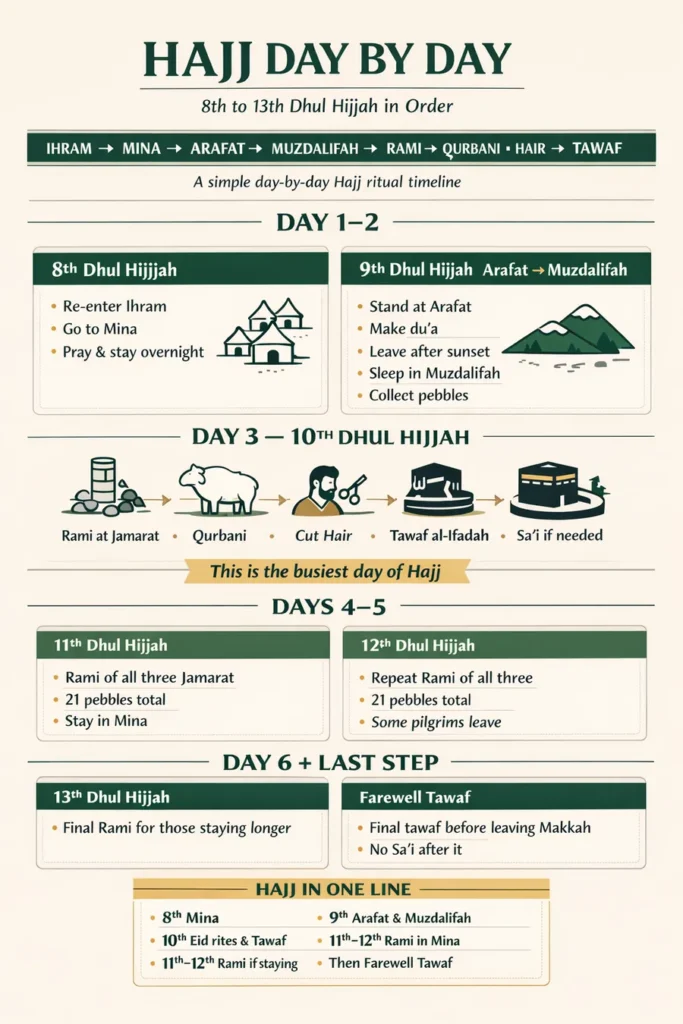
If you want the cleanest one-line summary of this complete step-by-step hajj guide, it is this: Day 1 Mina, Day 2 Arafat and Muzdalifah, Day 3 Eid rites and Tawaf, Days 4 and 5 Rami in Mina, Day 6 extra Rami for those staying, then farewell tawaf before leaving.
Common mistakes + quick fixes
- Mistake 1: Treating Arafat like a sightseeing stop. Quick fix: Fill the day with du‘a, not wandering.
- Mistake 2: Thinking bigger pebbles are better. Quick fix: Use small pebbles, not chunks.
- Mistake 3: Forgetting the order of the three Jamarat. Quick fix: Small, middle, large.
- Mistake 4: Delaying tawaf out of confusion. Quick fix: Stay with your group and confirm your plan early.
- Mistake 5: Finishing Hajj outwardly but dropping salah afterward. Quick fix: Protect the habits Hajj built in you.
Quick checklist before each Hajj day
Use this simple mental check:
Know your day, know your rite, know your group point, keep water with you, protect your temper, and keep your tongue busy with dhikr.
📊 hajj day by day guide: 8th to 13th Dhul Hijjah at a glance
This table gives the clearest hajj day by day schedule for beginners, from the first move to Mina to the last goodbye tawaf in Makkah.
🕋 Show Hajj Day-by-Day Table
| Day | Main place | Main ritual | What to remember |
|---|---|---|---|
| Before 8th | Makkah | Umrah in Tamattu | Ihram, Tawaf, Sa’i, clip shave hair |
| 8th Dhul Hijjah | Mina | Re-enter Ihram and stay in Mina | Day of Tarwiyah, prayers and overnight stay |
| 9th Dhul Hijjah | Arafat / Muzdalifah | Standing at Arafat, then move after sunset | Arafat is the heart of Hajj; collect pebbles later |
| 10th Dhul Hijjah | Mina / Makkah | Rami, Qurbani, Halq/Taqsir, Tawaf al-Ifadah | Busiest day; 7 pebbles at Jamarat al-Aqaba |
| 11th Dhul Hijjah | Mina | Rami of all three Jamarat | 21 pebbles total: small, middle, large |
| 12th Dhul Hijjah | Mina | Repeat Rami of all three Jamarat | May leave after this if conditions are met |
| 13th Dhul Hijjah | Mina | Final Rami for those staying | Extra day, valid option for some pilgrims |
| Last step | Makkah | Tawaf al-Wida | Farewell Tawaf before leaving Makkah |
FAQs
📘 hajj day by day guide FAQs
How to perform Hajj day by day?
Show Answer
Start with Umrah first if doing Tamattu, then re-enter Ihram on the 8th of Dhul Hijjah, go to Mina, stand at Arafat on the 9th, sleep in Muzdalifah, do Rami, Qurbani, hair cutting, and Tawaf al-Ifadah on the 10th, continue Rami on the 11th and 12th, and finish with Farewell Tawaf before leaving Makkah.
What are the 7 main steps of Hajj?
Show Answer
The 7 main steps are Ihram, Mina, Arafat, Muzdalifah, Rami, Qurbani with halq or taqsir, and Tawaf al-Ifadah with Sa’i. After that come the Days of Tashreeq and the Farewell Tawaf.
What do you do in the 5 days of Hajj?
Show Answer
Across the main Hajj days, you stay in Mina, stand at Arafat, move to Muzdalifah, stone the Jamarat, offer Qurbani, shave or trim hair, do Tawaf al-Ifadah, and continue Rami during the Days of Tashreeq.
What happens on each day of Hajj?
Show Answer
The 8th is Mina, the 9th is Arafat then Muzdalifah, the 10th is Rami, Qurbani, hair cutting, and Tawaf al-Ifadah, the 11th and 12th are repeated Rami in Mina, and the 13th is an extra Mina day for those who stay longer.
What is the order of Hajj rituals?
Show Answer
A clear order is: intention, Ihram, Mina, Arafat, Muzdalifah, Rami, Qurbani, hair cutting, Tawaf al-Ifadah, Days of Tashreeq in Mina, then Tawaf al-Wida before departure.
When do you perform Tawaf al-Ifadah and Farewell Tawaf?
Show Answer
Tawaf al-Ifadah is done after the Mina rites of the 10th Dhul Hijjah. Farewell Tawaf comes at the very end, just before leaving Makkah.
What happens on day 3 of Hajj?
Show Answer
Day 3, the 10th of Dhul Hijjah, includes Rami at Jamarat al-Aqaba with 7 pebbles, Qurbani, shaving or trimming the hair, and Tawaf al-Ifadah. It is the busiest and most packed day of the pilgrimage.
How many pebbles do you need for Hajj?
Show Answer
A common total through the 12th is 49 pebbles: 7 on the 10th, then 21 on the 11th, and 21 on the 12th. Pilgrims often collect extra in case some are lost.
Do you have to stay until the 13th of Dhul Hijjah?
Show Answer
Not always. Some pilgrims leave after the 12th if they complete the rites and depart in time. Others stay until the 13th and perform one more Rami. Both are known ways in Hajj.
Is Farewell Tawaf obligatory in Hajj?
Show Answer
It is generally treated as obligatory for pilgrims leaving Makkah, with menstruating women excused. It should be the last rite before departure.
What are the common mistakes to avoid during Hajj?
Show Answer
Common mistakes include not learning the rite order, crowd panic, harsh behavior in Mina, using oversized pebbles, and treating symbolic acts like Rami as angry performance instead of worship.
What do you do in Safa and Marwa during Hajj Tamattu?
Show Answer
You perform Sa’i by moving between Safa and Marwa for seven laps after tawaf. In Tamattu, this comes first with Umrah before the Hajj days, and later another Sa’i may follow Tawaf al-Ifadah depending on your Hajj setup.
Hajj Day by Day Ritual Timeline from 8th to 13th Dhul Hijjah
Related Articles
- Miqat for Hajj
- Niyyah for Hajj and Umrah
- Muzdalifah Guide
- Halq and Taqsir Ritual
- Hajj Mistakes to Avoid
- Hajj with Elderly Parents
- Hajj Vaccine Requirements 2026
You Can Also Check
- nafl tawaf guide
- tawaf al umrah guide
- tawaf al qudum guide
- tawaf al ifadah guide
- tawaf al ziyarah guide
- tawaf faqs guide

Farrukh Farooqi has been living in Sharaya, Makkah, Saudi Arabia since 2010. With over 14 years of firsthand experience witnessing the sacred journey of millions of pilgrims, Farrukh specializes in providing practical, insider tips for Hajj and Umrah travelers. His work blends real-world observations, the latest Saudi updates, and essential crowd management strategies — helping pilgrims and worshippers plan smarter, stay safer, and experience a spiritually fulfilling journey across the Holy Cities.


