
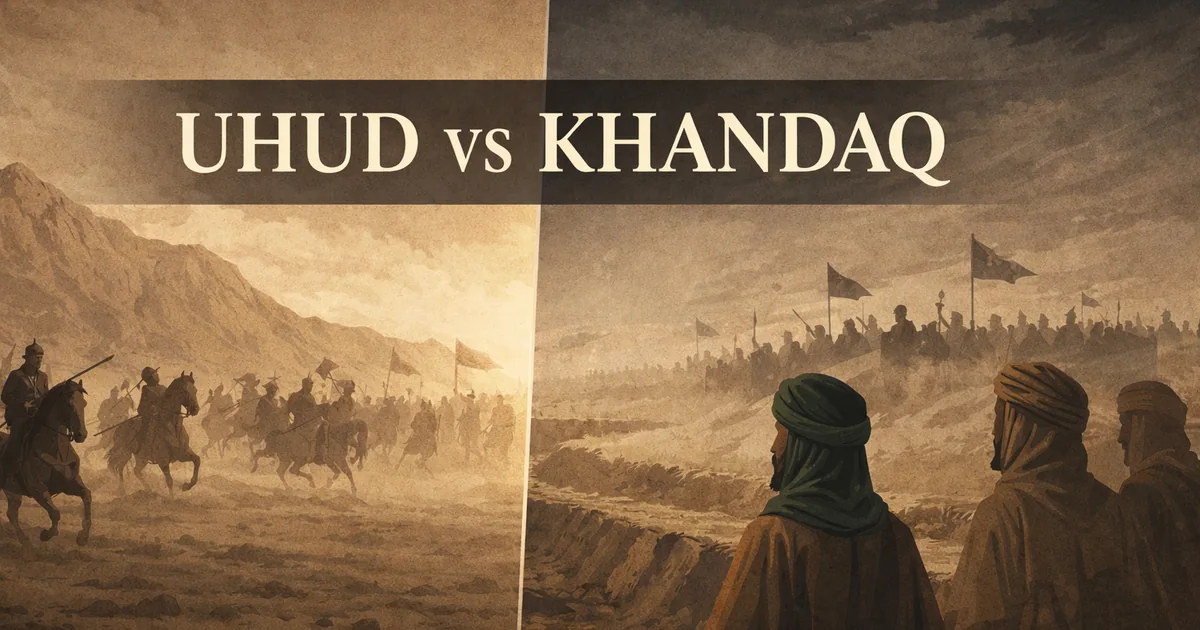
Battle of the Trench vs Uhud: What Changed in Strategy, Pressure, and Outcome
Battle of the Trench vs Uhud is really a story of change. Battle of Uhud vs battle of the Trench shows how the Muslims moved from an open battlefield experience at Uhud to a planned defensive trench response at Khandaq. If you want the wider Khandaq background first, see Battle of the Trench.
Uhud exposed painful weaknesses.
Khandaq showed what happened after those weaknesses were faced, understood, and corrected.
✅ TL;DR – battle of the trench vs uhud
Battle of the Trench vs Uhud is a comparison between two very different moments in seerah. Uhud was an open battle vs siege in Islam lesson marked by battlefield reversal and hard loss. Khandaq was a defensive siege marked by planning, patience, coalition pressure, and survival through strategy, unity, and Allah’s help.
Battle of the Trench vs Uhud Quick Answer
Battle of the Trench vs Uhud explained in one line: Uhud was a direct field confrontation near Mount Uhud, while Khandaq was a city-defense siege around Medina using a trench. So the real contrast is not just two battles. It is a shift in method, pressure, and result.
What is the difference between Uhud and Khandaq?
What is the difference between Uhud and Khandaq? The biggest difference is this: Uhud happened in a more direct military encounter, while Khandaq was built around defense and preventing entry into Medina. In simple words, Uhud tested discipline in an exposed position. Khandaq tested patience during a siege.
Why was the Battle of the Trench different from Uhud?
Why was the Battle of the Trench different from Uhud? Because the threat was different. At Uhud, the Muslims faced Quraysh in a more direct battle. At Khandaq, the threat came as a wider coalition siege by confederates aiming to crush Medina from outside while internal pressure also grew. That demanded a different response.
Battle of the Trench vs Uhud explained
This uhud and trench comparison works best when you look at three things side by side: strategy, pressure, and outcome. Many pages miss that and just retell both stories. But readers usually want the change, not two disconnected summaries.
📚 You Can Also Read:
Battle of the Trench Timeline • Causes of the Battle of the Trench • Who Suggested Digging the Trench
Which Battle Came First Uhud or Khandaq?
Which battle came first Uhud or Khandaq? Uhud came first. That matters because Khandaq makes much more sense when you see it as a response to what came after Uhud, not as a random new tactic dropped into seerah without context.
Which battle came first Uhud or Khandaq?
The Battle of Uhud came before the Battle of the Trench. Uhud took place in 3 AH, and Khandaq came later in 5 AH. So the trench battle belongs to a later phase of the Madinan struggle, when threats had become broader and more organized.
What is the Khandaq after Uhud timeline?
Khandaq after Uhud timeline matters because it shows development. Uhud came after Badr and exposed cracks under pressure. Then the Muslim community in Medina continued to live under danger. By the time Khandaq arrived, the conflict had grown into a more serious, multi-tribal attempt to eliminate the Muslims.
How are Uhud and Khandaq linked in seerah?
They are linked through learning. This seerah battle comparison shows that Uhud was not the end of the story. It became part of the preparation for Khandaq. In other words, the setback at Uhud did not freeze the Muslim community. It trained it.
Open Battle vs Defensive Siege in Islam
Open battle vs siege in Islam is one of the clearest ways to explain the difference. At Uhud, the clash unfolded in a more exposed military environment. At Khandaq, the Muslims did not go out looking for a direct collision in the same way. They built a barrier and forced the enemy into delay, frustration, and exhaustion.
What is open battle vs siege in Islam?
An open battle usually means direct encounter in the field. A siege means pressure over time, often around a city or defended place. In this battle strategy comparison, Uhud represents the pain of a battlefield reversal, while Khandaq represents a defense that denied the enemy what it wanted most: entry and breakthrough.
How did open battlefield differ from defensive trench warfare?
The open battlefield at Uhud left little room for a defensive obstacle once positions broke. At Khandaq, the trench itself changed movement, especially cavalry movement, and blocked a fast, crushing attack. That is why the trench was not a small detail. It was the whole shape of the battle.
Why does this battle strategy comparison matter?
Because readers do not only want to know who fought whom. They want to know why one battle became a lesson in battlefield discipline and another became a lesson in strategic adaptation. That is the heart of the page.
What Changed After Uhud?
What did Muslims learn after Uhud? A lot. Uhud taught that bravery alone is not enough. A community can have sincerity and still suffer if it mishandles orders, timing, or battlefield positioning. That is why lessons from defeat matter so much here.
What did Muslims learn after Uhud?
The strongest lesson was obedience under pressure. Another was realism. The Muslims learned that the enemy would keep coming, and that the defense of Medina needed discipline, planning, and a sharper reading of threat. This is why uhud lessons vs khandaq lessons is such a strong search intent. People sense that Khandaq is partly the answer to Uhud.
How did strategy improve after Uhud?
How strategy improved after Uhud can be summed up like this: the Muslim response became more defensive, more organized, and more adapted to the enemy’s size and method. Khandaq was not reckless courage. It was controlled defense.
How did Medina defense after Uhud change?
Medina defense after Uhud changed from relying on a more direct response to building smarter protection around the city. The trench did not come from fear. It came from clear thinking. There is a difference.
📖 Qur’an Reflection Box
Arabic:
وَلَقَدْ صَدَقَكُمُ اللَّهُ وَعْدَهُ إِذْ تَحُسُّونَهُم بِإِذْنِهِ حَتَّىٰ إِذَا فَشِلْتُمْ وَتَنَازَعْتُمْ فِي الْأَمْرِ وَعَصَيْتُم
Transliteration:
Wa laqad sadaqakumullahu wa‘dahu idh tahussunahum bi idhnihi hatta idha fashiltum wa تنازعتم fil-amri wa ‘asaytum.
Translation:
Allah certainly fulfilled His promise to you when you were routing them by His permission, until you lost heart, disputed in the matter, and disobeyed.
Why Trench Strategy Was Used After Uhud
Why trench strategy was used after Uhud is one of the most important angles on this page. It was used because the Muslims were now facing a larger, more dangerous threat, and because the lessons of Uhud made it clear that a direct repeat approach would be foolish.
Why trench strategy was used after Uhud?
The trench was used because the enemy numbers were overwhelming and the shape of the threat had changed. This was not just Quraysh coming for revenge again. It was a confederate force pressing Medina. So the Muslims needed something that could stop movement, slow cavalry, and buy survival.
How Khandaq differed from Uhud in planning?
How Khandaq differed from Uhud in planning is simple: Khandaq involved prior defensive preparation on a larger city level. Uhud had battlefield positioning, yes, but Khandaq had urban defense logic. It turned geography into protection.
What does strategic adaptation mean in this comparison?
Strategic adaptation here means learning from pain without being paralyzed by it. It means not fighting the next battle like the last one just because that feels familiar. In seerah, that lesson is gold.
How Enemy Pressure Changed Between Uhud and Khandaq
The enemy pressure did not just get bigger. It got more layered. This is one of the strongest parts of the difference between Uhud and Khandaq.
How did Medina pressure change after Uhud?
Medina pressure changed from the threat of direct military confrontation to something heavier: siege fear, coalition coordination, and psychological strain. Khandaq was not only about soldiers at the border. It was about a city under suffocating pressure.
What made Khandaq a coalition siege?
Khandaq was a coalition siege because several groups aligned together against the Muslims. That made the threat wider than Uhud. This was not just a repeat duel. It was an attempt to surround, isolate, and break Medina.
How did the confederates create a different type of threat?
The confederates created a different type of threat because they brought numbers, siege pressure, and fear of collapse from more than one side. At Uhud, the pain was sharp and battlefield-based. At Khandaq, the pain was stretched out.
Leadership Under Pressure in Uhud and Khandaq
Leadership under pressure is one of the richest comparison angles in this topic. Both battles show the leadership of Prophet Muhammad ﷺ, but in two very different battle environments.
What does this seerah battle comparison show about leadership?
This seerah battle comparison shows that leadership is not one skill. At Uhud, leadership had to deal with battlefield shock, injury, rumor, and regrouping. At Khandaq, leadership had to manage fear, digging, hunger, waiting, alliances, and siege morale.
How did leadership under pressure appear at Uhud?
At Uhud, leadership appeared in steadiness when the situation turned. The battle did not remain a simple advance. Confusion hit, the Prophet ﷺ was injured, and the Muslims had to recover their footing under real pain.
How did leadership under pressure appear at Khandaq?
At Khandaq, leadership appeared in planning, morale-building, and endurance. There is a big difference between leading people in a fast clash and leading them through days of fear, cold, hunger, and uncertainty. Khandaq brings that out sharply.
📖 Qur’an Reflection Box
Arabic:
يَا أَيُّهَا الَّذِينَ آمَنُوا اذْكُرُوا نِعْمَةَ اللَّهِ عَلَيْكُمْ إِذْ جَاءَتْكُمْ جُنُودٌ فَأَرْسَلْنَا عَلَيْهِمْ رِيحًا وَجُنُودًا لَّمْ تَرَوْهَا
Transliteration:
Ya ayyuhalladhina amanu-udhkurū ni‘matallahi ‘alaykum idh ja’atkum junudun fa arsalna ‘alayhim rihan wa junudan lam tarawha.
Translation:
O believers, remember Allah’s favor upon you when forces came against you, so We sent against them a wind and forces you did not see.
Outcome of Uhud vs Outcome of the Battle of the Trench
Outcome of Uhud vs outcome of the Battle of the Trench is where the contrast becomes impossible to miss. Uhud hurt deeply and exposed weakness. Khandaq protected Medina and broke enemy momentum.
What was the outcome of Uhud vs Battle of the Trench?
Uhud ended with painful Muslim losses and a sobering battlefield reversal, even though the enemy did not wipe out the Muslim community. Khandaq ended with the confederates failing to achieve their aim, Medina holding firm, and the initiative shifting away from the attackers.
How did battle outcomes differ?
Battle outcomes differed in tone and strategic effect. Uhud was a setback. Khandaq was a defensive success. Uhud left wounds. Khandaq left a message: Medina could not be crushed so easily anymore.
Why did Khandaq become a turning point after Uhud?
Khandaq became one of the great seerah turning points because the largest coordinated attempt to destroy the Muslims failed. After that, the aura of unstoppable enemy pressure weakened badly.
Uhud Lessons vs Khandaq Lessons
Uhud lessons vs Khandaq lessons is one of the strongest reader-intent sections because it answers the question behind the comparison: what are we supposed to learn from putting these two battles side by side?
What are the main Uhud lessons vs Khandaq lessons?
Uhud teaches obedience, discipline, and the cost of breaking formation under pressure. Khandaq teaches planning, patience, and the value of intelligent defense. Put together, they teach that faith does not cancel strategy. It sharpens it.
What do lessons from defeat show in this comparison?
Lessons from defeat show that painful moments can become future strength if a community actually learns from them. That is exactly why Khandaq should not be read as a separate heroic episode only. It should be read as a developed answer to earlier pain.
Which lessons matter most for readers today?
Three stand out:
- Don’t repeat avoidable mistakes.
- Change strategy when the threat changes.
- Hold steady when pressure becomes long and exhausting.
That applies in study, leadership, family, work, and community life. Not just in military reading.
Battle of Uhud vs Battle of the Trench Side by Side
This section is the cleanest side-by-side answer for people who want the contrast fast.
Difference between Uhud and Khandaq in strategy
The difference between Uhud and Khandaq in strategy is that Uhud unfolded in a direct field confrontation, while Khandaq used a barrier-based city defense. One tested position-holding in battle. The other tested whether the enemy could be stopped before entering.
Difference between Uhud and Khandaq in pressure
At Uhud, pressure was intense, immediate, and battlefield-centered. At Khandaq, pressure was broad, slow, and suffocating. One was a reversal in combat. The other was survival in siege.
Difference between Uhud and Khandaq in outcome
Uhud ended as a painful setback. Khandaq ended as a failed enemy siege and a major strengthening of Medina’s position. That is why how Khandaq changed after Uhud is not a small question. It is the whole point of this page.
📊 Battle of the Trench vs Uhud side-by-side table
Use this table when you want the clearest possible contrast in strategy, pressure, and outcome.
⚔️ Show Uhud vs Khandaq Comparison Table
| Comparison point | Uhud | Khandaq |
|---|---|---|
| Battle form | More direct field battle near Mount Uhud | Defensive siege around Medina |
| Main strategic image | Open battlefield | Defensive trench |
| Pressure type | Fast combat reversal | Coalition siege and prolonged fear |
| Key lesson | Obedience and discipline | Planning and endurance |
| Outcome | Painful setback | Defensive success and turning point |
| Big seerah meaning | Lessons from defeat | Strategic adaptation after Uhud |
📘 battle of the trench vs uhud FAQs
Uhud and Battle of the Trench comparison for students
Show Answer
Battle comparison for students is easiest when broken into three words: strategy, pressure, outcome. Uhud was an open battle that turned painfully. Khandaq was a defensive siege that held. That is the short student answer.
Battle of the Trench and Uhud lessons in simple words
Show Answer
Battle of the Trench and Uhud lessons in simple words: don’t ignore orders, don’t repeat mistakes, and don’t think courage means using the same method every time.
How Khandaq changed after Uhud
Show Answer
How Khandaq changed after Uhud is really asking how the Muslim response matured. After Uhud, defense became sharper, the threat was read more seriously, and a new method was used that matched the enemy situation better.
Which battle was harder emotionally: Uhud or Khandaq?
Show Answer
In different ways, both were hard. Uhud was brutally painful because of visible losses and shock. Khandaq was hard because of hunger, cold, fear, and long siege pressure.
Was Khandaq only about the trench itself?
Show Answer
No. The trench was central, but Khandaq was also about morale, alliance pressure, patience, and leadership under siege. Reducing it to just a ditch misses the whole seerah picture.
Why does this page compare change instead of retelling both battles fully?
Show Answer
Because the strongest reader intent here is contrast. People searching khandaq vs uhud usually want to know what changed in strategy, pressure, and outcome, not two long summaries placed beside each other without analysis.
📚 You Can Also Read:
Battle of the Trench in the Qur’an • Dhu al-Qadah • Treaty of Hudaybiyyah in Dhu al-Qadah

Farrukh Farooqi has been living in Sharaya, Makkah, Saudi Arabia since 2010. With over 14 years of firsthand experience witnessing the sacred journey of millions of pilgrims, Farrukh specializes in providing practical, insider tips for Hajj and Umrah travelers. His work blends real-world observations, the latest Saudi updates, and essential crowd management strategies — helping pilgrims and worshippers plan smarter, stay safer, and experience a spiritually fulfilling journey across the Holy Cities.


