
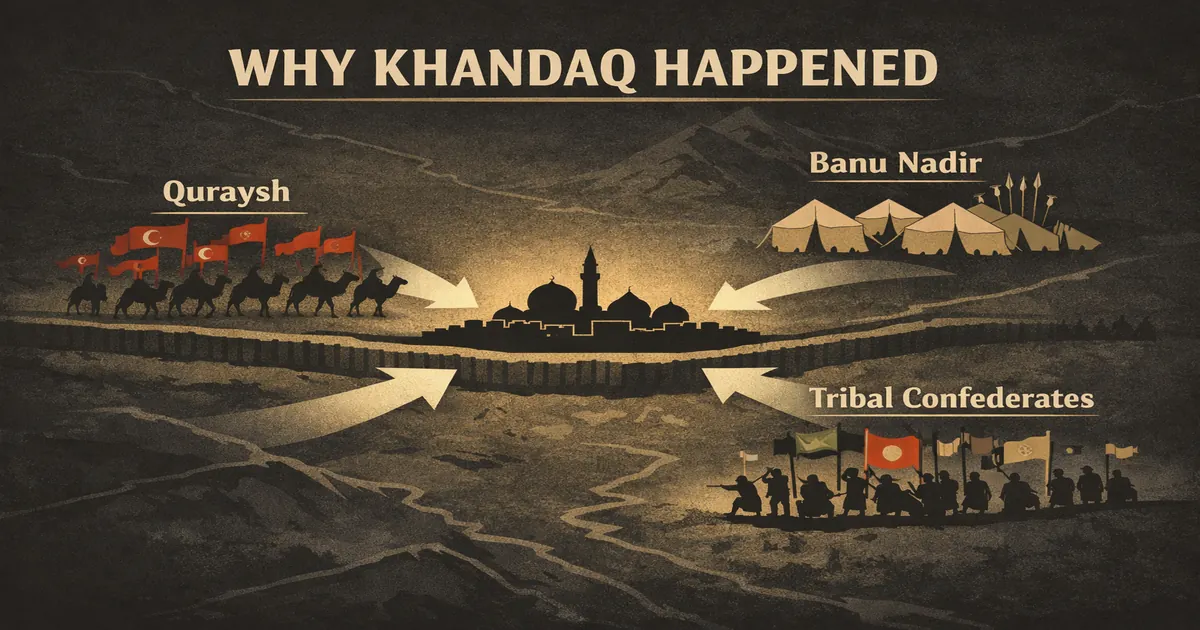
Causes of the Battle of the Trench: Why the Confederates Moved Against Medina
Causes of the Battle of the Trench were not random. Why did the Battle of the Trench happen? Because Medina was facing a large confederate alliance made up of Quraysh, tribal forces like Ghatafan, and hostile figures linked to Banu Nadir. It was the result of revenge, political fear, alliance-building, and rising strategic pressure on the Muslim community. For the wider battle overview, see Battle of the Trench.
This battle was a siege before it was a clash.
That point matters because many pages explain the trench itself but skip the real “why.” The trench was the answer. It was not the cause.
✅ TL;DR – causes of the battle of the trench
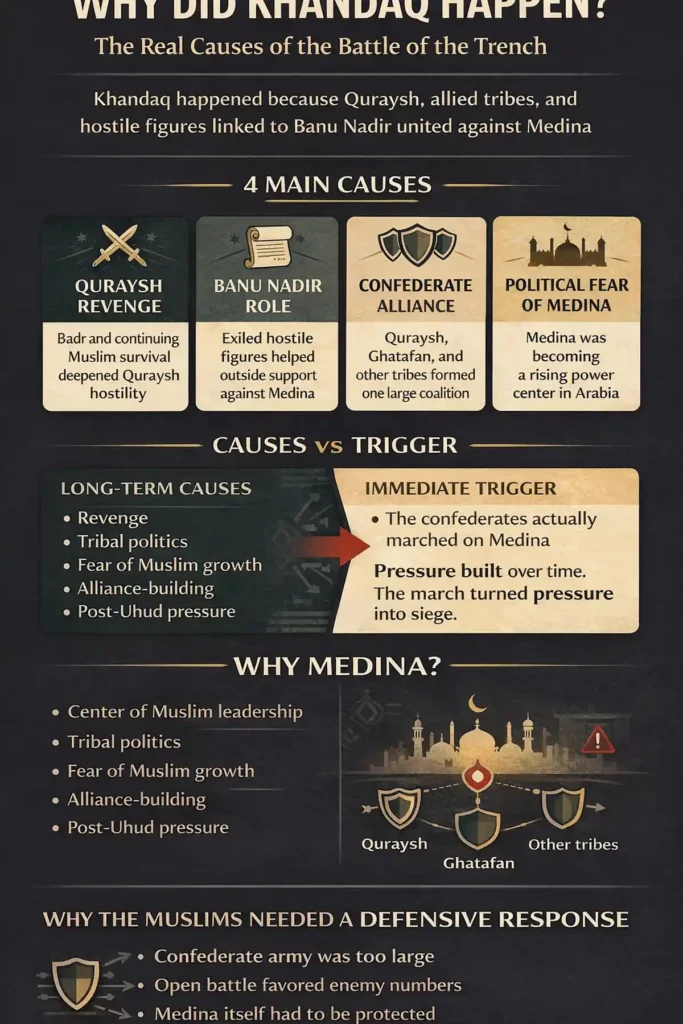
Battle of the Trench causes came from a combined push to break Medina. The biggest drivers were the Quraysh revenge motive after earlier battles, the Banu Nadir role in building an anti-Muslim alliance, support from the Ghatafan alliance and other allied tribes, and the belief that Medina could be crushed through a massive confederate buildup. That is why why confederates attacked Medina cannot be explained by one trigger alone.
What Caused the Battle of the Trench?
What caused the Battle of the Trench? The short answer is this: Medina had become the center of a growing Muslim community, and its enemies wanted to break that growth before it became too strong to stop. So the battle of the trench causes were military, political, and emotional at the same time.
Why did the Battle of the Trench happen?
Why did the Battle of the Trench happen? Because the enemies of Medina did not want a stable Muslim base to survive after Badr and Uhud. They wanted one large, decisive move that could crush the Muslims, restore old Arab power patterns, and end the rise of Medina.
What led to the Battle of the Trench?
What led to battle of the trench was a long chain, not a single spark. Earlier battles had already deepened hostility. Exiled enemies were still active. Tribal politics were shifting. Trade, prestige, and control were all part of the pressure.
What was the main trigger behind Khandaq?
The main immediate battle of trench trigger was the formation of a huge confederate alliance against Medina. But the deeper reasons for battle of Khandaq had been building for a while.
The Situation in Medina Before Khandaq
Before Khandaq, Medina was already under serious pressure. This is the part many people skip. They jump straight to the trench and miss the months of tension behind it.
Why was Medina under threat?
Medina under threat was not just about one army marching in. It was about a city surrounded by enemies, uneasy tribes, and a fragile regional balance. The Muslim community had survived Badr. It had faced the shock of Uhud. Now its enemies were looking for a final answer.
What was the battle of trench background?
Battle of trench background includes earlier raids, treaty tensions, tribal movement, and rising fear of Muslim political strength. Medina was no longer a small local settlement. It had become a power center in Arabia, and that changed how others looked at it.
How did seerah background shape the conflict?
The seerah background matters because Khandaq did not appear out of nowhere. In seerah, events connect. Badr changed prestige. Uhud changed confidence. Exile changed loyalties. The siege came from that whole chain.
📚 You Can Also Read:
Battle of the Trench Timeline • 12 Islamic Months • Hijri Calendar
What Changed After Uhud?
After Uhud, the political mood changed. The Muslims were still standing, but their enemies saw an opening. That opening helped turn ordinary hostility into a broader coalition plan.
How did after Uhud tensions increase?
After Uhud tensions increase because Quraysh and other groups no longer saw Medina as untouchable. Even though Uhud did not destroy the Muslims, it encouraged enemies to think that another, bigger attack might finish the job.
Did Uhud encourage new enemies of Medina?
Yes. Uhud gave confidence to old enemies and courage to new ones. It made some tribes more willing to join pressure campaigns against Medina, especially if a stronger coalition could be formed.
Was Khandaq linked to earlier battles?
Yes. Was the battle of the trench revenge for Badr and Uhud? In part, yes. Badr left deep wounds in Quraysh pride. Uhud gave them partial recovery. Khandaq was shaped by both.
How the Confederates Formed
This is where the story gets sharper. The siege did not happen because a crowd randomly gathered. It happened because different groups were stitched together into one large front.
Who formed the confederate alliance?
Who formed the confederate alliance? The strongest answer is that hostile leaders linked to Banu Nadir helped push the plan, while Quraysh under Abu Sufyan provided major leadership and force. Then tribal partners like Ghatafan and other allied tribes were added to the coalition.
How did the tribal coalition come together?
The tribal coalition came together through shared fear and shared interest. Some wanted revenge. Some wanted influence. Some wanted loot. Some wanted Medina weakened before it became even stronger. Different motives, same direction.
What was the confederate buildup before the siege?
The confederate buildup was serious because the force was far larger than what Medina usually faced. The size of the confederate army changed the whole strategic picture. This was not a raid. It was a siege plan.
The Role of Quraysh in the Alliance
Quraysh was not a side player. It was central. If you remove Quraysh from the story, the siege loses its spine.
Why did Quraysh join the confederates?
Why did Quraysh join the confederates? Because Medina represented a direct challenge to Quraysh power, honor, and regional leadership. Quraysh wanted to stop the Muslim community before the balance shifted permanently.
Was Quraysh driven by revenge?
Yes, revenge was a major part of it. Quraysh had not forgotten Badr. And while Uhud gave them some satisfaction, it did not erase the larger problem: Medina was still standing, and Islam was still spreading.
How strong was the Quraysh revenge motive?
The Quraysh revenge motive was strong, but not alone. Revenge mixed with politics, prestige, trade pressure, and fear of long-term Muslim survival. So it is accurate to say revenge mattered, but too simple to say revenge was the only cause.
The Role of Banu Nadir and Other Tribes
This section is one of the biggest gaps on weaker competitor pages. They mention names fast, then move on. But the Banu Nadir role is one of the clearest keys to understanding the siege.
What was the Banu Nadir role in the Battle of the Trench?
Banu Nadir role in battle of the trench was alliance-building and incitement after exile. Their leaders had reason to seek retaliation against Medina, and they were involved in encouraging outside forces to unite against the Muslims.
How did exile turn into anti-Muslim alliance building?
Exile did not end the threat. It moved it. That is the important point. Once pushed out, hostile elements could still travel, persuade, promise support, and help create an anti-Muslim alliance from outside Medina.
Why did other tribes support the siege?
Other tribes joined because coalitions often form from mixed motives. Some saw an opportunity for gain. Some followed stronger tribes. Some feared being left out. Some simply thought this was the best moment to crush Medina.
📦 Cause Breakdown Box
Main long-term causes: Quraysh hostility, post-Uhud pressure, tribal fear of Muslim growth, and alliance-building by enemies of Medina.
Main immediate trigger: a large confederate force actually forming and marching toward Medina.
Why Medina Became the Target
Why confederates attacked Medina is one of the real core questions. They did not attack just because a battle sounded dramatic. They attacked because Medina was the heart of the Muslim project.
Why did the confederates attack Medina?
They attacked Medina because it was the center of Muslim leadership, community, and defense. If Medina fell, the Muslim position in Arabia would be shattered. That was the thinking behind the siege.
Why was Medina targeted in Khandaq?
Why was Medina targeted in Khandaq? Because it was the city that had to be broken if the confederates wanted a decisive result. This was not about a border clash. It was about the survival of a city and what that city stood for.
What made the siege of Medina possible?
Siege of Medina causes included coalition size, regional coordination, internal hopes of pressure from more than one side, and the belief that the Muslims could be cornered through numbers and fear.
The Political Causes Behind the Siege
Battle of the trench political causes are often ignored because battle stories usually focus on swords, not power. But this was deeply political.
What were the battle of the trench political causes?
The political causes included fear of Medina’s growing legitimacy, fear of changing tribal loyalties, and the danger that Islam would become the new organizing power in Arabia. That is bigger than one fight.
How did Medina politics increase the threat?
Medina politics increased the threat because the city was no longer just sheltering believers. It was building law, alliances, leadership, and a working society. Enemies could see that if this model survived, the old order would weaken.
Why was this more than a simple military clash?
Because the siege was about power, not only combat. It was about who would define order in Arabia, who would lead, and whether Medina would remain a living Islamic center.
Why Open Battle Was Risky
This is where strategy enters the story properly. Once the confederate force formed, the Muslims had to think differently.
Why was direct battle dangerous for the Muslims?
Direct battle was dangerous because the confederate army was too large for a normal field fight. A head-on clash would have handed the enemy the kind of battle it wanted.
How did the confederate army change the strategy?
The size of the coalition changed everything. Instead of asking, “How do we beat them in open combat?” the question became, “How do we stop them from using their numbers?” That is a very different military problem.
Why was defense of Medina the priority?
Defense of Medina became the priority because the city itself was the target. Protecting the city, the community, and the vulnerable inside it was more important than chasing battlefield glory.
Why the Trench Became the Best Response
Now the trench makes sense. Once you understand the causes, the trench stops looking like a clever trick and starts looking like the only smart answer.
Why did the trench strategy become necessary?
Why did the trench strategy become necessary? Because the Muslims were dealing with siege motivation, massive numbers, and a threat aimed at the city itself. A defensive barrier was the best way to block cavalry movement and break the enemy plan.
How did trench strategy answer the siege motivation?
The trench strategy answered the siege motivation by denying the confederates quick entry. It turned their strength into frustration. A large army without easy access to the city became stuck, stretched, and vulnerable to time.
What does this show about strategic pressure on Medina?
It shows how serious the strategic pressure really was. The trench was not a dramatic extra. It was a survival response to the exact kind of threat Medina was facing.
Causes vs Triggers in Seerah
This is the best angle to beat thin competitor pages: separate long-term causes from immediate triggers. Once you do that, the whole event becomes clearer.
What caused the Battle of the Trench over time?
Over time, the causes of the battle of the trench included rising Muslim strength, post-Uhud enemy confidence, Quraysh revenge, tribal politics, exile-driven hostility, and the fear that Medina would become too strong to defeat later.
What were the immediate trigger events?
The immediate battle of the trench trigger events were the successful formation of the confederate coalition, the march toward Medina, and the practical move from hostility to siege.
What is the battle of the trench cause and effect?
Battle of the trench cause and effect is simple once stripped down: long pressure created a coalition, the coalition created a siege, the siege forced the trench, and the trench helped turn the confederate plan into failure.
📊 causes of the battle of the trench: long-term causes vs immediate triggers
This table is the easiest way to keep the topic clear. It shows what built the pressure over time and what finally turned that pressure into the Battle of Khandaq.
🛡️ Show Causes vs Triggers Table
| Type | What it included | Why it mattered |
|---|---|---|
| Long-term causes | Quraysh hostility, after Uhud tension, Banu Nadir bitterness, tribal fear of Muslim growth | Built the pressure that made a large attack likely |
| Political causes | Medina politics, leadership struggle, prestige, alliance shifts | Made the conflict about power, not just battle |
| Alliance causes | Confederate alliance, Ghatafan alliance, allied tribes, Abu Sufyan leadership | Turned hostility into a real siege threat |
| Immediate trigger | The confederates actually marched on Medina | Forced the Muslims into urgent defense |
| Strategic response | Trench strategy and defense of Medina | Blocked the enemy’s best advantage: numbers and movement |
📘 causes of the battle of the trench FAQs
what caused the battle of the trench?
Show Answer
What caused the Battle of the Trench was a mix of Quraysh hostility, revenge motives, tribal coalition-building, the Banu Nadir role, and fear of Medina’s growing strength.
why did the confederates attack medina?
Show Answer
Why did the confederates attack Medina? Because Medina was the center of Muslim leadership and survival. If Medina fell, the Muslim community would be shattered.
was the battle of the trench mainly about revenge?
Show Answer
Revenge was a major part of it, especially for Quraysh, but it was not the only cause. Politics, prestige, alliance pressure, and fear of Muslim growth also mattered.
what was the banu nadir role in the battle of the trench?
Show Answer
Banu Nadir role in battle of the trench included pushing hostility from outside Medina and helping build support for a wider anti-Muslim coalition.
how did after uhud tensions lead to khandaq?
Show Answer
After Uhud, enemy confidence rose. That made more tribes think Medina could be defeated if enough forces joined together.
who formed the confederate alliance?
Show Answer
Who formed the confederate alliance? Major leadership came from Quraysh under Abu Sufyan, with support from tribes like Ghatafan and encouragement from hostile figures linked to Banu Nadir.
why was medina targeted in khandaq?
Show Answer
Why was Medina targeted in Khandaq? Because Medina was the political and religious center of the Muslim community. Attacking it meant attacking the whole Muslim position.
what were the political causes behind the siege?
Show Answer
Battle of the trench political causes included fear of Medina’s growing legitimacy, changing tribal loyalties, and the rise of a new power center in Arabia.
why was open battle risky for the muslims?
Show Answer
Open battle was risky because the confederate army was too large. The Muslims needed to protect Medina, not give the enemy the fight it wanted.
was the trench the cause of the battle?
Show Answer
No. The trench was not the cause. It was the response. The causes came first; the trench came because those causes created a siege threat.
what is the easiest way to understand battle of the trench cause and effect?
Show Answer
Long-term hostility and politics produced a coalition. The coalition produced a siege. The siege produced the trench. That is the cleanest battle of the trench cause and effect chain.
Related Articles
Masjid al-Hudaibiyah
Masjid al-Jiranah
Holy Sites in Makkah
How to Perform Hajj
Hajj Checklist
Hajj and Umrah: A Complete Guide
Why the Confederates Moved Against Medina in the Battle of the Trench

Farrukh Farooqi has been living in Sharaya, Makkah, Saudi Arabia since 2010. With over 14 years of firsthand experience witnessing the sacred journey of millions of pilgrims, Farrukh specializes in providing practical, insider tips for Hajj and Umrah travelers. His work blends real-world observations, the latest Saudi updates, and essential crowd management strategies — helping pilgrims and worshippers plan smarter, stay safer, and experience a spiritually fulfilling journey across the Holy Cities.


