
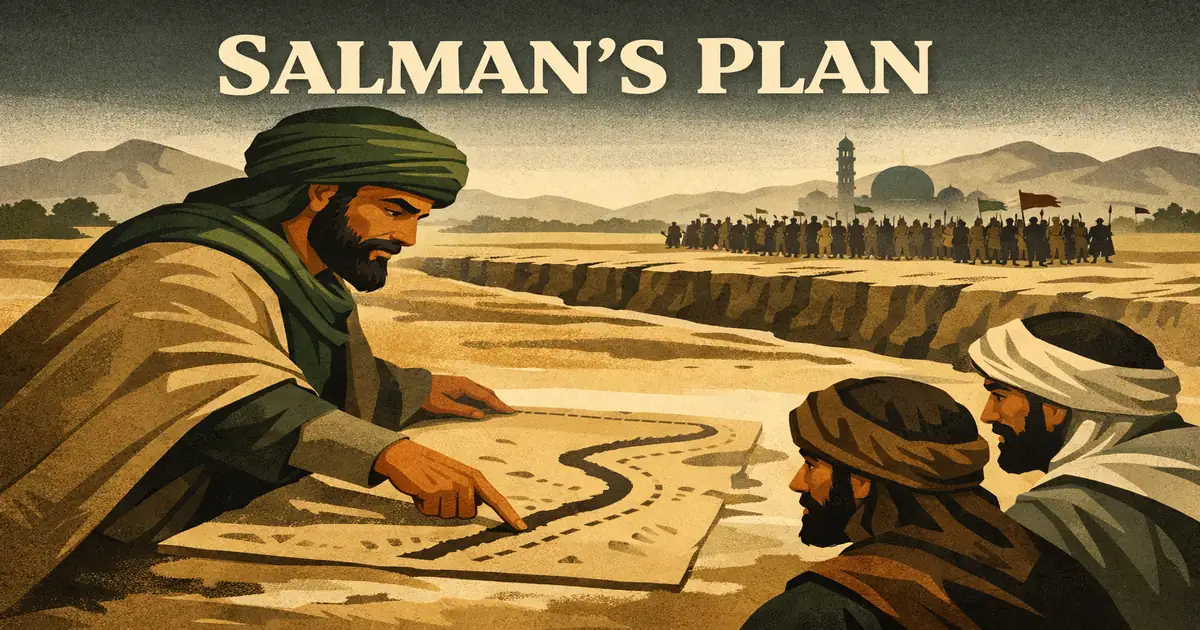
Who Suggested Digging the Trench? The Salman al-Farsi Strategy in Khandaq
Who suggested digging the trench? The direct answer is Salman al-Farsi. He is widely remembered as the companion who brought the trench idea in Islamic history to the defense of Medina during the Battle of Khandaq. The Prophet Muhammad ﷺ accepted that plan, and it became the core of the battle of the trench strategy. For the wider battle background, see Battle of the Trench.
This is not only a name-answer page.
It is really about shura in seerah, smart battle planning, and why a single good idea can save a city when direct combat would have been a disaster.
✅ TL;DR – who suggested digging the trench
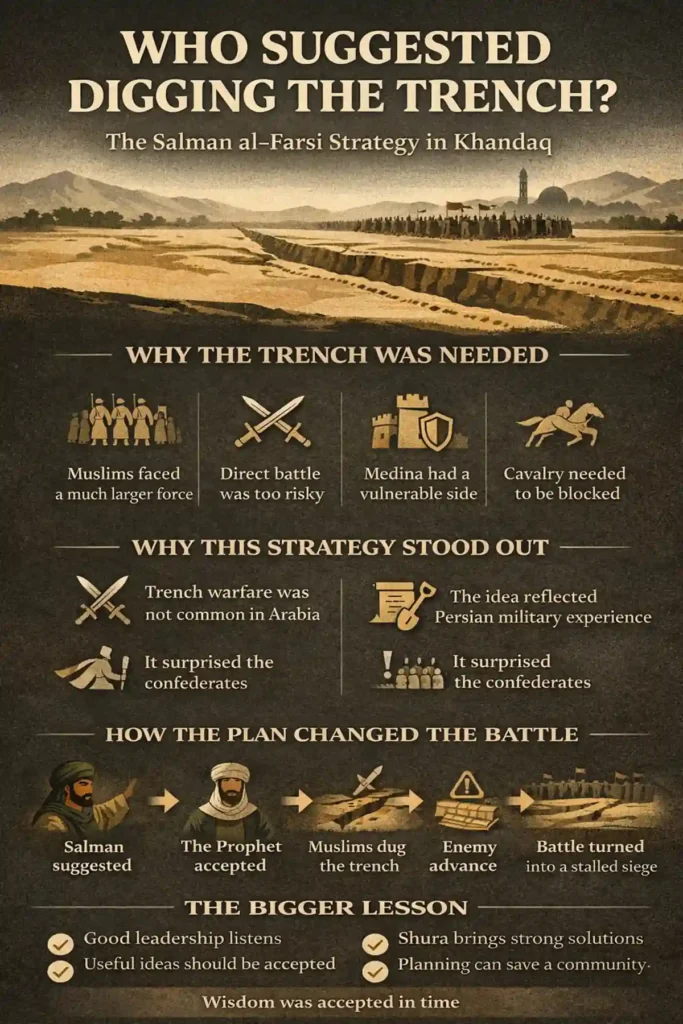
Salman al-Farsi is the companion most widely known for suggesting that Muslims dig a trench to protect Medina during the Battle of Khandaq. The plan was unusual in Arabia, where open fighting was more familiar, but it worked because it blocked the confederates, protected the weak side of the city, and turned a dangerous invasion into a stalled siege.
Who Suggested Digging the Trench?
Who suggested digging the trench in the Battle of the Trench? The well-known answer in seerah is Salman al-Farsi. He advised digging a trench around the vulnerable side of Medina, and that advice shaped the whole battle of Khandaq strategy.
Who suggested digging the trench in the Battle of the Trench?
Who suggested digging the trench in battle of the trench? Salman al-Farsi trench is the key answer. When the Muslim community faced a much larger attacking force, he brought a defensive idea known from Persian experience, and that changed the entire situation.
Was Salman al-Farsi the one who suggested the trench?
Was Salman al-Farsi the one who suggested the trench? Yes, that is the strongest and most widely repeated answer in the classical seerah narrative. That is why his name is tied so closely to Khandaq.
Who came up with the trench idea?
Who came up with the trench idea? Salman trench plan is the answer people remember because he was the companion who brought this unusual defensive strategy into the consultation at the most dangerous moment.
Who Was Salman al-Farsi?
Who was Salman al-Farsi? He was a famous companion of the Prophet ﷺ, known for his long search for truth, his sincerity, and his wisdom. In this battle, his background mattered because it gave the Muslims access to a tactic not common in local warfare.
Why was Salman al-Farsi important in Khandaq?
Why was Salman al-Farsi important in Khandaq? Because he did not just work hard with the others. He brought the key idea. Without that suggestion, the Muslims would likely have faced a far more dangerous direct assault.
What was Salman al-Farsi’s role in battle of Khandaq?
Salman al-Farsi role in battle of Khandaq was strategic. He was not just one more digger in the line. He was the one whose advice helped define the whole shape of the defense.
Why does Salman al-Farsi stand out in Islamic history?
He stands out because his story combines truth-seeking, loyalty, and innovation in Islamic history. He shows that wisdom can come from a lifetime of struggle, and that useful knowledge should be welcomed when it serves Islam.
📚 You Can Also Read:
Causes of the Battle of the Trench • Battle of the Trench Timeline • Major Events in Dhu al-Qadah
Why Medina Needed a New Strategy
Why did Muslims dig a trench in Medina? Because the threat was too large for a normal open-field clash. The Muslim side faced a major coalition, and Medina defense needed something smarter than bravery alone.
Why did Muslims dig a trench in Medina?
Why did Muslims dig a trench in Medina? They dug it because the enemy force was far larger, cavalry could be deadly in open ground, and the city had one especially vulnerable side that needed protection.
Why was direct battle too risky?
Direct battle was too risky because the Muslims were outnumbered. This was a moment of strategy under pressure, not a moment for reckless heroics. A bad decision here could have opened the way for the enemy to break into the city.
What made defensive strategy necessary?
What made defensive strategy necessary? Numbers, terrain, and urgency. The Muslim side needed a barrier that could slow the attackers, reduce the cavalry advantage, and buy time. That is exactly what the trench did.
Why the Trench Suggestion Was So Unusual
Was trench warfare common in Arabia? No. That is one reason this story matters so much. The plan was not just useful. It was surprising.
Was trench warfare common in Arabia?
Was trench warfare common in Arabia? No. Trench warfare in Medina was unusual in that environment. Arabian fighting was more familiar with raids, open clashes, and movement, not this kind of fixed defensive barrier.
Why was this a foreign tactic in Arabia?
Why was this a foreign tactic in Arabia? Because the trench method was linked to Persian military experience, not standard local practice. That is why the suggestion felt fresh and why the enemy struggled to respond to it quickly.
How did innovation in Islamic history appear at Khandaq?
Innovation in Islamic history appeared here in a practical way. The Muslims did not change their faith to copy others. They used a lawful, smart, worldly tactic for protection. That is a big difference, and many people miss it.
How the Prophet Responded to Salman’s Idea
Who accepted Salman’s suggestion? The Prophet Muhammad ﷺ accepted it. That is one of the strongest leadership moments in this event.
Who accepted Salman’s suggestion?
Who accepted Salman’s suggestion? The Prophet ﷺ accepted the advice after consultation. This is why the answer is not only “Salman said it.” The fuller answer is “Salman suggested it, and the Prophet accepted and led it.”
Why did the Prophet accept the trench plan?
Why did the Prophet accept the trench plan? Because it fit the reality of the threat. It protected the exposed side of the city, reduced the enemy advantage, and offered the best available answer at the time.
What does this show about prophetic consultation?
Prophetic consultation here shows calm leadership. The Prophet ﷺ did not reject a good idea because it came from a different background. He accepted the useful plan and then personally joined the work. That is leadership, not ego.
Shura in Seerah and Battle Planning
What is shura in seerah? It is consultation in serious matters. Khandaq is one of the clearest examples because a major defense decision emerged through consultation, then moved straight into action.
What is shura in seerah?
Shura in seerah means leadership that listens, weighs reality, and chooses wisely. It is not random talk. It is disciplined consultation.
How did consultation shape the Battle of the Trench strategy?
Consultation shaped the battle of the trench strategy by making space for a strong idea to emerge when ordinary tactics were not enough. This is one of the most practical examples of battle planning in the seerah.
What does this teach about leadership under pressure?
It teaches that strong leaders do not pretend to know everything alone. They gather people, listen carefully, and move decisively once the right path becomes clear.
📦 Leadership Lessons Box
What Khandaq teaches fast:
- Listen early when danger is rising.
- Choose the useful idea, not the familiar one.
- Lead from the front, not from comfort.
- Use shura when pressure is highest.
Where the Trench Was Dug in Medina
Where was the trench dug? It was dug along the vulnerable open side of Medina, near Mount Sala’, where natural barriers were weaker and enemy entry was more possible.
Where was the trench dug?
Where was the trench dug? Not around every side of the city. That is an important point. The trench was placed where attack risk was highest, not everywhere.
Why was the trench placed near Mount Sala’?
Why was the trench placed near Mount Sala’? Because that area suited the defensive layout. The mountain helped anchor one side, while the trench blocked the exposed front.
How did Medina defense shape the trench location?
Medina defense was shaped by terrain. Some sides already had stronger natural protection, so the trench focused on the vulnerable line. That made the plan realistic and efficient.
How the Trench Was Organized
How the trench was organized? It was organized as a serious shared labor project, not a random rush. The companions worked, the Prophet ﷺ worked with them, and the task was broken into manageable sections.
How the trench was organized?
How the trench was organized is one reason the project succeeded. The work was structured, assigned, and pushed forward quickly because there was no luxury of delay.
Who worked on trench digging?
Who worked on trench digging? The companions worked on it, and the Prophet ﷺ himself joined the labor. That image matters. He did not merely approve the plan. He participated in carrying it out.
How was Khandaq preparation managed?
Khandaq preparation was managed with urgency, teamwork, and shared sacrifice. In stories like this, people often focus only on the suggestion. But the plan also needed organization, morale, and hard physical effort.
How the Trench Idea Changed the Battle
How did the trench idea help in Khandaq? It prevented the enemy from using their strength the way they wanted. That alone changed the battle.
How did the trench idea help in Khandaq?
How did the trench idea help in Khandaq? It blocked cavalry movement, slowed the attack, and forced the confederates into frustration and siege instead of direct breakthrough.
How the trench changed the battle?
How the trench changed the battle is simple to explain: it turned a likely open clash into a stalled confrontation. That gave the Muslims a survivable position and denied the enemy their clean attack path.
Why did the confederates struggle against the trench?
They struggled because the tactic was unfamiliar, the barrier worked, and the battle no longer followed the pattern they expected. A huge army is less useful when it cannot reach the target the way it planned.
Salman al-Farsi and the Battle of the Trench Strategy
What was the battle of the trench strategy? It was a defensive response built around blocking access to Medina’s vulnerable side. That is why Salman al-Farsi in Khandaq remains such an important part of the story.
What was the battle of the trench strategy?
Battle of the trench strategy was to deny the enemy direct entry, force delay, and protect the city through a physical barrier placed at the key point of attack.
What was the battle of Khandaq strategy?
Battle of Khandaq strategy was not based on charging out with a smaller force. It was based on survival, denial of enemy movement, and smart military adaptation.
Why is Salman’s trench plan remembered?
It is remembered because it joined wisdom, humility, and results. Who gave the trench idea is a question people ask, but the deeper reason the story lasts is that the idea actually worked.
>📘 who suggested digging the trench FAQs
Who advised the trench?
Show Answer
Who advised the trench? Salman al-Farsi is the companion most widely known for advising the trench as the key defensive move at Khandaq.
Who planned the trench in Medina?
Show Answer
Who planned the trench in Medina? The idea is tied to Salman al-Farsi, while the actual execution happened under the Prophet’s leadership with the companions taking part in the work.
What is the trench strategy in battle of the trench explained?
Show Answer
Trench strategy in battle of the trench explained means creating a barrier that stopped the enemy from making a direct cavalry-led attack into Medina’s weak side. It changed the whole battle dynamic.
Who gave the trench idea?
Show Answer
Who gave the trench idea? Salman al-Farsi gave the famous trench suggestion during consultation before the battle.
Was trench warfare common in Arabia?
Show Answer
Was trench warfare common in Arabia? No. That is exactly why the idea stood out and why the enemy struggled to respond to it.
Why did the Prophet accept the trench plan?
Show Answer
Why did the Prophet accept the trench plan? Because it was the strongest practical answer to a large invasion force and fit Medina’s terrain and needs.
How the trench changed the battle?
Show Answer
How the trench changed the battle is simple: it blocked the main attack path, neutralized cavalry advantage, and turned a dangerous assault into a long, frustrated siege.
Why was Salman al-Farsi important in Khandaq?
Show Answer
Why was Salman al-Farsi important in Khandaq? Because his advice produced the most decisive defensive move of the battle.
What was Salman al-Farsi’s role in battle of Khandaq?
Show Answer
Salman al-Farsi’s role in battle of Khandaq was strategic and influential. He contributed the trench idea that became central to the defense.
What is the main lesson from this trench idea?
Show Answer
The main lesson is that faith does not cancel planning. Good leadership uses shura, accepts useful ideas, and acts before danger becomes irreversible.
Conclusion: Why Salman’s Trench Idea Still Matters
Who suggested digging the trench is a simple question with a clear answer: Salman al-Farsi. But the real strength of the page is bigger than the name. It shows how shura in seerah, smart defensive strategy, and calm leadership protected Medina when the odds looked terrible.
That is why this story still feels alive.
Not because a trench was dug.
Because wisdom was accepted in time.
📊 who suggested digging the trench: quick summary table
Use this table if you want the fastest clean answer on the key figure, the reason, the tactic, and the result.
🛡️ Show Khandaq Strategy Table
| Question | Direct answer | Why it matters |
|---|---|---|
| Who suggested digging the trench? | Salman al-Farsi | He brought the key defense idea |
| Why was it needed? | The Muslims faced a much larger force | Direct battle was too risky |
| Why was it unusual? | It was not common Arabian warfare | It caught the enemy off guard |
| Who accepted the plan? | The Prophet Muhammad ﷺ | It shows prophetic consultation and leadership |
| What did the trench do? | Blocked the attack route | It changed the battle into a stalled siege |
Who Suggested Digging the Trench and Why It Changed Khandaq

Farrukh Farooqi has been living in Sharaya, Makkah, Saudi Arabia since 2010. With over 14 years of firsthand experience witnessing the sacred journey of millions of pilgrims, Farrukh specializes in providing practical, insider tips for Hajj and Umrah travelers. His work blends real-world observations, the latest Saudi updates, and essential crowd management strategies — helping pilgrims and worshippers plan smarter, stay safer, and experience a spiritually fulfilling journey across the Holy Cities.


