
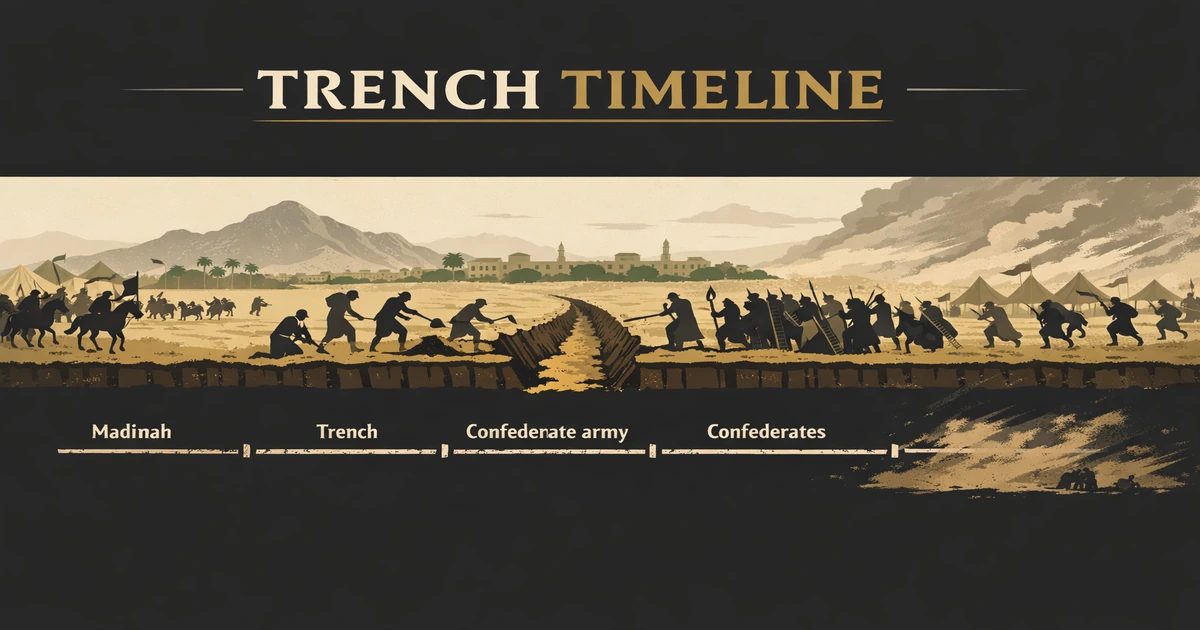
Battle of the Trench Timeline: Key Events in Order
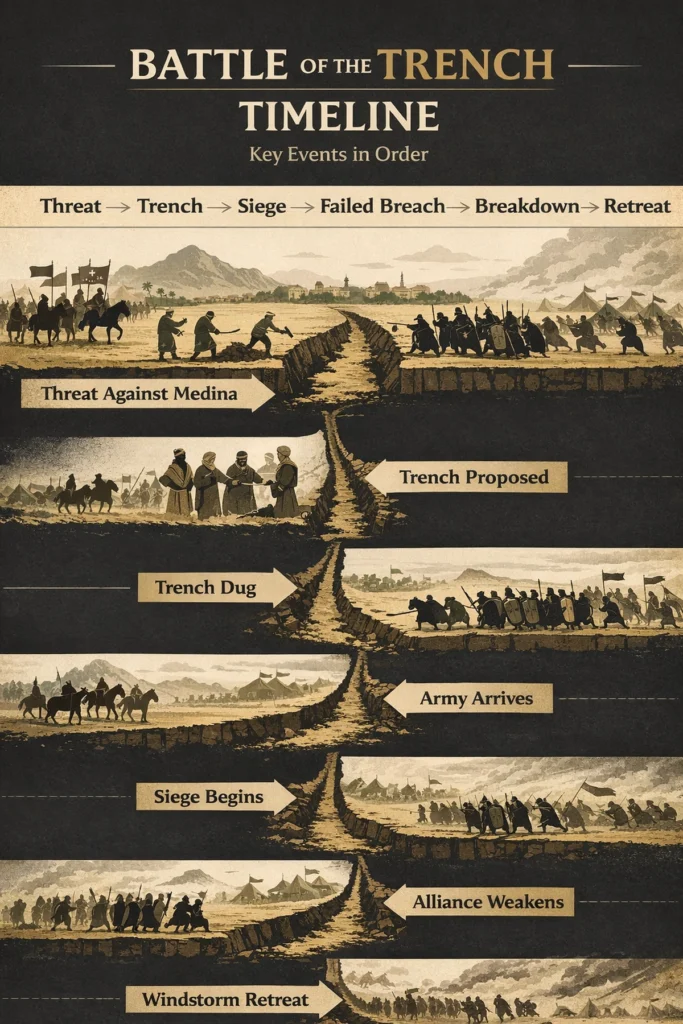
Battle of the Trench Timeline starts with news of a confederate alliance against Medina, then moves to the trench plan, rapid digging, enemy arrival, siege pressure, failed crossing attempts, alliance breakdown, and the final windstorm retreat. That is the short version. For the broader battle background, see Battle of the Trench.
If you are here for the simple order, this page is built for exactly that.
✅ TL;DR – battle of the trench timeline
Battle of the Trench Timeline begins with the confederate alliance forming against Medina, followed by the trench being dug on the exposed side of the city after the suggestion of Salman al-Farsi. Then came the confederate arrival, the siege, failed crossing attempts, fear inside the city, alliance breakdown, and finally the confederates withdrawal timeline after a violent windstorm and collapsing morale.
📖 Qur’an Box
Arabic:
يَا أَيُّهَا الَّذِينَ آمَنُوا اذْكُرُوا نِعْمَةَ اللَّهِ عَلَيْكُمْ إِذْ جَاءَتْكُمْ جُنُودٌ فَأَرْسَلْنَا عَلَيْهِمْ رِيحًا وَجُنُودًا لَمْ تَرَوْهَا
Transliteration:
Yā ayyuhā alladhīna āmanū u dhkurū ni‘mata Allāhi ‘alaykum idh jā’atkum junūdun fa-arsalnā ‘alayhim rīḥan wa junūdan lam tarawhā.
Translation:
O believers, remember Allah’s favor upon you when forces came against you, and We sent upon them a wind and forces you did not see.
Battle of the Trench Timeline at a Glance
Battle of the trench timeline explained in the simplest way looks like this: threat, trench, siege, failed breach, inner pressure, then retreat. Users often get lost because many articles mix lessons, maps, miracles, and biography details together. This page keeps the battle of the trench order clear.
- Confederate alliance forms against Medina.
- Salman al-Farsi suggests the trench.
- Prophet Muhammad ﷺ and the companions dig quickly.
- Confederate army arrives and is blocked.
- The siege turns into a tense stalemate.
- Some horsemen attempt to cross.
- Ali ibn Abi Talib defeats a major challenger.
- Fear rises inside the city.
- Alliance breakdown weakens the attackers.
- A storm hits and Abu Sufyan withdraws.
What is the battle of the trench timeline in simple order?
What is the battle of the trench timeline in simple order? It is the sequence from the confederate threat against Medina, to digging the trench, to the siege, to failed attack attempts, and finally the storm-driven retreat. That is the battle of the trench sequence in one line.
What happened first in the battle of Khandaq?
What happened first in battle of the trench was not the digging itself. First came the political threat. Leaders from hostile groups, especially around Banu Nadir, helped push Quraysh and other tribes into a broad anti-Muslim coalition. That is the real start of the battle of khandaq timeline.
How long did the battle of the trench last?
How long did the battle of the trench last? In the broad sense, the event is usually understood as a siege lasting around three to four weeks, with the trench itself dug rapidly beforehand. Many summaries describe roughly six days of digging followed by about twenty to thirty days of siege pressure. So if someone asks for the battle of the trench day by day, the best beginner-safe answer is: quick preparation, then a long standoff.
The Threat Against Medina Before the Siege
The first stage in the siege of medina timeline was political, not physical. Before the armies reached the city, plans were already moving between tribes that wanted to crush the Muslim community once and for all.
How was the confederate army formed?
The confederate army formed when anti-Muslim factions persuaded major tribes to unite around one goal: attacking Medina. Quraysh took the lead, and tribes such as Banu Ghatafan joined the coalition. This is why the battle is also called Al-Ahzab, the battle of the confederates.
Why did Quraysh, Banu Ghatafan, and Banu Nadir move against Medina?
They moved against Medina because they saw the growing Muslim community as a political and military threat. Quraysh wanted revenge and control. Banu Nadir had their own hostility after earlier conflict and exile. Banu Ghatafan joined for alliance, pressure, and expected advantage. Put simply, fear, revenge, and opportunity met in one moment.
Why did the Muslims prepare for a siege instead of open battle?
The Muslims prepared for a siege because the numbers were badly uneven. Meeting a much larger coalition in an open-field clash would have repeated the risk of earlier battlefield exposure. The stronger move was defensive control, not dramatic attack. That decision shaped the whole medina defense sequence.
📚 You Can Also Read:
12 Islamic Months • Hijri Calendar • Discovering the Hijri Calendar
The Decision to Dig the Trench
This is the most famous stage in the battle of the trench stages. The defense plan was unusual for Arabia, and that is exactly why it worked. Sometimes the turning point in a battle is not bravery first. It is fresh thinking first.
Who suggested the trench strategy?
Salman al-Farsi suggested the trench strategy. He had seen this kind of defensive method in Persian warfare, where trenches were used against invading forces. His idea became the single clearest tactical change in the whole battle order explained.
Why was the trench dug on the exposed side of Medina?
The trench was dug on the exposed northern side because other areas of Medina had natural protection. That made the vulnerable front the obvious place for the barrier. This was not random digging. It was targeted defense.
How did the trench change the battle order?
It changed everything. Instead of a fast cavalry assault and direct clash, the trench forced the attackers into distance, delay, frustration, and failed probing attempts. In other words, the trench broke the expected Arab battle pattern and rewrote the battle of the trench order.
📜 Hadith Box
Arabic:
اللَّهُمَّ لَوْلَا أَنْتَ مَا اهْتَدَيْنَا وَلَا تَصَدَّقْنَا وَلَا صَلَّيْنَا
Transliteration:
Allāhumma lawlā anta mā ihtadaynā wa lā taṣaddaqnā wa lā ṣallaynā.
Translation:
O Allah, if not for You, we would not have been guided, nor given charity, nor prayed.
How Long Did Trench Digging Take?
One reason readers search when was the trench dug in medina is because the digging phase feels almost unbelievable. The army was under pressure, the weather was harsh, food was short, and yet the trench was completed very quickly.
Was the trench dug in six days?
Was the trench dug in six days? Many seerah summaries present the digging as a rapid operation of about six days. Some longer historical treatments are less rigid about exact day-count wording, but six days is the most repeated simple timeline answer and fits the high-speed emergency nature of the work.
What happened during the trench digging stage?
During this stage, the Muslims divided the work, dug the defensive line, carried soil, broke hard ground, and worked through cold, hunger, and anxiety. This is one of the most important trench strategy stages because the battle was partly won before the enemy even arrived.
How did Prophet Muhammad ﷺ and the companions take part?
Prophet Muhammad ﷺ did not stand back and supervise from comfort. He worked with the companions, carried soil, encouraged them, and shared the hardship. That matters. It turns the seerah timeline here from a military note into a leadership lesson.
The Confederate Army Reaches Medina
The next stage in the battle of the trench events in order is the arrival itself. This is where the coalition finally sees the defense and realizes the city will not fall in the easy way they expected.
When did the confederate army arrive?
The confederate arrival came shortly after the trench was completed. In common timeline summaries, the army reached the outskirts of Medina in Shawwal 5 AH, after the Muslims had just managed to finish the defensive line.
Why were the attackers shocked by the trench?
They were shocked because the trench was unfamiliar in Arabian warfare. Cavalry power depended on movement, pressure, and breakthrough. A trench killed that advantage. The attackers expected a city to face them. Instead, they found a barrier.
Where was the Muslim command position near Mount Sala’?
The Muslim defensive position was near Mount Sala’, using the mountain as support behind them and the trench in front. This mount sala command point matters because it shows the battlefield was arranged with terrain, not just courage.
📚 You Can Also Read:
Dhu al-Qadah • Dhu al-Qadah Meaning • Why Dhu al-Qadah Is Sacred
What Happened During the Siege?
This is where the battle of the trench quick chronology slows down. Once the enemy could not cross easily, the battle stopped looking like a normal clash and started looking like a test of nerves, food, trust, and patience.
What were the main battle of the trench events during the siege?
The main battle of the trench events during the siege were blocked assaults, exchanges of arrows and stones, pressure on weak points, rising fear in the city, and repeated enemy frustration. The battle did not become a huge open-field bloodbath. It became a pressure cooker.
How did the siege of Medina unfold?
How the siege of medina unfolded is simple to picture: the confederates camped outside, the Muslims held the line behind the trench, each side watched the other, and the days stretched. Hardship inside the city increased while the coalition grew more irritated outside.
Why did the battle turn into a long stalemate?
Because the trench blocked decisive movement, and because neither side could quickly force the kind of engagement that would end the battle. The attackers were too strong for careless exposure, and the defenders were too disciplined to surrender the advantage. That is why the battle of trench chronology becomes a stalemate story in the middle.
Failed Attempts to Cross the Trench
These are the moments many readers remember most. Not because they changed the whole war alone, but because they show exactly how the trench worked under pressure.
Who tried to cross the trench?
A small group of mounted fighters found a narrower crossing point and tried to break through. Among the most famous names in this stage was ‘Amr ibn ‘Abd Wudd. These crossing attempts were limited, risky, and symbolic: if they succeeded, morale would shift fast.
What happened in the duel involving Ali ibn Abi Talib?
Ali ibn Abi Talib stepped forward to face ‘Amr ibn ‘Abd Wudd in single combat. The duel ended with Ali defeating him, which was a major blow to enemy morale. It did not end the siege on the spot, but it helped show that even where the trench was breached, the defense could still hold.
Why did the crossing attempts fail?
They failed because the trench turned cavalry movement into isolated risk. A few men might cross, but they could not turn that into a full, stable breakthrough. So the attackers gained drama, not victory. That is one reason the battle of the trench turning points are tied more to patience and breakdown than to one charge.
Internal Pressure and Rising Fear
This part matters because the battle was not only outside the city. Fear moved inside too. The Qur’an itself describes the emotional shaking of that moment.
How did siege pressure affect Medina?
Siege pressure affected Medina through hunger, cold, uncertainty, and fear about weak points around the city. The problem was not just the enemy camp outside. It was also the strain of waiting, watching, and wondering how long the crisis would last.
How did alliance breakdown weaken the confederates?
Alliance breakdown weakened the confederates because coalitions are strong only while trust holds. Once suspicion spread between allied parties, the coalition stopped behaving like one body. A large army without trust becomes a crowd with tents.
Why was this one of the biggest turning points in the battle?
Because numbers alone were not enough anymore. When distrust, delay, weather, and frustration stacked together, the confederates lost the one thing that made them dangerous: unity. That is one of the biggest battle turning points in the whole khandaq timeline.
📦 Battle Pressure Box
What made the siege so hard? Cold weather, hunger, fear inside Medina, a huge confederate army outside, weak points to guard, and the constant chance that one small breach could change everything.
The Withdrawal of the Confederates
The final phase of the confederates withdrawal timeline is one of the clearest endings in seerah. The coalition did not win by force, and it did not stay long enough to recover. It cracked and left.
What caused the confederates withdrawal?
The withdrawal was caused by a mix of failed strategy, low morale, coalition distrust, harsh weather, and the loss of confidence that the siege could succeed. Once these piled up, staying no longer looked worthwhile.
How did the windstorm retreat change the battle?
The windstorm retreat turned frustration into collapse. Tents were shaken, fires and cooking arrangements were disrupted, and the atmosphere of the camp changed from pressure to panic. It was the final push in a battle already moving away from the attackers.
When did Abu Sufyan decide to leave?
Abu Sufyan decided to leave when the confederate camp had reached the point where staying promised more loss than gain. In simple order: no breakthrough, bad weather, distrust, then departure. That is the cleanest way to tell the end of the battle of khandaq timeline.
Battle of the Trench Turning Points in Order
If someone asks for the battle of the trench simplified timeline, this is the section that answers it best. Not every moment carried equal weight. A few moments changed the whole direction.
What was the first major turning point?
The first major turning point was the decision to dig the trench. Without that, the battle likely becomes a very different kind of confrontation. This is the first real hinge in the battle of the trench stages.
What were the biggest battle turning points of Khandaq?
- The coalition forming against Medina.
- The trench strategy suggested by Salman al-Farsi.
- The enemy shock at an unfamiliar defense.
- The failed crossing attempts, especially the duel involving Ali ibn Abi Talib.
- The alliance breakdown inside the confederate camp.
- The windstorm retreat and final withdrawal.
Why did the confederate army fail despite its size?
Because size is not the same as control. The confederate army had numbers, but the Muslims had terrain, discipline, leadership, and a defense that changed the battle’s shape. Then the confederates lost trust in each other. Big numbers without a clear path to victory become a burden.
Why This Timeline Matters in Seerah
Battle of the trench timeline explained properly helps readers stop seeing Khandaq as just “the battle with a trench.” It was a structured sequence of threat, planning, discipline, crisis, and reversal. That order matters.
What does the battle of trench chronology teach readers?
Battle of trench chronology teaches that seerah is not only about bravery in the moment. It is also about consultation, preparation, strategy, endurance, and trust in Allah under pressure.
Why is this one of the clearest seerah timeline examples?
Because the sequence is unusually sharp. First the threat. Then the trench. Then the siege. Then the failed breach. Then the breakdown. Then the retreat. Few seerah events show “what happened next” as clearly as this one.
How does this timeline help students understand the battle in order?
It helps students by separating the battle of the trench events in order from general seerah summaries. Once the order is clear, the lessons become clearer too. Confusion usually comes when every detail is thrown into one paragraph. This timeline fixes that.
📊 battle of the trench timeline summary table
Use this table for the full battle of the trench order at a glance, from the first threat to the final retreat.
🛡️ Show Battle Timeline Table
| Stage | What happened | Why it mattered |
|---|---|---|
| Threat phase | A confederate alliance formed against Medina | Set the siege in motion |
| Strategy phase | Salman al-Farsi suggested the trench | Changed the expected battle pattern |
| Digging phase | The trench was dug rapidly under pressure | Prepared the city before the attackers arrived |
| Arrival phase | The confederate army reached the outskirts | The attackers were shocked by the trench |
| Siege phase | A long stalemate followed | Pressure shifted from speed to endurance |
| Crossing phase | Small groups tried to jump the trench | Showed the trench could not be converted into a real breakthrough |
| Breakdown phase | Alliance breakdown spread through the coalition | The attackers lost unity |
| Retreat phase | Storm and morale collapse led to withdrawal | Ended the siege in Muslim favor |
FAQs
📘 battle of the trench timeline FAQs
what is the battle of the trench timeline in one line?
Show Answer
It is the order from confederate threat, to trench digging, to siege, to failed breach attempts, to coalition breakdown, to final retreat.
is battle of khandaq timeline the same as the Battle of the Trench timeline?
Show Answer
Yes. Khandaq means trench, so both names refer to the same battle.
what happened first in the battle of the trench sequence?
Show Answer
The first stage was the formation of the confederate threat against Medina, not the trench itself.
when was the trench dug in Medina?
Show Answer
It was dug in Shawwal, 5 AH, as an emergency defense before the coalition reached the city.
how long did the siege of medina timeline last?
Show Answer
Most simple summaries describe a siege lasting roughly twenty to thirty days after rapid trench digging.
why is Salman al-Farsi central to the battle order explained?
Show Answer
Because his trench idea changed the whole military pattern of the battle and helped stop a much larger force.
what were the biggest battle turning points?
Show Answer
The trench decision, enemy shock at the barrier, failed crossings, coalition distrust, and the final storm were the biggest turning points.
why does the confederates withdrawal timeline matter so much?
Show Answer
Because it marked the failure of the largest direct attempt to destroy the Muslim community in Medina.
where was the mount sala command point in the battle?
Show Answer
The Muslim force positioned itself near Mount Sala’, with the mountain behind and the trench ahead.
why is this seerah timeline useful for students?
Show Answer
Because it shows the battle in order, which helps readers understand cause and effect instead of memorizing scattered facts.
📚 You Can Also Read:
Virtues of Dhu al-Qadah • Fasting in Dhu al-Qadah • Months of Hajj Explained • Misconceptions About Dhu al-Qadah
Battle of the Trench Timeline from Threat to Retreat

Farrukh Farooqi has been living in Sharaya, Makkah, Saudi Arabia since 2010. With over 14 years of firsthand experience witnessing the sacred journey of millions of pilgrims, Farrukh specializes in providing practical, insider tips for Hajj and Umrah travelers. His work blends real-world observations, the latest Saudi updates, and essential crowd management strategies — helping pilgrims and worshippers plan smarter, stay safer, and experience a spiritually fulfilling journey across the Holy Cities.


