
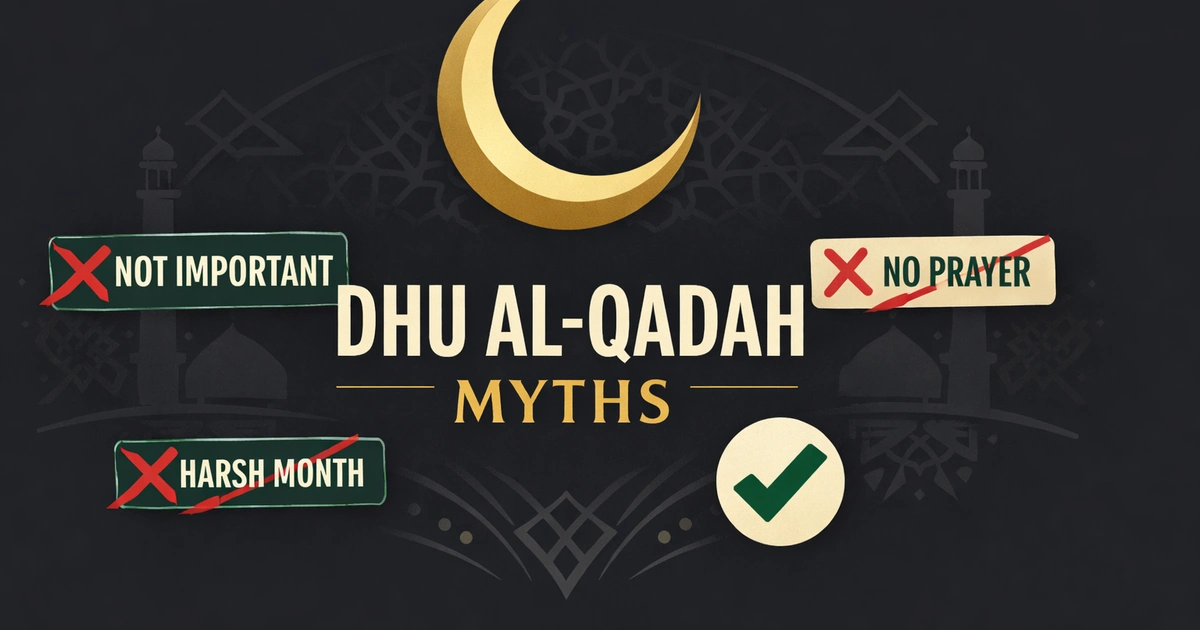
Common Misconceptions About Dhu al-Qadah
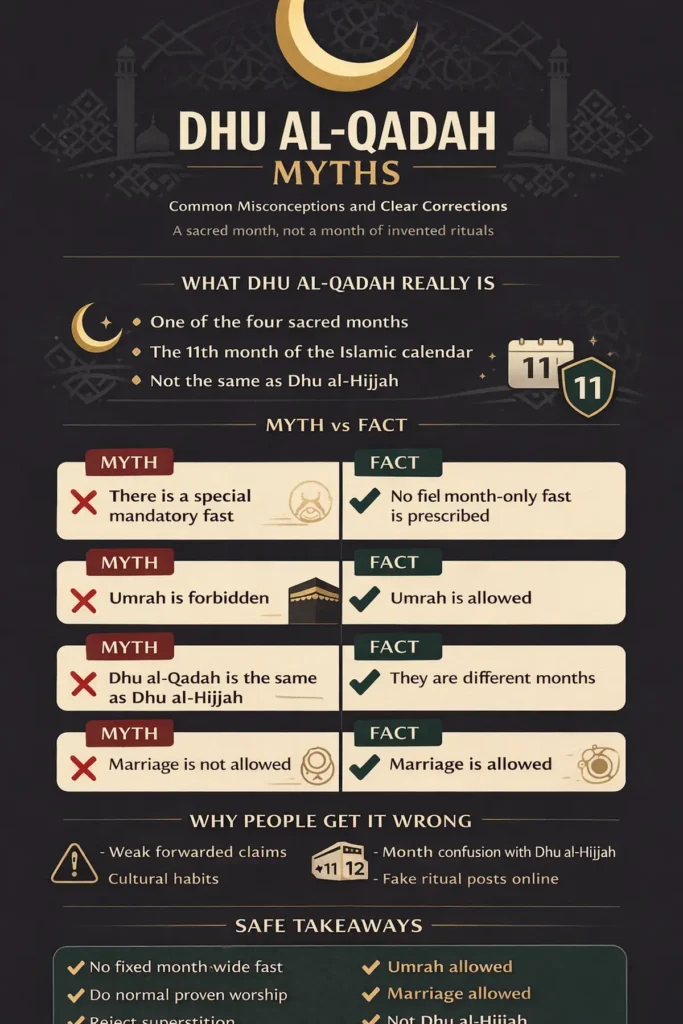
Common misconceptions about Dhu al-Qadah usually come from weak forwards, cultural habits, and people mixing this month with Dhu al-Hijjah. The direct answer is simple: there is no fixed month-wide fast, Umrah allowed, marriage is allowed, and Dhu al-Qadah is not the same as Dhu al-Hijjah. It is a sacred month, but not a month of invented rituals. For the core background first, see Dhu al-Qadah.
A lot of people don’t get this month wrong because they are evil.
They get it wrong because religious noise spreads faster than quiet truth.
✅ TL;DR – common misconceptions about Dhu al-Qadah
Common misconceptions about Dhu al-Qadah include false ideas that there is a special mandatory fast, that Umrah is forbidden, that marriage is not allowed, that the month has fixed special rituals, or that it only matters to pilgrims. The safer understanding is this: Dhu al-Qadah is one of the sacred months, but most online exaggerations about it are weak, invented, or confused with other months.
📖 Sacred Month Foundation
Arabic: إِنَّ عِدَّةَ الشُّهُورِ عِندَ اللَّهِ اثْنَا عَشَرَ شَهْرًا فِي كِتَابِ اللَّهِ يَوْمَ خَلَقَ السَّمَاوَاتِ وَالْأَرْضَ مِنْهَا أَرْبَعَةٌ حُرُمٌ
Transliteration: Inna ‘iddata ash-shuhūri ‘inda Allāhi ithnā ‘ashara shahran fī kitābi Allāhi yawma khalaqa as-samāwāti wal-arḍa minhā arba‘atun ḥurum.
Translation: Indeed, the number of months with Allah is twelve months in the register of Allah from the day He created the heavens and the earth; of these, four are sacred.
Hadith summary: The Prophet ﷺ named the four sacred months as Dhu al-Qadah, Dhu al-Hijjah, Muharram, and Rajab.
Arabic: مِنْهَا أَرْبَعَةٌ حُرُمٌ ثَلَاثٌ مُتَوَالِيَاتٌ ذُو الْقَعْدَةِ وَذُو الْحِجَّةِ وَالْمُحَرَّمُ
Transliteration: Minhā arba‘atun ḥurum, thalāthun mutawāliyātun: Dhul-Qa‘dah wa Dhul-Ḥijjah wal-Muḥarram.
Translation: Of them four are sacred, three consecutive: Dhu al-Qadah, Dhu al-Hijjah, and Muharram.
What Are the Most Common Misconceptions About Dhu al-Qadah?
What are common misconceptions about Dhu al-Qadah? The biggest ones are about fasting, Umrah month confusion, marriage, fake rituals, and people treating it as either a “dead month” or a “special ritual month.” Both extremes are wrong. Dhu al-Qadah myths usually come from mixing true sacred-month respect with false details that were never proven.
Why are there so many myths about Dhu al-Qadah?
Because sacred months attract emotion, and emotion attracts storytelling. Once a month is known to be holy, people start adding things to it. A weak line becomes a family habit. A family habit becomes a “rule.” Then someone posts it online like it came straight from revelation.
How do weak claims and cultural habits create confusion?
Weak claims and cultural habits create confusion when people stop asking one simple question: “Where did this come from?” That question saves a lot of trouble. Many wrong ideas about sacred months are not open rebellion against Islam. They are just inherited noise with a religious face.
Which myths should be corrected first?
The first myths to correct are the ones that actually change people’s behavior. These are the dangerous ones because they stop halal things, add fake worship, or make readers suspicious of a blessed month.
- Fake fasting claims that turn optional worship into a fixed rule
- Umrah month confusion that makes people think Umrah is forbidden
- Sacred month mistakes about marriage and daily life
- Month of truce myths that turn “peaceful month” into “useless month”
- Hajj month confusion that mixes Dhu al-Qadah with Dhu al-Hijjah
📚 You Can Also Read:
Dhu al-Qadah Meaning • Why Dhu al-Qadah Is Sacred • Virtues of Dhu al-Qadah
Myth 1: There Is a Special Mandatory Fast in Dhu al-Qadah
This is one of the most repeated myths about Dhul Qadah. People hear that sacred months are special, then jump to the claim that there is a special fast in Dhu al-Qadah that everyone should do in a fixed way. That jump is the problem. Respecting a month is one thing. Inventing a compulsory pattern is another.
Is there a special fast in Dhu al-Qadah?
Is there a special fast in Dhu al-Qadah? There is no known fixed, month-specific obligatory fast for Dhu al-Qadah. A Muslim may do voluntary fasting, just as one may fast on Mondays, Thursdays, or the white days in other months. But turning that into a special mandatory Dhu al-Qadah program is not correct.
Is there a fixed month-wide fast in Dhu al-Qadah?
No fixed month-wide fast is prescribed for this month. That needs to be said clearly because some readers are scared into thinking they are missing a hidden obligation. They are not.
What fasting claims about Dhu al-Qadah are weak?
Fasting claims become weak when they promise a fixed reward for a fixed schedule that has no reliable basis. A general encouragement to do good in sacred months is one thing. A viral poster saying “fast these exact days of Dhu al-Qadah or lose special reward” is another. Abu Dawud 2428 is often mentioned in broader sacred-month fasting discussions, but that still does not create a unique month-wide rule only for Dhu al-Qadah.
Myth 2: Umrah Is Forbidden in Dhu al-Qadah
This is one of the strangest dhu al-qadah myths, because the Prophetic practice points the other way. If anything, Umrah month confusion here flips the evidence upside down.
Is Umrah forbidden in Dhu al-Qadah?
Is Umrah forbidden in Dhu al-Qadah? No. Umrah allowed is the clear correction. It is not forbidden. In fact, this month is strongly connected to the Prophet’s ﷺ Umrahs.
Why does Umrah month confusion happen?
It happens because some people hear “month before Hajj” and assume lesser pilgrimage must stop. Others hear “sacred month” and assume extra restrictions must exist. This is how Umrah month confusion spreads: half-memory plus overconfidence.
How does the Prophet’s practice correct this myth?
The Prophet ﷺ performed multiple Umrahs in Dhu al-Qadah, except the one connected to his Hajj. That fact alone crushes the myth. My students always ask about this part because it feels so simple once you hear it: if the Prophet ﷺ did Umrah in the month, how can the month itself be forbidden for Umrah?
🕋 Correction Box
Myth: Umrah is forbidden in Dhu al-Qadah.
Fact: The Prophetic practice shows the opposite. This month is not closed to Umrah; it is one of the months strongly linked to it.
Myth 3: Dhu al-Qadah Is the Same as Dhu al-Hijjah
This one sounds harmless, but it creates real Hajj month confusion. Once people blend the two months together, the whole Islamic calendar starts getting messy in their minds.
Is Dhu al-Qadah the same as Dhu al-Hijjah?
Is Dhu al-Qadah the same as Dhu al-Hijjah? No. They are two different months. Not same as Dhu al-Hijjah is a correction that should be stated bluntly. Dhu al-Qadah is the eleventh month. Dhu al-Hijjah is the twelfth.
What is the difference between Dhu al-Qadah and Dhu al-Hijjah?
Dhu al-Qadah is a sacred month of truce and preparation before Hajj. Dhu al-Hijjah is the month in which the Hajj rites and the days of Eid al-Adha occur. One prepares the road. The other carries the major pilgrimage days.
Why does Hajj month confusion mislead readers?
Because readers start assigning the special rulings of one month to the other. Then they think every Hajj-specific detail belongs to Dhu al-Qadah, or that the spiritual value of Dhu al-Qadah only exists as a waiting room for Dhu al-Hijjah. Both are wrong.
📚 You Can Also Read:
Myth 4: You Cannot Marry in Sacred Months
This is one of the oldest wrong ideas about sacred months. It survives because people are often more scared of cultural gossip than weak evidence.
Can you not marry in sacred months?
Can you not marry in sacred months? There is no general Islamic ban on marriage in the sacred months. Saying a sacred month is unlucky for nikah is not a careful religious claim. It is superstition dressed up in pious clothing.
Can you marry in Dhu al-Qadah?
Can you marry in Dhu al-Qadah? Yes. Marriage is allowed. This month is blessed, not cursed. A month Allah made sacred should not be presented as a month of bad luck for halal life events.
Why is this one of the most common sacred month mistakes?
Because marriage fears spread emotionally. People remember one broken marriage and attach it to a month. Then a superstition is born. But a failed marriage does not rewrite fiqh. Mufti Muhammad Taqi Usmani called this belief baseless, and that is a fair and needed correction.
Myth 5: Dhu al-Qadah Has Fixed Special Rituals and Dua
This myth traps sincere people because it sounds religious. Someone says there is a “special dua,” a fixed prayer cycle, or a hidden ritual package for the month. Sincere readers think they are about to unlock something precious. In reality, they may just be stepping into invented practice.
Does Dhu al-Qadah have a fixed special dua?
Does Dhu al-Qadah have a fixed special dua? There is no well-known fixed special dua uniquely prescribed for this month in the way some people claim. A Muslim can make dua in this month, of course. But that is not the same as proving a unique formula attached only to Dhu al-Qadah.
Are there invented practices in Dhu al-Qadah?
Are there invented practices in Dhu al-Qadah? Yes, there can be. That is why bid‘ah concerns matter here. The month is sacred, but its sacredness does not give people permission to create new fixed acts of worship, then market them as religious certainty.
How do bid‘ah concerns apply to this topic?
They apply when general good deeds are turned into specific ritual packages without proof. Reading Qur’an, charity, repentance, voluntary prayer, and peace-making are always good. But saying “this exact dua must be read this many times in Dhu al-Qadah” needs evidence. Without that, caution is wiser.
🌙 Safe Worship Box
Safe and sound: Qur’an, dua, repentance, charity, voluntary fasting, better manners, and leaving conflict.
Not safe to claim without proof: fixed special duas, fixed month-only rituals, guaranteed reward charts, and copy-paste worship formulas.
Myth 6: Dhu al-Qadah Is Only for Hajj Pilgrims
This myth turns a sacred month into a niche month. That is too small. Much too small.
Is the month only for Hajj pilgrims?
Is the month only for Hajj pilgrims? No. Even though it stands right before Dhu al-Hijjah and helps explain pilgrimage timing, Dhu al-Qadah matters to all Muslims. Sacred months are not VIP zones for travelers only.
Can ordinary Muslim readers benefit from Dhu al-Qadah?
Can ordinary Muslim readers benefit from Dhu al-Qadah? Yes. This month invites all believers to increase good deeds, avoid sin, and live the ethics of a sacred season. You do not need a Hajj package to benefit from sacred time.
Why is Dhu al-Qadah not just calendar filler?
Because a sacred month is never filler. Not just calendar filler is one of the most important corrections in this topic. If Allah singled out a month as sacred, then a Muslim should not treat it like dead space between two more exciting dates.
Myth 7: Dhu al-Qadah Is an Unimportant Waiting Month
Some people do not add false rituals. They do the opposite. They empty the month of value completely. That is another mistake.
Is Dhu al-Qadah just a waiting month?
Is Dhu al-Qadah just a waiting month? No. It does prepare for what comes next, but that does not make it spiritually empty. A doorway is still important even if it is not the whole house.
Why is it called a peaceful month or month of truce?
It is called that because people would sit back from conflict and allow safer movement, especially around pilgrimage seasons. That is why phrases like month of truce myths matter. The month of truce does not mean a month of passivity. It means a month where peace, restraint, and safety are honored.
What does sacred month behavior look like in practice?
Sacred month behavior looks less dramatic than many people expect. It means fewer grudges, less verbal filth, more Qur’an, more repentance, more hidden charity, more self-control, and less appetite for conflict. The month is peaceful, but not lazy. Quiet, but not empty.
How to Separate Fact From Myth in Dhu al-Qadah
This is the part most readers need. Not because the topic is impossible, but because online religious content often rewards confidence more than accuracy.
Is every claim about the month authentic?
Is every claim about the month authentic? No. Some are sound, some are weak, and some are invented. Sacred-month content needs the same honesty as any other Islamic topic. Maybe more.
Is every online claim about Dhu al-Qadah reliable?
Is every online claim about Dhu al-Qadah reliable? No. Some pages mix sound verses, broad reminders, weak reports, cultural myths, and personal reflections into one pot. The result can look beautiful while teaching confusion.
What should readers be careful about?
Readers should be careful about three things: fake certainty, weak forwarded claims, and emotional superstitions. Here is a simple filter:
- Check the source before trusting the claim.
- Separate general virtue from fixed ritual formulas.
- Watch for month confusion between Dhu al-Qadah and Dhu al-Hijjah.
- Reject superstition about marriage, luck, or “bad timing.”
- Prefer educational correction over viral drama.
📚 You Can Also Read:
Fasting in Dhu al-Qadah • Dhu al-Qadah Dos and Don’ts • Niyyah for Hajj and Umrah
Quick Fact-Check Summary of Dhu al-Qadah Myths
This section is your fast reset. If you forget the longer discussion, remember this table and these short corrections.
No fixed month-wide fast
There is no proven fixed month-wide fasting program unique to Dhu al-Qadah.
Umrah allowed
Umrah allowed. The month is not forbidden for lesser pilgrimage.
Not same as Dhu al-Hijjah
Not same as Dhu al-Hijjah. They are different months with different roles.
No fixed special rituals
There is no known fixed special dua or ritual package unique to the month.
Marriage is allowed
Marriage is halal in Dhu al-Qadah. “Unlucky month” thinking is baseless.
The month matters for all Muslims
This is a sacred month for all believers, not just pilgrims.
📊 Myth vs Fact Table
| Myth | Fact | Safe takeaway |
|---|---|---|
| There is a special mandatory fast | No fixed month-only fast is prescribed | Do voluntary fasting without inventing a rule |
| Umrah is forbidden | Umrah is allowed, and Prophetic practice corrects the myth | Do not confuse sacredness with prohibition |
| Dhu al-Qadah = Dhu al-Hijjah | They are two different Hijri months | Avoid Hajj month confusion |
| You cannot marry in sacred months | Marriage is allowed | Reject superstitious fear |
| There are fixed special rituals and duas | No proven month-specific ritual package | Stick to established worship |
| It only matters for pilgrims | It matters for all Muslims | Treat it as a sacred month for your own life |
| It is just an unimportant waiting month | It is a peaceful month with real spiritual weight | Practice sacred month behavior |
Common misconceptions about Dhu al-Qadah survive when people love dramatic claims more than careful truth. The fix is not complicated: respect the month, reject fake details, and keep your worship inside what is actually proven. That way, the month stays blessed without becoming burdened by superstition.
📚 You Can Also Read:
Prophet’s Umrahs in Dhu al-Qadah • Treaty of Hudaybiyyah in Dhu al-Qadah • Major Events in Dhu al-Qadah • Holy Sites in Makkah
📘 common misconceptions about Dhu al-Qadah FAQs
is Dhu al-Qadah an unlucky month?
Show Answer
No. Calling Dhu al-Qadah unlucky is one of the most common misconceptions about Dhu al-Qadah. A month that belongs to the sacred months should not be treated like a bad-omen month. That idea comes from superstition, not sound Islamic teaching.
can you travel in Dhu al-Qadah, or is travel disliked?
Show Answer
Yes, you can travel in Dhu al-Qadah. In fact, the month’s historical link with truce and safe movement is part of why travel around pilgrimage season became easier. So turning the month into a “don’t travel” month is one of those wrong ideas about sacred months that needs correcting.
is it wrong to hold a family gathering in Dhu al-Qadah?
Show Answer
No, a normal halal family gathering is not wrong in Dhu al-Qadah. The problem starts when people either ban lawful things without proof or turn simple gatherings into fixed religious rituals. That balance matters in avoiding sacred month mistakes.
does Dhu al-Qadah have a “bad luck for new beginnings” belief in Islam?
Show Answer
No. Starting a business, moving house, getting married, or beginning a new chapter in Dhu al-Qadah is not Islamically cursed. This is one of the emotional myths about Dhul Qadah that survives because people remember stories more than evidence.
is the “month of truce myths” idea about doing nothing all month correct?
Show Answer
No. “Month of truce” does not mean “month of doing nothing.” It means a peaceful month marked by restraint from conflict and a stronger call to right conduct. So the right reading is peace with purpose, not passivity.
can someone increase good deeds in Dhu al-Qadah without inventing new rituals?
Show Answer
Yes, and that is actually the safest path. A Muslim can increase Qur’an, dua, charity, repentance, better manners, and voluntary worship in Dhu al-Qadah without creating fake month-only practices. That is a clean way to avoid bid‘ah concerns while still honoring sacred time.
if Dhu al-Qadah is sacred, does that mean every viral post about it must be true?
Show Answer
No. This is where many readers slip. A sacred topic attracts both truth and exaggeration. So when you see a dramatic post about Dhu al-Qadah, especially one with exact promises, fixed formulas, or emotional pressure, slow down and check it. Not every sacred-sounding post is reliable.
what should parents teach children about Dhu al-Qadah first?
Show Answer
Start with simple truths: Dhu al-Qadah is one of the sacred months, it is a month of peace and restraint, and it prepares hearts for what comes before Hajj. Don’t start with complicated debates. Start with reverence, calm, and clear facts.
is every statement linked to hadith about Dhu al-Qadah automatically strong?
Show Answer
No. People often use the word hadith as if that ends the discussion. It doesn’t. Some reports are stronger than others, and some claims about Dhu al-Qadah are built on weak or badly explained material. That is why weak claims need to be separated from sound evidence.
does respecting Dhu al-Qadah mean avoiding all disagreement completely?
Show Answer
Not every disagreement disappears in a sacred month, but sacred month behavior should make a Muslim slower to fight, slower to insult, and quicker to calm down. The aim is not fake silence. The aim is cleaner conduct.
can someone who is not going for Hajj still prepare spiritually in Dhu al-Qadah?
Show Answer
Yes. This is one of the best ways to understand the month. Even if you are not going for Hajj, you can use Dhu al-Qadah to clean up habits, renew repentance, soften your heart, and prepare for the season of Dhu al-Hijjah. The month is not restricted to travelers.
is there any benefit in correcting misconceptions about Dhu al-Qadah gently instead of arguing?
Show Answer
Yes. Gentle educational correction usually works better than public humiliation. Many people hold misconceptions about Dhu al-Qadah because they inherited them, not because they are trying to mislead others. Calm correction often opens hearts faster than sharp debate.
what is the safest one-line way to remember Dhu al-Qadah?
Show Answer
Dhu al-Qadah is a sacred, peaceful month before Dhu al-Hijjah that calls Muslims to truth, restraint, and better worship without inventing new religious rituals.
Common Misconceptions About Dhu al-Qadah Myth vs Fact Guide

Farrukh Farooqi has been living in Sharaya, Makkah, Saudi Arabia since 2010. With over 14 years of firsthand experience witnessing the sacred journey of millions of pilgrims, Farrukh specializes in providing practical, insider tips for Hajj and Umrah travelers. His work blends real-world observations, the latest Saudi updates, and essential crowd management strategies — helping pilgrims and worshippers plan smarter, stay safer, and experience a spiritually fulfilling journey across the Holy Cities.


