
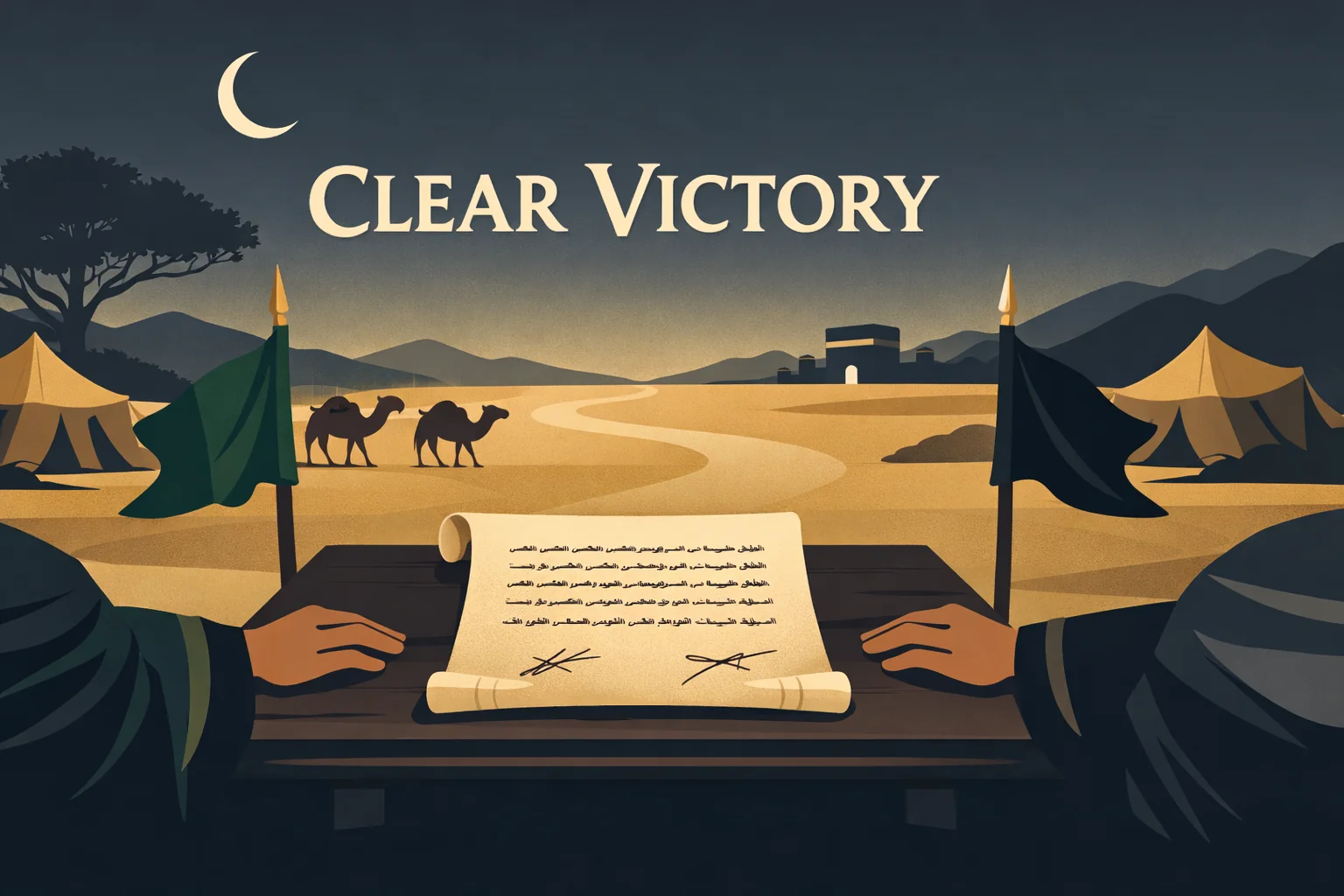
Treaty of Hudaybiyyah in Dhu al-Qadah: Clear Victory, Terms, and Lessons
The Treaty of Hudaybiyyah in Dhu al-Qadah was signed in Dhu al-Qadah, 6 AH—commonly placed in March 628 CE—after the Prophet Muhammad ﷺ and his companions travelled from Madinah for an Umrah attempt but were stopped by the Quraysh near Makkah. What looked painful at first later became a clear victory. For the month background first, see Dhu al-Qadah.
That is the short answer.
The deeper answer is even more powerful: this was not just a truce. It was a turning point in dhu al-qadah history, a test of obedience, a lesson in patience, and the bridge between a blocked pilgrimage and the road to Makkah opening later.
✅ TL;DR – Treaty of Hudaybiyyah in Dhu al-Qadah
The Treaty of Hudaybiyyah in Dhu al-Qadah took place in Dhu al-Qadah 6 AH when the Prophet ﷺ and about 1,400 companions came for Umrah and were stopped by the Quraysh. The result was a ten-year truce, delayed Umrah until the next year, Bay‘at al-Ridwan, and the revelation of Surah Al-Fath, which called it a clear victory.
What Is the Treaty of Hudaybiyyah in Dhu al-Qadah?
What is the treaty of hudaybiyyah? It was a peace agreement between the Muslims of Madinah and the Quraysh of Makkah. The event took place in the sacred month of Dhu al-Qadah, which is why searches like hudaybiyyah dhu al-qadah and treaty of hudaybiyyah month matter so much. This was not just a seerah event. It was a month-specific turning point.
In which month was the Treaty of Hudaybiyyah signed?
In which month was the treaty of hudaybiyyah signed? It was signed in Dhu al-Qadah, the eleventh Hijri month and one of the sacred months. That is why the phrase hudaybiyyah sacred month is so central to the topic.
Was Hudaybiyyah in Dhu al-Qadah?
Was Hudaybiyyah in Dhu al-Qadah? Yes. This is one of the clearest answers in the whole topic. The sulh hudaybiyyah happened in Dhu al-Qadah 6 AH, not in a random month with no sacred-month context.
What happened in 6 AH in Dhu al-Qadah?
What happened in 6 AH in Dhu al-Qadah? The Prophet ﷺ set out for Umrah, the Muslims were stopped near Makkah, Bay‘at al-Ridwan was taken under the tree, and the treaty was signed. If you want one sentence only: hudaibiyah in 6 ah changed the direction of the seerah without a major battle.
📚 You Can Also Read:
12 Islamic Months • Hijri Calendar • Discovering the Hijri Calendar
What Happened at Hudaybiyyah?
What happened at hudaybiyyah? The Prophet ﷺ saw a dream of entering the Sacred Mosque, then left Madinah with pilgrims, not an invasion force. The Quraysh blocked the route. Negotiations followed. Rumours spread. The pledge under the tree happened. Then the treaty was signed. That is the event in its simplest line.
Why did the Prophet ﷺ set out from Madinah?
He set out from Madinah to perform Umrah, not to launch war. The group wore ihram and brought sacrificial animals, which made their intention clear. This is why the event is tied so strongly to the phrase Umrah attempt.
Was the Prophet prevented from Umrah?
Was the Prophet prevented from Umrah? Yes. The Muslims did not complete Umrah that year. They returned and then came back the following year under the treaty terms. That delay hurt many hearts at the time. It really did.
How did the Quraysh stop the Umrah attempt?
The Quraysh sent forces to block the pilgrimage route and refused to let the Muslims enter Makkah that year. The Prophet ﷺ changed route, camped at Hudaybiyyah, and chose negotiation over reckless confrontation. That choice is one of the biggest hudaybiyyah lessons in the whole story.
Why Is Hudaybiyyah Linked to Dhu al-Qadah?
Why is hudaybiyyah linked to dhu al-qadah? Because it happened in that month, but also because the sacred-month setting adds meaning. A blocked pilgrimage in a sacred month is not a normal political event. It carries moral and spiritual weight.
Why is Hudaybiyyah linked to Dhu al-Qadah?
It is linked to Dhu al-Qadah because that is when the Muslims came for Umrah, when the stand-off happened, and when the treaty was signed. So hudaybiyyah dhu al-qadah is not just SEO phrasing. It is the actual frame of the event.
Why does this matter in Dhu al-Qadah?
Why does this matter in Dhu al-Qadah? Because Dhu al-Qadah is a sacred month tied to peace, restraint, and preparation before Hajj season. When the event is read inside that month, it becomes even clearer why patience and truce mattered so much.
What does the sacred month context add to the event?
The sacred-month context adds three things: moral seriousness, pilgrimage meaning, and the contrast between peaceful intention and hostile blockage. It turns the event from “just another treaty” into a sacred-month test of wisdom.
📚 You Can Also Read:
Four Sacred Months • Why Dhu al-Qadah Is Sacred • Virtues of Dhu al-Qadah
Bay‘at al-Ridwan Before the Treaty
Bay‘at al-Ridwan happened before the treaty was finalized. When the rumour spread that Sayyiduna ‘Uthman رضي الله عنه had been killed, the believers pledged under the tree that they would stand firm. This moment shaped everything that came after.
What is Bay‘at al-Ridwan?
What is bayat al-ridwan? It is the pledge of allegiance taken by the believers under the tree at Hudaybiyyah. Allah mentioned it in Surah Al-Fath, and that alone tells you how honored the moment was.
📖 Qur’an Box – Bay‘at al-Ridwan
Arabic:
لَقَدْ رَضِيَ ٱللَّهُ عَنِ ٱلْمُؤْمِنِينَ إِذْ يُبَايِعُونَكَ تَحْتَ ٱلشَّجَرَةِ
Transliteration:
Laqad raḍiya Allāhu ‘ani al-mu’minīna idh yubāyi‘ūnaka taḥta ash-shajarah.
Translation:
Allah was certainly pleased with the believers when they pledged allegiance to you under the tree.
Why was the pledge taken under the tree?
It was taken under the tree because that was the moment and place where the believers gathered after hearing the rumour about ‘Uthman رضي الله عنه. Sometimes history turns under a tree, not on a battlefield. That is one of those moments.
How did Bay‘at al-Ridwan shape the treaty?
Bayat al-ridwan showed the strength, loyalty, and seriousness of the Muslim side. The Quraysh were no longer dealing with a weak group they could easily push around. The pledge changed the tone of negotiations.
Main Terms of the Treaty of Hudaybiyyah
What was the truce at hudaybiyyah? It was a peace agreement with terms that looked hard on the Muslims at first, especially emotionally. But step by step, those same terms opened space for Islam to spread, for tribes to choose sides openly, and for the road to Makkah to change.
What was the truce at Hudaybiyyah?
The best short answer is this: a ten-year truce between the Muslims and the Quraysh, with delayed Umrah for that year and a return the following year under agreed conditions. That is the core of the sulh hudaybiyyah.
What were the main conditions of the treaty?
- Ten-year truce between both sides.
- Return that year without completing Umrah.
- Come back next year for Umrah and stay three days.
- Carry only sheathed swords, not open battle weapons.
- Tribes free to ally with either side.
- Return clause for certain people coming from Quraysh to the Muslims.
Why did some terms seem difficult at first?
Because they looked uneven. The believers had come with longing for Umrah, not to turn back. Some companions found the terms heavy, especially in the moment. I understand that reaction, honestly. A victory that first tastes like loss is hard for the heart.
📦 Quick Terms Box
Treaty before makkah conquest is the right way to think about this event. It did not give the Muslims everything that day. It gave them something better: breathing room, recognition, and a path that later opened Makkah.
Surah Al-Fath and the Clear Victory
Surah al-fath hudaybiyyah is one of the clearest Qur’anic pairings in seerah. The treaty looked disappointing to many believers in the moment, yet Allah called it a clear victory. That changes how the whole event must be read.
What does Surah Al-Fath have to do with Hudaybiyyah?
What does surah al-fath have to do with hudaybiyyah? It was revealed after the return from Hudaybiyyah and framed the event as victory, not defeat. This is why the topic cannot be explained properly without Surah Al-Fath 48:1.
📖 Qur’an Box – Surah Al-Fath 48:1
Arabic:
إِنَّا فَتَحْنَا لَكَ فَتْحًا مُّبِينًا
Transliteration:
Innā fataḥnā laka fatḥan mubīnā.
Translation:
Indeed, We have granted you a clear victory.
Why was it called a clear victory?
Why was it called a victory? Because the treaty broke the deadlock, recognized the Muslim side politically, opened peaceful contact, allowed alliances, and led to major growth afterward. Victories are not always loud. Some arrive dressed as compromise.
How did Surah Al-Fath change how the believers saw the treaty?
Surah Al-Fath taught the believers to trust Allah’s wider plan. What looked like painful delay became a door. What looked like concession became advance. That is one of the deepest hudaybiyyah lessons.
How Hudaybiyyah Led to Makkah
How did hudaybiyyah lead to makkah? The treaty calmed the front with Quraysh, gave tribes freedom to align openly, and changed the political landscape of Arabia. Two years later, after the treaty was broken, the road to Makkah opened in a way that would have been much harder without Hudaybiyyah first.
How did Hudaybiyyah lead to Makkah?
It led to Makkah by creating a period of peace and contact. More people heard Islam without battle noise around it. More tribes saw the Muslim community as a real power. That matters a lot.
Why is it called a treaty before Makkah conquest?
Treaty before makkah conquest fits because Hudaybiyyah came before the conquest and made it possible. It did not conquer Makkah by the sword that day. It prepared the way for Makkah by wisdom.
What changed after the truce?
After the truce, the Muslims gained room to move, preach, correspond, and build. The balance shifted. The story of Makkah after Hudaybiyyah is not random. It grows directly out of this treaty.
📚 You Can Also Read:
Hajj and Umrah: A Complete Guide • How to Perform Hajj • Hajj Checklist
Key People and Terms in the Hudaybiyyah Story
This story becomes much easier once the names stop feeling crowded. A few key people and terms carry most of the event.
Who were the Quraysh in this event?
The Quraysh were the dominant tribe of Makkah and the main opposing force in this event. They blocked the Muslims from entering Makkah for Umrah that year and negotiated the treaty through Suhayl ibn ‘Amr.
What does Sulh Hudaybiyyah mean?
Sulh Hudaybiyyah means the peace settlement or treaty of Hudaybiyyah. It is one of the most common Arabic labels for the event.
Why do Makkah and Madinah both matter in this story?
Because this is a story of movement from Madinah to Makkah, of longing for the Sacred House, and of the tension between the two cities softening through treaty rather than immediate battle. Both cities are in the bones of this story.
Lessons From the Treaty of Hudaybiyyah in Dhu al-Qadah
What are the lessons of hudaybiyyah? Patience over panic. Peace over needless clash. Trust over shallow first impressions. And maybe the hardest lesson of all: not every blocked door is a loss.
What are the lessons of Hudaybiyyah?
- Patience can beat haste.
- Peace can be stronger than display.
- A painful term can hide a bigger gain.
- Loyalty matters in crisis.
- Allah’s view of victory is wiser than ours.
What should readers learn from Hudaybiyyah?
What should readers learn from hudaybiyyah? Learn that leadership is not loudness. Learn that sacred months are not empty dates on a calendar. Learn that Surah Al-Fath teaches us to judge by revelation, not by mood.
Why does this event still matter today?
Because people still mistake patience for weakness. They still think compromise always means surrender. They still want quick wins. Hudaybiyyah corrects all of that. It teaches that a calm step taken for Allah can change history more than a dramatic reaction ever could.
📘 Treaty of Hudaybiyyah in Dhu al-Qadah FAQs
where was the Treaty of Hudaybiyyah signed?
Show Answer
The Treaty of Hudaybiyyah was signed at Hudaybiyyah, a place near Makkah on the edge of the sacred boundary. Today, many people connect the site with Masjid al-Hudaibiyah. So when readers ask where hudaybiyyah dhu al-qadah happened, the answer is: near Makkah, not inside the city itself.
who negotiated the sulh hudaybiyyah from the Quraysh side?
Show Answer
The best-known negotiator from the Quraysh side was Suhayl ibn ‘Amr. His arrival signaled that the Meccans were now moving toward a formal settlement, not just a tense stand-off. That is one reason sulh hudaybiyyah became such a major turning point.
who wrote down the terms of the Treaty of Hudaybiyyah in Dhu al-Qadah?
Show Answer
The terms were written down by Sayyiduna ‘Ali رضي الله عنه. This detail matters because it is tied to one of the most emotional moments in the story, when wording about the Prophet ﷺ as the Messenger of Allah was challenged during the negotiations.
how many companions were with the Prophet ﷺ at Hudaybiyyah?
Show Answer
Most summaries say around 1,400 companions, while some reports mention about 1,500. The safest way to write it in a polished article is “around 1,400 companions,” because that is the most common wording in seerah discussions of hudaibiyah in 6 ah.
how long was the truce in the Treaty of Hudaybiyyah month event supposed to last?
Show Answer
The truce was set for ten years. That long period of peace is one of the biggest reasons this treaty of hudaybiyyah month event mattered so much. It gave space for Islam to spread through contact, not just confrontation.
did the Muslims perform Umrah in the same year as Bay‘at al-Ridwan?
Show Answer
No. They did not complete Umrah in that same year. The Muslims returned to Madinah and then came back the following year under the treaty terms. That delay is a huge part of why the event first felt painful even though it later proved to be a clear victory.
what happened to Abu Jandal during the Treaty of Hudaybiyyah story?
Show Answer
Abu Jandal came to the Muslim camp during the treaty process in a heartbreaking state, but because of the newly agreed terms, he was returned. This scene made the hard side of the Treaty of Hudaybiyyah feel very real to the believers. It was not an abstract political agreement. People were crying inside it.
why were some companions upset after the sulh hudaybiyyah?
Show Answer
Some companions were upset because the treaty terms looked difficult, especially after the long journey for Umrah. From the outside, it seemed like the Muslims were stepping back. But later events showed that sulh hudaybiyyah was not retreat in the weak sense. It was disciplined strategy under revelation.
why did the Prophet ﷺ accept terms that seemed hard in the hudaybiyyah sacred month?
Show Answer
Because the Prophet ﷺ saw farther than the moment. The hudaybiyyah sacred month setting, the blocked Umrah attempt, and the treaty terms all came together in a way that looked narrow at first but opened great benefit later. That is one of the biggest hudaybiyyah lessons for any reader.
what does Fath Mubin mean in the surah al-fath hudaybiyyah context?
Show Answer
Fath Mubin means a clear victory or manifest victory. In the surah al-fath hudaybiyyah context, it refers to the treaty itself and what it opened afterward. This is the Qur’anic correction of shallow first impressions.
who broke the Treaty before Makkah conquest?
Show Answer
The treaty was broken when Banu Bakr, who were aligned with the Quraysh, attacked Banu Khuza‘ah, who were aligned with the Muslims. That breach is why the event is often called the treaty before makkah conquest. The truce did not end as a small footnote. It led into one of the biggest moments in Islamic history.
when was the Treaty of Hudaybiyyah in Dhu al-Qadah broken?
Show Answer
It was broken about two years later, in 8 AH. That later violation is part of why The Treaty of Hudaybiyyah in Dhu al-Qadah cannot be read as an isolated peace document. It sits inside a bigger chain of events leading toward Makkah.
is Masjid al-Hudaibiyah directly connected to hudaybiyyah dhu al-qadah today?
Show Answer
Yes. Masjid al-Hudaibiyah is tied to the location remembered for the event. That is why many pilgrims and readers connect the modern site with hudaybiyyah dhu al-qadah, even though the original historical landscape and the modern built area are not identical in every small detail.
why did Makkah and Madinah both change after the truce?
Show Answer
Because the truce changed the relationship between Makkah and Madinah. The Muslims were no longer seen only through war. The Quraysh had effectively dealt with them through formal agreement, and that shifted how tribes across Arabia viewed both sides.
did Bay‘at al-Ridwan happen before or after the treaty was signed?
Show Answer
Bay‘at al-Ridwan happened before the treaty was signed. It came during the tense phase when the rumour spread that ‘Uthman رضي الله عنه had been killed. So the pledge belongs to the emotional build-up of the event, not the quiet paperwork after everything was settled.
why is the Treaty of Hudaybiyyah month story so important for modern readers?
Show Answer
Because modern readers also struggle with delayed outcomes. The Treaty of Hudaybiyyah month story teaches that obedience, patience, and long-view thinking can bring better results than emotional reactions. That is why the event still speaks so strongly today.
📊 Treaty of Hudaybiyyah in Dhu al-Qadah: what looked hard and what it achieved
This table keeps the event simple: what felt difficult in the moment, and what benefit later became clear.
🌙 Show Hudaybiyyah Table
| What happened | How it felt then | What it achieved later |
|---|---|---|
| Blocked from Umrah | Painful and disappointing | Set up the return for Umrah the following year |
| Ten-year truce | Looked like compromise | Created room for Islam to spread peacefully |
| Bay‘at al-Ridwan | Moment of danger and tension | Showed loyalty and strength under pressure |
| Hard treaty terms | Seemed uneven | Opened the road toward Makkah later |
| Surah Al-Fath | Reframed the event completely | Taught believers that this was a clear victory |
📚 You Can Also Read:
Nusuk App for Hajj and Umrah • Niyyah for Hajj and Umrah • Masjid al-Hudaibiyah • Holy Sites in Makkah
Clear Victory, Treaty Terms, and Lessons from Hudaybiyyah


Farrukh Farooqi has been living in Sharaya, Makkah, Saudi Arabia since 2010. With over 14 years of firsthand experience witnessing the sacred journey of millions of pilgrims, Farrukh specializes in providing practical, insider tips for Hajj and Umrah travelers. His work blends real-world observations, the latest Saudi updates, and essential crowd management strategies — helping pilgrims and worshippers plan smarter, stay safer, and experience a spiritually fulfilling journey across the Holy Cities.
Related Posts

Saudi Arabia Makkah Entry Permit Rules for Expats
Saudi Arabia Makkah Entry Permit Rules for Expats Saudi Arabia Makkah Entry Permit Rules for Expats now decide who can enter the holy city, who must leave, and who will…

Battle of the Confederates Meaning: Why Khandaq Has More Than One Name
Battle of the Confederates Meaning: Why Khandaq Has More Than One Name Battle of the Confederates meaning is simple once you split the names properly. Khandaq points to the trench….

Battle of the Trench Aftermath: Why Khandaq Became a Seerah Turning Point
Battle of the Trench Aftermath: Why Khandaq Became a Seerah Turning Point Battle of the Trench aftermath matters because the siege failed, the confederate retreat changed the balance of power,…

Battle of the Trench Lessons: Strategy, Shura, Patience, and Trust in Allah
Battle of the Trench Lessons: Strategy, Shura, Patience, and Trust in Allah Battle of the Trench lessons are not soft slogans. The biggest lessons from Battle of Khandaq are strategy…

Battle of the Trench vs Uhud: What Changed in Strategy, Pressure, and Outcome
Battle of the Trench vs Uhud: What Changed in Strategy, Pressure, and Outcome Battle of the Trench vs Uhud is really a story of change. Battle of Uhud vs battle…

Battle of the Trench Key Figures: The Names That Shaped Khandaq
Battle of the Trench Key Figures: The Names That Shaped Khandaq Battle of the Trench key figures include Prophet Muhammad ﷺ, Salman al-Farsi, Abu Sufyan, Ali ibn Abi Talib, Amr…