
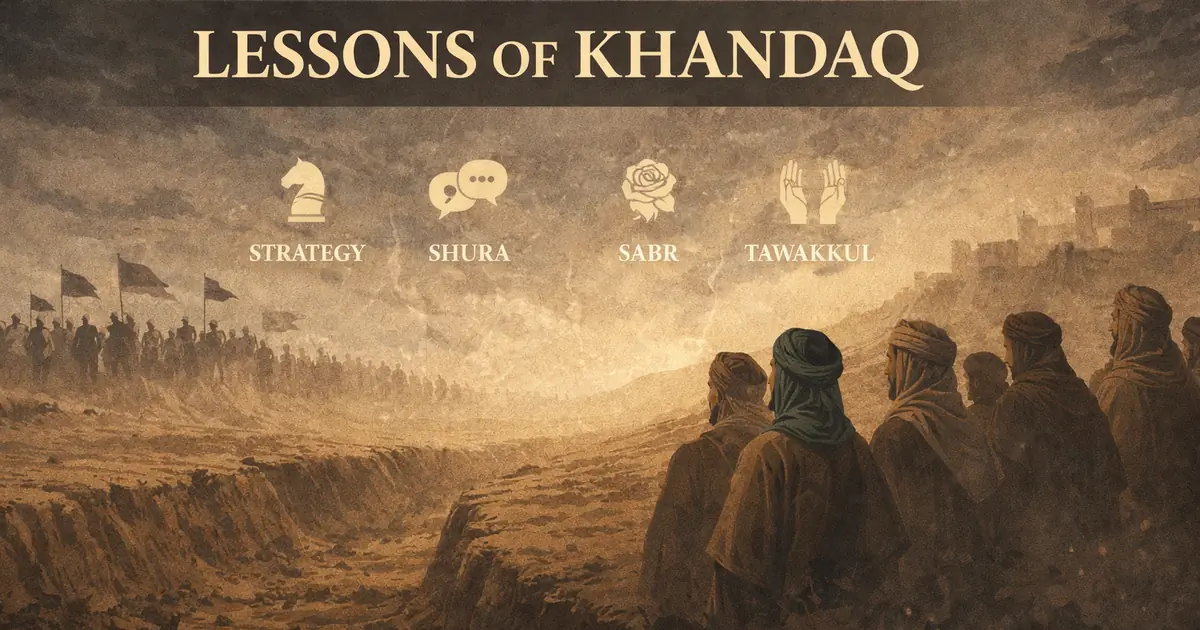
Battle of the Trench Lessons: Strategy, Shura, Patience, and Trust in Allah
Battle of the Trench lessons are not soft slogans. The biggest lessons from Battle of Khandaq are strategy under pressure, serious shura, hard sabr, intelligent tawakkul, real teamwork in Khandaq, and firm unity when fear closes in. This battle was a siege, not a neat classroom story. For the full event background first, see Battle of the Trench.
That is why these khandaq lessons still hit so hard.
They were born in hunger, cold, trench-digging, betrayal risk, and a city under threat.
✅ TL;DR – battle of the trench lessons
What we learn from the Battle of the Trench is this: Muslims do not choose between planning and faith. Battle of the Trench strategy lessons show that believers dig the trench, consult wisely, work together, stay patient in fear, and still place their hearts fully with Allah. That is the real balance of shura, sabr, tawakkul, resilience, and prophetic leadership.
📖 Qur’an and Hadith Anchor
Arabic:
يَا أَيُّهَا الَّذِينَ آمَنُوا اذْكُرُوا نِعْمَةَ اللَّهِ عَلَيْكُمْ إِذْ جَاءَتْكُمْ جُنُودٌ فَأَرْسَلْنَا عَلَيْهِمْ رِيحًا وَجُنُودًا لَّمْ تَرَوْهَا
Transliteration:
Yā ayyuhā alladhīna āmanū u dhkurū ni‘mata Allāhi ‘alaykum idh jā’atkum junūdun fa arsalnā ‘alayhim rīḥan wa junūdan lam tarawhā.
Translation:
O believers, remember Allah’s favor upon you when forces came against you, then We sent against them a wind and forces you did not see.
Arabic:
السَّنَةُ اثْنَا عَشَرَ شَهْرًا… ثَلَاثٌ مُتَوَالِيَاتٌ ذُو الْقَعْدَةِ وَذُو الْحِجَّةِ وَالْمُحَرَّمُ
Transliteration:
As-sanatu ithnā ‘ashara shahran… thalāthun mutawāliyātun Dhul-Qa‘dah wa Dhul-Ḥijjah wal-Muḥarram.
Translation:
The year is twelve months… three consecutive sacred months are Dhu al-Qadah, Dhul Hijjah, and Muharram.
What Are the Main Lessons of Khandaq?
What are the lessons of the Battle of the Trench? The clearest battle of trench morals are strategic thinking, listening to expertise, unity under siege, patience during fear, and trust in Allah without laziness. These are not five random morals. They are connected parts of one survival story.
What are the lessons of the Battle of the Trench?
The main islamic lessons from khandaq are that believers must think clearly, consult honestly, work together, endure hardship, and keep the heart tied to Allah even while taking every lawful means. This is not passive faith. It is active faith.
What do we learn from the Battle of the Trench?
What we learn from the Battle of the Trench is that a smaller, pressured community can still stand firm when it combines strategy, unity, and tawakkul. Khandaq was not won by numbers. It was carried by obedience, planning, and steadfastness.
Why do Battle of the Trench lessons still matter today?
Because most Muslims today are not facing a literal trench, but they do face pressure, confusion, poor leadership, weak teamwork, shallow slogans, and fear. That is why why Khandaq matters today is not just a history question. It is a life question.
📚 You Can Also Read:
Battle of the Trench Timeline • Causes of Battle of the Trench • Battle of the Trench vs Uhud
Strategy Under Pressure
What does Khandaq teach about strategy? The battle proves that strategy is not a lack of faith. It is part of responsible faith. The trench itself became the clearest symbol of strategic thinking under pressure.
What does Khandaq teach about strategy?
What does Khandaq teach about strategy? That Muslims do not wait for miracles while refusing effort. They assess danger, study weakness, and act wisely. The Prophet Muhammad ﷺ did not say, “We have iman, so no plan is needed.” He listened, judged, and chose the strongest available defense.
Why was the trench a lesson in strategic thinking?
The trench was a lesson in innovation because it was unusual in Arabia, but deeply practical for the situation in Madinah. That matters. A faithful community is not required to repeat old methods when a better lawful method can protect lives. My students always ask about this part because they think old equals better. Not always.
What do the battle of the trench strategy lessons show?
Battle of the trench strategy lessons show that good strategy does three things at once: it lowers enemy advantage, protects the vulnerable, and buys time. That is exactly what the trench did.
Shura and Listening to Good Advice
Shura in Battle of the Trench is one of the strongest sections competitors usually weaken. The trench idea itself came through listening. That means the battle was not only about digging. It was about who was humble enough to hear wisdom.
What does Khandaq teach about shura?
What does Khandaq teach about shura? It teaches that real consultation is not decoration. It changes outcomes. In a crisis, leaders who only love their own voice become dangerous.
What are the lessons from Salman al-Farsi’s idea?
Lessons from Salman al-Farsi’s idea include respect for expertise, openness to unfamiliar solutions, and freedom from tribal arrogance. The idea did not come from “Arab custom.” It came from a companion whose experience offered something different. Good leadership recognized value and used it.
Why does good leadership listen before acting?
Because pressure makes loud leaders even louder. But prophetic leadership is different. It does not panic into ego. It listens, weighs, and then acts.
Teamwork in Digging and Defense
Teamwork in Khandaq was not motivational poster teamwork. It was physical, exhausting, and necessary. The trench was dug by real hands in real strain, not by speeches.
What are the teamwork lessons from Battle of Khandaq?
Teamwork lessons from Battle of Khandaq include shared labor, shared sacrifice, and shared morale. The community did not split into “important people” and “workers.” The work itself became part of the defense.
How did unity help the Muslims at Khandaq?
Unity helped because siege pressure breaks communities from inside before enemies break them from outside. When people stay aligned, fear has less room to spread.
What does community defense teach about shared effort?
Community defense teaches that protection is not somebody else’s job. Sometimes the wall stands because everyone carried a piece of it.
🧱 Quick Checklist From teamwork in khandaq
- Share the burden, don’t dump it downward.
- Work beside people, don’t just command them.
- Protect morale while the work is hard.
- Stay united when pressure rises.
- Finish the useful task, not the flashy one.
Patience During Long Pressure
What does Khandaq teach about sabr? It teaches patient endurance in a siege, not pretty patience in comfort. This was cold, hunger, waiting, threat, and uncertainty. Patience in Khandaq had dust on it.
What does Khandaq teach about sabr?
Sabr here means remaining firm when fear stretches time. It is not only “don’t complain.” It is “do not collapse while hardship continues.” That is a harder lesson.
What does patience in Khandaq look like in real hardship?
Patience in Khandaq looked like digging while hungry, guarding while exhausted, and holding your heart steady while danger did not quickly disappear. One sentence, but that is the weight of it.
How did the believers endure fear, hunger, and siege?
The believers endured through iman, companionship, obedience, and hope. Not fake optimism. Hope with effort. Hope with trench dirt under the nails.
Trust in Allah Without Neglecting Means
This is one of the most important battle of confederates lessons. Tawakkul in Khandaq was not an excuse to do nothing. It was trust after doing what had to be done.
What does Khandaq teach about tawakkul?
What does Khandaq teach about tawakkul? It teaches that you tie the heart to Allah and the hands to the work. You do not separate them.
How do trust in Allah and practical planning work together?
They work together the way body and soul work together. Planning without Allah becomes arrogance. Claiming trust without planning becomes irresponsibility. Khandaq rejected both extremes.
Why is reliance without action not the lesson of Khandaq?
Because the trench was dug. The city was defended. Advice was taken. Guard was maintained. If reliance without action were the lesson, none of that would have happened.
Leadership in Scarcity and Fear
Leadership lessons from Battle of the Trench are some of the richest khandaq leadership under pressure takeaways in the seerah. The Prophet Muhammad ﷺ did not lead from distance. He led from inside the hardship.
What are the leadership lessons from Battle of the Trench?
Leadership lessons from Battle of the Trench include calm under threat, participation in hardship, consultation before decision, and keeping the community focused when anxiety is everywhere.
How did Prophet Muhammad ﷺ lead under pressure?
He ﷺ led with presence, effort, and clarity. He shared the burden, steadied hearts, accepted sound counsel, and kept the mission from dissolving into panic. That is prophetic leadership.
Why does prophetic leadership matter in crisis?
Because crisis exposes fake leadership fast. Some leaders become noise. Some become blame. Some disappear. But prophetic leadership becomes steadiness.
📚 You Can Also Read:
Who Suggested Digging the Trench? • Battle of the Trench in the Qur’an • Treaty of Hudaybiyyah in Dhu al-Qadah
Unity Against Coalition Pressure
What does Khandaq teach about unity? It teaches that unity is not a slogan for peaceful times only. Its real value appears when a coalition gathers against you and wants you to break from inside.
What does Khandaq teach about unity?
Khandaq lessons show that unity is a protective force. It keeps a pressured community from becoming ten frightened pieces instead of one steady body.
How did the believers respond to confederate pressure?
The confederates came with numbers and intimidation, but the Muslims answered with defense, steadiness, and obedience. That response matters because fear often pushes people toward rash decisions. Khandaq did not allow that.
Why does fear and faith become a major lesson here?
Because this battle shows both at once. Fear and faith are not always opposites in the moment. Sometimes believers feel fear deeply and still choose faith correctly. That is more honest than pretending the righteous never tremble.
Resilience, Innovation, and Steadfastness
Battle of the Trench and resilience belong together naturally. The trench itself was innovation. The long defense was resilience. The refusal to collapse was steadfastness.
What does the Battle of the Trench teach about resilience?
What does the Battle of the Trench teach about resilience? It teaches staying firm during long strain, not just surviving a quick blow. Real resilience is often slow.
Why was innovation part of faithfulness, not weakness?
Because using a new method to protect the Muslim community did not betray faith. It served faith. This is one of the strongest battle of the trench strategy lessons: lawful innovation in service of truth is not weakness.
How did the Muslims stay steady during severe pressure?
They stayed steady through shared work, disciplined defense, remembrance of Allah, and refusing to let the siege define the whole truth. Severe pressure was real. It was not the final reality.
Spiritual Lessons From Surah Al-Ahzab and Khandaq
Spiritual lessons from Surah Al-Ahzab and Khandaq bring the inner side of the battle into view. The siege was not only about a trench in the ground. It was also about what was happening inside the hearts of the believers.
What spiritual lessons come from Surah Al-Ahzab and Khandaq?
The strongest spiritual lessons are testing, sincerity, hope, and remembering that Allah sees what pressure reveals. Hardship exposes hearts. Surah Al-Ahzab does not hide that.
How were believers tested in this battle?
They were tested with fear, siege, exhaustion, uncertainty, and coalition pressure. Tests like that do not only ask, “Are you brave?” They ask, “Are you still truthful when comfort disappears?”
What does this battle teach about sabr, tawakkul, and hope?
It teaches that sabr keeps you from breaking, tawakkul keeps you from despairing, and hope keeps you from surrendering early. These are not separate shelves. They work together.
📊 battle of the trench lessons summary table
Use this as the quick-reference filter: each lesson is tied to a real battlefield pressure, not a vague slogan.
Show Battle of the Trench Lessons Table
| Lesson | What Khandaq showed | Modern takeaway |
|---|---|---|
| Strategy | The trench reduced enemy advantage | Think before reacting |
| Shura | Wise advice was accepted | Listen to real expertise |
| Teamwork | The community shared the digging and defense | Carry burdens together |
| Sabr | Believers endured hunger, fear, and waiting | Stay steady in long hardship |
| Tawakkul | Trust came with action, not instead of it | Plan hard, trust harder |
| Unity | Coalition pressure did not break the believers | Protect internal strength |
How to Apply Battle of the Trench Lessons Today
What are the Battle of the Trench modern lessons? They are not “just be positive.” The modern lessons are sharper than that: plan seriously, seek counsel, build teamwork, endure long pressure, and keep faith from becoming passive.
What are the Battle of the Trench modern lessons?
Battle of the Trench modern lessons include crisis planning, consulting capable people, keeping communities united, and refusing panic-driven decisions. In short: don’t romanticize pressure. Prepare for it.
What can students learn from Khandaq?
What can students learn from Khandaq? They can learn that intelligence and iman belong together, that listening matters, and that exams of life are often longer than one dramatic moment. Some are academic. Some are emotional. Some are moral.
Why does Khandaq matter today for Muslims?
Because Muslims still need substance, not slogans. Why Khandaq matters today is that it teaches how faith behaves when a community feels surrounded.
Mistakes to Avoid When Teaching the Lessons
This section matters because many pages flatten battle of trench morals into weak motivational writing. That misses the siege, the strategy, the anxiety, and the depth of the test.
Why should Battle of the Trench lessons not become soft cliché?
Because cliché removes the trench itself. It removes the fear, the cold, the hunger, and the hard choices. Then the lesson becomes too soft to help anybody.
What lessons are often oversimplified or flattened?
The most flattened lessons are usually tawakkul, sabr, and unity. People say “trust Allah,” but skip planning. They say “be patient,” but skip how painful the siege really was. They say “be united,” but skip the labor that unity costs.
How do you teach morals from Khandaq with substance?
Teach them with the battlefield pressure still attached. Keep the trench in the lesson. Keep Salman al-Farsi in the lesson. Keep the believers’ fear in the lesson. Keep Surah Al-Ahzab in the lesson. Then the page becomes useful.
📘 battle of the trench lessons FAQs
what are the lessons of the battle of the trench?
Show Answer
The main Battle of the Trench lessons are strategy, shura, teamwork, sabr, tawakkul, unity, and steady leadership under siege pressure.
what does khandaq teach about strategy?
Show Answer
Khandaq teaches that Muslims should use lawful, intelligent planning in crisis. Digging the trench showed strategic thinking, not weakness.
what are the lessons from salman al-farsi’s idea?
Show Answer
The lessons are respect for expertise, humility in leadership, and willingness to accept a useful idea even when it is unfamiliar.
what does khandaq teach about tawakkul?
Show Answer
Tawakkul in Khandaq means trusting Allah while still taking means. The Muslims planned, dug, defended, and relied on Allah together.
what are the leadership lessons from battle of the trench?
Show Answer
The strongest leadership lessons from Battle of the Trench are calmness, shared hardship, listening before acting, and keeping a community focused during fear.
what does khandaq teach about sabr?
Show Answer
Patience in Khandaq was endurance through siege, hunger, cold, and anxiety. It was active steadfastness, not passive waiting.
what can students learn from khandaq?
Show Answer
Students can learn that faith and intelligence belong together, that teamwork matters, and that pressure should be met with effort, not panic.
why does khandaq matter today?
Show Answer
Why Khandaq matters today is that it teaches Muslims how to stay principled, strategic, and united during intense pressure.
what are the spiritual lessons from surah al-ahzab and khandaq?
Show Answer
The spiritual lessons are testing, sincerity, hope, remembrance of Allah, and the honest reality that believers can feel fear yet still remain faithful.
what mistakes should be avoided when teaching battle of the trench lessons?
Show Answer
Avoid turning Khandaq into shallow motivational writing. Keep the siege pressure, the trench strategy, the shura, and the real hardship visible in the lesson.
Related Articles
Who Suggested Digging the Trench?
Battle of the Trench in the Qur’an
Major Events in Dhu al-Qadah
Dhu al-Qadah
The Prophet’s Umrahs in Dhu al-Qadah
Holy Sites in Makkah

Farrukh Farooqi has been living in Sharaya, Makkah, Saudi Arabia since 2010. With over 14 years of firsthand experience witnessing the sacred journey of millions of pilgrims, Farrukh specializes in providing practical, insider tips for Hajj and Umrah travelers. His work blends real-world observations, the latest Saudi updates, and essential crowd management strategies — helping pilgrims and worshippers plan smarter, stay safer, and experience a spiritually fulfilling journey across the Holy Cities.


