
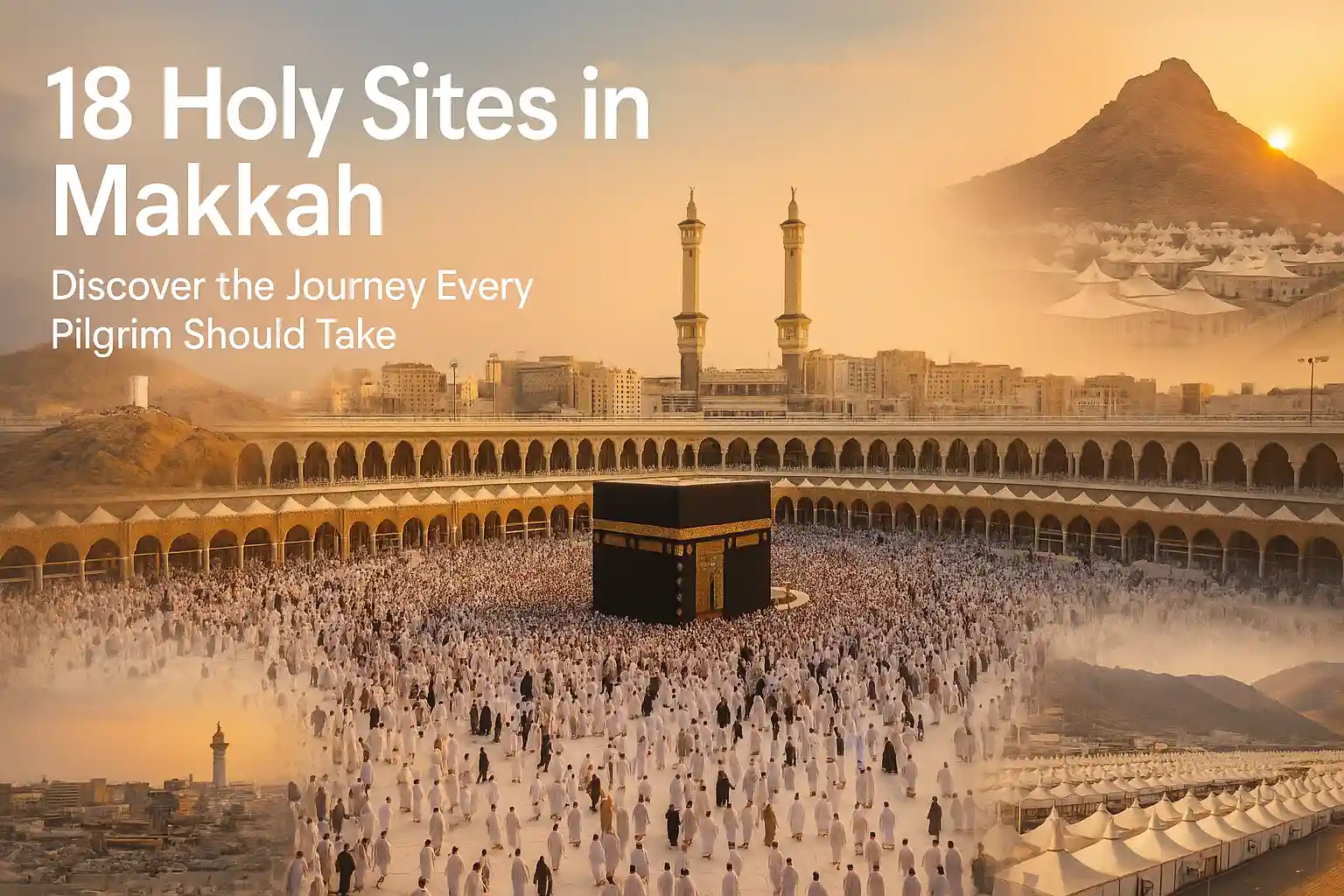
🕋 Holy Sites in Makkah: 2026 Guide to Sacred Places Every Pilgrim Should Visit
🟧 TL;DR – Holy Sites in Makkah
Holy Sites in Makkah are not just landmarks; they’re living chapters of Islamic history, spirituality, and devotion. At the center lies the Kaaba, the Qiblah for Muslims globally. Performing Tawaf around it symbolizes deep submission and unity.
Just beyond the Haram, you’ll find the Well of Zamzam, flowing since the time of Prophet Ibrahim (AS). Next is the Maqam Ibrahim, preserving his sacred footprints. Sites like Mina, Muzdalifah, Mount Arafat, the Cave of Hira, and Cave of Thawr each hold unique connections to Hajj, revelation, and Prophethood. Visiting these places turns your pilgrimage into a journey of divine closeness and transformative reflection.
Why Visiting the Holy Sites in Makkah Changes Everything
Let’s be honest. You can’t set foot in Makkah without feeling like your entire soul pauses.
It’s not just about the rituals. It’s about walking the same ground as Prophet Muhammad ﷺ, seeing what he saw, praying where he prayed. Each site isn’t just a place. It’s a portal into Islamic legacy, wrapped in centuries of prayer, tears, and transformation.
For many pilgrims, the journey begins with awe. The first sight of the Kaaba can stop your breath. It’s not just a cube. It’s the beating heart of the Ummah. Every second that passes near it feels like your entire past and future are being rewritten. And yet, that’s just one moment in a series of deeply moving stops.
You’ll walk through Mina, where prophets once camped and where you’ll cast stones at what tempts you most. You’ll stand at Mount Arafat, where hearts shatter open in dua, hoping for forgiveness.
You’ll sleep under open skies in Muzdalifah, humbled by the stars and your own smallness. Then there’s the quiet climb to Cave Hira, where revelation changed the course of history.
These aren’t tourist spots. They’re living verses, each one teaching something: patience, sacrifice, surrender, love.
And here’s the truth. Most people rush through the rituals. They check off the boxes but never truly connect with the meaning. They miss the stories beneath the surface. They miss the tears that once fell where they now walk.
This guide is here to change that. It’s designed to help you slow down, breathe in the significance, and experience each site the way it was meant to be felt as a doorway to something far greater than yourself.
The Core Holy Sites in Makkah (Top 1–8)
These are the most important, and you simply can’t leave them out. Whether you’re performing Hajj and Umrah, or Ziyarat, these eight places are non-negotiable for your spiritual itinerary.
1. Masjid al-Haram – The Grand Mosque
The Masjid al-Haram is not just the largest mosque in the world. It is the holiest site in Islam and the spiritual heartbeat of over a billion Muslims. At its centre lies the Kaaba, the Qiblah, the direction every Muslim turns to in prayer, five times a day, no matter where they are in the world. But the sanctity of Masjid al-Haram doesn’t stop there.
It also contains the Black Stone, the Well of Zamzam, the Maqam Ibrahim, and the area for Sa’i between Safa and Marwah. It is a space where the past and present merge in the rhythm of worship.
Let that sink in. When you enter Masjid al-Haram, you’re not just entering a mosque. You’re stepping into a place where Prophet Ibrahim (AS) once raised the foundation of the Kaaba.
You’re walking on the same ground where Prophet Muhammad ﷺ made Tawaf. You’re drinking from the well that sprang up beneath the feet of baby Isma’il, when Hajar ran desperately between two hills, trusting in Allah when there was no sign of help.
Every inch of this sacred space carries the weight of divine history. And yet, despite its timelessness, it feels deeply personal. You might stand in a crowd of thousands, yet still feel as if Allah is listening only to you.
That’s the kind of spiritual gravity Masjid al-Haram holds.
And then there’s the reward. According to authentic Hadith, praying a single Salah here equals the reward of 100,000 prayers elsewhere. That’s not a small figure.
That’s a lifetime of prayer condensed into one prostration. No other mosque in the world shares this unique blessing.
But it’s not just the math that matters. It’s the feeling. When you perform Tawaf, circling the Kaaba seven times, your heart starts to spin with it. You’re part of a river of people, old and young, rich and poor, all united in a rhythm of surrender.
And after that, you drink from Zamzam, quenching not just your thirst, but your hopes, your fears, your du’as.
Masjid al-Haram is not just where prayers are offered. It’s where lives change. It’s where sins are shed, hearts are cracked open, and souls are lifted.
Whether you’re standing near the Kaaba, making du’a at Maqam Ibrahim, walking the path of Safa and Marwah, or simply watching the sun rise over its marble floors, something inside you will shift.
This is the epicentre of Islam. And once you’ve been here, something about the way you pray, love, and live will never be the same again.
2. The Kaaba – Heart of the Muslim Ummah
At the very centre of Masjid al-Haram stands the Kaaba, the sacred, cube-shaped structure that serves as the Qiblah for more than 1.9 billion Muslims around the world.
Wherever you are, whether in Jakarta, Cairo, London, or Makkah itself, when you raise your hands for prayer, your heart and body align toward this one holy point. It is not just a direction. It is a declaration of unity, faith, and surrender to the oneness of Allah.
According to Islamic tradition, the Kaaba was originally built by Prophet Ibrahim (AS) and his son Isma’il (AS) as a house of worship for Allah alone. It represents pure monotheism, the same message carried by every prophet, from Adam (AS) to Muhammad ﷺ.
And what’s amazing is that despite its simplicity in structure, its significance is beyond words. Every brick echoes devotion. Every inch holds stories of divine obedience.
When pilgrims arrive in Masjid al-Haram, the first sight of the Kaaba is often overwhelming. Tears come naturally. Hearts race. There’s something magnetic about it. You may have seen pictures before, but standing in front of it feels like time pauses. It’s a moment you never forget.
The ritual of Tawaf, circling the Kaaba seven times in an anti-clockwise direction, is performed with deep humility. Each step reminds you that life revolves around the Creator, not the creation.
Whether you are a first-timer or someone returning after years, the Tawaf always feels new. It’s a spiritual reset, a way to shed distractions and reconnect with your purpose.
One of the most revered parts of the Kaaba is the Black Stone (Al-Hajar al-Aswad), set into the eastern corner. It is Sunnah to touch or kiss it if possible. But don’t worry if the crowd is too thick.
i8x Even raising your hand and pointing toward it with sincere intention carries the reward. This is about devotion, not competition.
Another powerful moment happens between the Yemeni Corner and the Black Stone, where it’s Sunnah to recite a beautiful dua:
“Rabbana atina fid-dunya hasanah wa fil-akhirati hasanah wa qina ‘adhaban-nar”
“O our Lord, give us in this world good, and in the Hereafter good, and protect us from the punishment of the Fire.”
Many also pause near the Multazam, the area between the door of the Kaaba and the Black Stone, to place their chest and arms against the wall in quiet prayer.
This is where wishes are whispered and sins are silently regretted. No one hears you but Allah, and that’s enough.
Visiting the Kaaba is more than an act of worship. It’s a moment of return. A reminder that no matter how far you’ve strayed, you’re always one sincere dua away from closeness to your Lord.
3. Mount Arafat – The Day of Forgiveness
If there’s one place on Earth where dua feels heavier, where hearts spill over in complete surrender, it’s Mount Arafat. Located around 20 kilometres southeast of Masjid al-Haram, this plain is not just another stop during Hajj.
It is the core of the pilgrimage. Without standing here on the 9th of Dhul Hijjah, a pilgrim’s Hajj is incomplete. That’s how central it is.
This is the land where Prophet Muhammad ﷺ gave his Farewell Sermon. He stood upon Jabal al-Rahmah, the Hill of Mercy, and addressed over a hundred thousand companions.
His voice carried messages of justice, equality, kindness, and the sanctity of life. What was said here shaped the ethical backbone of the Muslim Ummah.
But Mount Arafat is more than a historical location. On the Day of Arafah, it becomes a place of intense personal reckoning. Pilgrims dress in simple white garments.
There are no labels, no wealth, no distractions. Just hearts exposed before their Creator. People raise their hands, whispering secrets only Allah hears. Some cry. Some sit in silence. Others shake with emotion. It’s raw. It’s real.
What makes this moment even more powerful is what’s happening in the unseen. The Prophet ﷺ said that on the Day of Arafah, Allah draws near and boasts about His servants to the angels, saying, “What do they want?” It is the day of forgiveness. Sins are wiped clean. Lives change forever.
For those not performing Hajj, fasting on this day brings immense reward. The Prophet ﷺ promised that fasting on Arafah wipes out the sins of the past year and the year to come. That’s a gift of mercy unlike any other.
Mount Arafat is also a reminder of something greater. It reflects the Day of Judgment, when all of humanity will stand before Allah, waiting for their records. No shade. No barrier. Just souls and their deeds. So, standing here in this life prepares the heart for that final standing.
The entire area of Arafat becomes a sea of white garments and raised hands. Pilgrims don’t perform any specific prayer or ritual here. They simply stand, reflect, and pour their hearts out. This act is known as Wuquf, and it’s the heartbeat of Hajj.
When the sun sets, pilgrims leave for Muzdalifah, carrying with them a sense of spiritual weightlessness. Forgiven. Cleansed. Reborn.
Mount Arafat is not just a mountain. It is a mirror showing you who you really are when all else is stripped away.
4. Mina – The Tent City of Faith
Just a few kilometres from Makkah, Mina turns into a sea of white tents during Hajj.
This is where pilgrims:
- Spend the night before Eid
- Perform the stoning of the Jamarat
- Offer the sacrifice (Qurbani)
Each ritual reenacts the legacy of Prophet Ibrahim, who stood firm against Shaytan and obeyed Allah even when asked to sacrifice his own son.
The symbolic stoning of the Jamarat pillars here is one of the most powerful acts of defiance against evil.
5. Muzdalifah – Where Time Stands Still
Between Arafat and Mina lies Muzdalifah, a quiet plain under the open sky.
After the sun sets at Arafat, pilgrims move here to:
- Pray Maghrib and Isha
- Rest overnight
- Collect pebbles for the next day’s stoning
There are no tents. No barriers. Just thousands of believers lying under the stars in total submission. It’s a moment of spiritual silence unlike anything else on earth.
6. Safa and Marwa – The Sa’i Journey of Hajar
Inside Masjid al-Haram, the two small hills of Safa and Marwa commemorate the desperation and devotion of Hajar, the mother of Ismail.
She ran between these hills seven times searching for water, a mother’s plea, answered by Allah with the spring of Zamzam.
Every pilgrim walks this path during Umrah and Hajj, feeling the depth of that moment. It’s not just history, it’s worship powered by a mother’s love.
7. Well of Zamzam – A Spring from the Divine
You’ve heard the name. But did you know it still flows?
The Well of Zamzam, next to the Kaaba, burst forth when baby Ismail rubbed his feet on the ground.
Pilgrims drink from it with hopes for healing, mercy, and answered duas. Many carry it home, preserving it like a treasure of barakah.
One sip, and your heart remembers the divine generosity that created it.
8. Maqam Ibrahim – The Prophet’s Footprint
Right behind the Kaaba is a glass enclosure with a stone inside, known as Maqam Ibrahim.
It has the footprints of Prophet Ibrahim, where he stood to build the Kaaba. Allah preserved it as a sign. Every pilgrim offers two Rak’ahs of prayer behind this station after Tawaf.
It’s not just a rock. It’s a reminder that a true legacy is built through obedience.
Historical & Revelation Sites in Makkah (Ranks 9–18)
These sacred sites are tied directly to the life of the Prophet Muhammad ﷺ, the first Quranic revelations, and major milestones in Islamic history. Visiting them isn’t just recommended, it deepens your understanding of why Makkah matters beyond Hajj rituals.
9. Cave of Hira – Where the Quran Began
You’ve probably heard this in every seerah class: The very first revelation happened here.
Nestled at the peak of Jabal al-Nour, this small, narrow cave is where the Prophet ﷺ used to retreat for solitude. It was here, during one of those nights, that Angel Jibril (Gabriel) appeared and revealed:
“Iqra’ – Read” (Surah Al-‘Alaq, 96:1)
Even now, people climb the steep hill for hours just to sit in that silence, a silence that changed the world.
10. Cave of Thawr – The Escape of Hijrah
When the Prophet ﷺ was migrating to Medina, the Quraysh were in hot pursuit. He and Abu Bakr (RA) took shelter in this cave, located in Mount Thawr.
Inside, a spider spun a web across the entrance, and a pigeon laid eggs nearby, making it look untouched. The Quraysh walked away. The moment proved Allah’s protection over His messenger.
This site speaks of trust, patience, and unseen help. And let’s be real, it gives goosebumps just reading about it.
11. Masjid Nimrah – Final Sermon of the Prophet ﷺ
Located in Arafat, this mosque holds history in every stone.
It’s where the Prophet ﷺ delivered his last sermon during Hajj, reminding the Ummah about:
- Human equality
- Rights of women
- Ending racism
- Importance of the Quran and Sunnah
If you visit on the Day of Arafah, you’ll witness over 2 million pilgrims gathered here in awe.
12. Masjid al-Khaif – The Mosque of the Prophets
This mosque in Mina is believed to have been visited by over 70 prophets, according to Islamic tradition.
The Prophet ﷺ himself prayed here during his Hajj. It sits close to the Jamarat pillars, making it a peaceful stop between rituals.
Inside, the tranquillity is unlike anything; it feels like the air remembers the past.
13. Masjid al-Jinn – A Moment Beyond Human Eyes
This mosque, Masjid al-Jinn, also known as Masjid Haras, marks the site where a group of jinn listened to the Prophet ﷺ recite the Quran and accepted Islam.
He drew a line in the sand to separate his companion Abdullah ibn Mas’ud, then engaged with the unseen guests.
It reminds us that the message of Islam is universal, even beyond the human world.
14. Mount Thabir – A Forgotten Gem
This quiet peak near Muzdalifah isn’t often included in popular Ziyarat tours. But according to many scholars, it’s mentioned in early Islamic texts and seen as a landmark for the boundaries of Muzdalifah.
If you’re someone who wants to cover every sacred footstep, include this in your journey.
15. Mount Abu Qubais – Witness to a Miracle
Just east of the Kaaba, this mountain is believed to be where the Prophet ﷺ showed the miracle of the moon splitting.
It’s also said that Hajar and Ismail lived near its base, and many early events in Islam took place here. Though not commonly visited, it holds a spiritual echo of the Prophet’s early struggles.
16. Jannat al-Mu’alla – Resting Place of Khadijah (RA)
Jannat al-Mu’alla is where the beloved wife of the Prophet ﷺ, Khadijah (RA), is buried, along with other family members like Abu Talib and Abd Manaf.
Visiting it isn’t just about history. It’s about standing before the people who sacrificed everything for Islam, long before it was easy to be Muslim.
17. Masjid Aisha (Taneem) – Miqat for a Second Umrah
If you’re planning to do multiple Umrahs, this is the place to restart your Ihram.
Located just 7 km from the Kaaba, Masjid Aisha is often used by pilgrims, especially women, to enter Ihram for another Umrah without leaving Makkah.
It’s clean, quiet, and equipped for your spiritual reset.
18. Al-Bay’ah Mosque – Where Loyalty Was Sealed
This small mosque in Mina marks the site of the Pledge of Aqabah, where the Ansar of Madinah pledged to protect the Prophet ﷺ even if it meant war.
Their loyalty led to the first Islamic state. Their faith changed history.
It’s not just a historical stop, it’s a reminder of what commitment to Islam should look like.
Comparison Table of Holy Sites in Makkah (Top 1–18)
📊 Holy Sites in Makkah – Rituals, Location & Access
| Site | Ritual Involved | Distance from Kaaba | Access Type |
|---|---|---|---|
| Kaaba | Tawaf, Qiblah | 0 km | Inside Masjid al-Haram |
| Mount Arafat | Wuquf (Standing) | ~20 km | Bus/Hajj group |
| Mina | Jamarat, Qurbani | ~7 km | Train, Bus |
| Muzdalifah | Isha/Maghrib, Pebble Collection | ~9 km | Bus, On foot |
| Cave of Hira | First Revelation | ~4 km | Hike (~1200 steps) |
| Well of Zamzam | Drink after Tawaf | 0 km | Inside Masjid al-Haram |
Hidden Gems & Bonus Sacred Sites (Ranks 19–25)
These sites aren’t part of the core rituals, but they bring history, emotion, and educational depth that few blogs mention.
19. Al-Mash’ar al-Haram Mosque – Echoes of Muzdalifah
This humble mosque in Muzdalifah is tied to Quranic verses. Pilgrims stop here to remember Allah after leaving Arafat. It’s quiet, under-visited, but deeply spiritual.
20. Assalamu Aleyka Ayyuhan Nabiyyu Museum – Prophet’s Life Visualised
This modern museum uses interactive storytelling to show the life, family, and legacy of the Prophet ﷺ. It’s deeply emotional and perfect for families.
21. Makkah Museum – Time Capsule of Islamic History
If you want to understand pre-Islamic Makkah, Quraysh tribe culture, or the architecture of early mosques, this is your spot. A must for knowledge seekers.
22. Kiswa Factory – Where the Kaaba Cover is Born
Each year, the Kaaba’s Kiswa (black cloth) is handcrafted here by skilled artisans using silk and gold thread. Witnessing this centuries-old tradition is unforgettable.
23. Makkah Library – Built on the Prophet’s Birthplace
This quiet library stands on what is believed to be the birthplace of the Prophet Muhammad ﷺ. It’s a beautiful blend of spirituality and scholarship.
24. Zubaida Canal – A Queen’s Gift to Pilgrims
Commissioned by Queen Zubaida in 809 CE, this ancient canal system brought fresh water to pilgrims long before modern pipes. It still inspires gratitude.
25. Clock Tower Museum – Time, Astronomy & Faith
Atop the iconic Abraj al-Bait Towers, this museum explores Islamic timekeeping, prayer schedules, and astronomy through the ages, with views of the Kaaba below.
Frequently Asked Questions About Holy Sites in Makkah
❓ Frequently Asked Questions – Holy Sites in Makkah
What are the most important Holy Sites in Makkah?
The most important holy sites include the Kaaba, Masjid al-Haram, Mount Arafat, Mina, Muzdalifah, and Safa and Marwa.
Can you visit the Cave of Hira during Umrah?
Yes, many pilgrims hike to the Cave of Hira during Umrah, but it’s optional and not part of the core rituals.
What is the significance of Mount Arafat?
Mount Arafat is where pilgrims gather for the Day of Arafah. It’s where the Prophet ﷺ delivered his Farewell Sermon and where prayers are accepted.
Is it allowed to visit Masjid al-Jinn?
Yes, it is allowed. Masjid al-Jinn is a historic place where jinn accepted Islam after hearing the Prophet ﷺ recite the Quran.
Why is Mina called the Tent City?
Because more than 100,000 air-conditioned tents are set up every year in Mina to house Hajj pilgrims during their stay.
What is special about Zamzam water?
Zamzam water is believed to be a miraculous spring created by Allah, first appearing for Hajar and Ismail. It is sacred and spiritually beneficial.
Can you perform multiple Umrahs from Masjid Aisha?
Yes, Masjid Aisha is the closest Miqat point for Makkah residents and visitors to renew Ihram for another Umrah.
How far is Muzdalifah from the Kaaba?
Muzdalifah is approximately 9 kilometers from the Kaaba and is located between Arafat and Mina.
What is the Black Stone in the Kaaba?
The Black Stone (Hajar al-Aswad) is believed to have come from paradise. Pilgrims touch or point to it during Tawaf.
Are non-Muslims allowed to visit Makkah?
No, entry to Makkah is strictly prohibited for non-Muslims as per Saudi law, due to its sacred status in Islam.
What are the holy sites in Makkah?
Makkah is home to several holy sites that hold deep significance in Islam. These include the Kaaba, Masjid al-Haram, Mount Arafat, Mina, Muzdalifah, Cave of Hira, Well of Zamzam, and more. Each of these sites connects directly to the life of the Prophet ﷺ and key events in Islamic history.
What is the sacred site of the Mecca?
The most sacred site in Makkah is the Kaaba, located at the heart of Masjid al-Haram. It is the Qiblah for Muslims worldwide and the focal point for Tawaf during Hajj and Umrah. Praying in this location is considered to carry immense spiritual reward.
Which Ziyarat is famous in Makkah?
One of the most famous Ziyarat places in Makkah is the Cave of Hira, where the first revelation of the Quran occurred. Other popular spots include Jabal al-Thawr, Masjid Aisha, Jannat al-Mu’alla, and the Well of Zamzam — all visited for their historical and religious value.
How many places to visit in Makkah?
There are over 18 sacred places to visit in Makkah, ranging from ritual sites like Mina and Arafat, to historical landmarks like Cave of Hira, Cave of Thawr, and Masjid al-Jinn. Many pilgrims explore these during Umrah or Ziyarat tours.
What are the top Ziyarat places in Makkah?
Top Ziyarat places include the Kaaba, Cave of Hira, Cave of Thawr, Masjid Nimrah, Masjid al-Khayf, Masjid al-Jinn, Masjid Aisha, Jannat al-Mu’alla, and the Well of Zamzam. Each holds spiritual or historical importance and is frequently visited by pilgrims.
What are the holy sites in Madinah?
In Madinah, the most important holy site is Al-Masjid an-Nabawi, the mosque of the Prophet ﷺ. Other significant places include Jannat al-Baqi, Mount Uhud, Masjid Quba, and Masjid Qiblatain. These locations are often visited after pilgrims complete their journey in Makkah.
What are the best places to visit in Makkah during Umrah?
During Umrah, the best places to visit include Masjid al-Haram, the Kaaba, Mount Arafat, Mina, Muzdalifah, Cave of Hira, and Well of Zamzam. Many pilgrims also add Ziyarat tours to visit historical and lesser-known Islamic sites nearby.
What are the holy places in Makkah and Madinah?
The holy places in Makkah include Masjid al-Haram, Kaaba, Mount Arafat, Mina, and Cave of Hira. In Madinah, the main sites are Masjid an-Nabawi, Mount Uhud, Masjid Quba, and Jannat al-Baqi. These form the spiritual heart of Islamic pilgrimage.
Where is Makkah Haram located on the map?
The Masjid al-Haram is located in the city center of Makkah, Saudi Arabia. It’s easily found on all digital maps by searching for “Masjid al-Haram” or “Kaaba”, and it serves as the central landmark of the entire city.
What are the historical places to visit in Makkah?
Important historical places in Makkah include the Cave of Hira, where the Quran was first revealed, the Cave of Thawr, where the Prophet ﷺ hid during migration, Masjid al-Jinn, Jannat al-Mu’alla, and the ancient Zamzam Well. Each place carries a deep connection to early Islamic events.
How to find the Masjid al-Haram directions?
You can find Masjid al-Haram directions easily using apps like Google Maps, Apple Maps, or Nusuk. Search for “Masjid al-Haram, Makkah,” and you’ll receive walking, bus, or ride-share options depending on your location in the city.
What is the official website of Masjid al-Haram?
There isn’t a single official website just for Masjid al-Haram, but all official updates, timings, and information are shared by the General Presidency for the Affairs of the Two Holy Mosques via gph.gov.sa. You can also track prayer times, khutbahs, and live feeds from there.

Farrukh Farooqi has been living in Sharaya, Makkah, Saudi Arabia since 2010. With over 14 years of firsthand experience witnessing the sacred journey of millions of pilgrims, Farrukh specializes in providing practical, insider tips for Hajj and Umrah travelers. His work blends real-world observations, the latest Saudi updates, and essential crowd management strategies — helping pilgrims and worshippers plan smarter, stay safer, and experience a spiritually fulfilling journey across the Holy Cities.


