
Jabal al-Nour Guide 2026: Cave of Hira, First Revelation & Visitor Tips
Jabal al-Nour is not just a mountain in Makkah. It is a sacred place where heaven touched the earth first. First Revelation in Ghar Hira The first revelation of the Quran was given to Prophet Muhammad ﷺ in a small cave called Ghar Hira, and history turned forever after that.
Here’s the truth. To most people, mountains are hiking places or climbs for tourists. But this one? It’s in a class by itself.
If you are visiting during Hajj, post-Umrah or are in search of something more, this place has an undeniable energy. And now, in 2026, with new upgrades and an expanded Hira Cultural District, the pilgrimage experience to Jabal al-Nour is even more intense.
🟧 TL;DR – Jabal al-Nour
Jabal al-Nour, the Mountain of Light, is where Prophet Muhammad ﷺ received the first Qur’anic revelation inside the Cave of Hira. Though not a ritual of Hajj, it is one of the most spiritually profound sites in Makkah.
The climb to the cave includes 1,750 steps and takes up to 2 hours. In 2026, it is more accessible due to the Hira Cultural District, with attractions like the Revelation Gallery and Quran Museum. A cable car project is also in development to assist elderly and disabled visitors.
What is Jabal al-Nour? (2026 Meaning & Significance)
You might be wondering why Jabal al-Nour is so important.
It’s more than just elevation. This mountain carries weight. Spiritual weight. Historical weight. Emotional weight. Let’s break that down.
Historical Names & Islamic Meaning
The name Jabal al-Nour literally means “Mountain of Light”. That name didn’t come from its shape or how the sunlight hits it. It came from what happened there, the moment divine light first reached the Prophet Muhammad ﷺ.
It’s also been called Jabal Hira, Jabal al-Quran, and even Jabal al-Islam by early scholars. But most pilgrims know it today as the Mountain of Light because this is where the first revelation of the Quran took place.
Does a name really matter?
Well, in this case, yes. Because every name carries a layer of meaning, Jabal al-Nour reflects the spiritual illumination that began in that cave. It represents the beginning of guidance, the spark that lit the path for over a billion people. And you feel that the moment you stand at its base.
The Cave of Hira sits near the summit of this mountain. Small, narrow, and difficult to reach, but incredibly sacred. It’s less than 4 meters long, only wide enough for about five people. Yet, it changed the course of history forever.
Before the first revelation, the Prophet ﷺ would often climb this mountain seeking silence. He didn’t go there to be seen. He went there to be alone, to reflect, to think. And it was in that very silence that the voice of Angel Jibreel first echoed.
Cave of Hira and the First Revelation of the Quran
Let’s talk about that night. It wasn’t random. It was the month of Ramadan. One of the last ten nights. Possibly the Laylat al-Qadr, the Night of Power.
The Prophet was inside the cave, deep in reflection. No phones. No noise. Just his thoughts and the night sky.
Then suddenly, Jibreel appeared. Not a dream. Not a vision. Real. Standing there, commanding:
“Read in the name of your Lord who created…”
But the Prophet ﷺ was not someone trained to read or write. His answer? “I cannot read.”
Finally, the verses came:
Surah Al-Alaq (96:1–5) – First Revelation of the Quran
Full Quranic Verse in Arabic from Surah Al-Alaq
Arabic (القرآن الكريم)
اقْرَأْ بِاسْمِ رَبِّكَ الَّذِي خَلَقَ
خَلَقَ الْإِنسَانَ مِنْ عَلَقٍ
اقْرَأْ وَرَبُّكَ الْأَكْرَمُ
الَّذِي عَلَّمَ بِالْقَلَمِ
عَلَّمَ الْإِنسَانَ مَا لَمْ يَعْلَمْ
Transliteration of “Read in the Name of Your Lord” (Iqra) Verse
Transliteration (Latin Script)
Iqra’ bismi rabbika allathee khalaq
Khalaqal-insāna min ‘alaq
Iqra’ wa rabbukal-akram
Allathee ‘allama bil-qalam
‘Allamal-insāna mā lam ya‘lam
English Translation of the First Revealed Quranic Verses
Translation (English Meaning)
Read in the name of your Lord who created.
Created man from a clot.
Read, and your Lord is the Most Generous.
Who was taught by the pen?
Taught man what he did not know.
Why Surah Al-Alaq Was the First Revelation in Islam
Why This Verse Matters
This is the very first revelation of the Quran. It marks the moment when Prophet Muhammad ﷺ, while in solitude in the Cave of Hira on Jabal al-Nour, was visited by Angel Jibreel (Gabriel).
The word “Iqra” (Read) wasn’t just a command to read letters, it was the awakening of divine knowledge. It began the final chapter of prophethood. This verse taught that:
- Knowledge begins with the name of Allah
- Human origin is humble (a clot)
- True honour comes from learning
- Writing and literacy (pen) are tools of divine elevation
- Allah teaches what humans could never know on their own
How the First Revelation Happened Inside the Cave of Hira
How It Was Revealed
- The Prophet ﷺ was meditating alone in the Cave of Hira, seeking clarity
- Angel Jibreel appeared and said, “Read”
- The Prophet replied: “I cannot read”
- The angel embraced him tightly and repeated: “Read”
- This occurred three times, after which these verses were recited
- The Prophet ﷺ memorised them and rushed home to Khadijah, trembling
That night was Laylat al-Qadr, in Ramadan, and it changed the world forever.
The first revelation. The spark of Islam.
The Prophet rushed back to his home. He was visibly shaken. His heart was pounding. He told his wife, Khadijah, to cover for him. And those moments, those very human reactions, are what make the story so raw. So real.
From that night forward, nothing was ever the same again.
This small cave, hidden on a desert peak, became the spot where divine guidance first touched the world.
And here’s the thing: you can still visit it today.
Climbing those 1,750 steps, looking out over Makkah, and standing inside the same cave, it’s hard not to feel something stir deep inside. Even people who aren’t Muslim report feeling an emotional pull there. The silence speaks. The rocks, remember.
Importance of Jabal al-Nour in Islam vs. Other Holy Sites
So, how does it compare to other sacred places?
It’s time to be real about this. Sites like Masjid al-Haram, Mount Arafat, and Mina are central to rituals. They’re required stops in the journey of Hajj. But Jabal al-Nour? It’s different. It’s not a requirement. It’s a personal journey.
There’s no ritual here. No prayer must be performed. No points of obligation. And yet, it draws people. Every single day.
Because here’s the truth. It’s not about obligation. It’s about connection.
You feel it when you start the climb. You feel it more when the path gets steep. And by the time you reach the cave, you’re not just tired, you’re transformed.
Most people visit to remember the first revelation, but others go seeking something personal. Reflection. Solitude. Answers. And many say they leave with something more than they expected.
The spiritual importance of Jabal al-Nour comes not from what you do there but from what happens there. And that difference matters.
This is where the call of Islam began. Before the first prayer. Before the migration. Before the miracles. It started in the dark, in silence, in a cave. And that’s what makes it so powerful.
How to Visit Jabal al-Nour in 2026 (Step-by-Step Guide)
So you’ve decided to visit Jabal al-Nour. Smart move. But before you pack your water bottle and lace up your shoes, you’ll want to know exactly what you’re getting into. Because this isn’t a quick 10-minute stop. It’s a journey, physical, emotional, and spiritual.
Let’s walk through how to visit Jabal al-Nour in 2026 like someone who’s done their homework.
Step 1 – Getting There (Location & Transport Tips)
But first, where is this mountain?
Jabal al-Nour is located approximately 4 km north of Masjid al-Haram in the Al-Hira region of Makkah. “Most taxi and ride-share drivers and tour guides all know that street.” It’s a 15 to 20-minute drive, depending on traffic, if you’re staying near the Haram.
There are some rudimentary services around the base of the mountain, which sell snacks, prayer rugs, water, and even walking sticks. But it may be expensive (especially during Hajj or Umrah season). So yeah, if you can, bring your supplies.
Pro tip: Go early. Like before sunrise, early. The later you’re out there, the more heat and people you’ll have to contend with.
Step 2 – Climbing the Trail (What to Expect, Duration & Safety)
And here’s where it gets real.
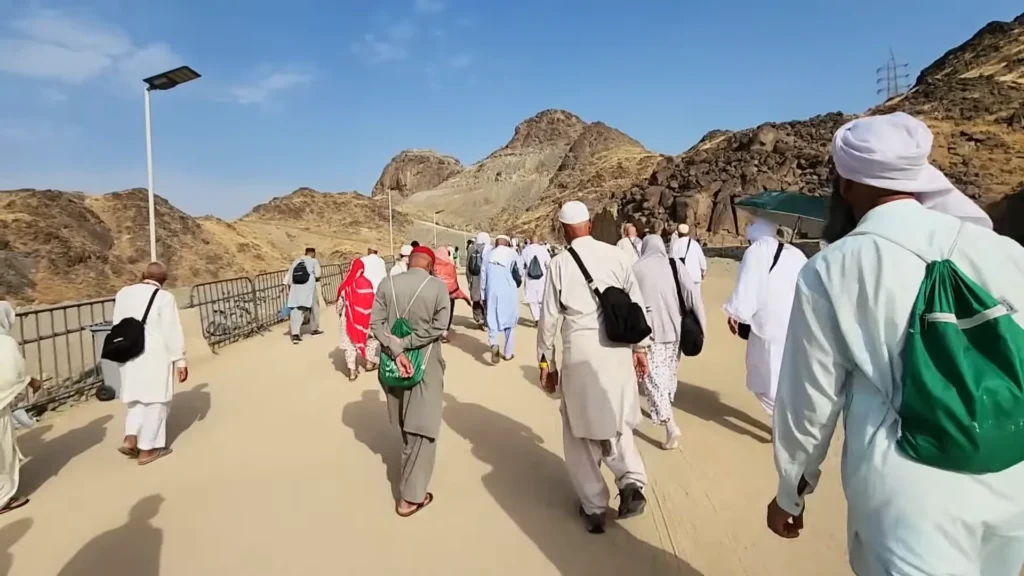
It is generally a 1,750-step climb to the Cave of Hira. These are steep, uneven steps and, in places, rather narrow. Even though it’s physically feasible to make the hike in 45 minutes, most people, especially first-timers, usually take 1.5 to 2 hours. And that’s just going up.
The trail is not paved. It’s dusty. It’s rocky. And there are no railings. At various moments, you’ll need to come to a halt, panting, and let your legs recover. That’s totally fine. You don’t really want to, in all honesty, not if you want to enjoy the beauty of the thing.
What to bring:
- Plenty of water (at least 1.5 litres per person)
- Good walking shoes
- Flashlight if you’re climbing before Fajr or after Maghrib
- A light snack (dates or energy bars)
- Prayer mat for rest or Salah
And here’s a gentle reminder: don’t underestimate the climb. People in their 60s do it, yes. But only when they’re healthy and careful. Heatstroke is real, especially in the Saudi summer. Hydrate, rest, and pace yourself.
You’re not here to prove anything. You’re here to connect.
Step 3 – Visiting the Cave (Spiritual Reflection & Behaviour)

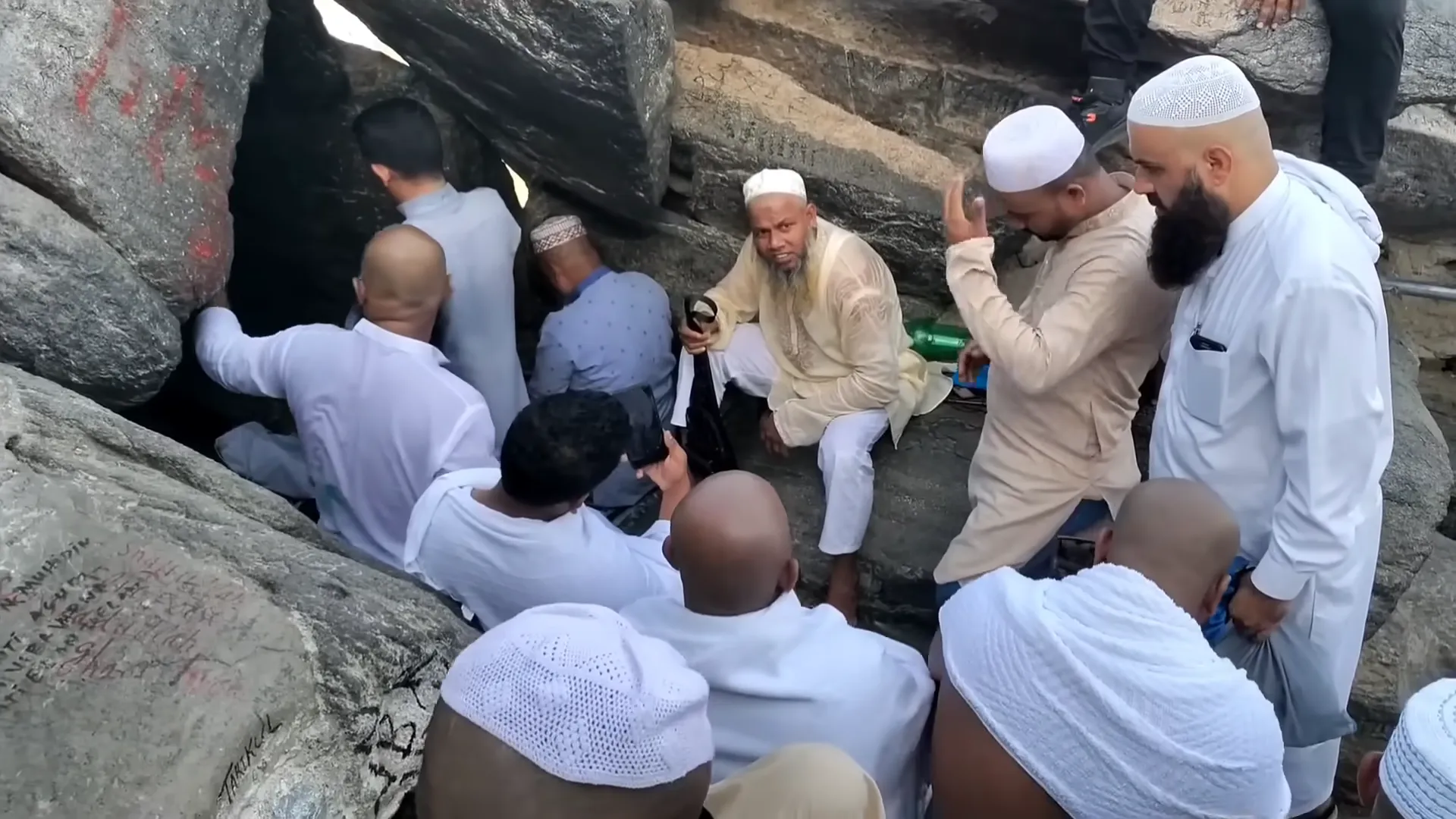
Once you reach the top, the cave doesn’t jump out at you. It’s tucked into the rock, marked by a painted sign. If there’s a crowd, you’ll likely see people waiting in line to enter. Be patient. Many people only stay inside for a few minutes to reflect or pray.
The Cave of Hira is small, about 3.7 meters long and 1.6 meters wide. It tilts slightly downward and opens toward the Kaaba. That direction alone gives many visitors goosebumps.
You’ll notice names, messages, and markings on the rock walls, some written by people over the years. It’s best to avoid adding to that. Instead, just be present. Sit quietly. Reflect. Maybe recite the verses of Surah Al-Alaq. Maybe whisper a dua. Maybe just let your heart breathe.
And yes, it’s totally okay to cry.
Most visitors stay inside for 5 to 10 minutes out of respect for others waiting. Once you step out, you’ll get an incredible view of Makkah skyscrapers, roads, mosques, and the Haram itself in the distance.
Step 4 – Descending Safely & Avoiding Common Mistakes
Climbing up is tough, but going down? It’s trickier than it looks.
Your legs will be tired. Your feet might ache. And now gravity isn’t your friend. Some parts of the trail can feel slippery, especially if you’re wearing worn-out shoes. So go slow. Take your time. There’s no prize for reaching the bottom first.
Common mistakes people make:
- Not stretching before the hike
- Forgetting sunscreen or a hat
- Climbing in slippers or sandals
- Not carrying enough water
- Overcrowding the cave
Avoid these, and your experience will be a lot smoother.
Jabal al-Nour in 2026: Development, Tourism & Real-Time Updates
A lot has changed in recent years. Saudi Arabia is investing heavily in religious tourism, and Jabal al-Nour is no exception. From infrastructure upgrades to cultural preservation, here’s what’s happening on the mountain in 2026.
Hira Cultural District (What’s New in 2026)
Right at the base of the mountain is the newly developed Hira Cultural District, a game-changer for visitors. It’s not just a museum or a stopover. It’s an entire experience.
Let’s break down what’s inside:
- The Revelation Gallery: A beautifully designed hall that narrates the story of the first revelation, complete with visuals, sound, and interactive storytelling.
- The Holy Quran Museum: Exhibits rare manuscripts, early Arabic calligraphy, and digital showcases of Quranic preservation.
- Saudi Coffee Museum: Yeah, that’s real. It offers a deep dive into regional coffee culture and lets you sip while you learn.
- Cultural Library & Exhibition Rooms: Featuring Islamic history, art, and curated artefacts.
- Hira Garden: A peaceful, shaded space for rest or family visits.
You don’t need to climb the mountain to enjoy all this. In fact, many elderly visitors or families with kids prefer staying at the base and immersing themselves in the exhibitions.
And in 2026, the buzz is all about the new cable car project.
While it’s still under construction, plans are in place to offer aerial access to the Cave of Hira. This would dramatically improve accessibility for people who can’t physically hike, especially seniors or those with disabilities.
It’s not active yet, but keep an eye out. It could be operational later this year.
Jabal al-Nour vs Other Holy Sites in Makkah
You might be asking yourself, “How does Jabal al-Nour compare to other sacred places in Makkah?” That’s a fair question — and it’s one most people never really dig into.
Let’s break it down.
Many visitors think of Mount Arafat, Mina, or Jabal Thawr as the go-to religious destinations in Saudi Arabia. And they’re not wrong. Each one has a clear place in the rituals of Hajj and Islamic history. But Jabal al-Nour stands apart, not because of rituals, but because of revelation.
Here’s a side-by-side to help you understand the difference.
Comparison Table – Jabal al-Nour vs. Other Sacred Sites
| Site Name | Role in Islam | Ritual Requirement | Unique Feature | Visitor Type |
|---|---|---|---|---|
| Jabal al-Nour | Site of first revelation in Cave of Hira | ❌ Not required | Home of Ghar Hira and divine light | Pilgrims, Seekers |
| Mount Arafat | Location of Prophet’s last sermon | ✅ Part of Hajj | Main pillar of Hajj | All Hajj pilgrims |
| Mina | Stoning of the devil (Jamarat) | ✅ Part of Hajj | Symbolic rejection of Shaytan | All Hajj pilgrims |
| Jabal Thawr | Cave of hiding during Hijrah | ❌ Not required | Shelter of Prophet and Abu Bakr | History lovers |
As you can see, Jabal al-Nour isn’t tied to any one ritual. But its significance runs deeper than obligation. It’s about origin. The start of something divine.
Why Visit Jabal al-Nour? (Top Reasons Pilgrims Go)
Here’s the only list you’ll need if you’re thinking about climbing Jabal al-Nour. These are the reasons people from around the world risk the heat, the height, and the hardship of standing in silence inside a small cave.
✅ Top 7 Reasons People Visit Jabal al-Nour
- To connect with the origin of revelation
- To retrace the Prophet’s early spiritual retreat
- To reflect in solitude far from the noise of the city
- To witness the exact site of the first Quranic verses
- To see the Kaaba from a unique mountain view
- To physically challenge themselves and disconnect
- To visit the new Hira Cultural District and Quran Museum
Each reason is personal. And honestly, that’s what makes the journey to Jabal al-Nour so meaningful. No one goes just for photos. They feel.
You Can Also Read
- Medina Travel Guide 2025: Sacred Sites, History & Pilgrim Tips
- Jabal Abu Qubais: Sacred History, Hidden Stories & Spiritual Significance
Frequently Asked Questions about Jabal al-Nour (2026 Guide)
Where is Jabal al-Nour located?
Jabal al-Nour is in Makkah, about 4 kilometres northeast of Masjid al-Haram, in the Al-Hira district.
How long does it take to climb Jabal al-Nour?
The climb takes between 45 minutes to 2 hours, depending on your fitness level and pace.
How many steps to the Cave of Hira?
There are roughly 1,750 steps carved into the mountain trail leading to the Cave of Hira.
Can women climb Jabal al-Nour?
Yes, women can and do climb Jabal al-Nour. Modest clothing, proper footwear, and hydration are essential.
Is it part of the Hajj rituals?
No. Visiting Jabal al-Nour is not part of the Hajj or Umrah rituals. It’s a voluntary visit for reflection.
Can you pray inside the Cave of Hira?
Yes, many visitors offer nafl prayers inside the cave. However, it’s small and usually crowded, so people take turns.
What is the best time to climb Jabal al-Nour?
The best time is just before Fajr or after Asr to avoid the midday heat.
Is there an entry fee to visit the Hira Cultural District?
Some exhibitions may require a small ticket fee, especially for the Revelation Gallery and Quran Museum.
Is the cable car to the Cave of Hira operational in 2026?
Not yet. The cable car project is still in development. It may launch later in 2025 or early 2026.
Can elderly people visit the cave?
Climbing the mountain is difficult for the elderly. But they can still enjoy the Hira Cultural District at the base without needing to hike.
What is the story of Jabal al-Nour?
Jabal al-Nour is where the first revelation of the Quran took place. Inside the Cave of Hira, the angel Jibreel appeared to Prophet Muhammad ﷺ and commanded him to “Read.”
That moment marked the beginning of divine revelation and changed history forever.
Is there a Wikipedia page for Jabal al-Nour?
Yes, Jabal al-Nour has a detailed page on Wikipedia that covers its location, religious history, and the story of the Cave of Hira.
However, for spiritual tips, current travel info, and 2026 updates, it’s best to use a trusted travel or Islamic source.
Do you need tickets to visit Jabal al-Nour?
No, you don’t need tickets to climb Jabal al-Nour or visit the Cave of Hira. However, certain exhibitions inside the Hira Cultural District, like the Revelation Gallery or Quran Museum, may require a small entry fee.
What is the Jabal al-Nour Museum?
The Jabal al-Nour Museum refers to the Holy Quran Museum and Revelation Gallery located at the base of the mountain in the Hira Cultural District.
It showcases rare manuscripts, Quranic history, and modern exhibits on the first revelation.
What are the directions to Jabal al-Nour?
Jabal al-Nour is about 4 kilometres northeast of Masjid al-Haram in Makkah.
It’s located in the Al-Hira District. Most taxi drivers and rideshare services can take you directly to the base of the mountain.
What are the opening hours for the Jabal al-Nour Museum?
The Holy Quran Museum and Revelation Gallery at Jabal al-Nour are typically open from 9 AM to 10 PM, but timings may vary during Ramadan or the Hajj season.
It’s best to visit during daylight hours for the full experience.
Can you visit Jabal al-Nour at night?
Yes, many people climb Jabal al-Nour at night, especially to avoid the daytime heat. However, bring a flashlight, wear proper shoes, and go with someone if possible.
The view of Makkah from the summit under the stars is unforgettable.
How hard is the Jabal al-Nour hike?
The Jabal al-Nour hike is considered moderately difficult. The path has around 1,750 uneven steps, and the climb can take up to 2 hours.
It’s not a casual stroll. Proper footwear, hydration, and patience are essential.
What’s the story behind the mountain Ghar Hira?
Ghar Hira, or the Cave of Hira, is located at the summit of Jabal al-Nour. It’s where Prophet Muhammad ﷺ received the first verses of the Quran.
He used to retreat there in solitude before revelation, engaging in deep worship and reflection.
Final Thoughts: A Mountain That Speaks to the Heart
Here’s what most people won’t tell you. The climb to Jabal al-Nour isn’t just steep. It’s emotional.
Here’s what most people won’t tell you. The climb to Jabal al-Nour isn’t just steep. It’s emotional.
You feel every step. Not because of the slope. But because of what it represents.
This isn’t just a story in a book. This is the spot where revelation touched the earth. Where silence turned to scripture. Where a man alone in the dark became the Messenger of God.
And you’re walking that same path.
When you sit in the Cave of Hira, even for a minute, something changes. Your heart beats a little slower. Your thoughts go a little deeper. And suddenly, all the hardship of the climb, the sweat, the fatigue, fades.
You’re not thinking about the view. You’re thinking about the voice that echoed in that cave over 1400 years ago. The voice that began with:
“Read in the name of your Lord who created…”
And when you walk back down that mountain, you’re not the same person who started the journey.
You carry something more.

Farrukh Farooqi has been living in Sharaya, Makkah, Saudi Arabia since 2010. With over 14 years of firsthand experience witnessing the sacred journey of millions of pilgrims, Farrukh specializes in providing practical, insider tips for Hajj and Umrah travelers. His work blends real-world observations, the latest Saudi updates, and essential crowd management strategies — helping pilgrims and worshippers plan smarter, stay safer, and experience a spiritually fulfilling journey across the Holy Cities.


