
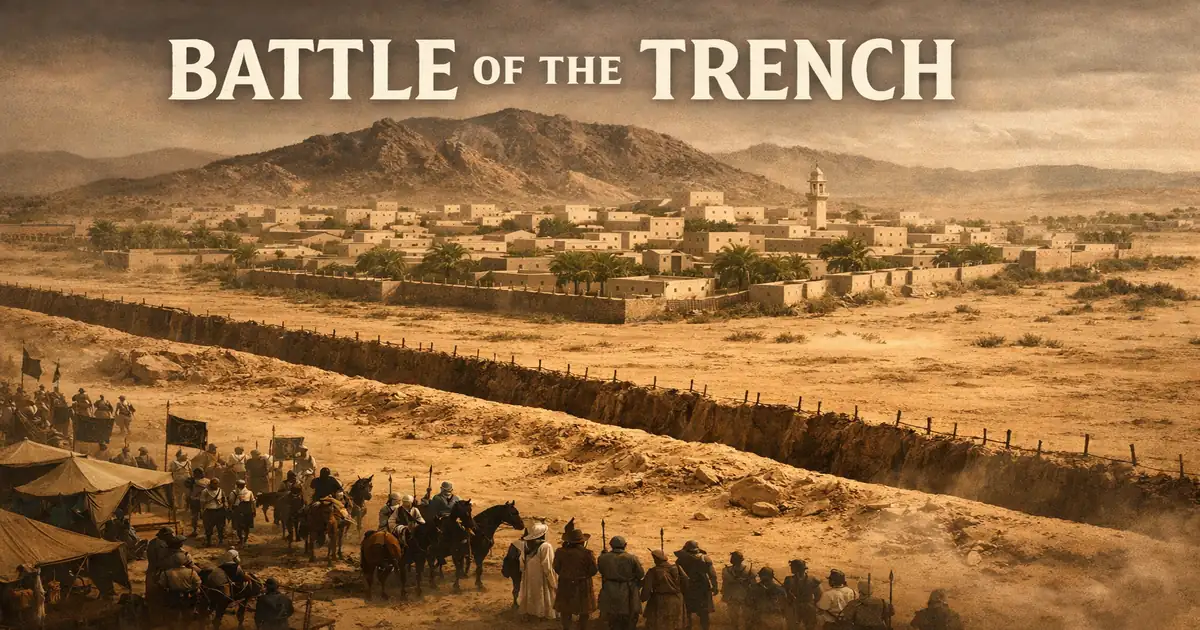
Battle of the Trench: Timeline, Map, Key Facts, and Lessons
Battle of the Trench was the great siege of Madinah in 5 AH, commonly placed in 627 CE, when a huge confederate force tried to crush the Muslims, but failed after the Muslims defended the city with a trench suggested by Salman al-Farsi. It is also known as Battle of Khandaq, Battle of the Confederates, Battle of the Ditch, and Ghazwa Khandaq. For the broader Hijri context behind sacred-month timing in early Islam, see Discovering the Hijri Calendar.
This was not just another clash.
It was a pressure test of faith, planning, nerves, hunger, weather, and leadership.
✅ TL;DR – battle of the trench
Battle of the Trench was the 627 CE siege of Madinah in which the Muslims defended the city by digging a trench, a strategy suggested by Salman al-Farsi. It is also called Battle of Khandaq, Battle of the Confederates, Battle of the Ditch, and Ghazwa Khandaq. The confederates failed to break the defense, the siege collapsed, and the event became a major turning point in seerah battles.
What Was the Battle of the Trench?
What was the battle of the trench? It was a siege of Madinah by a coalition of Quraysh and allied tribes who wanted to destroy the Muslim community. The Muslims, though heavily outnumbered, defended Madinah by digging a trench on the exposed side of the city and holding firm until the attackers lost momentum and withdrew.
Battle of the trench summary
Battle of the trench summary is simple: a confederate army marched on Madinah, the Muslims dug a trench, the siege dragged on, the attackers failed to cross in any decisive way, internal distrust spread among the confederates, harsh conditions broke their will, and the siege ended in a clear Muslim success.
What happened in the battle of the trench?
What happened in the battle of the trench? The Muslims prepared a defensive barrier around the vulnerable northern side of Madinah. The enemy expected open battle. Instead, they found a trench blocking cavalry movement. They camped outside, exchanged arrows and pressure tactics, tried to exploit internal weakness in Madinah, but never achieved a full breakthrough.
Why was the battle of the trench a turning point in seerah battles?
This battle changed the mood of the struggle. Before this, Quraysh still hoped they could break Madinah by one overwhelming push. After this failed siege, that confidence cracked. Battle of the trench history matters because it marks the point where the Muslims were no longer just surviving. They were becoming impossible to uproot.
📚 You Can Also Read:
Why Is It Also Called Battle of Khandaq and Battle of the Confederates?
The different names point to different sides of the same event. One name highlights the trench itself. The other highlights the alliance gathered against Madinah.
What does battle of khandaq mean?
Battle of Khandaq means the battle of the trench. The Arabic word khandaq refers to the ditch that was dug as a defensive barrier. So when people search khandaq explained, the shortest answer is this: it means trench.
Why was it called the battle of the confederates?
Battle of the Confederates refers to the coalition, or ahzab, that united against the Muslims. It was not a single tribe acting alone. It was a combined hostile force, which is why the event is also known as the ahzab battle.
Why is it also called battle of the ditch and ghazwa khandaq?
Battle of the Ditch is simply another English rendering of the same trench idea. Ghazwa Khandaq is the Arabic-Islamic form many Muslims use in seerah lessons. All these names refer to the same event.
When Was the Battle of the Trench?
When was the battle of the trench? It took place in 5 AH and is commonly placed in 627 CE. Many seerah works link it to Shawwal, while some descriptions of the siege extend into the start of Dhu al-Qadah. So the safe summary is: 5 AH, commonly mapped to 627 CE, during the seerah phase after Uhud and before Hudaybiyyah.
When was the battle of the trench?
The standard seerah answer is 5 AH. In common modern dating, that is 627 CE. If someone asks for the shortest usable line, use that.
Battle of the trench timeline explained
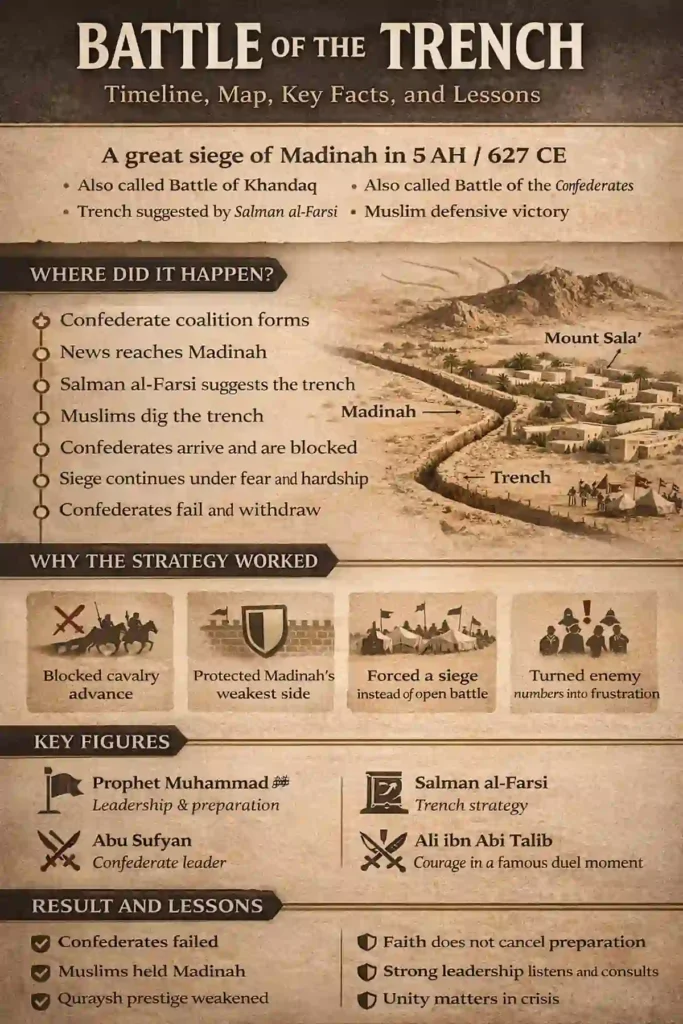
Battle of the trench timeline explained in order:
- Enemy coalition forms after growing hostility toward Madinah.
- News reaches the Prophet Muhammad ﷺ that a major attack is coming.
- Salman al-Farsi trench idea is accepted.
- The trench is dug on the exposed northern side.
- The confederates arrive and are shocked by the barrier.
- The siege drags on with pressure, fear, hunger, and failed crossing attempts.
- The confederates collapse and withdraw, ending the siege.
Was medina siege 627 the same as battle of the trench?
Yes. Medina siege 627 is another way of describing the same event. It helps searchers who remember the year and city more than the Arabic names.
Where Did the Battle of the Trench Happen?
Where did the battle of the trench happen? It happened around Madinah, especially on the vulnerable northern side where the trench was dug. The rest of the city already had natural protection from rocky ground, settlements, and terrain that made a full cavalry sweep far less practical.
Where did the battle of the trench happen?
The battle took place in and around Medina, with the main defensive line near the northern approaches to the city.
Battle of the trench map medina
Battle of the trench map in simple words looks like this: protected city behind the Muslims, exposed approach in front of them, trench across that vulnerable front, and the confederate forces stuck outside trying to find a workable crossing point. That is the picture a beginner should hold first.
How did Mount Sala’ shape the defense of Medina?
Mount Sala’ mattered because it sat near the defensive zone and helped shape the Muslim position. In simple terms, the terrain around Madinah did part of the defensive work already, and the trench completed what the landscape had started. The city was not wide open on every side.
📚 You Can Also Read:
Why Did the Confederates Attack Medina?
The attack was not random. It grew out of revenge, fear of Muslim growth, tribal politics, old hostility, and active agitation by enemies who wanted to build one crushing alliance against Madinah.
Who made up the confederate army medina?
The confederate army medina included Quraysh and allied tribes, especially forces connected to Ghatafan, along with hostile elements linked to Banu Nadir. The whole point was to gather a force far larger than the Muslims could field in open battle.
What role did quraish and ghatafan play?
Quraish and Ghatafan were two of the biggest names in the crisis. Quraysh brought the major Meccan political and military pressure. Ghatafan strengthened the confederate side and made the threat feel wider than one city-state grudge.
How were Banu Nadir and Banu Qurayza linked to the crisis?
Banu Nadir played a role in stirring the coalition against the Muslims. Banu Qurayza became linked to the crisis inside Madinah through the tense pact situation during the siege. This internal pressure made the moment especially dangerous because the Muslims were worried about both the outside attack and possible internal betrayal.
Who Suggested Digging the Trench?
Who suggested digging the trench? The famous answer is Salman al-Farsi. His idea introduced a style of city defense that Arab armies were not expecting in that setting.
Who suggested digging the trench?
Salman al-Farsi suggested it. That one fact is so central that many people remember the whole event through that image alone.
What was salman al-farsi trench strategy?
Salman al-Farsi trench strategy was smart because it did not try to match the enemy in open-field numbers. Instead, it turned the battlefield into a problem the confederates could not easily solve. Cavalry power became far less useful once the trench blocked direct advance.
Why did trench strategy islam work in Medina?
Trench strategy Islam worked in Madinah because it matched the terrain, the weakness of the Muslim numbers, and the strength of the confederate cavalry. Good strategy is not magic. It is putting the right idea in the right place at the right time.
📦 Strategy Snapshot
Why the trench worked: it blocked cavalry, forced a siege instead of a breakthrough, bought time, protected Madinah’s weakest side, and turned enemy numbers into frustration instead of victory.
How Did the Battle of the Trench Unfold?
This part matters because many people imagine one dramatic open clash. It was not like Badr. It was a siege, a standoff, a pressure cooker.
How did the Muslims prepare before the siege?
The Muslims prepared by gathering, consulting, digging, and defending. Prophet Muhammad ﷺ himself took part in the work. That matters. Leadership here was not orders from a tent only. It was shared hardship.
What happened during the siege of Medina?
During the siege of Medina, the confederates camped outside, pressure rose, food and nerves were tested, arrows were exchanged, and fear spread in Madinah. The city faced one of its hardest crisis moments.
How did the confederates fail to cross the trench?
They failed because the trench broke the rhythm of attack. Their cavalry could not roll through like it expected. Small attempts happened, but no decisive crossing changed the outcome. Time began working against them.
What happened between Ali ibn Abi Talib and Amr ibn Abd Wudd?
One of the famous dramatic moments of the siege is the duel linked to Ali ibn Abi Talib and Amr ibn Abd Wudd. It stands in seerah memory as a moment of courage during a battle that was otherwise shaped more by defense, endurance, and strategy than by long open-field combat.
Who Were the Key Figures in the Battle of the Trench?
Key figures in the battle of the trench include the Prophet ﷺ as leader, Salman as strategist, Abu Sufyan as confederate leader, and several tribal figures who shaped the larger coalition crisis.
What was the role of Prophet Muhammad ﷺ?
Prophet Muhammad ﷺ led the consultation, accepted the trench strategy, joined the labor, managed morale, and guided the community through a crisis that was military, social, and spiritual at the same time.
What was the role of Salman al-Farsi?
Salman al-Farsi offered the key military idea that gave the Muslims a workable defensive edge. His role is one of the clearest examples in seerah that wisdom can come through consultation and that strong leadership listens.
What was the role of Abu Sufyan?
Abu Sufyan stood as the leading face of the confederate pressure from the Quraysh side. His coalition came to finish the Madinah problem, but left without the result it wanted.
Which tribes and leaders shaped the ahzab battle?
The ahzab battle was shaped by Quraysh, Ghatafan, hostile pressures tied to Banu Nadir, and the dangerous pact crisis involving Banu Qurayza. That is why this was called the battle of confederates, not just a single tribal raid.
Is the Battle of the Trench in the Quran?
Yes. The battle is strongly tied to Surah Al-Ahzab, which captures the fear, shaking, pressure, hypocrisy, trust, and divine help around the siege.
📖 Qur’an Box
Arabic:
يَا أَيُّهَا الَّذِينَ آمَنُوا اذْكُرُوا نِعْمَةَ اللَّهِ عَلَيْكُمْ إِذْ جَاءَتْكُمْ جُنُودٌ فَأَرْسَلْنَا عَلَيْهِمْ رِيحًا وَجُنُودًا لَمْ تَرَوْهَا
Transliteration:
Yā ayyuhā alladhīna āmanū uḏkurū ni‘mata Allāhi ‘alaykum idh jā’atkum junūdun fa-arsalnā ‘alayhim rīḥan wa junūdan lam tarawhā.
Translation:
O believers, remember Allah’s favor upon you when armies came against you, and We sent upon them a wind and forces you did not see.
Where does Surah Al-Ahzab mention the battle?
Surah Al-Ahzab speaks directly to the believers about the armies that came against them and the severe test they faced. This is one of the clearest Qur’anic windows into the emotional atmosphere of the siege.
What does battle of the trench in quran teach?
Battle of the trench in quran teaches that crises reveal what is inside people. Faith, hypocrisy, fear, courage, patience, and trust all get exposed when pressure rises.
How does Surah Al-Ahzab describe fear, trial, and victory?
It describes a moment when eyes swerved, hearts reached throats, and believers were severely tested. That is such a human picture. It does not read like a fantasy war story. It reads like a real siege with real fear and real reliance on Allah.
📜 Hadith Box
Arabic:
اَللّٰهُمَّ مُنْزِلَ الْكِتَابِ، سَرِيعَ الْحِسَابِ، اهْزِمِ الْأَحْزَابَ، اَللّٰهُمَّ اهْزِمْهُمْ وَزَلْزِلْهُمْ
Transliteration:
Allāhumma munzila al-kitāb, sarī‘a al-ḥisāb, ihzim al-aḥzāb, Allāhumma ihzimhum wa zalzilhum.
Translation:
O Allah, Revealer of the Book, swift in account, defeat the confederates. O Allah, defeat them and shake them.
Who Won the Battle of the Trench?
Who won battle of the trench? The Muslims won in the real strategic sense. It was not a flashy field victory with long pursuit. It was a failed siege by the confederates and a clear Muslim success in defense, survival, and political outcome.
Who won battle of the trench?
Who won battle of the trench? The answer is the Muslims. The confederates came to crush Madinah. They failed. That means the Muslim side achieved the decisive result.
Why was it a muslim victory medina?
Muslim victory Medina is the right phrase because the Muslims protected the city, kept the enemy out, held through extreme fear, and watched the coalition break without achieving its goal.
Was it a direct battle or a failed siege by the confederates?
It was more accurate to call it a failed siege than a classic open-field battle. That matters because it explains why the trench was so central. The trench turned the whole nature of the conflict.
What Was the Result and Aftermath of the Battle of the Trench?
Result and aftermath of the battle of the trench matter as much as the siege itself. This is where the political meaning becomes obvious.
Result and aftermath of the battle of the trench
The confederate coalition withdrew in failure. Madinah survived. Quraysh lost momentum and prestige. The event opened a new phase in the struggle where the Muslims were no longer seen as a small force waiting to be erased.
What changed in Medina after the siege ended?
After the siege, Madinah felt less fragile. The community had passed one of its worst tests and did not collapse. That changes how people think, even before it changes maps.
Why did this battle weaken Quraysh prestige?
Because Quraysh gathered a huge alliance and still could not finish the job. In tribal politics, that hurts badly. Strength is not just numbers. It is results. And here the result embarrassed the attackers.
📦 Outcome Box
Battle aftermath: confederate failure, Muslim survival, stronger Madinah, weaker Quraysh prestige, and a major shift in the balance of power in the seerah.
What Are the Main Battle of the Trench Lessons?
Battle of the trench lessons are not just military. They are about planning, consultation, teamwork, emotional endurance, and tawakkul when the numbers look terrifying.
Battle of the trench lessons on strategy and preparation
The first lesson is obvious: faith does not cancel preparation. The Muslims trusted Allah, but they also dug. A lot. That matters. Tawakkul without effort is not the lesson of Khandaq.
Battle of the trench lessons on leadership and unity
Another major lesson is leadership that works with people, not above them only. Prophet Muhammad ﷺ shared the hardship. The community acted together. In crisis, unity is not a slogan. It is survival.
Battle of the trench lessons on patience, tawakkul, and crisis response
One more lesson: real crisis squeezes people. It shows who panics, who divides, who stays steady, and who remembers Allah when fear climbs into the throat. This battle teaches patience under siege, tawakkul with action, and calm thinking under pressure.
Battle of the Trench for Kids and Beginners
This section is for the reader who just wants the clean first understanding without getting buried in too many names at once.
What was the battle of the trench for kids?
Battle of the trench for kids means this: a very large enemy army came to attack Madinah, but the Muslims dug a huge trench so the enemy could not rush in with horses. The attackers got stuck, became weak, and went home without winning.
Khandaq explained in simple words
Khandaq explained in the simplest way: it was a smart defensive ditch that saved Madinah when the Muslims were badly outnumbered.
What should a beginner remember first about the battle of the trench?
If you remember only three things, remember these:
- It was a siege, not a normal open-field clash.
- Salman al-Farsi suggested the trench.
- The Muslims won by strategy, patience, unity, and Allah’s help.
📊 battle of the trench quick reference table
| Point | Direct answer |
|---|---|
| battle of the trench | The 5 AH siege of Madinah, commonly placed in 627 CE |
| other names | Battle of Khandaq, Battle of the Confederates, Battle of the Ditch, Ghazwa Khandaq |
| where | Madinah, especially the exposed northern side near the trench line |
| main idea | Defensive trench blocked confederate cavalry and forced a failed siege |
| key strategist | Salman al-Farsi |
| who won battle of the trench | The Muslims, because the confederates failed and withdrew |
| big lesson | Preparation and tawakkul work together |
📘 battle of the trench FAQs
how many Muslims were in the battle of the trench?
Show Answer
In the usual seerah summary, around 3,000 Muslims defended Medina in the battle of the trench. The attacking coalition was much larger, which is one reason the trench strategy islam became so important.
how many attackers were in the battle of the confederates?
Show Answer
The confederate force is commonly described as around 10,000. That is why the event is remembered as the battle of the confederates and not just a small tribal clash. It was a serious coalition threat against Medina.
how long did the medina siege 627 last?
Show Answer
Many seerah summaries describe the medina siege 627 as lasting around two to four weeks, depending on whether someone counts only the siege itself or also includes the trench-digging and the wider crisis period. The short answer is: it was a tense, extended siege, not a one-day fight.
how big was the trench in the battle of khandaq?
Show Answer
Different sources give different dimensions, so the beginner-safe answer is this: the trench in the battle of khandaq was long enough and deep enough to block cavalry from charging into the exposed side of Medina. That practical effect matters more than acting too precise with measurements that vary between retellings.
was the battle of the ditch a miracle-only victory or a strategy victory?
Show Answer
The battle of the ditch teaches both. The Muslims used real planning, hard labor, unity, and patient defense. At the same time, believers also see Allah’s help in how the siege broke apart. So this was not “strategy without tawakkul” and not “tawakkul without strategy.” It was both together.
did the Muslims attack first in the ahzab battle?
Show Answer
No. In the ahzab battle, the Muslims were defending Medina against a coalition that came to break them. The trench itself shows the defensive nature of the Muslim response.
why didn’t the confederates just go around the trench in ghazwa khandaq?
Show Answer
Because the trench was placed on the exposed approach, while other sides of Medina already had natural and structural protection. That is why ghazwa khandaq is remembered as smart defensive planning, not just digging for the sake of digging.
what made salman al-farsi trench idea so unusual for Arabia?
Show Answer
The salman al-farsi trench idea was unusual because open-field fighting and direct raids were more familiar patterns in Arabia. A trench changed the terms of battle. It forced the enemy to stop fighting the way they liked best.
did weather matter in the battle of the trench history?
Show Answer
Yes, weather mattered in battle of the trench history. Harsh winds, cold conditions, and the strain of a long failed siege weakened the attackers. In a short battle, weather may be a detail. In a drawn-out siege, it becomes part of the story.
what was daily life like for Muslims during the siege of Medina?
Show Answer
Daily life during the siege of Medina was hard. There was fear, hunger, exhaustion, pressure, and constant uncertainty. That is part of why battle of the trench lessons hit so deeply. This was not a comfortable victory story.
was there a lot of hand-to-hand fighting in the battle of khandaq?
Show Answer
Not in the same way as battles like Badr or Uhud. The battle of khandaq was mainly a siege and defensive standoff, though there were tense moments, exchanges, and limited breakthrough attempts.
how is surah al-ahzab connected to the emotional side of the battle?
Show Answer
Surah Al-Ahzab captures the fear, shaking, pressure, and testing that believers felt during the siege. It does not hide the emotional side. That is one reason the battle of the trench in quran feels so powerful and real.
was the battle of the trench before or after Uhud?
Show Answer
The battle of the trench came after Uhud. That matters because one of the strongest battle of the trench lessons is how the Muslim community learned from earlier pain and responded with better strategy and stronger readiness.
what is the easiest way to remember what happened in the battle of the trench?
Show Answer
Use this simple memory line for what happened in the battle of the trench: coalition came, trench blocked, siege dragged, fear rose, alliance cracked, enemy withdrew. That gives beginners the bones of the story fast.
why does the battle aftermath matter more than many people think?
Show Answer
The battle aftermath matters because the siege failure damaged the confidence and prestige of Quraysh. It was not just “they went home.” It changed how power was seen in Arabia. That is a huge part of why who won battle of the trench has such an important answer.
what should students remember first about the key figures in the battle of the trench?
Show Answer
For the key figures in the battle of the trench, remember this order first: Prophet Muhammad ﷺ as leader, Salman al-Farsi as the man behind the trench idea, Abu Sufyan as the leading confederate figure, and Ali ibn Abi Talib in one of the battle’s most famous courage moments.
what is one clean line for battle of the trench for kids?
Show Answer
Battle of the trench for kids: a large enemy army tried to attack Medina, but the Muslims dug a trench, stayed patient, and the attackers could not win.
📚 You Can Also Read:
Dhu al-Qadah • Treaty of Hudaybiyyah in Dhu al-Qadah • Major Events of Dhu al-Qadah • Months of Hajj Explained
How the Siege of Madinah Was Defended in 627 CE

Farrukh Farooqi has been living in Sharaya, Makkah, Saudi Arabia since 2010. With over 14 years of firsthand experience witnessing the sacred journey of millions of pilgrims, Farrukh specializes in providing practical, insider tips for Hajj and Umrah travelers. His work blends real-world observations, the latest Saudi updates, and essential crowd management strategies — helping pilgrims and worshippers plan smarter, stay safer, and experience a spiritually fulfilling journey across the Holy Cities.


