
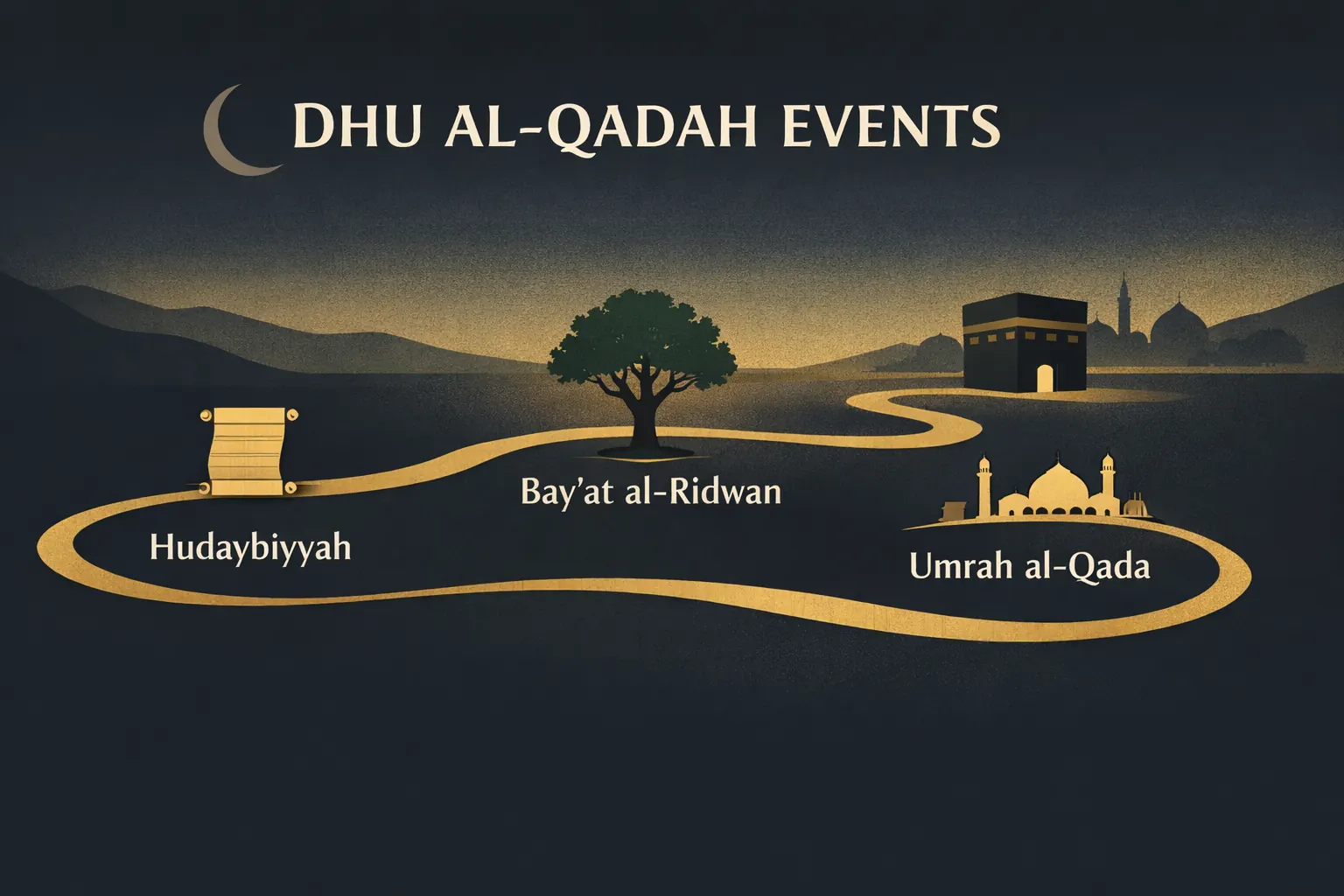
Major Events in Dhu al-Qadah
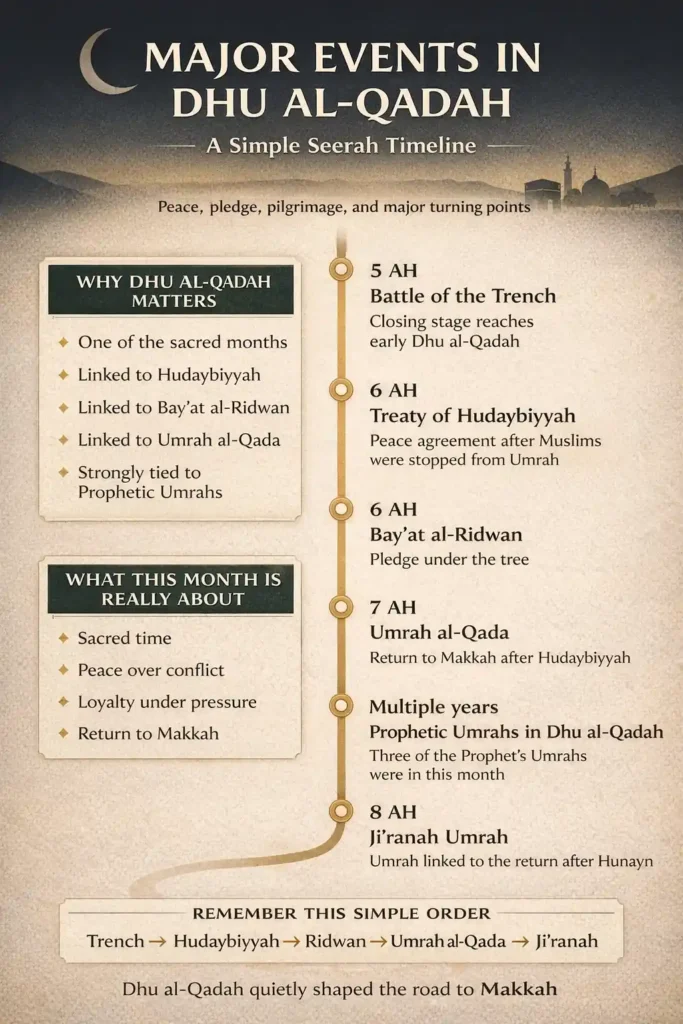
Major events in Dhu al-Qadah include the closing stage of the Battle of the Trench, the Treaty of Hudaybiyyah, Bay‘at al-Ridwan, Umrah al-Qada, and the other Prophetic Umrahs tied to this month. That is why this month is not just a “quiet sacred month.” It is a major part of the early seerah timeline. For the month background first, see Dhu al-Qadah.
✅ TL;DR – major events in dhu al-qadah
What are the major events in Dhu al-Qadah? The strongest historical anchors are the end of the Battle of the Trench in 5 AH, the Hudaybiyyah timeline in 6 AH, Bay‘at al-Ridwan in 6 AH, Umrah al-Qada timeline in 7 AH, and the Prophet’s later Umrah from Ji‘ranah. This month links peace, pilgrimage, and turning points in early Islam.
This summary reflects the core events most consistently tied to the month in primary and mainstream seerah references.
What Happened in Dhu al-Qadah?
What happened in Dhu al-Qadah? The short answer is this: some of the most important islamic events in dhu al-qadah happened around peace, pledge, and pilgrimage, not just battle. The month carries the Hudaybiyyah turning point, the pledge under the tree, the later return for Umrah al-Qada, and several Prophetic Umrahs. That makes the history of Dhu al-Qadah much stronger than many quick month summaries suggest.
Why Dhu al-Qadah Matters in Islamic History
Why is Dhu al-Qadah important in Islamic history? Because it sits at the meeting point of sacred time, peace, and the road to Makkah. It is one of the sacred months, and it became the stage for events that changed the future of the Muslim community without being a simple battlefield victory story. In other words, this is the month where strategy, patience, and obedience did a lot of the heavy lifting.
📖 Qur’an Box
Arabic:
لَقَدْ رَضِيَ اللَّهُ عَنِ الْمُؤْمِنِينَ إِذْ يُبَايِعُونَكَ تَحْتَ الشَّجَرَةِ
Transliteration:
Laqad raḍiya Allāhu ‘ani al-mu’minīna idh yubāyi‘ūnaka taḥta ash-shajarah.
Translation:
Allah was certainly pleased with the believers when they pledged allegiance to you under the tree.
This verse is directly tied to Bay‘at al-Ridwan at Hudaybiyyah, which is one of the clearest dhu al-qadah seerah events.
Dhu al-Qadah History Timeline
Dhu al-Qadah history timeline works best when you learn it in order. That is the easiest way to see why this month is often overlooked. People remember Hajj season more easily than the month that quietly prepared the way for it. But the groundwork sits here.
Battle of the Trench and Dhu al-Qadah
The Battle of the Trench is usually remembered as a Shawwal event, but major seerah summaries note that the siege extended into early Dhu al-Qadah. So if someone asks whether the battle of the trench belongs in events in dhu al-qadah, the careful answer is yes — in the sense that its closing stage reached into the beginning of the month. That is a small detail, but it matters for a clean islamic calendar history timeline.
Treaty of Hudaybiyyah in 6 AH
The Treaty of Hudaybiyyah in 6 AH is one of the strongest major events in Dhul Qadah. The Prophet Muhammad ﷺ and the companions set out intending Umrah, the Quraysh blocked entry, and a treaty was signed in Dhu al-Qadah 6 AH. At first, some Muslims found the terms hard to accept. Later, it became clear that this was a door-opening peace, not a defeat.
Bay‘at al-Ridwan in 6 AH
Bay‘at al-Ridwan happened in the same Hudaybiyyah setting in 6 AH. When rumors spread that ‘Uthman ibn ‘Affan رضي الله عنه had been harmed, the believers pledged under the tree. This is one of the most emotionally powerful prophet events in dhu al-qadah because it shows loyalty under uncertainty, not comfort.
Umrah al-Qada in 7 AH
Was Umrah al-Qada in Dhu al-Qadah? Yes. Umrah al-Qada took place in Dhu al-Qadah 7 AH, the year after Hudaybiyyah. This was the return to Makkah after the treaty terms allowed the Muslims to come back peacefully. If you want one line to remember the umrah al-qada timeline, it is this: blocked in 6 AH, returned in 7 AH.
Prophetic Umrahs in Dhu al-Qadah
This is one of the strongest and most underused points in the topic. Sahih al-Bukhari reports that the Prophet ﷺ performed four Umrahs, and three of them were in Dhi-l-Qa‘dah, except the one performed with Hajj. That means Prophetic Umrahs in Dhu al-Qadah are not a side note. They are part of the month’s core identity.
📜 Hadith Box
Arabic:
اعْتَمَرَ النَّبِيُّ صَلَّى اللهُ عَلَيْهِ وَسَلَّمَ أَرْبَعَ عُمَرٍ، كُلُّهُنَّ فِي ذِي الْقَعْدَةِ، إِلَّا الَّتِي مَعَ حَجَّتِهِ
Transliteration:
I‘tamara an-nabiyyu ṣallallāhu ‘alayhi wa sallama arba‘a ‘umar, kulluhunna fī Dhī al-Qa‘dah, illā allatī ma‘a ḥajjatih.
Translation:
The Prophet ﷺ performed four Umrahs, all of them in Dhu al-Qadah except the one with his Hajj.
This hadith is one of the best anchors for the whole article.
Ji‘ranah and the Dhu al-Qadah Seerah Timeline
Ji‘ranah belongs in this article because the Prophet’s Umrah from al-Ji‘ranah is counted among the Umrahs tied to Dhu al-Qadah. After Hunayn and the distribution of booty, he entered ihram from al-Ji‘ranah and performed Umrah, then returned to Madinah in Dhu al-Qadah 8 AH. That makes Ji‘ranah and the Dhu al-Qadah seerah timeline a real connection, not filler.
📚 You Can Also Read:
Treaty of Hudaybiyyah in Dhu al-Qadah • Prophet’s Umrahs in Dhu al-Qadah • Masjid al-Ji‘ranah
Was Hudaybiyyah in Dhu al-Qadah?
Was Hudaybiyyah in Dhu al-Qadah? Yes. The strongest seerah references place the Treaty of Hudaybiyyah in Dhu al-Qadah 6 AH. So if your whole article is built around Hudaybiyyah timeline, you are on solid ground making it one of the headline events in Dhu al-Qadah.
Was Umrah al-Qada in Dhu al-Qadah?
Was Umrah al-Qada in Dhu al-Qadah? Yes. The return Umrah took place in Dhu al-Qadah 7 AH, which is why it stands as one of the clearest important dates in Dhu al-Qadah and one of the easiest entries in a child-friendly seerah timeline.
What Links Dhu al-Qadah to Hajj and Peace?
What links the month to Hajj and peace? Dhu al-Qadah is one of the sacred months and comes right before Dhul Hijjah. That makes it a month of truce, safer movement, and preparation before the Hajj season. In simple words, the road to pilgrimage is easier to imagine when the month before it is marked by peace rather than tribal warfare.
This is why the month is often called the month of truce. It is not just because of one treaty. It is because the whole month sits inside a sacred rhythm of restraint and pilgrimage.
Important Dates in Dhu al-Qadah
Important dates in Dhu al-Qadah are easiest to learn as a short timeline, not scattered facts. That format is cleaner for readers and better for search because people are usually asking some version of “what happened in 6 AH and 7 AH in Dhu al-Qadah?” or “what is the easiest way to learn Dhu al-Qadah history?”
📦 Quick Timeline Box
5 AH: Battle of the Trench reaches into early Dhu al-Qadah.
6 AH: Treaty of Hudaybiyyah and Bay‘at al-Ridwan.
7 AH: Umrah al-Qada.
8 AH: Umrah from Ji‘ranah tied to the Prophetic Dhu al-Qadah Umrahs.
That four-point timeline is the cleanest SEO-safe structure for this topic.
What Muslims Can Learn From the Major Events in Dhu al-Qadah
The lessons are not hard to spot. Hudaybiyyah teaches patience when terms look painful. Bay‘at al-Ridwan teaches loyalty. Umrah al-Qada teaches that delayed obedience is not failed obedience. The Prophetic Umrahs teach that this month is strongly tied to sacred movement toward Makkah. And the closing of the Battle of the Trench reminds us that not every victory is loud. Some victories are just survival, restraint, and a road that stays open for what comes next.
That is also why major events in dhul qadah deserve a timeline page, not just another thin explainer. A timeline lets readers connect the Quraysh, the companions, the Makkah route, the sacred month status, and the movement toward Hajj in one place.
📊 major events in dhu al-qadah timeline table
| Event | AH | Why it matters |
|---|---|---|
| Battle of the Trench | 5 AH | Its closing stage reaches early Dhu al-Qadah, linking the month to a major defensive turning point. |
| Treaty of Hudaybiyyah | 6 AH | Peace treaty that opened the way for later pilgrimage and wider growth. |
| Bay‘at al-Ridwan | 6 AH | A pledge of loyalty under the tree praised in the Qur’an. |
| Umrah al-Qada | 7 AH | The return Umrah after the Hudaybiyyah agreement. |
| Prophetic Umrahs in Dhu al-Qadah | Multiple years | Shows this month’s deep tie to Umrah in the Prophetic seerah. |
| Ji‘ranah Umrah | 8 AH | One of the Prophet’s Dhu al-Qadah Umrahs after Hunayn and booty distribution. |
📘 major events in dhu al-qadah FAQs
why are the major events in dhu al-qadah easier to understand in a timeline format?
Show Answer
Because a timeline stops the month from feeling like scattered facts. The dhu al-qadah history timeline becomes much easier when you place the closing stage of the Battle of the Trench, then Hudaybiyyah, then Bay‘at al-Ridwan, then Umrah al-Qada, and then Ji‘ranah in order.
what is the easiest way to remember the events in dhu al-qadah?
Show Answer
Use this simple memory chain: defense, truce, pledge, return, umrah. Defense points to the Battle of the Trench, truce points to Hudaybiyyah, pledge points to Bay‘at al-Ridwan, return points to Umrah al-Qada, and umrah points to the wider prophet events in dhu al-qadah.
why is the history of dhu al-qadah often overlooked?
Show Answer
Because many people jump straight to Dhul Hijjah and Hajj topics. So the month before it gets treated like a waiting room. But the history of dhu al-qadah is full of turning points, especially peace-making, treaty-building, and return-to-Makkah moments.
did the Prophet ﷺ perform umrah in this month more than once?
Show Answer
Yes. This is one of the strongest parts of the topic. The Prophetic Umrahs in Dhu al-Qadah are a major reason the month matters in the seerah timeline. So if someone asks, did the prophet perform umrah in this month, the answer is clearly yes.
what happened before hajj in dhu al-qadah that makes the month historically important?
Show Answer
What happened before Hajj in Dhu al-Qadah was the building of peace and access. This is the month of truce, the month of Hudaybiyyah, and the month that helps explain the road to Makkah before the great days of pilgrimage arrive.
how does the hudaybiyyah timeline change the way we read early Islamic history?
Show Answer
It teaches that not every victory looks like conquest. The hudaybiyyah timeline shows patience, negotiation, and delayed success. At first the treaty looked hard. Later it became one of the clearest examples of how Allah opens doors through restraint, not just force.
what do the companions teach us through the dhu al-qadah seerah events?
Show Answer
The companions teach loyalty, patience, and trust. In the dhu al-qadah seerah events, they followed the Prophet ﷺ through uncertainty at Hudaybiyyah, pledged under the tree, and then returned the next year for Umrah al-Qada with discipline rather than bitterness.
is there a child-friendly way to teach the islamic events in dhu al-qadah?
Show Answer
Yes. Teach it as a three-step story: they were stopped, they stayed loyal, they returned peacefully. That makes the islamic events in dhu al-qadah easier for kids to understand without drowning them in too many names at once.
why does ji‘ranah belong in the dhu al-qadah history timeline?
Show Answer
Ji‘ranah belongs here because it connects the month to one of the Prophet’s Umrahs. Many people know Hudaybiyyah and Umrah al-Qada, but forget that Ji‘ranah also strengthens the month’s link to Umrah and the makkah route.
what makes major events in dhul qadah different from random historical dates?
Show Answer
The difference is impact. Major events in Dhul Qadah are not just dates people list because they happened. They changed the direction of the Muslim community. Hudaybiyyah, Bay‘at al-Ridwan, and Umrah al-Qada all shaped what came next.
how does the month of truce idea help explain what links the month to hajj and peace?
Show Answer
The phrase month of truce helps because it captures the mood of Dhu al-Qadah. It is a sacred month close to the hajj months, so peace matters here in a very practical way. The road to pilgrimage should be protected, not poisoned by conflict.
what is the cleanest way to answer what happened in 6 ah and 7 ah in dhu al-qadah?
Show Answer
6 AH gave us the Treaty of Hudaybiyyah and Bay‘at al-Ridwan. 7 AH gave us Umrah al-Qada. That is the simplest and cleanest way to answer what happened in 6 ah and 7 ah in dhu al-qadah.
why do people searching important dates in dhu al-qadah usually want more than a date list?
Show Answer
Because dates alone are dry. When people search important dates in dhu al-qadah, they usually also want meaning, context, and a quick way to connect one event to the next. That is why a short narrative timeline works better than a bare list.
what is the best one-line answer to which seerah events happened in dhu al-qadah?
Show Answer
The best one-line answer is this: the strongest seerah events in Dhu al-Qadah are Hudaybiyyah, Bay‘at al-Ridwan, Umrah al-Qada, the Prophetic Umrahs, and the Ji‘ranah connection, with the Battle of the Trench reaching into the month’s early stage.
Major Events in Dhu al-Qadah Timeline and Seerah Guide

Farrukh Farooqi has been living in Sharaya, Makkah, Saudi Arabia since 2010. With over 14 years of firsthand experience witnessing the sacred journey of millions of pilgrims, Farrukh specializes in providing practical, insider tips for Hajj and Umrah travelers. His work blends real-world observations, the latest Saudi updates, and essential crowd management strategies — helping pilgrims and worshippers plan smarter, stay safer, and experience a spiritually fulfilling journey across the Holy Cities.


