

Dhu al-Qadah Dos and Don’ts
Dhu al-Qadah dos and don’ts are simple at the core: reduce sin, increase worship, calm your speech, avoid conflict, and treat the month as a serious lead-in to Dhu al-Hijjah. If you want the direct answer without fluff, that is it. For the wider month background, see Dhu al-Qadah.
This month is not about inventing special rituals.
It is about honoring sacred time properly.
✅ TL;DR – Dhu al-Qadah dos and don’ts
What to do in Dhu al-Qadah: increase worship in Dhu al-Qadah, make more dhikr, dua, and tawbah, improve your manners, and begin Hajj prep with humility. What not to do in sacred months: don’t wrong yourself, don’t feed quarrelling, don’t use harsh speech, and don’t waste a sacred month in spiritual carelessness. The whole month teaches restraint, conflict avoidance, and steady spiritual discipline.
What Are the Dhu al-Qadah Dos and Don’ts?
What are the rules of Dhu al-Qadah? The main rule is not complicated: honor the sacred month by doing more good and avoiding more wrong. Rules of Dhu al-Qadah are less about a long ritual checklist and more about sacred month behavior in real life.
What should you do in Dhu al-Qadah?
What should you do in Dhu al-Qadah? Pray better, speak better, repent more, give charity, keep peace, and prepare your heart for the season of Hajj. If your worship became weak after Ramadan, this month is a strong place to steady it again.
What should you not do in Dhu al-Qadah?
What should you not do in Dhu al-Qadah? Don’t treat it like an ordinary month. Don’t be careless with sins, don’t push conflict, don’t enjoy harsh speech, and don’t let the sacred days pass with a dead heart.
What are the rules of Dhu al-Qadah?
Rules of Dhu al-Qadah come back to one idea: sacred time should change your behavior. A Muslim should become more careful with speech, anger, grudges, prayer, and everyday dealings during this month.
Why Is Dhu al-Qadah a Sacred Month?
Dhu al-Qadah is sacred because Allah named four months as sacred, and this is one of them. That is enough reason by itself. Once Allah honors a time, a believer should not treat that time casually.
📖 Qur’an Box
Arabic:
إِنَّ عِدَّةَ الشُّهُورِ عِندَ اللَّهِ اثْنَا عَشَرَ شَهْرًا فِي كِتَابِ اللَّهِ يَوْمَ خَلَقَ السَّمَاوَاتِ وَالْأَرْضَ مِنْهَا أَرْبَعَةٌ حُرُمٌ ۚ ذَٰلِكَ الدِّينُ الْقَيِّمُ فَلَا تَظْلِمُوا فِيهِنَّ أَنفُسَكُمْ
Transliteration:
Inna ‘iddata ash-shuhūri ‘inda Allāhi ithnā ‘ashara shahran fī kitābi Allāhi yawma khalaqa as-samāwāti wal-arḍa minhā arba‘atun ḥurum, dhālika ad-dīnu al-qayyim falā taẓlimū fīhinna anfusakum.
Translation:
Indeed, the number of months with Allah is twelve in Allah’s Record since the day He created the heavens and the earth, of which four are sacred. That is the right religion, so do not wrong yourselves during them.
What does Qur’an 9:36 mean in Dhu al-Qadah?
Qur’an 9:36 means sacred months are not symbolic decoration. They are real markers in the Islamic year. So Dhu al-Qadah etiquette should reflect that reality in speech, manners, worship, and dealing with people.
What does “do not wrong yourselves” mean?
Do not wrong yourselves means do not harm your soul through sin, neglect, stubbornness, or injustice. It also means don’t act like sacred time carries no weight. My students always ask if this only means fighting. No. It includes the full range of wrongdoing.
Is Dhu al-Qadah a month of peace?
Yes, month of peace Islam fits this month well. It is not a modern slogan. It reflects the month’s sacred character, its link to truce, and its role before the movement of pilgrims into Dhu al-Hijjah.
📚 You Can Also Read:
Why Dhu al-Qadah Is Sacred • Four Sacred Months • Dhu al-Qadah Meaning
What Not to Do in Sacred Months
What not to do in sacred months starts with the obvious: avoid clear sins, avoid injustice, and avoid careless hearts. But it also includes small ugly habits that people excuse too easily, like rude replies, family tension, and enjoying argument for no reason.
Can you argue in sacred months?
Can you argue in sacred months? Normal disagreement can happen, but feeding quarrelling, ego battles, and ugly argument goes against the spirit of the month. A sacred month should make you slower to react, not quicker to explode.
What sins should be avoided in Dhu al-Qadah?
What sins should be avoided in Dhu al-Qadah? All sins should be avoided, but this month calls for extra caution with: harsh speech, backbiting, conflict, injustice, neglected prayer, pride, and harming others. If you want to avoid sins in sacred months, start with your tongue and your temper.
How does sacred month behavior apply at home and with others?
Sacred month behavior starts at home before it appears online or in public. If a person posts holy reminders but snaps at family, the month has not really changed them. A Muslim home should feel softer in this month, not more tense.
Why should quarrelling, conflict, and harsh behavior be avoided?
Because sacred months train the soul away from aggression. Conflict avoidance is not weakness here. It is obedience, maturity, and protection of the heart. Choosing calm over heat can be one of the best hidden acts of worship in this month.
What to Do in Dhu al-Qadah
What to do in Dhu al-Qadah is not mysterious. Build a month of quiet obedience. Keep your obligations strong, add simple voluntary worship, and treat the month as a training ground for spiritual discipline.
How to spend Dhu al-Qadah productively
How to spend Dhu al-Qadah productively means using the month like a serious believer, not a bored observer. Keep your days anchored with prayer, Qur’an, repentance, and small acts of goodness that do not need applause.
What ibadah should I do in Dhu al-Qadah?
What ibadah should I do in Dhu al-Qadah? Start with what Allah already made obligatory. Then add what you can sustain: more Qur’an, more dhikr, more dua, extra charity, and extra moments of tawbah. I used to see people search for “special month formulas” and miss the obvious. The obvious is powerful.
How do dhikr, dua, and tawbah fit this month?
Dhikr, dua, and tawbah fit perfectly because this month is about softening the soul and correcting yourself before bigger sacred days arrive. A person who remembers Allah often usually argues less, forgives faster, and wastes less time.
Can fasting be part of worship in Dhu al-Qadah?
Yes, fasting can be part of worship in Dhu al-Qadah. Voluntary fasting is a good deed, but do not turn this into a made-up fixed schedule that you present as a required month ritual. Keep it simple, sincere, and evidence-safe.
🌙 Sacred Month Action Box
Best low-pressure routine for this month:
Guard the five prayers, add daily Qur’an, make morning and evening dhikr, increase dua after salah, and end the day with one honest moment of repentance.
Dhu al-Qadah Etiquette for Daily Life
Dhu al-Qadah etiquette is where sacred-month talk becomes real. If sacred time does not improve daily manners, then the lesson has stayed in the head and never reached the heart.
What manners fit a sacred month?
What manners fit a sacred month? Gentle speech, patience, humility, forgiveness, fairness, and lowered anger. Sacred months should make a Muslim more careful with people, not just more emotional in private worship.
How can Muslims practice restraint and patience?
Practice restraint by delaying your reaction. Practice patience by refusing to answer every irritation immediately. Sometimes the best deed in a sacred month is the message you never send.
How can a Muslim home build family reflection and conflict avoidance?
A Muslim home can build family reflection by slowing the emotional temperature of the house. Short reminders, calmer voices, shared Qur’an, apology without pride, and less pointless arguing all help. Sacred months are a good time to make the home breathe differently.
📚 You Can Also Read:
Virtues of Dhu al-Qadah • Fasting in Dhu al-Qadah • Discovering the Hijri Calendar
Family-Friendly Ways to Honor Dhu al-Qadah
This month should not stay trapped in adult theory. Families can live it in ordinary ways. That is where the topic becomes useful instead of decorative.
How to teach Dhu al-Qadah at home
How to teach Dhu al-Qadah at home can be very simple: explain that Allah honored this month, so the family should become calmer, kinder, and more serious about worship. Children understand mood before they understand lectures.
What are everyday acts for Dhu al-Qadah?
What are everyday acts for Dhu al-Qadah? Everyday acts include speaking kindly, controlling anger, praying on time, helping family, giving a little charity, reading Qur’an, and making short dua often. Sacred months are built through repeated small deeds.
How can family routines reflect sacred month manners?
Family routines can reflect sacred month manners by making the house less noisy in spirit, not just in volume. Fewer fights. More mercy. More shared reminders. More apology. That is real month honor.
Hajj Prep in Dhu al-Qadah
Hajj prep belongs naturally in this month because Dhu al-Qadah leads directly into Dhu al-Hijjah. Even people not going for Hajj can still use the month to prepare spiritually.
Can I prepare for Hajj in Dhu al-Qadah?
Can I prepare for Hajj in Dhu al-Qadah? Yes. This is one of the best times to begin. Learn the rites, clean your intentions, settle wrongs, review practical needs, and ask Allah for acceptance before the season becomes intense.
Why does Dhu al-Qadah lead into Dhu al-Hijjah?
It leads into Dhu al-Hijjah as a month of settling and restraint before the month of pilgrimage. That sequence teaches that sacred action should be preceded by inner order.
How can Hajj prep become spiritual discipline?
How can Hajj prep become spiritual discipline? By not reducing preparation to bags, bookings, and checklists only. Real Hajj prep also means repentance, better manners, paying back rights, and calming the heart before sacred travel.
📚 You Can Also Read:
Hajj and Umrah: A Complete Guide • Hajj Checklist • How to Perform Hajj • Nusuk App for Hajj and Umrah
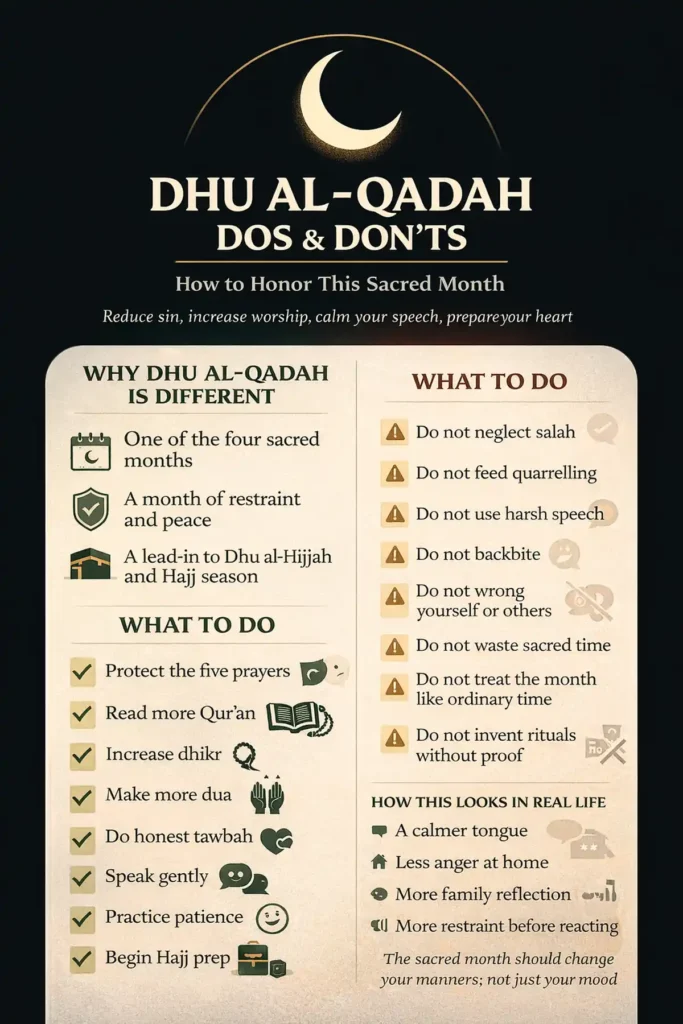
Dhu al-Qadah Dos and Don’ts List
This is the short list many readers actually want.
Best deeds to increase in Dhu al-Qadah
- Protect obligatory prayer
- Increase Qur’an
- Make more dhikr
- Make honest dua
- Do more tawbah
- Give charity quietly
- Begin Hajj prep
Main mistakes to avoid in Dhu al-Qadah
- Quarrelling over small issues
- Harsh speech at home
- Neglecting salah
- Wasting sacred time
- Treating the month like ordinary time
- Inventing rituals without proof
How Should Muslims Behave in Sacred Months?
How should Muslims behave in sacred months? With more fear of Allah, more care with sin, and more respect for people’s rights. Sacred months are not there to make us dramatic. They are there to make us cleaner.
What is the main principle of Dhu al-Qadah?
The main principle of Dhu al-Qadah dos and donts is this: honor sacred time by reducing wrongdoing and increasing obedience. Everything else in the article grows from that.
How can you avoid wasting Dhu al-Qadah?
How to avoid wasting Dhu al-Qadah is easier than people think. Pick a few steady actions and protect them daily. Don’t wait for a perfect spiritual mood. Start with one page of Qur’an, one sincere dua, one act of kindness, and one avoided argument.
That is how a month changes you.
📊 Dhu al-Qadah dos and don’ts quick table
Use this table as the fast-reference version of the whole topic.
🌙 Show Dhu al-Qadah Dos and Don’ts Table
| Area | Do | Don’t |
|---|---|---|
| Worship | Increase prayer, Qur’an, dhikr, dua, tawbah | Don’t become lazy with obligations |
| Speech | Speak gently and with patience | Don’t feed quarrelling or harsh replies |
| Home | Build family reflection and calmer family routines | Don’t make the house emotionally toxic |
| Character | Practice restraint and conflict avoidance | Don’t wrong yourself or others |
| Preparation | Use the month for Hajj prep and inner correction | Don’t wait until the last minute to prepare spiritually |
📘 Dhu al-Qadah dos and don’ts FAQs
what should you do in dhu al-qadah?
Show Answer
Increase worship in Dhu al-Qadah, make more dhikr, dua, and repentance, improve your manners, and begin sincere Hajj prep.
what should you not do in dhu al-qadah?
Show Answer
Do not wrong yourself with sin, do not enjoy quarrelling, do not neglect prayer, and do not waste the month in heedlessness.
what are the rules of dhu al-qadah?
Show Answer
The main rules of Dhu al-Qadah are to honor the sacred month, avoid wrongdoing, and increase obedience and calmness in behavior.
can you argue in sacred months?
Show Answer
Disagreement may happen, but feeding ugly argument and ego-driven conflict goes against sacred month behavior.
what sins should be avoided in dhu al-qadah?
Show Answer
Avoid all sins, with extra care around harsh speech, backbiting, injustice, neglected prayer, and home conflict.
what ibadah should i do in dhu al-qadah?
Show Answer
Focus on salah, Qur’an, dhikr, dua, charity, and regular tawbah. Voluntary fasting can also be part of your worship.
how to teach dhu al-qadah at home?
Show Answer
Teach it through calmer speech, shared reminders, family Qur’an time, and practical kindness, not only theory.
can i prepare for hajj in dhu al-qadah?
Show Answer
Yes. This is one of the best months for Hajj prep, both spiritually and practically.
is dhu al-qadah a month of peace?
Show Answer
Yes. Month of peace Islam is a fair description because the month teaches restraint, truce, and lower aggression.
how to avoid wasting dhu al-qadah?
Show Answer
Pick a few steady habits and protect them daily: prayer on time, a little Qur’an, regular dua, and controlled reactions.
does Dhu al-Qadah have any special prayer that must be done?
Show Answer
No fixed special prayer is required only because it is Dhu al-Qadah. The safe path is to strengthen your regular salah and increase normal voluntary worship in Dhu al-Qadah without inventing a ritual that has no clear basis.
can a person start a personal reset in Dhu al-Qadah?
Show Answer
Yes, and this is one of the most practical ways to how to spend Dhu al-Qadah well. You can use the month to restart prayer habits, clean up your speech, reduce distractions, and rebuild spiritual discipline before Dhu al-Hijjah.
is being careless with time part of what not to do in sacred months?
Show Answer
Yes. Wasting the month in laziness, endless scrolling, and spiritual neglect falls under the broader problem of what not to do in sacred months. Sacred time should wake you up, not pass by like background noise.
can someone focus on character improvement as part of Dhu al-Qadah etiquette?
Show Answer
Yes. Dhu al-Qadah etiquette is not only about rituals. It also includes fixing your tone, controlling anger, being fair at home, keeping promises, and learning restraint in ordinary situations.
how can working people practice sacred month behavior without changing their full schedule?
Show Answer
Sacred month behavior does not need a dramatic lifestyle change. A working person can protect salah, add short dhikr, make sincere dua while commuting, avoid useless arguments, and become more careful with the tongue. Small steady changes are often more honest than big emotional plans.
should a Muslim reduce social media arguments in Dhu al-Qadah?
Show Answer
Yes. If you are serious about avoid sins in sacred months, online behavior counts too. Picking fights, mocking others, posting harsh replies, and enjoying public drama all go against the spirit of a sacred month.
can Dhu al-Qadah be a good month to repair broken relationships?
Show Answer
Yes. This is one of the most beautiful forms of what to do in Dhu al-Qadah. A phone call, a soft apology, or even stepping back from old tension can fit the month far better than loud public reminders about peace.
what if someone keeps worship strong but manners weak in Dhu al-Qadah?
Show Answer
That means the month still needs to reach deeper. Worship in Dhu al-Qadah should improve both your prayer and your behavior. If a person recites Qur’an but keeps hurting people, the lesson of do not wrong yourselves has not settled properly yet.
is silence better than winning an argument in a sacred month?
Show Answer
Often, yes. In sacred months, silence can be a form of wisdom, especially when the argument is driven by pride, not truth. Walking away from useless conflict may protect your heart more than “winning” ever will.
can students use Dhu al-Qadah for discipline and focus?
Show Answer
Yes. Students can use Dhu al-Qadah dos and donts as a simple discipline month: pray on time, reduce distractions, control anger, speak respectfully, and build a daily worship routine that does not collapse after two days.
what are quiet deeds that fit Dhu al-Qadah well?
Show Answer
Quiet deeds include hidden charity, private dua, daily dhikr, helping family without being asked, giving up one bad habit, and choosing patience when you could have reacted sharply.
can a Muslim make a Dhu al-Qadah family plan without making religion feel forced?
Show Answer
Yes. Keep it light and real. A short reminder after Maghrib, one shared Qur’an session a week, calmer speech at home, and simple family routines around kindness can build family reflection without turning the month into a lecture series.
how can parents connect children to Dhu al-Qadah without overcomplicating it?
Show Answer
The easiest way is through mood and habit. Teach children that this is a sacred month, so the home becomes kinder, shouting becomes less acceptable, and good deeds matter more. That simple approach usually works better than giving children long abstract talks.
is preparing the heart for Hajj part of what to do in Dhu al-Qadah even for non-pilgrims?
Show Answer
Yes. Hajj prep is not only for the people travelling. Even if you are staying home, you can prepare your heart through repentance, reflection, learning about the rites, and entering Dhu al-Hijjah with more humility.
does Dhu al-Qadah etiquette include financial behavior too?
Show Answer
Yes. Dhu al-Qadah etiquette should affect money matters too. Avoid unfair dealing, delaying people’s rights, being rude over payments, or using wealth carelessly. Sacred months should make a Muslim more trustworthy, not only more emotional.
can this month help someone break a cycle of anger?
Show Answer
Yes, and that may be one of the best uses of the month. If someone enters Dhu al-Qadah with a clear goal to reduce anger, stop quarrelling, and build restraint, the month can become a turning point instead of just another date on the calendar.
Dhu al-Qadah Dos and Don’ts Guide for Sacred Month Behavior

Farrukh Farooqi has been living in Sharaya, Makkah, Saudi Arabia since 2010. With over 14 years of firsthand experience witnessing the sacred journey of millions of pilgrims, Farrukh specializes in providing practical, insider tips for Hajj and Umrah travelers. His work blends real-world observations, the latest Saudi updates, and essential crowd management strategies — helping pilgrims and worshippers plan smarter, stay safer, and experience a spiritually fulfilling journey across the Holy Cities.
Related Posts

Saudi Arabia Makkah Entry Permit Rules for Expats
Saudi Arabia Makkah Entry Permit Rules for Expats Saudi Arabia Makkah Entry Permit Rules for Expats now decide who can enter the holy city, who must leave, and who will…

Battle of the Confederates Meaning: Why Khandaq Has More Than One Name
Battle of the Confederates Meaning: Why Khandaq Has More Than One Name Battle of the Confederates meaning is simple once you split the names properly. Khandaq points to the trench….

Battle of the Trench Aftermath: Why Khandaq Became a Seerah Turning Point
Battle of the Trench Aftermath: Why Khandaq Became a Seerah Turning Point Battle of the Trench aftermath matters because the siege failed, the confederate retreat changed the balance of power,…

Battle of the Trench Lessons: Strategy, Shura, Patience, and Trust in Allah
Battle of the Trench Lessons: Strategy, Shura, Patience, and Trust in Allah Battle of the Trench lessons are not soft slogans. The biggest lessons from Battle of Khandaq are strategy…

Battle of the Trench vs Uhud: What Changed in Strategy, Pressure, and Outcome
Battle of the Trench vs Uhud: What Changed in Strategy, Pressure, and Outcome Battle of the Trench vs Uhud is really a story of change. Battle of Uhud vs battle…

Battle of the Trench Key Figures: The Names That Shaped Khandaq
Battle of the Trench Key Figures: The Names That Shaped Khandaq Battle of the Trench key figures include Prophet Muhammad ﷺ, Salman al-Farsi, Abu Sufyan, Ali ibn Abi Talib, Amr…