
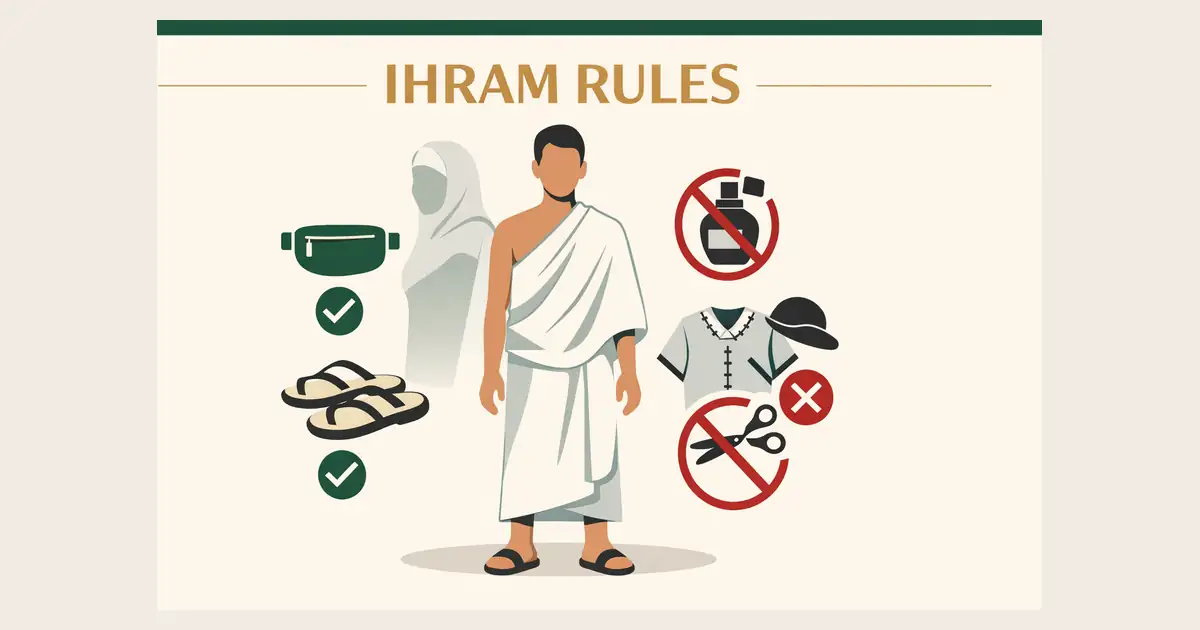
Ihram Rules For Hajj: Complete Guide for Men, Women, Miqat, Restrictions & Mistakes
Ihram rules for hajj start before you reach Makkah. The simple rule is this: enter ihram before crossing your miqat for hajj, make your intention, begin the talbiyah for hajj, and then stay away from the known prohibitions of ihram such as perfume, hair cutting, nail trimming, sexual intimacy, and certain clothing rules for men. That is the heart of the matter.
If you need the boundary details first, read Miqat for Hajj.
✅ TL;DR – ihram rules for hajj
Ihram rules for hajj mean you must enter ihram before the miqat boundary for hajj, wear the correct clothing, avoid perfume, hair and nail cutting, intimacy, and sinful arguing, and know when restrictions are partly lifted and fully lifted. Men and women share many rules, but clothing and face-covering rules differ.
📖 A key reminder from the Qur’an and Sunnah
Qur’an 2:197
الْحَجُّ أَشْهُرٌ مَعْلُومَاتٌ ۚ فَمَنْ فَرَضَ فِيهِنَّ الْحَجَّ فَلَا رَفَثَ وَلَا فُسُوقَ وَلَا جِدَالَ فِي الْحَجِّ
Transliteration: Al-hajju ashhurun ma‘lumat, faman farada fihinna al-hajja fala rafatha wa la fusuqa wa la jidala fil-hajj.
Meaning: Hajj is in well-known months, so whoever enters upon Hajj should avoid intimate relations, sinful behavior, and arguing during Hajj.
The Prophet ﷺ also explained the dress rules clearly: men in ihram do not wear shirts, trousers, turbans, or head coverings, and a woman in ihram should not wear a niqab or gloves.
Quick Answer — What are the ihram rules for hajj?
The short answer: what every pilgrim must avoid in ihram
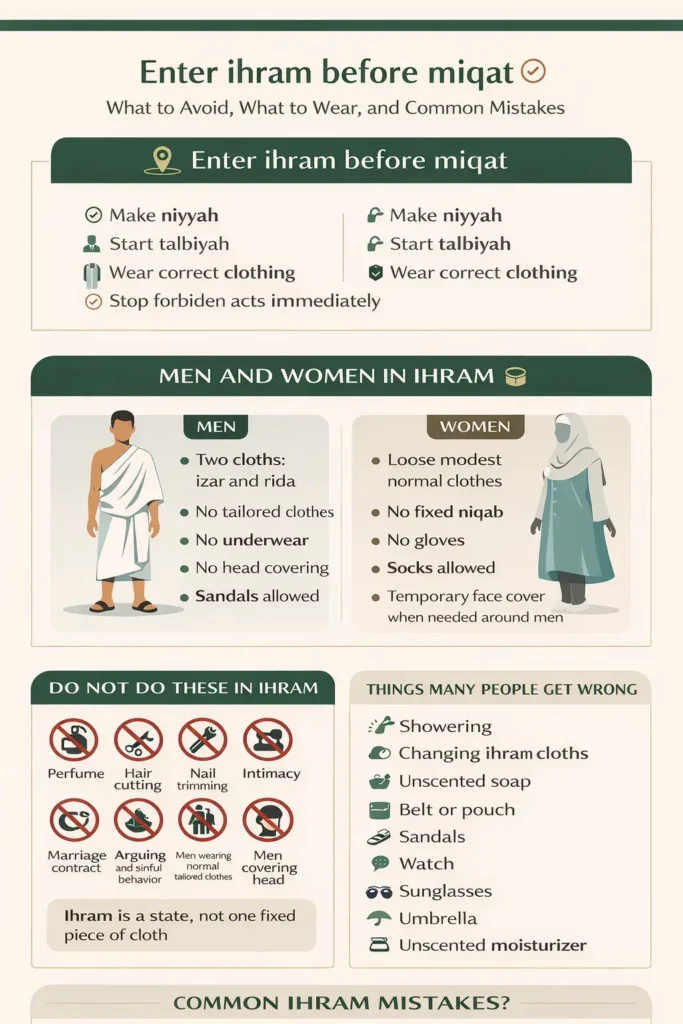
What are the ihram rules for hajj? In short: after entering ihram, the muhrim avoids perfume, cutting hair, trimming nails, sexual relations, marriage contracts, hunting game, and sinful arguing. Men also avoid body-shaped normal clothing and head covering. Women wear normal modest clothes, but do not wear niqab or gloves as fixed ihram wear.
Think of ihram like stepping into a sacred zone around your own behavior. The cloth matters, yes. But the bigger point is that your tongue, temper, body, and choices all enter a stricter mode. Clothes are the visible sign. Restraint is the real test.
When ihram starts for hajj and why miqat matters
When does ihram start for hajj? It starts when you make the intention for Hajj or Umrah and begin the talbiyah. For people coming from outside Makkah, that must happen before passing the relevant miqat or a parallel point on the route, whether by land or plane. You should not cross that boundary first and “fix it later” in Jeddah if you are heading straight for Hajj rites.
That part catches beginners all the time.
When ihram restrictions end in hajj
When do ihram restrictions end in hajj? There is a partial release and then a full release. After stoning Jamrat al-‘Aqabah and shaving or trimming the hair, the pilgrim enters the first release, and most restrictions end except intercourse. After tawaf al-ifadah, the remaining restriction ends and the pilgrim is fully out of ihram.
📚 You Can Also Read: Talbiyah in Hajj and Umrah
How to Enter Ihram for Hajj Step by Step
Ghusl, grooming, and what to do before wearing ihram
How to enter ihram for hajj step by step begins before the actual boundary. The Sunnah is to make ghusl before ihram or at least wudu, prepare yourself, and enter this state in a clean and respectful way. The Saudi Hajj guide states that ghusl or wudu before entering ihram is Sunnah.
Do your trimming before entering ihram, not after. Nails, unwanted hair, and fragrance issues become much harder once you are already in the sacred state. My students always ask about this part because they think “I’ll just sort it out later at the hotel.” No. Later can become a mistake.
Niyyah for ihram and when to say the talbiyah
The official Hajj guide explains that ihram begins with the intention and starts with the talbiyah. For Hajj, you state the ritual you intend and begin reciting: Labbayka Allahumma labbayk… Men raise their voices; women say it quietly.
That means the white cloth alone does not make you a muhrim. The cloth is like a uniform. The intention is what actually switches the state on.
Entering ihram before crossing the miqat boundary
You must enter ihram before crossing the miqat boundary for hajj. The Saudi guide says pilgrims traveling by plane or land should not go beyond these points without entering ihram, and airlines usually announce alignment with the miqat so pilgrims can prepare.
- Wash and prepare before the boundary.
- Wear the correct clothing before you need it.
- Make the niyyah for ihram at or before miqat.
- Start the talbiyah right away.
- Stop all forbidden acts from that moment.
📚 You Can Also Read: Niyyah for Hajj and Umrah
Ihram Rules for Men
Ihram clothing for men: izar, rida, and what is not allowed
Ihram rules for men are stricter on clothing. Men wear the two white cloths of izar and rida. The Prophet ﷺ forbade shirts, trousers, turbans, hooded cloaks, and similar body-fitted clothing for the male pilgrim in ihram.
People often hear “stitched clothes” and imagine the problem is the thread. It isn’t. The issue is normal tailored clothing shaped to the body. A patched cloth is still fine. A body-shaped shirt is not. That mix-up causes a lot of confusion.
Can men wear underwear, socks, or stitched clothes in ihram?
Can men wear underwear in ihram? No, not as part of normal male ihram. Can men wear stitched clothes in ihram? Not the regular tailored kind like shirts, trousers, and underwear. The hadith also mentions khuffs unless sandals are unavailable. So the safest beginner rule is: for men, avoid underwear, socks that function like normal enclosed footwear, and regular tailored garments while in ihram.
Can men cover their head in ihram?
Can men cover their head in ihram? No. Head covering is one of the clear male restrictions in ihram. Sunglasses are fine, and carrying a parasol or umbrella for shade is fine, because the Saudi guide lists glasses and carrying a parasol among things not forbidden during ihram.
📚 You Can Also Read: Hajj Packing List
Ihram Rules for Women
What women should wear in ihram for hajj
Ihram rules for women are easier on clothing. Women do not need the two white cloths. The Saudi guide says women may enter ihram in whatever clothes they want as long as the clothes are modest, loose, covering, and not attractive in a showy way.
So ihram rules for women during hajj are not “dress in white only.” Normal modest clothes are fine. That mistake is more cultural than fiqh.
Can women cover the face in ihram?
Can women cover face in ihram? As a fixed niqab style, no. The hadith says the woman in ihram should not wear niqab or gloves. But the official Saudi guide also notes that women may cover the face when they fear temptation or when men are nearby. So the practical beginner rule is: no fixed niqab as ihram wear, but temporary face covering for modesty around non-mahram men is recognized
Can women wear gloves, socks, or normal modest clothes in ihram?
Can women wear gloves in ihram? No, not as the normal state of ihram. Can women wear socks in ihram for hajj? Yes, ordinary modest clothing rules apply, and women are not under the male footwear restriction. Can women wear normal modest clothes in ihram? Yes. That is the basic rule.
What Is Forbidden in Ihram During Hajj?
Perfume, scented soap, and fragranced products
What is forbidden in ihram during hajj? Perfume is one of the clearest prohibitions. The Saudi guide lists applying perfume among the general prohibitions, and the hadith forbids perfumed garments for the muhrim. This includes using fragrance to smell nice after entering ihram
That means your “fresh” deodorant, scented face wipes, perfumed lotion, and fragranced soap can all become a problem if used after entering ihram.
Cutting hair, trimming nails, and grooming restrictions
Hair cutting and nail trimming are from the well-known mahzurat al ihram. The Qur’an mentions not shaving the head until the sacrifice reaches its place, and the Saudi guide lists shaving or clipping nails among the prohibitions
Sexual relations, marriage, and intimate contact rules
The Qur’an directly forbids intimate relations during Hajj, and the Saudi guide also lists sexual intercourse and marriage contracts among the prohibitions. Touching with desire also falls into a dangerous area that pilgrims should avoid.
Arguing, fighting, and sinful behavior in ihram
The Qur’an says there should be no sinful behavior and no arguing during Hajj. This is not a small side note. It is part of the spiritual discipline of hajj ihram rules. Crowds test patience. Ihram is supposed to test character too.
Hunting and harming animals: what is prohibited and what is allowed
Hunting game is prohibited in ihram. But harmful creatures are treated differently, and practical safety is not blocked. The Saudi guide lists hunting as prohibited, while ordinary safety steps and medical care remain allowed.
One-sentence rule: don’t turn “avoid hunting” into “ignore danger.”
Things Allowed in Ihram That Many People Get Wrong
Can you shower, change ihram clothes, or use unscented soap?
Can you shower in ihram for hajj? Yes. The Saudi guide lists showering among things not forbidden during ihram. And because ihram is a state, not magic attached to one specific cloth, changing into clean ihram cloths when needed is not itself the issue; the restrictions are about prohibited acts, not staying in one dirty wrap all day.
If your cloth gets dirty, change it. I used to see beginners panic over this.
Can you wear a belt, sandals, sunglasses, or a watch in ihram?
Can you wear a belt in ihram? Yes. Can you wear sandals in ihram? Yes. Can you wear sunglasses in ihram? Yes. Can you wear a watch in ihram? Yes. The Saudi guide specifically lists belts, glasses, watches, shoes, and carrying a parasol among things not forbidden during ihram.
- Belt or pouch: allowed and useful
- Sandals: allowed for men and women within the known rules
- Sunglasses: allowed
- Watch: allowed
- Umbrella/parasol: allowed
Can you brush teeth, use vaseline, or apply unscented moisturizer?
The safe principle here is simple: if it is unscented and not for beautification in the perfume sense, basic care is generally treated differently from prohibited fragrance. So brushing teeth, using plain petroleum jelly for chafing, and unscented moisturizer are commonly treated as allowed. The Saudi guide even advises using ointments on the body before walking and healing ointments if irritation happens.
Micro-scenario: if your thighs are burning from friction in the heat, plain unscented ointment is mercy, not luxury.
Common Ihram Mistakes During Hajj
Entering late after crossing miqat
This is one of the biggest common ihram mistakes. A pilgrim flies in, gets distracted, lands, and only then realizes the niyyah for ihram should have been made before crossing the boundary. The official rule is not to pass the miqat without entering ihram.
Using perfume without realizing it
Another common error is thinking perfume only means bottled scent. In real life, it may be deodorant, face cream, wet wipes, beard oil, or soap. Check labels before travel. “Fresh musk” and “clean cotton” are still fragrance.
Men wearing forbidden clothing by mistake
Men panic about the cloth slipping, then wear underwear under the izar or throw on a T-shirt “just for a minute.” That minute still matters. Secure the cloth properly with a belt and practice wearing it before travel.
Women misunderstanding face-covering rules
Some sisters think they must leave the face uncovered no matter what, even in packed mixed crowds. Others think a niqab is required as usual. The balanced beginner-safe reading is: no fixed niqab in ihram, but temporary covering when men are nearby is recognized in the Saudi guide.
Not knowing when restrictions are partly or fully lifted
This causes awkward and avoidable mistakes. After stoning and hair cutting, most restrictions are lifted. After tawaf al-ifadah, the rest are lifted. If you do not know this sequence, you can either over-restrict yourself or break a rule too early.
📚 You Can Also Read: Halq and Taqsir Ritual Head Shaving
Penalty for Breaking Ihram Rules
What is fidyah for breaking ihram rules?
What is fidyah for breaking ihram rules? The Qur’an mentions compensation by fasting, charity, or sacrifice in the case of a head ailment that requires shaving, and this verse is a key base for the expiation discussion. In practical Hajj teaching, fidyah for breaking ihram rules is not one flat penalty for every case; it depends on what happened.
Which mistakes need expiation and which may be excused?
A very important point: scholars distinguish between deliberate violation and cases of ignorance, forgetfulness, or compulsion. Reliable fiqh summaries state that forgetfulness, ignorance, or being forced can excuse the pilgrim from blame in many ihram violations, though the pilgrim must stop as soon as they realize the mistake.
There are differences of detail among scholars in some cases, especially in how penalties are categorized. A beginner should not self-issue a ruling after reading one chart online. Ask a qualified scholar with your exact case.
What to do immediately if you break an ihram rule
Do three things at once:
- Stop the act immediately.
- Check whether it happened by mistake, ignorance, need, or choice.
- Ask a qualified scholar or your Hajj group scholar quickly.
One short story. A brother once reached the hotel bathroom, washed his hands with a perfumed soap dispenser without thinking, then came out white as a sheet and said, “My Hajj is finished, right?” It wasn’t. He had made a mistake, stopped, washed it off, and asked a scholar. The fix was calm, not panic. That is why learning ihram do’s and don’ts before travel saves so much stress.
When Do Ihram Restrictions End in Hajj?
First release from ihram after stoning and hair cutting
The Saudi Day of Sacrifice guide says that after stoning Jamrah al-‘Aqabah and shaving or trimming the hair, the pilgrim reaches the first dissolution of ihram. At that stage, everything becomes allowed except intercourse.
Full release from ihram after tawaf al-ifadah
After that, once the pilgrim performs tawaf al-ifadah, the remaining prohibition is lifted and the pilgrim is fully out of ihram.
Difference between hajj and umrah ihram ending rules
For umrah, ihram ends after tawaf, sa‘i, and shaving or trimming the hair. For Hajj, there is the two-stage release described above. So do not mix the two. Many beginners do.
Ihram Checklist for Hajj
What to pack before wearing ihram
Pack for reality, not for Instagram. Heat, walking, crowding, dryness, and bathroom changes are the real test.
🎒 Simple ihram prep box
For men: two clean ihram cloths, secure belt, sandals, unscented toiletries, small pouch, sunglasses.
For women: loose modest clothes, socks if desired, hijab, unscented toiletries, simple bag, comfortable footwear.
For both: fragrance-free care items, water bottle, ID pouch, tissues, and patience.
Last-minute miqat checklist for men and women
- Remove fragrance from your routine.
- Finish grooming before entering ihram.
- Wear the right clothes in time.
- Know your miqat before the flight or road trip.
- Make your intention before crossing it.
- Start talbiyah without delay.
Simple do’s and don’ts list before you travel
Do: learn the sequence, pack unscented items, practice the clothing, and ask early if you have health needs.
Don’t: rely on airport rush, assume all soaps are safe, copy random social media answers, or treat every issue as “same for men and women.”
📚 You Can Also Read: Hajj with Elderly Parents
📊 ihram rules for hajj: quick summary table
Use this as a fast check before travel or while reviewing your Hajj notes.
🌙 Show Ihram Rules Summary Table
| Issue | Men | Women | Beginner-safe rule |
|---|---|---|---|
| Clothing | Two cloths: izar and rida | Loose, modest normal clothes | Men avoid tailored garments; women keep clothing modest |
| Head / face | No head covering | No niqab as fixed ihram wear; face may be covered when needed around men | Know the difference between fixed wear and temporary modesty cover |
| Perfume | Forbidden after entering ihram | Forbidden after entering ihram | Use only fragrance-free care items |
| Hair / nails | Do not cut in ihram | Do not cut in ihram | Do all grooming before miqat |
| Allowed items | Belt, sandals, watch, glasses, umbrella | Same general practical items allowed | Don’t confuse practical gear with forbidden clothing |
| Ending ihram | Partial after stoning + hair; full after tawaf al-ifadah | Same sequence, with women trimming hair not shaving | Learn the two-stage release before Day 10 |
FAQs
📘 ihram rules for hajj FAQs
what are the ihram rules for hajj for men and women?
Show Answer
Both men and women must avoid perfume, hair cutting, nail trimming, intimacy, marriage contracts, hunting, and sinful arguing. Men have extra clothing restrictions. Women wear modest normal clothes but do not wear niqab or gloves as fixed ihram wear.
when to wear ihram for hajj before miqat?
Show Answer
Wear the clothing before you need it, then make the intention and start talbiyah at or before your miqat point. Do not cross the miqat first and then enter ihram later if you are heading straight for Hajj or Umrah.
can men wear underwear in ihram?
Show Answer
No, men in ihram should not wear normal tailored undergarments. Use a secure ihram belt and practice wearing the cloth properly before travel.
can women cover face in ihram?
Show Answer
A woman in ihram should not wear a fixed niqab, but temporary face covering when non-mahram men are nearby is recognized in standard Hajj guidance.
can women wear socks in ihram for hajj?
Show Answer
Yes. Women are not under the same footwear rule as men. Ordinary modest clothing, including socks, is generally fine.
can you use perfume in ihram?
Show Answer
No. Perfume and fragranced products used after entering ihram are from the clear prohibitions. Check soaps, lotions, wipes, and deodorants before travel.
can you shower in ihram for hajj?
Show Answer
Yes. Showering is allowed in ihram. Just avoid scented products and avoid rough handling that causes hair to fall unnecessarily.
can you change ihram clothes during hajj?
Show Answer
Yes. You may change into clean ihram cloths when needed. Ihram is a state of worship, not a rule that you must stay in one specific dirty cloth.
can you brush teeth in ihram?
Show Answer
Yes, basic oral hygiene is fine. The safer choice is an unscented or lightly non-fragrant option so you do not drift into the perfume issue.
can you wear sunglasses in ihram?
Show Answer
Yes. Glasses and sunglasses are allowed and are not treated as forbidden face covering.
what breaks ihram during hajj?
Show Answer
The better way to say it is: what violates ihram rules. Common violations include perfume, hair or nail cutting, intimacy, and men wearing forbidden clothing. Some violations may require expiation depending on the case.
penalty for breaking ihram rules in hajj?
Show Answer
The penalty is not one single fixed answer for every mistake. Some cases involve fidyah such as fasting, charity, or sacrifice. Intent, ignorance, forgetfulness, and necessity can affect the ruling, so ask a qualified scholar with your exact situation.
when do ihram restrictions end in hajj?
Show Answer
Most restrictions end after stoning Jamrat al-‘Aqabah and shaving or trimming the hair. Full release comes after tawaf al-ifadah.
Ihram Rules for Hajj Explained: What Is Allowed and Forbidden
Related Articles
Hajj al-Tamattu Hajj al-Ifrad Hajj al-Qiran What Are Fard, Wajib and Sunnah of Hajj Rami al-Jamarat Tawaf al-Wida MuzdalifahYou Can Also Check
- nafl tawaf guide
- tawaf al umrah guide
- tawaf al qudum guide
- tawaf al ifadah guide
- tawaf al ziyarah guide
- tawaf faqs guide

Farrukh Farooqi has been living in Sharaya, Makkah, Saudi Arabia since 2010. With over 14 years of firsthand experience witnessing the sacred journey of millions of pilgrims, Farrukh specializes in providing practical, insider tips for Hajj and Umrah travelers. His work blends real-world observations, the latest Saudi updates, and essential crowd management strategies — helping pilgrims and worshippers plan smarter, stay safer, and experience a spiritually fulfilling journey across the Holy Cities.


