
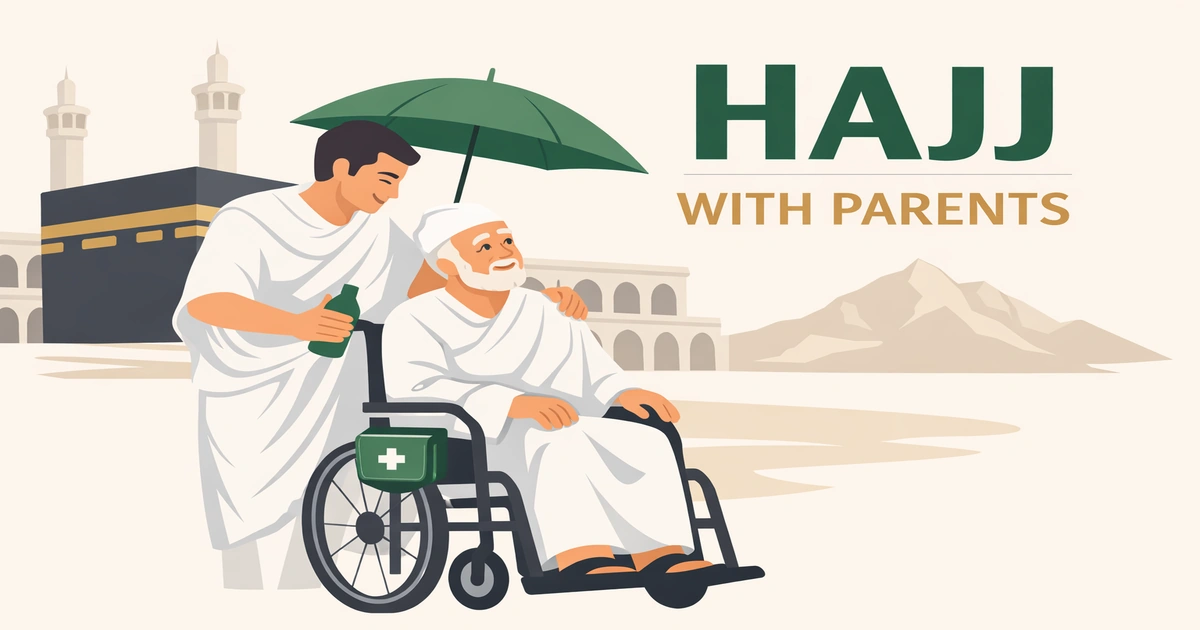
Hajj With Elderly Parents: Complete Practical Guide for Safety, Comfort, and Ritual Planning
Hajj with elderly parents is possible for many families, but it only goes well when you plan around health, mobility, heat, rest, and crowd safety before you ever book a package. The families who struggle most are usually not the ones with the oldest parents. They are the ones who plan the trip around price first, then try to “manage somehow” later.
If you are performing Hajj with elderly parents, think of it like carrying glass through a crowded station. You do not walk the same way. You do not rush the same way. You do not take “shortcuts” just because other people do. That mindset alone will save you from many bad decisions.
And yes, serving your parents in these days can be one of the most beautiful parts of the journey.
For Hajj planning basics and the official booking path, see How to Register on Nusuk Hajj.
✅ TL;DR – hajj with elderly parents
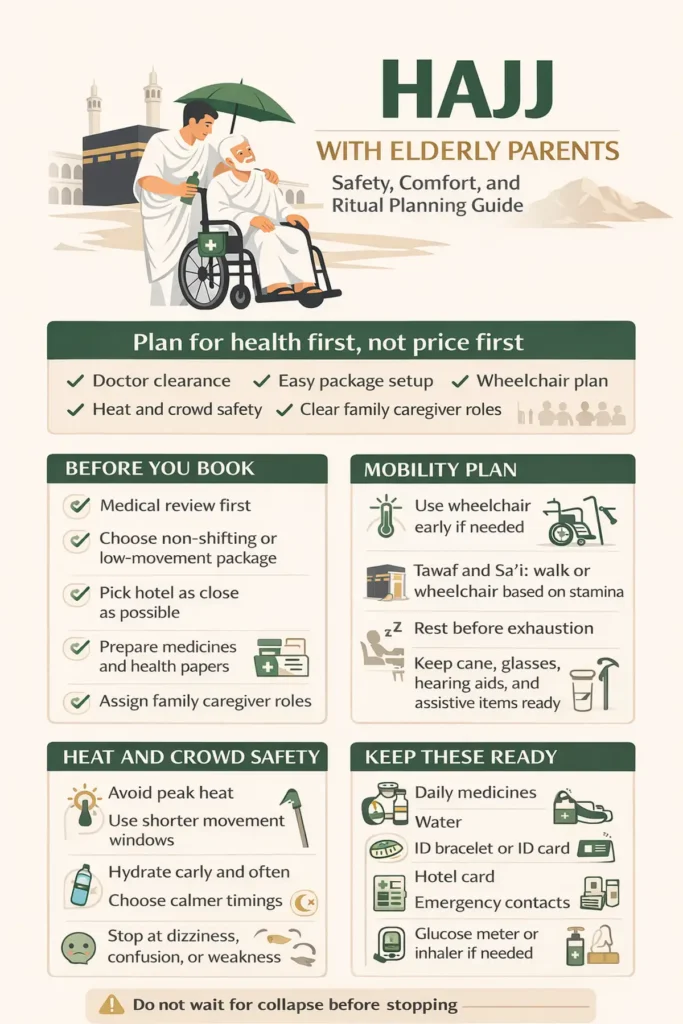
Hajj with elderly parents is safest when you get medical clearance first, choose a nearby non shifting hajj package, plan wheelchair use early, avoid peak heat and crowd pressure, carry medicines and ID details, and slow the ritual pace when needed.
📖 A Quran reminder for this journey
وَقَضَىٰ رَبُّكَ أَلَّا تَعْبُدُوا إِلَّا إِيَّاهُ وَبِالْوَالِدَيْنِ إِحْسَانًا ۚ إِمَّا يَبْلُغَنَّ عِندَكَ الْكِبَرَ أَحَدُهُمَا أَوْ كِلَاهُمَا فَلَا تَقُل لَّهُمَا أُفٍّ وَلَا تَنْهَرْهُمَا وَقُل لَّهُمَا قَوْلًا كَرِيمًا
Transliteration: Wa qada rabbuka allaa ta‘budoo illaa iyyaahu wa bil-waalidayni ihsaanaa. Immaa yablughanna ‘indakal kibara ahaduhumaa aw kilaahumaa falaa taqul lahumaa uffin wa laa tanharhumaa wa qul lahumaa qawlan kareemaa.
Meaning: Your Lord has decreed that you worship none but Him, and that you show excellent treatment to your parents. If one or both of them reach old age with you, do not even say “uff” to them, and do not scold them. Speak to them with honor.
How do you do Hajj with elderly parents safely?
How to do Hajj with elderly parents safely? Start with health, not hotel photos. Get a proper doctor review, choose the easiest package setup, plan mobility support before arrival, reduce walking and peak crowd exposure, and build the whole trip around hydration, rest, and caregiver roles.
The short answer: plan for health, mobility, heat, and rest first
The easiest way to think about how to do Hajj with elderly parents is this: first protect the body, then organize the rituals around that reality. A senior pilgrim can be spiritually ready and still be physically fragile. Both things can be true at once.
So the order matters.
Medical clearance. Nearby hotel. Wheelchair strategy. Medication plan. Rest windows. Crowd timing. Family roles.
Who this guide is for: seniors, wheelchair users, and parents with chronic illness
This guide is for families doing Hajj for elderly parents, especially if your mother or father has diabetes, blood pressure issues, weak knees, arthritis, breathing trouble, heart disease, poor balance, hearing loss, or general frailty. It also helps if you are taking a parent who may need a wheelchair for part of the trip, not necessarily all of it.
That middle category is common, by the way. My students always ask about this part. A parent may walk in the hotel hallway just fine, then struggle badly in Mina, Tawaf, or after one hour in heat.
The biggest mistake families make during Hajj with elderly parents
The biggest mistake in taking elderly parents to Hajj is choosing a cheaper setup that forces too much movement, then trying to solve it with willpower. Hajj does not reward reckless strain. It rewards sincere worship done within real ability.
Another mistake is emotional pressure: “We came all this way, so we must do everything the hardest way.” No. That thinking breaks people.
📚 You Can Also Read: Shifting vs Non-Shifting Hajj Packages
Can Elderly Parents Perform Hajj?
Can elderly people perform Hajj? Yes, many can. Age alone does not block Hajj. The real question is whether the person has the physical ability, medical stability, and safe support needed to complete the journey without serious harm.
When Hajj is possible for elderly parents
Can elderly parents perform Hajj? Yes, when they are medically stable enough to travel and perform the rites with reasonable support. A 70-year-old or 80-year-old may still do Hajj if the body can handle the journey with rest, mobility help, good planning, and doctor approval.
Plenty of older pilgrims complete Hajj every year. But “possible” does not mean “easy.”
When poor health changes the ruling or plan
If a parent has severe heart failure, severe lung disease needing oxygen, dialysis-dependent kidney failure, dementia, or another condition that makes the rites unsafe, the plan changes. In some cases, the journey should be delayed. In some cases, it may not be suitable at all.
This is where emotion can cloud judgment. Children want to fulfill a dream for their parents. That love is beautiful. But love without honesty can become harm.
When Hajj on behalf of an elderly parent may be discussed
If a parent is permanently unable to travel or perform Hajj due to old age or a chronic condition with no real hope of recovery, scholars discuss Hajj on behalf of an elderly parent. The well-known hadith mentions a man asking about his elderly father who could not perform Hajj or ‘Umrah or undertake the journey, and he was told to perform Hajj and ‘Umrah on behalf of his father.
That is not for every difficult case. It is for real inability, not simple discomfort. For personal application, ask a trusted scholar with your parent’s exact condition.
Step 1 — Get Medical Clearance Before You Book
Hajj medical checkup should come before package payment, not after. A real doctor visit helps you decide whether to go now, delay, or change the level of support needed.
Why elderly pilgrims should see a doctor before travel
Saudi health guidance tells pilgrims to see a doctor before travel and make sure their health is stable. For older adults, this is not a formality. It is the difference between a planned journey and a crisis trip.
Ask the doctor one direct question: “Can this person manage Hajj travel, walking, crowd exposure, heat, and interrupted sleep?” That simple question gets better answers than vague talk.
Chronic illnesses to review before Hajj
Review diabetes, heart disease, high blood pressure, asthma, COPD, arthritis, kidney disease, stroke history, memory problems, and any condition that affects walking, balance, breathing, or confusion. Also review medicines that can worsen dehydration or dizziness.
If your parent has fainted recently, had chest pain, severe breathlessness, repeated low sugar, falls, or recent hospital admission, do not treat that as a “small issue.”
What medical report, prescriptions, and dosage list to carry
Carry a short medical summary, a list of diagnoses, all prescriptions, exact dosages, allergy details, blood group if available, and extra copies in paper and phone form. Keep medicines in original packaging where possible.
For vaccine planning, visa-related health rules, and country-specific checks, see Hajj Vaccine Requirements 2026.
Step 2 — Choose the Best Hajj Package for Elderly Parents
Best Hajj package for elderly parents usually means the package that cuts movement, cuts confusion, and cuts walking distance. It is often not the cheapest one.
Why a non-shifting Hajj package is usually better for seniors
A non shifting hajj package for elderly parents is usually better because it reduces hotel changes, luggage stress, and unnecessary back-and-forth movement. For senior pilgrims, stability is comfort. Comfort is energy. Energy is safety.
🌙 Elderly-Friendly Package Filter
When comparing any premium hajj package for seniors or standard plan, check these first:
- Non-shifting stay or minimal hotel movement
- Hajj accommodation near Haram as much as budget allows
- Air-conditioned transport and organized transfers
- Lift access and nearby toilets
- Support for wheelchair users or official wheelchair access help
- Clear group leadership for lost/separated cases
Why hotel distance from the Haram matters more than price
Families often focus on package cost and tent details, but for elderly parent care during Hajj, hotel distance matters more than most people expect. A “not too far” hotel may still mean painful daily strain for someone with weak knees or breathing trouble.
Ten minutes on paper can feel like an hour in real Hajj conditions.
What to ask the travel agent about elderly support
Ask clear, practical questions, not brochure questions. Ask whether they have elderly-friendly group support, how they handle wheelchair movement, whether there are accessible restrooms nearby, what the transport setup is, how far the hotel really is in walking effort, and who helps if a parent gets separated.
📚 You Can Also Read: Nusuk Hajj Packages Explained
Step 3 — Build a Mobility Plan Before Arrival
A good wheelchair Hajj plan is not only for parents who “cannot walk at all.” It is also for parents who can walk some parts but become unstable, slow, or exhausted in rituals and crowds.
Wheelchair Hajj for seniors: when to use it
Wheelchair Hajj for seniors makes sense when walking causes pain, imbalance, swelling, dangerous fatigue, or severe delay. Use it early enough to prevent collapse, not late enough that the parent is already trembling.
I used to mix this up when teaching families. They often think a wheelchair means weakness. In reality, sometimes it is the tool that protects dignity.
Tawaf and Sa’i with elderly parents: walk, wheelchair, or assistant?
How to do Tawaf with elderly parents and how to do Sa’i with elderly parents depends on actual stamina, not family pride. Some parents can walk short parts slowly. Some should do both in a wheelchair. Some need a paid or assigned pushing assistant because family members themselves get exhausted.
For Tawaf and Sa’i, think in these terms:
- Walk if balance is good, pace is safe, and crowd pressure is low
- Wheelchair if walking will likely cause exhaustion, falls, or severe pain
- Assistant if pushing long distances will drain the caregiver too much
Canes, hearing aids, glasses, and other assistive devices to bring
Bring the things that keep your parent functional at home. Cane. Foldable wheelchair if practical. Glasses with backup pair. Hearing aids with spare batteries. Compression socks if already doctor-approved. Simple neck pillow. A lightweight bag clip for medicine access.
Families sometimes pack Ihram belts and chargers carefully, then forget the actual tools that help their parent hear, see, stand, or walk.
Step 4 — Prepare for Heat, Crowds, and Fatigue
Hajj heat safety for elderly is not a side issue. It is one of the central issues. Older bodies dehydrate faster, recover slower, and may not “announce” danger early.
How to avoid heat exhaustion during Hajj
How to avoid heat exhaustion during Hajj? Reduce direct sun, drink fluids regularly, use shade, cool the body early, and stop before the parent “looks terrible.” Waiting for obvious collapse is too late.
Watch for dizziness, confusion, unusual sleepiness, headache, cramps, flushed skin, nausea, or sudden weakness. Those are not signs to “push through.” They are signs to stop.
Best times to move elderly parents with less strain
Move earlier, later, or whenever crowd pressure is lower and sun is softer. Midday stubbornness is expensive. For many seniors, the best plan is shorter movement windows with longer recovery windows.
That slower rhythm is not failure. It is wisdom.
Why frequent rest breaks are not optional for senior pilgrims
Hajj rest breaks are part of the plan, not a bonus if you “have time.” A tired elderly pilgrim does not just feel tired. They make worse decisions, drink less, stumble more, forget instructions, and become harder to protect in crowds.
📚 You Can Also Read: Mount Arafat
Step 5 — Pack the Right Medication and Care Bag
What to pack for Hajj with elderly parents should be built around daily survival, not travel aesthetics. Your care bag should solve thirst, sugar drops, skin irritation, medication timing, and simple hygiene on the go.
Essential medication checklist for elderly pilgrims
A smart medical checklist for Hajj with elderly parents usually includes daily medicines, extras for delays, pain relief already approved by their doctor, glucose testing items if diabetic, inhalers if needed, and a written schedule for doses.
Do not depend on memory.
How to store medicines safely during Hajj travel
Keep medicines sorted by day and time, but also keep labels and prescriptions. Use a simple pouch for daily access and a separate backup stock in luggage. Heat-sensitive medicines need extra care, so ask the doctor or pharmacist how to store them safely during travel.
One common disaster is letting one relative carry everything. Then the wrong person disappears with the whole medicine supply.
What to keep in the daily care bag: water, mask, sanitizer, creams, glucose meter
The daily care bag should be light but useful. Keep water, unscented tissues, mask, sanitizer, skin cream for chafing, any sugar-related items, small snack if suitable, a foldable prayer mat if needed, and health papers.
For movement-heavy days, the bag is like a tiny clinic. Not fancy. Just lifesaving in simple ways.
Step 6 — Protect Elderly Parents in Crowded Rituals
Hajj crowd safety for seniors matters most in Tawaf, Sa’i, movement routes, and Jamarat. The goal is not to “win” the crowd. The goal is to finish the rites without crush risk, panic, falls, or medical collapse.
Tawaf crowd strategy for elderly parents
For Tawaf, do not chase the densest areas just because they look spiritually intense. Protect your parent from side pressure, sudden surges, and shoulder collisions. Keep them on the safer side of your body, and do not insist on getting close to the Black Stone.
Pointing is enough. Injury is not devotion.
Sa’i safety tips for seniors and wheelchair users
For Sa’i safety tips for seniors and wheelchair users, keep the pace steady, avoid emotional sprinting, watch for wheel traffic, and use official accessible routes where available. Sit before exhaustion becomes anger or confusion.
Micro-scenario: your father says, “I’m fine,” but his answers are getting slower and his face looks blank. Stop there. That is not the moment to argue. It is the moment to sit, cool, and drink.
Jamarat timing: how to avoid the most dangerous crowd periods
How to avoid crowds during Hajj with elderly parents matters especially at Rami al-Jamarat. Avoid the heaviest crush periods as much as your group’s plan and valid fiqh options allow. In difficult cases, ask your scholar and group guide about the safest valid timing and any concessions that may apply.
📚 You Can Also Read: Rami al-Jamarat
Step 7 — Keep Elderly Parents Hydrated and Identifiable
How to keep elderly parents safe during Hajj often comes down to two plain things: enough fluids and fast identification if something goes wrong.
How much to focus on fluids during Hajj days
Focus on fluids all day, not only when your parent says they are thirsty. Older people sometimes drink too little because they do not want bathroom trouble, do not feel thirst properly, or simply forget.
That quiet dehydration can turn into dizziness, confusion, low blood pressure, weakness, or heat illness fast.
Why an ID bracelet and health details matter
An ID bracelet or clear ID card with name, hotel, group, phone number, and key health details can save hours of panic. If your parent has diabetes, severe allergy, heart disease, or memory issues, that information matters.
Think of it as a shortcut for help. In Hajj, a few saved minutes can matter a lot.
What to do if an elderly parent gets separated
Before the trip, agree on one simple separation plan: stay where you are if safe, contact the group leader, use the ID details, and go to the agreed meeting point. Teach this plan when everyone is calm, not in the middle of chaos.
Micro-scenario: your mother panics easily in crowds. Give her one laminated card with hotel, group, and one family number in large print. Keep another copy in her bag and one in your phone case.
Step 8 — Make a Family Caregiver Plan
A real caregiver plan is one of the most underrated parts of hajj planning for elderly parents. Without it, everyone assumes someone else is handling the important stuff.
Who handles documents, meds, and movement
Assign one person for documents, one for medication timing, and one for movement decisions. On smaller trips, one caregiver may do two roles, but the duties must still be named clearly.
Vague teamwork creates avoidable mistakes.
How to split roles between siblings or companions
Split roles by temperament, not birth order. The calmest sibling may be best for crowd movement. The most organized may be best for medicines. The strongest may be best for chair pushing. The best phone user may be best for location and hotel contact.
That kind of honest role split keeps emotions down.
What one caregiver should always keep ready
One caregiver should always keep passport copy, Nusuk-related details, hotel card, medicine list, a charged phone, power bank, emergency contacts, and enough cash for small urgent needs. This person should also know exactly where the parent’s main medicines are.
📚 You Can Also Read: Nusuk App for Hajj and Umrah
Step 9 — Adjust Ritual Pace Without Causing Harm
Practical ease for elderly pilgrims does not mean neglecting Hajj. It means doing Hajj properly without forcing the body into danger.
Focus on completing Hajj properly, not forcefully
The best way to do Hajj with old parents is to aim for correct completion, not dramatic exhaustion. Hajj is not a test of how much pain your parent can hide.
Some families turn worship into a performance of toughness. That is one of the saddest mistakes in this topic.
When to delay movement for safety and rest
Delay movement when the parent is overheated, shaky, dizzy, confused, swollen, short of breath, or plainly exhausted. Rest first. A short delay can prevent a full medical problem.
Micro-scenario: you are rushing before the group bus, and your father says he can continue but keeps stopping every few steps. Believe the body, not the sentence.
Practical ease for elderly pilgrims in difficult moments
In hard moments, use valid ease: sit, rest, cool down, change timing when allowed, use a wheelchair, ask for help, and speak to a scholar when a real fiqh issue appears. Islam is not asking your parent to prove courage through collapse.
Hajj With Elderly Parents and Chronic Illness
Hajj with elderly parents and chronic illness needs closer planning because routine conditions become harder in heat, crowds, changed meals, and broken sleep.
Diabetes, heart disease, blood pressure, and breathing issues
If your parent has diabetes, watch meal timing, low sugar risk, dehydration, foot care, and medicine timing. With heart disease or blood pressure problems, watch exertion, swelling, dizziness, chest symptoms, and heat exposure. With asthma or other breathing issues, avoid dust-heavy stress, carry inhalers, and do not delay help if breathing worsens.
Warning signs that mean stop and get help
Stop and get help for chest pain, severe shortness of breath, fainting, confusion, repeated vomiting, very low or very high sugar readings, severe weakness, collapse, or signs of heat illness. Do not “monitor for a bit” when the signs are already serious.
That waiting habit is dangerous.
How to reduce risk during long ritual days
Reduce risk through shorter movement blocks, more sitting, planned fluids, medicine alarms, shade, lighter bags, easier routes, and realistic expectations. Long days become safer when broken into small, manageable parts.
Hajj Wheelchair Guide for Elderly Parents
Hajj with elderly parents wheelchair guide starts with one question: will the wheelchair protect them from harm and help them complete the rites with more calm? If yes, do not hesitate.
Can elderly parents do Hajj in a wheelchair?
Can elderly parents do Hajj in a wheelchair? Yes, many do. A wheelchair can make performing Hajj with elderly parents far more realistic when walking is painful, unsafe, or simply too draining.
Where wheelchairs help most during Hajj
Wheelchairs help most in long movement sections, Tawaf, Sa’i, and any place where slow walking would expose the parent to prolonged strain. They also help when energy needs to be saved for key rites instead of wasted on transfers.
When a pushing assistant is worth paying for
If a family member cannot push safely for long periods, or if the caregiver must also manage medicine, navigation, and crowd protection, a pushing assistant can be worth it. Sometimes paying for help is the thing that protects everyone’s energy and mood.
📚 You Can Also Read: Tawaf al-Wida
What to Pack for Hajj With Elderly Parents
What to pack for Hajj with elderly parents should make the trip easier hour by hour. Good packing feels boring before travel and brilliant during travel.
Travel documents and health papers
Keep passport, visa-related documents, package details, hotel card, emergency contacts, vaccination proof, medical summary, prescriptions, and insurance or support details if relevant. Put copies in more than one place.
Clothing, shoes, cooling items, and hygiene basics
Pack easy clothing, comfortable footwear, extra underlayers, unscented wipes, towels, mask, fragrance-free hygiene basics, cooling towel, hat or shade item where appropriate outside Ihram restrictions, and spare socks if needed for women or non-Ihram periods.
Senior-friendly extras that make a big difference
Small foldable stool if allowed in your setup, refillable bottle, oral rehydration support if doctor-suitable, blister care, gentle snacks, spare batteries, lanyard pouch, and a simple card explaining the parent’s condition can make a huge difference.
Common Mistakes When Taking Elderly Parents to Hajj
The common mistakes in taking elderly parents to Hajj are painfully predictable. That is the good news. Predictable mistakes can be prevented.
Choosing a cheap package with too much movement
This is the classic error. A package looks affordable until you add the hidden cost of fatigue, confusion, transfers, long walking, missed rest, and caregiver burnout. For elderly parents, too much movement is not a minor inconvenience.
Underestimating heat and walking distance
People think, “We walk every day at home.” Hajj walking is not normal walking. It comes with heat, crowd pressure, waiting, uneven pacing, delayed meals, and emotional intensity. Do not compare it to a calm evening walk in your neighborhood.
Forgetting backup meds, ID details, and rest windows
One family once told me they prepared everything except rest. They had every document, every pouch, every shoe, every charger. But their schedule had no breathing room. By the second hard day, everyone was irritated, and the mother was too tired to benefit from what they had arranged.
The fix was simple but late. They slowed the pace, split duties, shortened outings, and built proper sitting time into each movement block. The mood changed almost immediately. The lesson stayed with me: good Hajj care is not only what you carry. It is what you stop trying to force.
📊 hajj with elderly parents: safest planning summary
Use this table as a quick decision guide before you book, pack, and move through the main rites with elderly parents.
🌙 Show Elderly Hajj Planning Table
| Area | Best approach | Why it helps |
|---|---|---|
| Medical planning | Doctor review before booking | Checks if travel and rites are safe enough now |
| Package choice | Non shifting hajj package with less movement | Cuts transfers, luggage stress, and fatigue |
| Hotel location | Closer stay where possible | Reduces walking strain for senior pilgrims |
| Mobility | Wheelchair Hajj plan before arrival | Prevents exhaustion, falls, and panic decisions |
| Heat safety | Shade, fluids, shorter movement windows | Lowers risk of heat exhaustion and dehydration |
| Crowd safety | Avoid dense periods, use calmer timing | Reduces crush risk in Tawaf, Sa’i, and Jamarat |
| Caregiver roles | Assign one person for meds, one for movement | Stops confusion and missed essentials |
FAQs About Hajj With Elderly Parents
📘 hajj with elderly parents FAQs
Can a 70-year-old perform Hajj?
Show Answer
Yes, a 70-year-old can perform Hajj if they are medically stable and can manage the trip with proper support. Age alone is not the deciding factor. Real ability, safety, and doctor clearance matter more.
Can an 80-year-old go for Hajj?
Show Answer
Yes, some 80-year-olds do Hajj, but the planning must be much tighter. Many need a wheelchair strategy, more rest, shorter movement windows, and stronger caregiver support.
Can elderly parents do Tawaf and Sa’i in a wheelchair?
Show Answer
Yes. Elderly parents can do Tawaf and Sa’i in a wheelchair when walking is too difficult or unsafe. For many families, this is the most practical way to complete the rites without causing harm.
What is the best Hajj package for elderly parents?
Show Answer
Usually a best hajj package for elderly setup means a non shifting hajj package, reduced movement, better transport, and a hotel as close as possible to key routes. The cheapest package is often the wrong package for seniors.
How do you keep elderly parents safe during Hajj?
Show Answer
Get medical clearance first, use a realistic mobility plan, avoid extreme heat and dense crowd times, keep medicines and fluids ready, and assign clear caregiver roles. Safety during Hajj is mostly about planning before panic starts.
What should you pack for elderly parents during Hajj?
Show Answer
Pack medicines, prescriptions, a health summary, ID details, comfortable footwear, light hygiene items, cooling support, water access tools, and any assistive devices they already depend on at home.
Is Hajj compulsory for very elderly parents?
Show Answer
Hajj is tied to ability. If a very elderly parent truly cannot travel or perform the rites safely, the obligation is not the same as it is for a healthy, capable pilgrim. This is where a scholar and doctor should both be part of the discussion.
Can someone do Jamarat on behalf of elderly parents?
Show Answer
In difficult cases, families often ask about this. Because the details depend on actual inability and fiqh guidance, the safest route is to ask a trusted scholar attached to your group or country’s Hajj setup about your parent’s exact case.
Can elderly parents skip stoning in Hajj?
Show Answer
Do not decide this casually. If the crowd or physical weakness makes stoning unsafe, ask your scholar about valid concessions and timing options. Safety comes first, but the fiqh details should be checked properly.
What vaccines matter most for elderly pilgrims?
Show Answer
For 2026, Saudi rules require meningococcal vaccination for all Hajj pilgrims, and some pilgrims have added country-based vaccine requirements such as polio or yellow fever. Seasonal flu is also strongly worth discussing with the doctor for older adults.
What if an elderly parent gets lost during Hajj?
Show Answer
This is why ID bracelets, hotel cards, and one clear separation plan matter so much. Teach them one meeting point, keep emergency numbers in large print, and make sure the group leader’s contact is easy to access.
Can a parent with chronic illness still do Hajj?
Show Answer
Sometimes yes, sometimes no. A chronic illness does not automatically block Hajj, but severe or unstable disease may make the trip unsafe. The decision should be made with honest medical review, not family pressure.
Related Articles
- Nusuk Hajj Eligible Countries 2026
- Authorized Hajj Service Providers
- Mina in Hajj
- Muzdalifah
- What Are Fard, Wajib, and Sunnah of Hajj?
- Hajj al-Tamattu
- Hajj al-Ifrad
Hajj With Elderly Parents Safety and Care Planning Guide

Farrukh Farooqi has been living in Sharaya, Makkah, Saudi Arabia since 2010. With over 14 years of firsthand experience witnessing the sacred journey of millions of pilgrims, Farrukh specializes in providing practical, insider tips for Hajj and Umrah travelers. His work blends real-world observations, the latest Saudi updates, and essential crowd management strategies — helping pilgrims and worshippers plan smarter, stay safer, and experience a spiritually fulfilling journey across the Holy Cities.


