
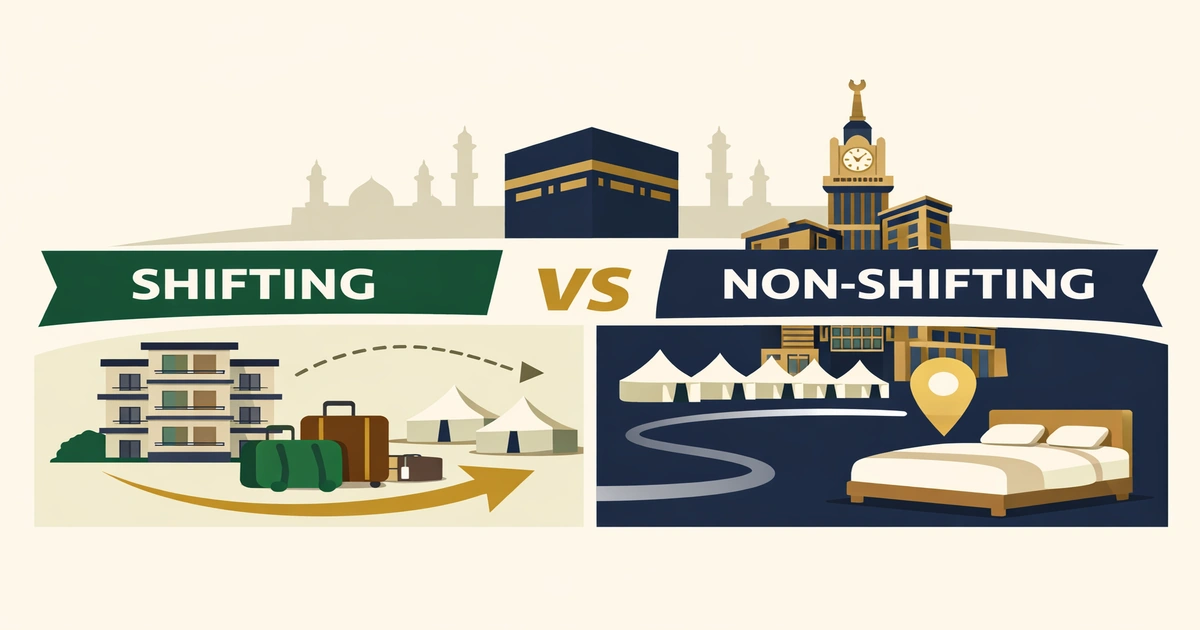
Shifting vs Non-Shifting Hajj Packages: What’s the Difference and Which One Is Better?
Shifting vs Non-Shifting Hajj Packages comes down to one big question: do you want a lower-cost package that usually involves more movement, or a more stable package that usually keeps you in one Makkah hotel and costs more?
The quick answer is this: shifting hajj packages usually give you one accommodation close to the Mashair during Hajj and another Makkah stay before or after Hajj, while non-shifting hajj packages keep you in one Makkah accommodation before and after the Hajj rituals.
That single difference changes almost everything else—price, hotel location, moving luggage during Hajj, comfort, and how easy the days feel when you’re already tired.
If you want the official booking path and package basics first, read Nusuk Hajj packages explained.
✅ TL;DR – Shifting vs Non-Shifting Hajj Packages
Shifting Hajj packages usually suit pilgrims who want a more affordable hajj package option and don’t mind more movement. Non-shifting Hajj packages usually suit pilgrims who want a premium hajj package near haram, less luggage stress, and more stability. If health, age, or comfort matter most, non-shifting often feels easier. If budget matters most, shifting often gives better value.
🌿 A simple reminder before you choose
إِنَّ الدِّينَ يُسْرٌ
Transliteration: Inna ad-deena yusr.
Meaning: The religion is ease.
That matters here. Choosing the package that fits your health, stamina, age, and budget is not “less spiritual.” Sometimes the wiser choice is the one that helps you worship with a calmer heart.
Quick Answer — What is the difference between shifting and non-shifting Hajj packages?
The difference between shifting and non-shifting hajj packages is mainly about accommodation setup. A shifting or non-shifting hajj package is not a different type of Hajj ritual. It is a different travel and stay arrangement.
Shifting Hajj packages in one simple definition
What is a shifting hajj package? Think of it like keeping your main things in one setup and changing your base when the busy Hajj days begin. In simple words, shifting hajj packages involve more than one accommodation stage, usually with a Hajj-period stay closer to the Sacred Mashair and another Makkah stay before or after.
Non-shifting Hajj packages in one simple definition
What is a non-shifting hajj package? Think of it like keeping the same home base in Makkah instead of changing rooms in the middle. Non-shifting hajj packages keep one Makkah accommodation before and after the Hajj rituals, so you’re not relocating during your stay in Makkah.
The shortest answer: which one costs more and which one is easier?
Non-shifting usually costs more and feels easier. Shifting usually costs less and asks more from you physically and mentally.
What Is a Shifting Hajj Package?
Shifting hajj packages explained: this type is built around movement between accommodation phases. That’s why many pilgrims link it with Aziziyah accommodation hajj, Mina access, carry-on planning, and lower overall cost.
How shifting accommodation works during Hajj days
During the Hajj period, the package usually places you in accommodation closer to the Mashair. Before or after that period, you may stay in a Makkah hotel, often one that gives better prayer access than a simple budget base.
It’s a bit like using a practical “working base” during the hardest days, then returning to a more familiar city stay before or after. My students always ask about this part because the word “shifting” sounds more dramatic than it really is.
Aziziyah stay, Mina access, and what happens to your luggage
This is where many booking mistakes happen. In many hajj package with aziziyah stay setups, pilgrims keep larger bags in the secondary accommodation and carry only what they need for the Hajj days.
That sounds simple on paper.
In real life, it means you need to pack with intention.
Micro-scenario: you packed every charger, every toiletry, and three extra outfits into your big suitcase. Then you realize your daily essentials are not in the small bag you took with you. That’s why moving luggage during hajj is not a small detail. It changes how tired or calm you feel.
Why shifting packages are usually cheaper
Is shifting hajj cheaper? Usually, yes. The main reason is simple: the package does not keep a premium Makkah hotel room for you the whole way through the Hajj days. When a room near the Haram is not being retained during that peak period, the total package cost is often lower.
That’s the heart of the price gap.
📚 You Can Also Read: How to Register on Nusuk Hajj
What Is a Non-Shifting Hajj Package?
Non-shifting hajj package near haram is the version many pilgrims imagine first: one hotel, one main Makkah base, fewer changes, less repacking, and a smoother return for key needs before and after the rituals.
Keeping the same Makkah hotel before and after Hajj
Does non-shifting hajj keep the same hotel throughout? In the normal package meaning, yes—the package keeps one Makkah accommodation before and after the Hajj rituals instead of switching you between Makkah stays.
That stability matters more than people think. When the body is already under pressure, even small changes—new room, new route, new luggage setup—can feel bigger than they sound.
Staying near the Haram during Hajj: what “non-shifting” really means
People often hear “non-shifting” and assume it only means luxury. Not always. The real meaning is stability in Makkah hotel during hajj planning. Many pilgrims choose it because they want a hotel retained during hajj rather than because they want flashy extras.
In plain English: you’re paying for fewer disruptions.
Why non-shifting packages usually cost more
The bigger bill usually comes from keeping that Makkah accommodation in place through a high-demand period, especially when the property is closer to the Haram or in a stronger service category. You are paying for location, continuity, and less hassle.
📚 You Can Also Read: Authorized Hajj Service Providers
Shifting vs Non-Shifting Hajj Packages — 7 Key Differences
Shifting vs non-shifting hajj packages explained in one line: one gives you more movement and often better affordability, the other gives you more stability and usually better convenience.
✨ Fast decision box
Choose shifting if you want better value and can handle more movement. Choose non-shifting if you want less disruption, easier hotel continuity, and a smoother physical experience.
1. Hotel location: Aziziyah vs near Haram
The usual comparison is Aziziyah or a Mashair-close setup versus a Makkah hotel with easier Haram access. This is the first thing to check in any hajj package accommodation comparison.
2. Price: which package is usually cheaper?
Shifting hajj packages are usually cheaper. Non-shifting hajj packages are usually more expensive because of hotel retention and convenience.
3. Luggage: do you need to move and repack?
Usually yes with shifting. Usually much less with non-shifting. If you hate re-packing, hate bag confusion, or travel with medications, this point matters a lot.
4. Comfort: which one feels easier during busy Hajj days?
Non-shifting usually feels easier because fewer moving parts means fewer small stresses. When you are exhausted, even finding one missing item can feel like climbing a hill twice.
5. Haram access: who gets easier prayer access?
In general, the pilgrim with the better Makkah location gets easier Haram access. That often favors non-shifting hajj packages, especially where the package keeps a stronger Makkah hotel position.
6. Duration: why non-shifting is often shorter and shifting longer
On Nusuk package categories, the official minimum duration is shorter for non-shifting and longer for shifting. So if you are comparing a short hajj package non-shifting versus a longer hajj package shifting, that pattern is not random.
7. Best fit: first-time, elderly, families, and budget pilgrims
Best hajj package for elderly pilgrims is often non-shifting. Best hajj package for first time pilgrims can go either way, but many first-timers prefer less disruption if budget allows. Families with children or pilgrims carrying regular medicines also often lean non-shifting. Strict budget pilgrims often lean shifting.
Is Shifting Hajj Cheaper Than Non-Shifting?
Is shifting hajj cheaper than non-shifting? Usually yes, and the reason is practical, not mysterious. The package cost changes mainly because of hotel continuity, location, and how much comfort the arrangement protects during the busiest part of the journey.
Why hotel retention near Haram raises the price
A room near the Haram is not just a bed. During Hajj season, it is convenience, time saved, route simplicity, and less physical strain. Keeping that room through the Hajj days raises the package price.
Why shifting can offer better value for budget-conscious pilgrims
If your question is which hajj package offers better value shifting or non-shifting, the honest answer is this: for raw budget value, shifting often wins. You spend less while still getting the essential Hajj journey.
But value is not the same as ease.
When paying more for non-shifting is actually worth it
It is worth it when the pilgrim is elderly, has mobility limits, gets confused by too many changes, travels with family, or simply wants to protect energy for worship instead of logistics.
Here’s the thing: some people save money on paper and lose peace in practice.
📚 You Can Also Read: Hajj Vaccine Requirements 2026
Which Hajj Package Is Better — Shifting or Non-Shifting?
Which hajj package is better shifting or non-shifting? Neither is “better” for everyone. The better one is the package that matches your body, budget, patience, and need for simplicity.
Best for elderly pilgrims
Shifting hajj package vs non-shifting for elderly pilgrims usually ends with non-shifting winning. Less movement, less repacking, and steadier rest make a real difference.
Best for first-time pilgrims
First-time pilgrims often underestimate how mentally tiring the logistics can be. If budget allows, non-shifting is often gentler. If budget is tight, shifting still works well when you prepare properly and know the trade-off.
Best for budget-focused pilgrims
This is usually shifting. If your main goal is an affordable hajj package option, this is where most people start comparing.
Best for comfort-focused pilgrims
This is usually non-shifting. Less friction. Less bag stress. More stable routine.
Best for pilgrims who want less luggage movement
Do shifting hajj packages require moving luggage? Often yes, at least in a practical sense of sorting, separating, or carrying essentials differently. If you want the fewest luggage decisions possible, non-shifting usually fits better.
Nusuk Shifting vs Non-Shifting Packages
Nusuk shifting vs non-shifting packages are standardized categories offered on the official platform, then filtered through service level, hotel class, duration, and itinerary details.
How Nusuk officially defines shifting packages
Nusuk describes nusuk shifting packages as packages that provide accommodation close to the Sacred Mashair during the Hajj period, plus a second accommodation in Makkah before or after Hajj, usually near Al-Masjid Al-Haram.
How Nusuk officially defines non-shifting packages
Nusuk describes nusuk non-shifting packages as packages with a single Makkah accommodation before and after performing the Hajj rituals, without requiring the pilgrim to relocate during the stay in Makkah.
Package categories: luxury, premium, and standard in both types
This is one part many people miss. The debate is not just shifting versus non-shifting. Inside both, you can still compare luxury, premium, and standard package levels. So a weak non-shifting deal is not automatically better than a strong shifting one.
Can you start in Madinah first or Makkah first?
Some providers offer different itinerary sequences, including madinah first or makkah first hajj package options. Always read the exact itinerary, city order, transport method, and check-in/check-out flow before you pay. I used to mix this up all the time when I was learning package language, because people focus on hotel stars and forget the route itself.
📚 You Can Also Read: Nusuk Hajj Eligible Countries 2026
Pros and Cons of Shifting Hajj Packages
Pros and cons of shifting hajj packages are really about comfort versus cost. If you know that from the start, the rest becomes clearer.
Main advantages of shifting packages
- Usually lower price than non-shifting
- Better fit for budget pilgrims who can manage movement
- Can suit longer stays and more practical accommodation setups
- Often useful for pilgrims who care more about value than hotel continuity
Main disadvantages of shifting packages
- More movement during an already tiring journey
- More luggage planning and higher chance of small mistakes
- Less simple routine for elderly or anxious pilgrims
- Hotel access near Haram may feel less convenient overall
Common mistakes pilgrims make before booking shifting packages
Mistake 1: Seeing a lower price and assuming the experience will feel almost the same. Fix: Ask exactly how the accommodation changes work.
Mistake 2: Ignoring the luggage plan. Fix: Ask what stays where and what you should carry yourself.
Mistake 3: Booking for an elderly parent without thinking about movement. Fix: Put stamina before savings.
Mistake 4: Reading hotel stars but not reading location notes. Fix: Check the actual accommodation stage, not just the headline.
Mistake 5: Assuming every shuttle pattern is the same. Fix: Ask what transport is included and when.
Pros and Cons of Non-Shifting Hajj Packages
Pros and cons of non-shifting hajj packages are almost the mirror image: more ease, more comfort, higher price.
Main advantages of non-shifting packages
You keep one main Makkah base, reduce movement, lower the chance of luggage confusion, and usually get a calmer overall flow. For many pilgrims, that steadiness is the real luxury.
Main disadvantages of non-shifting packages
The cost is the obvious drawback. Also, some people pay extra for “stability” when their own budget would have been better protected by a good shifting package and stronger personal preparation.
When non-shifting may not justify the extra cost
If you are healthy, experienced, comfortable with simple travel, and strongly budget-focused, you may not need to pay the premium. In that case, a well-planned shifting option can make more sense.
a short story of a beginner mistake (and the simple fix)
A brother once told me, “I booked the cheaper option because the hotel photos looked fine.”
Then the real trip began, and he realized he had not understood the accommodation flow at all.
His medicine pouch was in the wrong bag. His slippers were in the wrong suitcase. He kept saying, “I thought hotel stars were the main thing.”
They weren’t.
The fix was simple, but late: he split essentials into one daily-use bag, kept documents and medicine on him, and finally understood that comfort vs cost hajj package is not just a money question. It is an energy question.
ending: choose the package your body can carry
Should I choose shifting or non-shifting hajj package? Choose the one you can live through with dignity, calm, and enough energy left for worship.
If you’re strong, organized, and budget-focused, shifting hajj packages may be the better call.
If you need steadiness, easier hotel continuity, and less movement, non-shifting hajj packages may be the better call.
Don’t book the package that sounds impressive.
Book the one that makes your Hajj more bearable, more focused, and more honest.
📚 You Can Also Read: Mina in Hajj • Tawaf al-Wida • STC SIM for Hajj and Umrah
Shifting vs Non-Shifting Hajj Packages Comparison Guide

📊 Shifting vs Non-Shifting Hajj Packages — quick comparison
Use this table when you want the decision fast. It strips the topic down to the real booking differences that affect most pilgrims.
🌙 Show Comparison Table
| Point | Shifting | Non-Shifting |
|---|---|---|
| Accommodation pattern | More than one accommodation stage | Single Makkah accommodation before and after Hajj rituals |
| Typical price | Usually cheaper | Usually more expensive |
| Luggage handling | More planning and movement | Less repacking and less disruption |
| Comfort level | Good for practical, budget-aware pilgrims | Better for pilgrims who want ease and stability |
| Haram access feel | Often less direct overall | Often easier overall, depending on hotel location |
| Official minimum duration pattern | 14 days minimum on Nusuk category page | 10 days minimum on Nusuk category page |
| Best fit | Budget-focused, organized, physically steadier pilgrims | Elderly, first-timers, families, comfort-focused pilgrims |
FAQs About Shifting vs Non-Shifting Hajj Packages
📘 Shifting vs Non-Shifting Hajj Packages FAQs
What is a shifting Hajj package?
Show Answer
A shifting hajj package usually includes more than one accommodation stage, with a Hajj-period stay near the Mashair and another Makkah stay before or after Hajj.
What is a non-shifting Hajj package?
Show Answer
A non-shifting hajj package keeps one Makkah accommodation before and after the Hajj rituals, so the pilgrim is not relocating during the stay in Makkah.
Is shifting Hajj cheaper?
Show Answer
Usually yes. Shifting hajj packages are often cheaper because they do not keep the same premium Makkah hotel setup in the same way that many non-shifting hajj packages do.
Which Hajj package is better for elderly pilgrims?
Show Answer
In many cases, non-shifting is better for elderly pilgrims because it reduces movement, bag stress, and overall disruption.
Does non-shifting mean the same hotel throughout Hajj?
Show Answer
It means one Makkah accommodation is retained before and after the Hajj rituals. Always read the exact itinerary and service notes before paying.
Do shifting Hajj packages require moving luggage?
Show Answer
Often yes, at least in practical terms. You usually need a smarter split between your daily-use bag and your larger stored luggage.
Are both shifting and non-shifting available on Nusuk?
Show Answer
Yes. Nusuk presents both Shifting and Non-Shifting as standardized package categories.
Which package is better for first-time pilgrims?
Show Answer
If budget allows, many first-time pilgrims feel more comfortable with non-shifting because it removes one layer of confusion. But well-prepared first-timers can still do very well with shifting.
Which package is better for strict budgets?
Show Answer
Usually shifting. It is often the stronger choice for pilgrims who want an affordable hajj package option.
Do both package types come in luxury, premium, and standard levels?
Show Answer
Yes. On Nusuk, both package types are shown across accommodation classes such as luxury, premium, and standard.
Is non-shifting always near the Haram?
Show Answer
Not automatically. Many people associate it with a premium hajj package near haram, but you still need to check the actual hotel zone, class, and transfer details.
Can UK pilgrims choose either type?
Show Answer
Package availability depends on current serviced countries, provider offerings, and the season’s rules. UK pilgrims should check current Nusuk eligibility and live package listings at booking time.

Farrukh Farooqi has been living in Sharaya, Makkah, Saudi Arabia since 2010. With over 14 years of firsthand experience witnessing the sacred journey of millions of pilgrims, Farrukh specializes in providing practical, insider tips for Hajj and Umrah travelers. His work blends real-world observations, the latest Saudi updates, and essential crowd management strategies — helping pilgrims and worshippers plan smarter, stay safer, and experience a spiritually fulfilling journey across the Holy Cities.


