
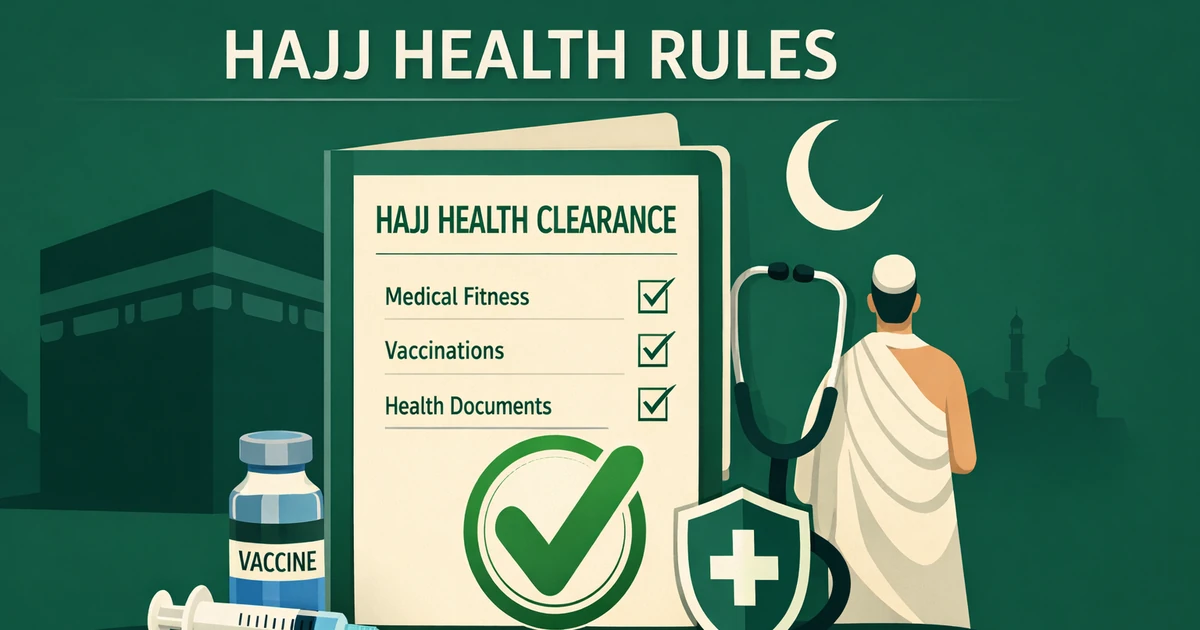
Hajj Medical Requirements 2026: Vaccines, Medical Fitness, Health Documents, and Travel Rules
Hajj medical requirements for 2026 come down to medical fitness for Hajj, Hajj vaccination requirements, country-based health rules, and the right documents before travel. The most important universal medical rule is the meningitis vaccine for Hajj, while polio vaccine for Hajj, yellow fever vaccine for Hajj, and some COVID vaccine for Hajj 2026 proof depend on official categories and country-based risk rules. If you are planning your route and official booking path, first check Nusuk Hajj eligible countries 2026.
Quick Takeaways
- Universal check: every pilgrim must review medical fitness for Hajj and the mandatory ACYW meningitis vaccine.
- Country-specific check: some pilgrims also need polio vaccine proof or a yellow fever certificate.
- COVID-19 check: some groups need accepted proof of vaccine or immunity.
- Document check: pilgrims should carry a Hajj vaccine certificate, medical report if they have chronic disease, and prescription-related papers.
- Safety check: heat, infection prevention, hydration, hygiene, and medicine planning are part of real Hajj health requirements 2026, not just vaccine rules.
What are the Hajj medical requirements for 2026?
What are the Hajj medical requirements for 2026? The short answer is this: pilgrims must meet Hajj medical requirements 2026 related to physical ability, required vaccines, country-based health rules, and travel health documentation. The biggest universal requirement is the meningitis vaccine for Hajj 2026. Beyond that, some travelers also fall under polio vaccine for Hajj, yellow fever vaccine for Hajj, and COVID vaccine for Hajj 2026 proof rules. Pilgrims with chronic illness should also prepare a clear medical report for Hajj pilgrims and a proper Hajj medicines checklist.
The 4 checks that matter most: fitness, vaccines, country rules, and health documents
The most practical way to understand medical requirements for Hajj is to split them into 4 checks:
- Medical fitness: can you safely perform the rites physically?
- Vaccination: do you meet the required Hajj vaccination requirements?
- Country rules: does your country trigger extra proof?
- Health documents: are your papers complete and readable?
Which Hajj medical requirements apply to all pilgrims, and which depend on your country?
Some Saudi Hajj medical requirements are universal. The clearest example is the required quadrivalent ACYW meningitis vaccine. Other rules depend on where a pilgrim is coming from, especially the polio vaccine for Hajj and yellow fever vaccine for Hajj categories. This is why many readers confuse universal rules with country-triggered rules.
Do you need a medical certificate for Hajj 2026? What is official, and what may be country-specific?
The safest wording is this: the official Saudi 2026 health rules clearly focus on medical fitness for Hajj and require countries to declare that pilgrims are free from conditions that contradict the minimum physical ability to perform Hajj. However, you should not say there is a single universal public-facing medical certificate for Hajj rule for every pilgrim in the exact same way unless your country’s Hajj authority requires one during its own process. In practice, many pilgrims still need a doctor review, screening, or country-specific Hajj health certificate as part of local Hajj clearance.
Hajj Medical Requirements 2026: Decision Table
This table gives real user value. It helps the pilgrim quickly separate universal rules from country-based rules and health-condition-based preparation.
| Medical Requirement | Who It Applies To | Why It Matters | What the Pilgrim Should Prepare |
|---|---|---|---|
| Medical fitness / physical ability | All pilgrims | Hajj requires major walking, crowd exposure, heat, and physical strain | Doctor checkup, chronic disease plan, medical report |
| Meningitis vaccine (ACYW / ACYWX) | All pilgrims | This is the main universal vaccine rule | Valid vaccine certificate with date and vaccine type |
| Polio vaccine proof | Pilgrims from listed countries | Country-based public health control | Accepted polio certificate within the correct timing window |
| Yellow fever certificate | Pilgrims from listed risk countries | Entry health requirement tied to yellow fever risk | International yellow fever certificate with correct timing |
| COVID-19 proof pathway | Specific groups | Some travelers must show vaccine or immunity proof | Updated dose, older primary series, or accepted recovery proof |
| Medical report / medicines | Especially chronic disease patients and elderly pilgrims | Helps safe treatment during travel and rituals | Doctor note, medicine list, prescriptions, original packaging |
Why this table helps: instead of mixing everything together, it shows exactly which Hajj medical requirements are universal, which are country-based, and which matter most for pilgrims with chronic conditions.
Hajj Medical Fitness 2026 — Who may be medically unfit to perform Hajj?
What “physical ability” means under the 2026 Saudi health rules
Hajj physical ability requirements are not just about general health. Hajj involves long walking, crowd pressure, heat exposure, sleep disruption, and physically demanding movement between sacred sites. So medical fitness for Hajj means the pilgrim can perform the rites without serious danger to self or others. This is one of the most important parts of Hajj health requirements.
Conditions that may make a pilgrim unfit for Hajj
When users search who is medically unfit for Hajj or who is medically unfit to perform Hajj, they usually want direct clarity. The main concern is whether a medical condition prevents safe movement, safe crowd exposure, or stable self-care during the journey.
Kidney failure, heart failure, severe lung disease, dementia, and active infectious disease
Examples of serious conditions that can conflict with Hajj fitness requirements include:
- Kidney failure requiring dialysis
- Heart failure with symptoms on minimal physical effort
- Chronic lung disease requiring intermittent or continuous oxygen
- Severe neurological or psychiatric disorders affecting cognition
- Senility with dementia
- Active infectious disease with public-health risk
- Active cancer treatment causing major immune suppression
Pregnancy and Hajj 2026: who should postpone travel
Hajj medical requirements for pregnant women should be handled carefully. High-risk pregnancy and pregnancy in the last three months are major concerns under the health rules. A pregnant pilgrim should not focus only on the Hajj vaccination requirements; she also needs honest medical advice about whether travel should be postponed.
📚 You Can Also Read: How to Register on Nusuk Hajj
Required Hajj Vaccines 2026
Meningitis vaccine for Hajj 2026: ACYW rule for all pilgrims
The center of all Hajj vaccine requirements 2026 is the meningitis vaccine for Hajj. This is the universal vaccine rule for pilgrims. Searches like do you need a meningitis vaccine for Hajj 2026 and what vaccines are required under Hajj medical requirements should be answered directly: the main required vaccine is the quadrivalent ACYW meningococcal vaccine, with accepted conjugate or polysaccharide pathways.
Conjugate vs polysaccharide meningitis vaccine: validity and timing
The difference matters for Hajj vaccine certificate validity:
- Conjugate ACYW or accepted ACYWX options can be valid up to 5 years
- Polysaccharide ACYW can be valid up to 3 years
- In both cases, the vaccine must be taken at least 10 days before arrival
If the vaccine type is not clearly shown, certificate handling can become stricter. This is why Hajj vaccine certificate details matter.
Polio vaccine for Hajj 2026: who must show proof
Polio vaccine for Hajj is not a blanket rule for every pilgrim. It applies to pilgrims arriving from listed countries or risk categories. This is one of the clearest examples of how country-specific Hajj medical rules differ from universal rules.
Yellow fever vaccine for Hajj 2026: which travelers need it
Yellow fever vaccine for Hajj is required for pilgrims arriving from listed yellow-fever-risk countries. The certificate becomes valid after the required pre-travel period and is treated as long-term proof. For most readers, this will only matter if their country or travel route triggers it.
COVID vaccine for Hajj 2026: who needs proof of vaccine or immunity
COVID vaccine for Hajj 2026 is not best explained as one identical rule for everyone. The official wording focuses on specific groups who need accepted proof of vaccine or immunity. This may include an updated seasonal dose, an earlier primary series, or documented recovery, depending on the accepted pathway.
Required Hajj Vaccines 2026: What the Pilgrim Must Check
- Check 1: Is your meningitis vaccine for Hajj still within validity?
- Check 2: Does your country trigger polio vaccine for Hajj proof?
- Check 3: Does your country trigger a yellow fever vaccine for Hajj certificate?
- Check 4: Do you fall into a COVID vaccine for Hajj 2026 proof category?
- Check 5: Does your Hajj vaccine certificate clearly show vaccine name and date?
📚 You Can Also Read: Hajj Vaccine Requirements 2026
Recommended Vaccines and Routine Immunizations for Hajj
Is flu vaccine mandatory for Hajj 2026 or recommended?
Is flu vaccine mandatory for Hajj 2026? The clean answer is that the flu vaccine for Hajj is officially recommended before travel, especially for high-risk pilgrims. Do not overstate it as a universal mandatory condition for every pilgrim in the same way as the meningitis rule.
COVID vaccine advice for pilgrims outside the mandatory groups
Even if a pilgrim is outside the groups that must show COVID proof, it is still sensible to review updated Hajj travel health advice and stay protected, especially for elderly pilgrims and those with chronic disease.
Routine vaccines pilgrims should update before Hajj
Beyond the main Hajj mandatory vaccines, pilgrims should also review routine immunizations before travel. Practical examples include vaccines related to routine immunization schedules such as tetanus, diphtheria, pertussis, measles, mumps, and other standard updates where relevant.
📚 You Can Also Read: Nusuk App for Hajj and Umrah
Medical Requirements for Hajj by Country
Pilgrims from polio-risk countries: what extra proof is required
Hajj medical requirements for pilgrims from polio countries often include extra vaccine proof within a defined time window before arrival. The important point is that this is not a universal rule for all pilgrims. It is a country-risk rule.
Pilgrims from yellow fever countries: certificate rules and timing
Hajj medical requirements for yellow fever countries focus on a valid international yellow fever certificate. Travelers from those countries should verify the certificate timing well before departure, not at the last minute.
Why country-specific Hajj medical rules are different from universal rules
Many weak articles mix everything together. Strong SEO writing should separate universal Hajj medical requirements from country-specific Hajj health requirements 2026. That helps users avoid the wrong assumption that every pilgrim must meet every vaccine rule.
📚 You Can Also Read: Hajj 2026 Pakistan Registration
Medical Documents to Carry for Hajj 2026
Vaccination certificate: what it must show
Your Hajj vaccine certificate should clearly show:
- Vaccine name
- Date of administration
- Readable identity match
- Correct timing for travel compliance
Medical report for chronic disease patients
A detailed medical report for Hajj pilgrims is especially useful for chronic disease patients. It should summarize the diagnosis, major history, regular medicines, dose timings, allergies, and emergency notes.
Prescription medicines: original packaging, copies, and doctor note
One of the most overlooked Hajj health documents is a proper medicines file. Bring medicines in original packaging, keep copies of prescriptions, and carry a short doctor note where needed. This is especially important for insulin, inhalers, cardiac medicines, and blood-pressure treatment.
Do you need proof of residency, insurance, or visa-linked health papers?
Do not write broad claims that automatic insurance is included for every pilgrim unless your route or authority states that specifically. In practical terms, pilgrims may still need visa-linked papers, country-channel health forms, or booking-related documents depending on their Hajj process. So the smart advice is to verify your exact Hajj visa medical requirements through your own Hajj authority or approved provider.
Medical Documents Checklist for Hajj 2026
- Passport and visa papers
- Hajj vaccine certificate
- Medical report for chronic disease patients
- Prescription copies and medicine list
- Doctor note for special medicines or devices
- Emergency contact details
- Travel-health copies in printed and digital form
📚 You Can Also Read: Authorized Hajj Service Providers
Chronic Disease Hajj Preparation
Hajj medical requirements for diabetics
Hajj medical requirements for diabetics go beyond vaccines. Diabetic pilgrims should carry a glucose meter, sugar-related supplies, enough medicines, and a clear medical report. They should not start demanding rituals without medicine, food, and hydration planning in place.
Hajj medical requirements for heart patients
Hajj medical requirements for heart patients depend on stability. A stable heart patient may travel after doctor review, but severe symptomatic heart failure is a serious fitness concern. Heart patients should avoid unnecessary strain, carry all medicines, and know when to seek urgent care.
Hajj medical requirements for asthma and lung disease patients
Hajj medical requirements for asthma and lung disease patients include inhaler planning, dust and crowd exposure awareness, rest periods, and quick response to symptoms. Severe chronic lung disease that requires oxygen is a major medical fitness issue.
Hajj medical requirements for elderly pilgrims
Hajj medical requirements for elderly pilgrims should focus on walking ability, hydration, medication discipline, heat safety, and honest doctor assessment. Age alone is not the only issue. Frailty, cognition, balance, and chronic disease control matter more.
📚 You Can Also Read: Nusuk Hajj Packages Explained
Hajj Medication and Packing Checklist
How much medicine to bring for Hajj
The best rule is simple: bring enough medicine for the full journey plus a small safety margin. This is one of the most practical parts of how to prepare medically for Hajj.
Items to pack: prescriptions, glucose meter, masks, sanitizer, sunscreen
A practical Hajj medication packing list should include:
- Regular prescription medicines
- Prescription copies
- Glucose meter if diabetic
- Masks
- Hand sanitizer
- Sunscreen
- Basic pain relief and hygiene items
How to store medicines safely during Hajj travel
Medicine storage matters in hot conditions. Keep medicines away from direct sun, protect heat-sensitive items properly, and do not leave important drugs in unsafe places during travel or tent movement.
Hajj Medicines Checklist
This box gives unique value because it solves a real user problem: pilgrims often remember vaccines but forget daily treatment basics.
- Main medicines for the full journey plus extra backup
- Prescription copies and a short doctor note
- Original packaging for important medicines
- Cooling plan for insulin or temperature-sensitive items
- Simple first-aid basics such as pain relief and wound care
- Hydration support items such as oral rehydration where needed
- Personal disease tools like a glucose meter or inhaler spacer
Health Safety During Hajj
Heat exhaustion and sunstroke prevention for pilgrims
Hajj heat safety tips matter because many pilgrims underestimate heat exposure. Use shade when possible, drink fluids regularly, avoid direct sun for too long, and do not ignore dizziness, weakness, or confusion.
Respiratory infection prevention in crowded rituals
Hajj respiratory infection prevention includes masks in crowded places, cough etiquette, hand hygiene, and avoiding close contact with visibly ill people. Respiratory illness is one of the most common Hajj health concerns.
Food poisoning, hygiene, and handwashing basics
Hajj hygiene checklist basics are simple but powerful: wash hands often, avoid unsafe food, keep food covered, do not leave cooked meals out too long, and drink safe water.
📚 You Can Also Read: STC SIM for Hajj and Umrah
Islamic Reminder About Ability and Protecting Health
Quran
وَلِلَّهِ عَلَى النَّاسِ حِجُّ الْبَيْتِ مَنِ اسْتَطَاعَ إِلَيْهِ سَبِيلًا
Transliteration: Wa lillahi ‘ala an-nasi hijjul bayti man استطاع إليه سبيلا.
Translation: And due to Allah from the people is a pilgrimage to the House — for whoever is able to find a way to it.
Meaning for this topic: Ability includes real physical and practical ability, which is why medical fitness for Hajj matters.
Hadith
لَا ضَرَرَ وَلَا ضِرَارَ
Transliteration: La darar wa la dirar.
Translation: There should be neither harm nor reciprocating harm.
Meaning for this topic: Careful health preparation protects both the pilgrim and the wider crowd during Hajj.
FAQs About Hajj Medical Requirements 2026
What are the Hajj medical requirements for 2026?
Hajj medical requirements 2026 include medical fitness for Hajj, the required meningitis vaccine for Hajj, country-based rules for polio vaccine for Hajj and yellow fever vaccine for Hajj, some COVID vaccine for Hajj 2026 proof categories, and proper travel health documents.
Do I need a medical certificate for Hajj 2026?
You should not treat a universal medical certificate for Hajj as a one-line rule for every pilgrim in all countries. But many pilgrims do need a doctor checkup, local Hajj health screening, or country-specific medical clearance during the Hajj process.
Is meningitis vaccine mandatory for Hajj 2026?
Yes. The meningitis vaccine for Hajj 2026 is the core universal vaccine requirement for pilgrims.
Is flu vaccine mandatory for Hajj 2026?
No, not as the main universal rule for all pilgrims. The flu vaccine for Hajj is officially recommended, especially for higher-risk travelers.
Is COVID vaccine required for Hajj 2026?
COVID vaccine for Hajj 2026 proof applies to specific groups using accepted vaccine or immunity pathways. It is best not to oversimplify it as the same rule for every pilgrim.
Who is medically unfit to perform Hajj?
People with serious conditions that clearly block safe performance of the rites may be considered unfit, such as major organ failure, severe cognitive impairment, severe oxygen-dependent lung disease, dangerous infectious disease, or high-risk pregnancy.
What medicines should I take for Hajj?
Take your regular prescribed medicines, copies of prescriptions, and condition-specific tools like a glucose meter or inhaler supplies. A proper Hajj medicines checklist is part of smart travel preparation.
What medical documents should I carry for Hajj?
Carry your Hajj vaccine certificate, medical report if you have chronic disease, prescription copies, and doctor notes for important medicines or devices.
More FAQs About Hajj Medical Requirements 2026
What medical requirements are needed for Hajj?
Medical requirements for Hajj include medical fitness for Hajj, the required meningitis vaccine for Hajj, any country-based polio vaccine for Hajj or yellow fever vaccine for Hajj rules, and the right Hajj health documents before travel. Pilgrims with chronic illness should also prepare a clear medical report for Hajj pilgrims and enough medicines in original packaging.
What are the Hajj health requirements 2026 besides vaccines?
Hajj health requirements 2026 go beyond vaccination. They also include Hajj health screening, medical fitness for Hajj, heat and infection prevention, safe medicine planning, and proper Hajj pre travel medical check preparation. This is why pilgrims should not treat the topic as only a vaccine checklist.
Do pilgrims need a medical certificate for Hajj 2026?
Many users search do pilgrims need a medical certificate for Hajj 2026 because local Hajj authorities often ask for health clearance. The safest answer is that country-specific processing may require a medical certificate for Hajj, doctor review, or health declaration, especially when a pilgrim has chronic disease or a higher-risk medical history.
What is the difference between Hajj medical requirements and Hajj vaccination requirements?
Hajj medical requirements are wider than Hajj vaccination requirements. Vaccine rules cover immunization and proof, while medical rules also include physical ability, chronic disease control, heat safety, infection prevention, and the documents a pilgrim may need during travel and rituals.
What is included in a Hajj pre travel medical check?
A practical Hajj pre travel medical check usually includes review of fitness, chronic illness stability, medicine planning, vaccination status, travel-risk advice, and whether the pilgrim can safely handle walking, crowd exposure, heat, and long travel days. This is one of the smartest steps in how to prepare medically for Hajj.
What medical test for Hajj visa may be asked by some countries?
Searches for medical test for Hajj visa usually reflect country-specific Hajj procedures, not one identical rule for every pilgrim worldwide. Depending on the home country or Hajj delegation, a pilgrim may be asked for a doctor examination, medical declaration, vaccination proof, or chronic-disease review as part of visa or travel processing.
What is a Hajj health certificate?
A Hajj health certificate usually means a health document that confirms the pilgrim’s medical status, vaccination status, or fitness review during local processing. In some cases, it overlaps with a medical certificate for Hajj; in other cases, it may simply be a supporting travel-health paper.
What Hajj health documents should pilgrims keep in printed form?
Hajj health documents are safer when kept in both digital and printed form. A pilgrim should usually carry printed copies of the Hajj vaccine certificate, prescription list, doctor note, chronic-disease medical report, and emergency contacts. Printed backup helps if a phone battery dies or internet access becomes difficult.
Can incomplete Hajj health documents delay travel?
Yes. Missing vaccine dates, unclear medicine papers, or incomplete Hajj health documents can create last-minute trouble during delegation review, airline checks, or travel preparation. Good paperwork is a real part of medical requirements for Hajj.
What should a medical report for Hajj pilgrims include?
A useful medical report for Hajj pilgrims should include diagnosis, current medicines, dose timings, allergies, major history, device needs, and emergency notes. This is especially helpful for pilgrims with diabetes, heart disease, asthma, kidney disease, or other long-term conditions.
What are Hajj medical requirements for people with chronic diseases?
Hajj medical requirements for people with chronic diseases focus on stability, doctor review, medicine planning, hydration, and the ability to tolerate physical effort safely. The pilgrim should not just ask about vaccines. They should also ask whether their condition is stable enough for Hajj travel and rituals.
What are Hajj medical requirements for elderly pilgrims?
Hajj medical requirements for elderly pilgrims include walking tolerance, balance, hydration, medicine discipline, heat safety, and cognition. Elderly pilgrims should be assessed based on actual function and disease control, not age alone.
What are Hajj medical requirements for diabetics?
Hajj medical requirements for diabetics include carrying enough diabetes medicine, a glucose meter, quick sugar support, a medical report, and a foot-protection plan. Diabetic pilgrims should also avoid beginning demanding rituals without food, medication, and hydration readiness.
What are Hajj medical requirements for heart patients?
Hajj medical requirements for heart patients depend on condition stability. A stable patient may travel with doctor advice, but severe symptomatic heart failure is a serious medical fitness for Hajj issue. Heart patients should carry all medicines, avoid overexertion, and know warning signs that need urgent care.
What are Hajj medical requirements for asthma and lung disease patients?
Hajj medical requirements for asthma and lung disease patients include inhaler planning, avoiding triggers, taking rest breaks, and monitoring symptoms in crowded or dusty conditions. Severe lung disease that needs oxygen is a major red flag under Hajj fitness requirements.
What are Hajj medical requirements for pregnant women?
Hajj medical requirements for pregnant women should be handled with extra care. High-risk pregnancy and late pregnancy can raise serious concerns about medical fitness for Hajj. A pregnant pilgrim should seek doctor advice early and not rely on general internet summaries.
Who is medically unfit for Hajj because of chronic disease?
Search intent around who is medically unfit for Hajj often points to severe disease that prevents safe performance of rituals. Examples include dialysis-dependent kidney failure, severe heart failure, oxygen-dependent chronic lung disease, severe dementia, and serious active infections that create public-health risk.
Can a pilgrim perform Hajj with dialysis-dependent kidney disease?
This is one of the most serious Hajj medical conditions. A pilgrim with dialysis-dependent kidney disease should not assume travel is safe just because vaccines are complete. This type of condition raises major medical fitness for Hajj concerns and needs specialist medical advice.
Can a pilgrim perform Hajj with dementia or severe cognitive problems?
Severe cognitive impairment is one of the strongest reasons users search who is medically unfit to perform Hajj. If dementia affects awareness, safety, or self-care, it can conflict with the minimum Hajj physical ability requirements.
Can active infectious disease stop a person from Hajj?
Yes. An active infectious disease that creates public-health risk in crowded conditions can be a serious barrier under Saudi Hajj medical requirements. This is why Hajj health screening and doctor review matter for symptomatic travelers.
What medicines should I take for Hajj if I have a chronic illness?
If you ask what medicines should I take for Hajj, the first answer is your regular prescribed medicines for the full journey plus backup supply. Your Hajj medicines checklist should also include prescriptions, copies of your medicine list, and disease-specific tools such as a glucose meter or inhalers.
How much medicine should I bring for Hajj?
The safest answer is enough for the entire journey plus extra backup in case of delay. This is a key part of every smart Hajj medication packing list, especially for pilgrims who depend on daily medicines for blood pressure, diabetes, heart disease, asthma, or kidney conditions.
Why should medicines stay in original packaging during Hajj travel?
Original packaging helps avoid confusion, proves the medicine identity, and makes it easier for medical staff to understand what the pilgrim is taking. This is especially important when carrying insulin, inhalers, heart medicines, or other long-term treatments.
What should be on a Hajj medicines checklist?
A practical Hajj medicines checklist should include regular medicines, prescription copies, original packaging, basic pain relief, sanitizer, masks, sunscreen, and disease-specific tools like a glucose meter or inhaler supplies. This supports both treatment safety and travel readiness.
What are the best Hajj heat safety tips for older and sick pilgrims?
Hajj heat safety tips include avoiding direct sun, drinking fluids regularly, taking rest breaks, using shade or an umbrella, and not pushing through dizziness or exhaustion. Older pilgrims and those with chronic disease should take heat risk very seriously.
What is the best Hajj respiratory infection prevention plan?
A good Hajj respiratory infection prevention plan includes mask use in crowded places, cough etiquette, hand hygiene, avoiding close contact with visibly ill people, and seeking medical help early if fever, cough, or breathing difficulty appears.
What is the most important Hajj hygiene checklist for pilgrims?
A basic Hajj hygiene checklist should include frequent handwashing, safe food choices, clean drinking water, proper tissue use when coughing or sneezing, wearing clean clothes, and keeping personal items separate. These simple habits prevent many common Hajj illnesses.
Do I need a Hajj doctor checkup even if I feel healthy?
A Hajj doctor checkup is still a smart step even for people who feel generally well. Hajj is physically demanding, so hidden problems with stamina, blood pressure, blood sugar, breathing, or medication planning can still affect safe travel and ritual performance.
What are common Hajj illness restrictions pilgrims should know?
Hajj illness restrictions usually relate to conditions that make crowded travel unsafe, such as major organ failure, dangerous infectious disease, severe cognitive impairment, and high-risk pregnancy. The key question is not only diagnosis, but whether the pilgrim can safely perform Hajj.
How do Hajj health check requirements affect travel planning?
Hajj health check requirements affect timing for doctor visits, vaccination, medicines, paperwork, and final travel readiness. Pilgrims who start late often face avoidable problems with documents, unstable conditions, or missing vaccine proof.
What documents should pilgrims carry for Hajj health requirements?
If you are asking what documents should pilgrims carry for Hajj health requirements, the best short answer is: carry your Hajj vaccine certificate, prescription list, doctor note, chronic-disease medical report, and emergency contacts in both printed and digital form.
Final Word
Hajj medical requirements are broader than vaccines alone. A strong article must explain medical fitness for Hajj, the universal meningitis vaccine for Hajj, country-based proof for polio and yellow fever, selected COVID vaccine for Hajj 2026 proof rules, and the real-world health documents and medicine planning pilgrims need. The pilgrim who prepares medically early usually avoids the biggest last-minute travel problems.
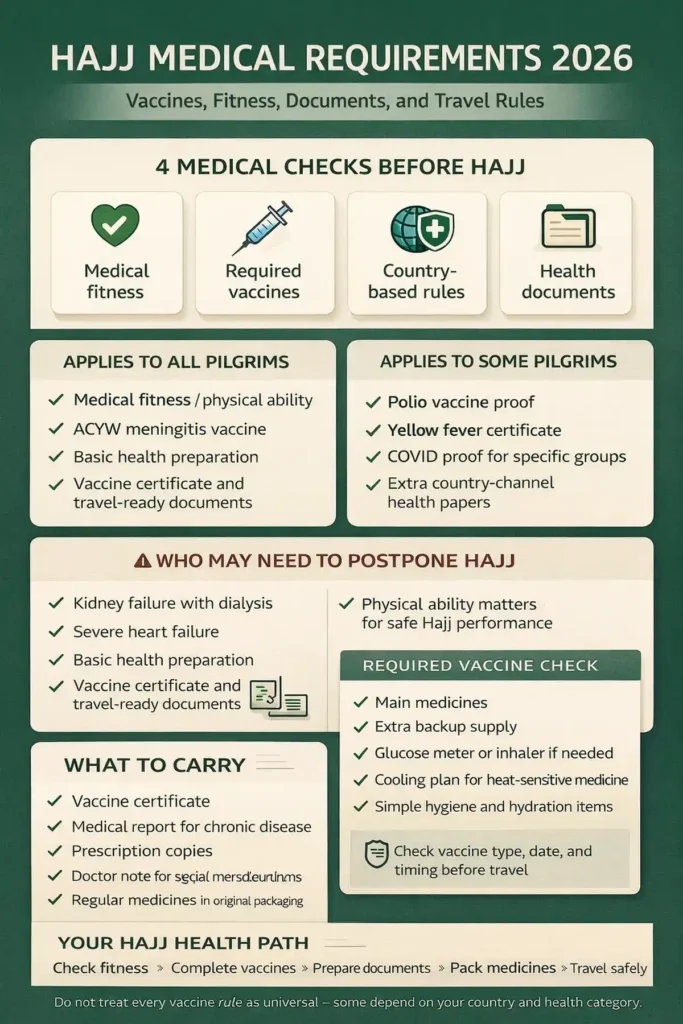
Hajj Medical Requirements 2026 Infographic: Vaccines, Fitness, and Documents

Farrukh Farooqi has been living in Sharaya, Makkah, Saudi Arabia since 2010. With over 14 years of firsthand experience witnessing the sacred journey of millions of pilgrims, Farrukh specializes in providing practical, insider tips for Hajj and Umrah travelers. His work blends real-world observations, the latest Saudi updates, and essential crowd management strategies — helping pilgrims and worshippers plan smarter, stay safer, and experience a spiritually fulfilling journey across the Holy Cities.


