

Miqat for Hajj: Meaning, 5 Miqat Points, Ihram Rules, and What to Do If You Miss It
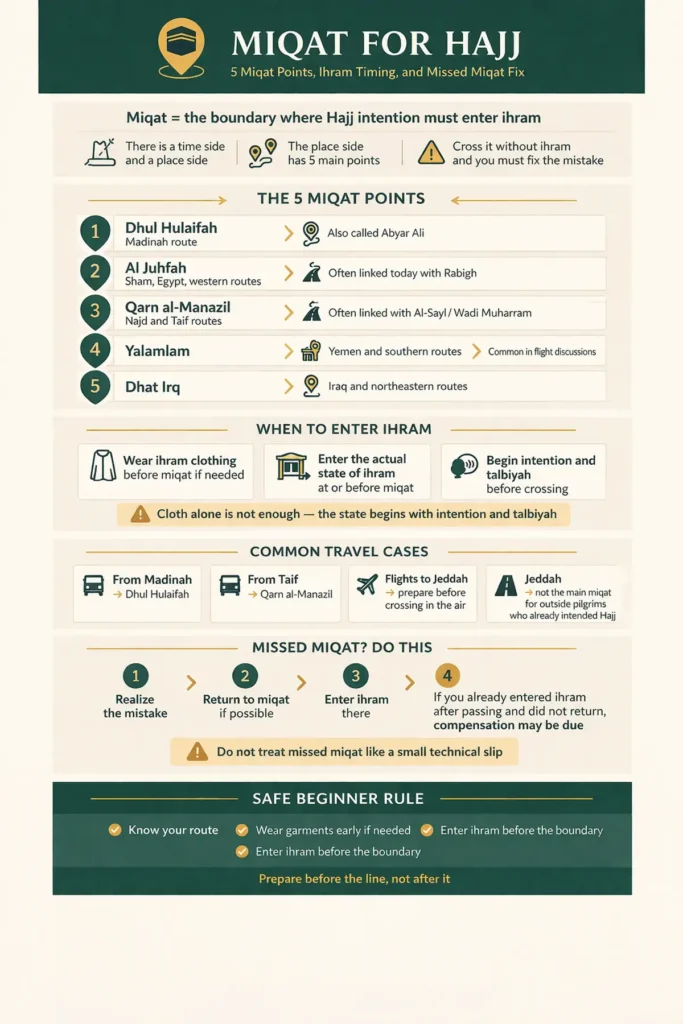
Miqat for Hajj means the appointed boundary where a pilgrim intending Hajj must enter ihram before moving on toward Makkah. There is a time side and a place side. The place side has five main points. Cross that boundary with Hajj intention but without ihram, and you have a real problem to fix, not a small technicality.
If you also need the wording for intention and pilgrimage formulas, read Niyyah for Hajj and Umrah. This page gives the direct answer first: what is miqat for hajj, which of the miqat points for hajj applies to your route, where to wear ihram for hajj, what happens on flights, and what to do if you cross late.
✅ TL;DR – miqat for hajj
Miqat for Hajj is the appointed time and boundary for entering ihram before Makkah. The five main points are Dhul Hulaifah, Al Juhfah, Qarn al-Manazil, Yalamlam, and Dhat Irq. Jeddah is not the main miqat for outside pilgrims already intending Hajj. If you miss miqat, return if possible; otherwise compensation may be due.
What Is Miqat for Hajj?
Miqat meaning in Hajj in one simple answer
What is miqat for hajj? It is the appointed gate of the pilgrimage. Think of it like the last checkpoint before entering a protected zone: once you reach it, you do not just keep going casually if you intend Hajj. You enter hajj ihram at miqat and move forward in a state of worship.
Miqat in hajj is not only a place name on a road sign. It marks the moment your journey changes from travel into ritual.
That shift matters.
The two types of miqat: temporal and spatial
The quick answer: there are two types of mawaqit. The first is temporal miqat, which means the known Hajj months. The second is spatial miqat, which means the physical boundary points where pilgrims coming toward Makkah must enter ihram.
For Hajj, the time window is not random. Hajj is tied to the known months of pilgrimage. Umrah is different, because it may be done throughout the year.
📖 Quran reminder about the time side of Hajj
ٱلْحَجُّ أَشْهُرٌ مَّعْلُومَاتٌۭ فَمَن فَرَضَ فِيهِنَّ ٱلْحَجَّ فَلَا رَفَثَ وَلَا فُسُوقَ وَلَا جِدَالَ فِى ٱلْحَجِّ
Transliteration: Al-hajju ashhurun ma‘lumat, faman farada fihinna al-hajja fala rafatha wa la fusuqa wa la jidala fil-hajj.
Meaning: Hajj is in well-known months, and whoever commits to Hajj in them should avoid indecency, sin, and quarrelling during Hajj.
Why miqat matters before entering Makkah
Why miqat matters before entering Makkah is simple: Makkah is not entered for Hajj like an ordinary city visit. The miqat teaches respect before arrival. You prepare before the sacred boundary, not after it.
Most beginners think the cloth is the main issue. It is not. The main issue is entering the state of worship at the right point.
I used to see people mix this up all the time when they were learning: they thought “I’m already wearing the two sheets, so I’m fine.” But wearing the clothes early is one thing. Entering ihram at the right boundary is the real rule.
What Are the 5 Miqat Points for Hajj?
What are the five miqat points for hajj? They are the five main spatial boundaries assigned to pilgrims by direction of travel: Dhul Hulaifah, Al Juhfah, Qarn al-Manazil, Yalamlam, and Dhat Irq. A pilgrim uses the miqat of the route they pass through, not simply the one nearest to their passport country.
Dhul Hulaifah — miqat from Madinah
Dhul Hulaifah, also known to many pilgrims as Abyar Ali, is the miqat from madinah. If you are leaving Madinah and heading for Makkah for Hajj, this is your main starting point for ihram.
It is the farthest of the five main points from Makkah, which surprises many people. But that long distance is not a problem. The rule is still the same: start your ritual there, not later on the highway.
📚 You Can Also Read: Masjid al-Shajarah in Madinah
Al Juhfah — miqat for pilgrims from Sham, Egypt, and the west
Al Juhfah is the miqat for pilgrims coming from Sham and western routes. In modern travel talk, many pilgrims now use Rabigh in connection with this route, so you will often hear both names together.
That is why people asking where is miqat for hajj sometimes get confused. The original named miqat is Al Juhfah, but practical entry today is often discussed with Rabigh.
Qarn al-Manazil — miqat for Najd and Taif routes
Qarn al-Manazil is the miqat for Najd routes and is closely tied to the Taif side. On modern roads, pilgrims may also hear names like Al-Sayl al-Kabir or Wadi Muharram depending on the route.
If you are coming from Taif toward Makkah for Hajj, this is the route-based answer people usually need.
Yalamlam — miqat for Yemen and southern routes
Yalamlam is for pilgrims approaching from Yemen and southern directions. Many air travelers heading into Jeddah from the south or southeast hear this name because their flight path lines up with it.
This is why miqat rules for air travelers matter so much. Your route can connect you to Yalamlam even if you never see a road sign on the ground.
Dhat Irq — miqat for Iraq and northeastern routes
Dhat Irq is the miqat for Iraq and northeastern routes. It is mentioned less in casual travel talk, but it remains one of the established main points.
People sometimes forget it because most modern group travel talks focus on Madinah, Jeddah, and flights. Still, it is part of the full answer when someone asks how many miqat are there for hajj.
📊 the 5 main miqat locations for hajj
This table keeps the route logic simple. The distance figures below match the Ministry’s English ihram guide.
🌙 Show Miqat for Hajj Table
| Miqat point | Usual route | Helpful note | Approx. distance from Makkah |
|---|---|---|---|
| Dhul Hulaifah | Madinah route | Also called Abyar Ali | 420 km |
| Al Juhfah | Sham, Egypt, western routes | Often discussed today with Rabigh | 187 km |
| Qarn al-Manazil | Najd and Taif routes | Often linked with Al-Sayl / Wadi Muharram | 94 km |
| Yalamlam | Yemen and southern routes | Common in flight discussions | 115 km |
| Dhat Irq | Iraq and northeastern routes | Less discussed, still one of the five | 92 km |
Where Do You Wear Ihram for Hajj?
When to enter ihram at miqat
When should you enter ihram at miqat for hajj? Before crossing it, or right at it, not after you have clearly gone beyond it. That is the safe beginner rule.
Ihram miqat for hajj does not mean “some time later when it feels convenient.” It means the state of pilgrimage begins at the boundary assigned to your route.
🧭 quick checklist before you reach miqat
- Know your route before leaving the hotel, airport, or bus station
- Wear the clothing early if changing later will be difficult
- Keep unscented basics ready before entering ihram
- Decide your rite clearly so you do not panic at the boundary
- Start talbiyah on time instead of “waiting a little more”
Can you wear ihram before miqat?
Can you wear ihram before miqat? Yes, you may wear the ihram clothing before the miqat. What you should not delay is entering the actual state of ihram once you reach the boundary.
This is one of the biggest beginner confusions. Wearing the sheets is like putting on a school uniform before class. The uniform can come early. The class starts when the bell rings. In the same way, the cloth can come first, but the ritual state must not be delayed beyond the miqat.
What to say at miqat: niyyah and talbiyah
The short answer: make your intention for Hajj and begin the talbiyah. Intention is not a dramatic speech contest. It is the decision in the heart to enter Hajj. Then you say the talbiyah.
My students always ask about this part. They expect a long script. You do not need one.
🕋 Talbiyah to say after entering ihram
لَبَّيْكَ اللَّهُمَّ لَبَّيْكَ، لَبَّيْكَ لَا شَرِيكَ لَكَ لَبَّيْكَ، إِنَّ الْحَمْدَ وَالنِّعْمَةَ لَكَ وَالْمُلْكَ، لَا شَرِيكَ لَكَ
Transliteration: Labbayka Allahumma labbayk, labbayka la sharika laka labbayk, innal-hamda wan-ni‘mata laka wal-mulk, la sharika lak.
Meaning: Here I am, O Allah, here I am. Here I am, You have no partner, here I am. Truly all praise, favor, and dominion are Yours. You have no partner.
📚 You Can Also Read: Nusuk App for Hajj and Umrah
Miqat Rules for Common Travel Routes
Miqat from Madinah
Which miqat is for pilgrims from madinah? The answer is Dhul Hulaifah. This is the clearest route answer in the whole topic. If you are going from Madinah toward Makkah for Hajj, do not leave this until later.
People sometimes rest in Madinah, visit places, and then assume the miqat question will sort itself out on the road. It will not. Decide before departure.
Miqat from Jeddah
Miqat from jeddah is where confusion explodes. Many people repeat the line “jeddah is not miqat” without the missing half of the sentence.
Here is the clean answer: for pilgrims coming from outside and already intending Hajj before arrival, Jeddah is not one of the original five main miqat points to rely on after landing. But for people who live in Jeddah, or for someone whose intention begins only after being in Jeddah, the rule is different, and they enter ihram from where they are.
Context changes the answer.
📚 You Can Also Read: STC SIM for Hajj and Umrah
Miqat from Taif
Taif miqat is tied to Qarn al-Manazil. In route talk, people may also mention Al-Sayl al-Kabir or Wadi Muharram, especially on Taif-side roads.
If your bus or car is coming from Taif toward Makkah for Hajj, prepare before that crossing. Do not treat it like a casual petrol stop question.
📚 You Can Also Read: Masjid al-Ji’ranah
Miqat for flights to Jeddah
Miqat for flights to jeddah usually means your plane will align with a miqat in the air before landing. So the practical rule is easy to remember: be ready before takeoff or well before the expected alignment, not when the wheels are almost down.
Some pilgrims wear the garments at home. Others change at the airport or on the plane. Both can work. The point is not to cross the boundary without entering the state of ihram.
Is Jeddah a miqat for Hajj?
Is Jeddah a miqat for Hajj? Not for the outside pilgrim who was already intending Hajj and then crossed the miqat by air, sea, or land. Yes, in a practical sense, for residents of Jeddah and people within the miqat zone whose intention begins from there.
So the safest answer is this: do not use Jeddah as a shortcut answer unless you first ask, “Was I already intending Hajj before I crossed the main boundary?”
Miqat for Air Travelers
When should you enter ihram on a flight?
Can air travelers enter ihram before miqat? Yes. In fact, for many travelers it is the smart way to avoid panic. You may put on the garments before boarding and then enter the state of ihram before the plane crosses the boundary.
Do not gamble with the boundary.
How to prepare before crossing miqat in the air
The easiest way is to plan this like a quiet routine, not like an emergency. Do these steps in order:
- Ask your airline or group leader early which route your flight normally aligns with
- Wear the ihram clothing before boarding if changing later will be stressful
- Keep your unscented needs done first before you enter the state
- Stay alert before descent instead of waiting for a last-second rush
- Begin intention and talbiyah before crossing once the alignment is near
A first-time pilgrim once told me he kept waiting for the “perfect moment” on the flight. He wanted the pilot to announce it clearly, the aisle to be empty, and the bathroom to be free. Of course, real travel did not cooperate. By the time he felt ready, he was already flustered. The simple fix was boring but wise: wear the garments early, sit calmly, and enter ihram before the rush starts. That one small change saved him from a very avoidable mistake.
📚 You Can Also Read: Hajj Packing List
What if the pilot announces miqat late?
If the pilot announces late, do not freeze. Enter ihram as soon as you realize the issue. Then ask your group scholar or Hajj authority about the next step if you are sure the crossing already happened while you still intended Hajj but had not entered ihram.
Scholars discuss edge cases in detail. The beginner-safe path is still simple: prepare early enough that a late announcement does not control your worship.
What Happens If You Pass Miqat Without Ihram?
Can you cross miqat without ihram for Hajj?
Can you cross miqat without ihram for hajj? Not if you already intend Hajj and are heading in through that route. The point of the miqat is that you do not pass it first and “sort it out later.”
If your intention was not for Hajj at the time of crossing, and only began later while inside the miqat zone, the ruling is different. That is why intention matters so much here.
Do you need to return to miqat?
What if you pass miqat without ihram? The first fix is to return to the miqat if you can. That is the cleanest correction.
If you return and enter ihram properly there, you have corrected the missed boundary in the proper way.
When is damm or fidyah required?
If a person goes past the miqat, then enters ihram only after passing it, compensation becomes the issue. Many pilgrims hear this called damm. Official Ministry wording also uses fidyah or compensation in this context.
⚠️ common mistakes + quick fixes
Mistake 1: Wearing the cloth early but delaying intention too long. Fix: remember the state begins with intention and talbiyah, not cloth alone.
Mistake 2: Thinking Jeddah solves every missed-miqat case. Fix: first ask whether your intention existed before crossing.
Mistake 3: Waiting for a perfect flight announcement. Fix: prepare early and be ready before descent.
Mistake 4: Following the group blindly without knowing your own route. Fix: ask before travel, not during panic.
Mistake 5: Treating a missed miqat like a minor technical slip. Fix: return if possible and ask about compensation if not.
Miqat for People Already Inside the Boundaries
Miqat for people living within the miqat limits
Miqat for people living within the miqat limits is easier than many expect. If someone lives between Makkah and the outer miqat points, they enter ihram from where they are.
That includes places such as Jeddah in practical guidance for residents inside that zone. They do not need to drive out to one of the distant five main points just to “make it look more official.”
Miqat for people of Makkah for Hajj
Can people of makkah enter ihram from makkah for hajj? Yes. For Hajj, the people of Makkah begin from Makkah itself.
This is one of the clearest hadith-based rulings in the topic, yet beginners still mix it up with Umrah rules because the words sound similar.
Difference between Hajj miqat and extra Umrah from Makkah
Here is the clean divide: for Hajj, the resident of Makkah starts from Makkah. For a new or extra Umrah from inside Makkah, the person goes outside the Haram boundary and enters ihram from Al-Hill.
That is why people go to places like Tan‘im or Ji‘ranah for extra Umrah. It is not because every mosque there is one of the original five main Hajj miqats. It is because they lie outside the Haram boundary.
📚 You Can Also Read: Masjid Aisha
Miqat for Hajj and Umrah — What Is the Difference?
Same spatial miqat points, different timing rules
Miqat for hajj and umrah shares the same main spatial entry logic for people coming from outside: the route decides the miqat you use. The difference is not mainly the five points themselves. The difference is often the timing and the case of people already in Makkah.
Temporal miqat for Hajj vs Umrah any time
Hajj has a known season. Umrah does not have the same limited seasonal window. So when people ask about the “time miqat,” they are really asking about Hajj’s appointed months.
This is the part many articles rush through, but it matters because it explains why Hajj has both an appointed place and an appointed season.
Why people confuse Masjid Aisha with the main hajj miqats
The confusion happens because Masjid Aisha is commonly used by people already inside Makkah who want to start another Umrah. So beginners start thinking it is the universal answer to all miqat questions.
It is not. For outside pilgrims approaching for Hajj, the main answer is still one of the established route-based miqats. Masjid Aisha fits a different case.
FAQs About Miqat for Hajj
📘 miqat for hajj FAQs
What is the miqat for Hajj?
Show Answer
What is the miqat for hajj? It is the appointed boundary and appointed season linked to Hajj. In practical travel talk, people usually mean the boundary point where you must enter ihram before going toward Makkah.
Where is the miqat for Hajj?
Show Answer
Where is miqat for hajj? It depends on your route. The five main points are Dhul Hulaifah, Al Juhfah, Qarn al-Manazil, Yalamlam, and Dhat Irq.
How many miqat are there for Hajj?
Show Answer
How many miqat are there for hajj? There are five main spatial miqat points for those approaching from outside, and Hajj also has a temporal miqat, meaning its known months.
Can air travelers enter ihram before miqat?
Show Answer
Yes. That is often the safer choice. Many travelers wear the garments early and then begin intention and talbiyah before the plane crosses the miqat line.
Is Jeddah a miqat for Hajj?
Show Answer
Is Jeddah a miqat for Hajj? Not for the outside pilgrim who already intended Hajj before crossing the main boundary. But for Jeddah residents and others within the miqat zone, entering ihram from where they are is the rule.
Can people of Makkah enter ihram from Makkah for Hajj?
Show Answer
Yes. For Hajj, the people of Makkah begin ihram from Makkah.
What if you miss miqat?
Show Answer
What happens if you miss miqat? Return to the miqat if possible and enter ihram there. If you already passed it and only entered ihram later without returning, compensation may be due.
Can you change into ihram at Jeddah airport?
Show Answer
You can change clothes there, but that does not solve the problem if your flight already crossed the miqat while you intended Hajj and had not entered ihram yet.
Is Masjid Aisha a main miqat point for Hajj?
Show Answer
No. It is commonly used for extra Umrah by people already in Makkah because it is outside the Haram boundary. That is a different case from the five main route-based Hajj miqats.
Which miqat is used for the Taif route?
Show Answer
The Taif-side answer is Qarn al-Manazil, often discussed in modern travel with Al-Sayl al-Kabir or Wadi Muharram.
Do you have to say a long Arabic formula for niyyah at miqat?
Show Answer
No. The intention is in the heart. The practical Sunnah sign of entering the rite is to begin talbiyah and clearly enter the state of Hajj.
Ending note: The whole topic becomes much easier when you stop treating miqat like a geography quiz and start seeing it as a worship boundary. Know your route. Prepare early. Enter ihram before the line. That is the part that keeps the journey calm.
Miqat for Hajj Guide to the 5 Points and Ihram Rules
Related Articles
Hajj al-Ifrad — useful for readers deciding their Hajj type before niyyah.
Hajj al-Tamattu — good follow-up for readers comparing rites and timing.
Hajj al-Qiran — strong internal link from the niyyah and talbiyah sections.
What Are Fard, Wajib, and Sunnah of Hajj? — useful after the missed-miqat and damm discussion.
Mina in Hajj — natural next step after entering ihram and beginning the rites.
Mount Arafat — good progression link for readers moving from preparation to the core Hajj days.
Muzdalifah — strong supporting link for pilgrims planning the ritual sequence.
Rami al-Jamarat — fits the Hajj journey after ihram and talbiyah are underway.

Farrukh Farooqi has been living in Sharaya, Makkah, Saudi Arabia since 2010. With over 14 years of firsthand experience witnessing the sacred journey of millions of pilgrims, Farrukh specializes in providing practical, insider tips for Hajj and Umrah travelers. His work blends real-world observations, the latest Saudi updates, and essential crowd management strategies — helping pilgrims and worshippers plan smarter, stay safer, and experience a spiritually fulfilling journey across the Holy Cities.


