
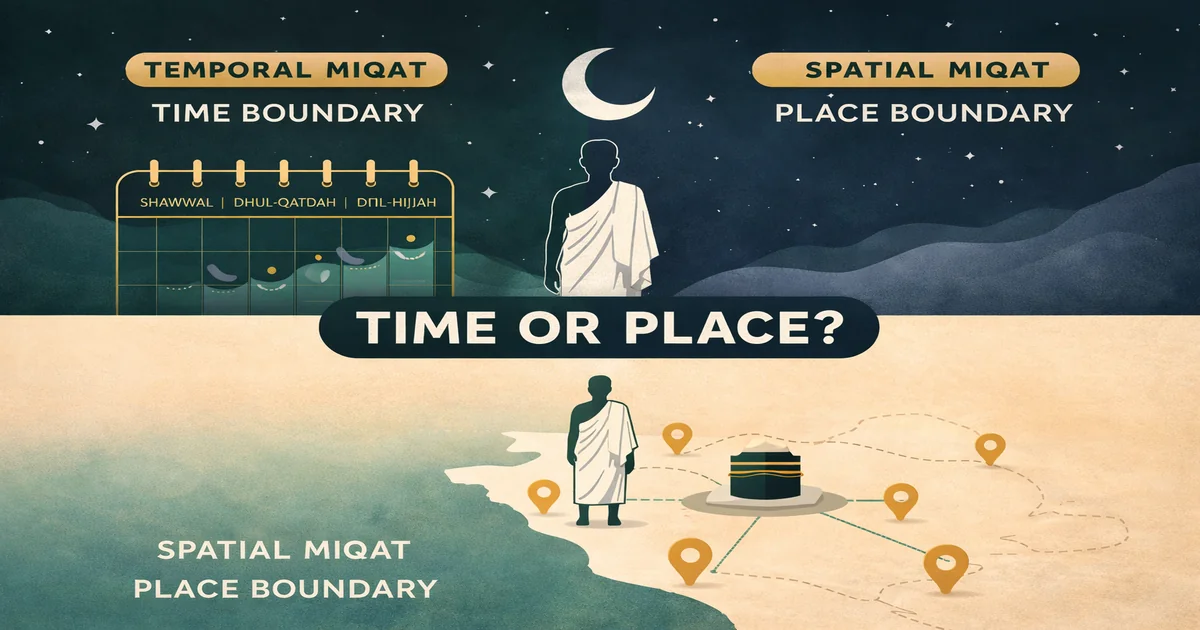
Spatial and Temporal Miqat: Meaning, Differences, Rules, and 5 Miqat Locations for Hajj and Umrah
Spatial and temporal miqat means the two boundaries that shape pilgrimage: a time boundary and a place boundary. If you understand that one split, most confusion disappears. In spatial and temporal miqat in Hajj, both time and place matter. In spatial and temporal miqat in Umrah, place matters, while time stays open through the year.
So the plain answer to what is spatial and temporal miqat is this: miqat zamani and miqat makani are the appointed time and appointed place for entering pilgrimage properly. That is the basic meaning of spatial and temporal miqat, the heart of the difference between spatial and temporal miqat, and the easiest way to understand the types of miqat in Islam.
If you want the place-focused version first, read Miqat for Hajj: the 5 points and ihram rules.
This topic sounds technical at first. It really isn’t.
Think of it like travel rules around a sacred city: one rule tells you when Hajj may begin, and one rule tells you where you must enter ihram before moving toward Makkah. I used to see beginners mix these two up all the time. They’d memorize names like Yalamlam and Qarn al-Manazil, then forget that those are place markers, not Hajj months.
✅ TL;DR – spatial and temporal miqat
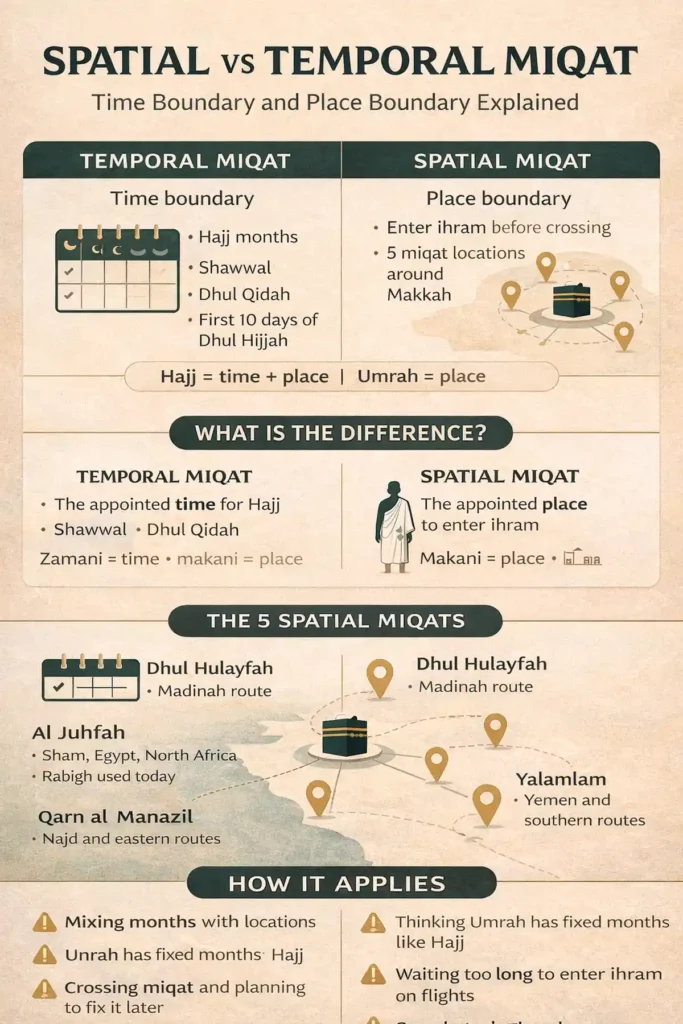
Spatial and temporal miqat means the two boundaries of pilgrimage: temporal miqat is the appointed time for Hajj, and spatial miqat is the appointed place where pilgrims must enter ihram. For Hajj, both matter. For Umrah, the place matters, but Umrah can be done any time of year.
What is spatial and temporal miqat?
Spatial and temporal miqat is the simple rule that pilgrimage has two boundaries: one in time and one in place. The temporal and spatial miqat question becomes easy once you stop mixing months with locations.
Spatial miqat and temporal miqat in one simple definition
Spatial miqat is the ihram boundary on the map. Temporal miqat is the appointed time for Hajj on the calendar. One tells you where to start the sacred state. The other tells you when Hajj can properly begin.
Place and time are not the same thing.
What is the difference between miqat zamani and miqat makani?
Miqat zamani means the time window. Miqat makani means the location boundary. So if someone asks about temporal miqat and spatial miqat, the shortest answer is: zamani = time, makani = place.
For Hajj, you need both. For Umrah, you still need the place boundary, but there is no fixed season that limits the whole year.
Why miqat matters before entering ihram
Miqat for Hajj and Umrah matters because entering ihram is not just about wearing the cloth. It is about beginning the rite at the right boundary with the right intention and the right respect for the Sacred House.
- It protects the sanctity of the route into Makkah.
- It separates normal travel from sacred travel.
- It keeps pilgrims from crossing casually and “fixing it later.”
Meaning of Miqat in Islam
The meaning of miqat in Islam is an appointed point set for a matter. In pilgrimage language, it became the word for the boundaries connected to Hajj and Umrah.
What does miqat mean linguistically and in Islamic use?
Linguistically, miqat means an appointed point or set time. In Islamic use, it works like a gate with two signs on it: one sign is a date, the other is a location. That is why scholars speak about spatial and temporal boundaries of ihram.
Not every gate looks like a wall. Some are legal boundaries. Miqat is one of them.
What are the two types of miqat?
The two types are miqat zamani and miqat makani. In plain English: temporal miqat and spatial miqat. These are the two types of miqat in Hajj that every beginner should know before learning the mawāqīt in Hajj in detail.
Why Allah set miqat boundaries for Hajj and Umrah
These boundaries teach reverence. You do not drift into Hajj or Umrah the way you drift into a shopping mall or a hotel lobby. You approach with intention, preparation, humility, and the beginning of talbiyah.
📖 Authentic Hadith on the appointed miqats
Arabic: وَقَّتَ رَسُولُ اللَّهِ صَلَّى اللَّهُ عَلَيْهِ وَسَلَّمَ لِأَهْلِ الْمَدِينَةِ ذَا الْحُلَيْفَةِ وَلِأَهْلِ الشَّامِ وَمِصْرَ الْجُحْفَةَ وَلِأَهْلِ الْعِرَاقِ ذَاتَ عِرْقٍ وَلِأَهْلِ نَجْدٍ قَرْنًا وَلِأَهْلِ الْيَمَنِ يَلَمْلَمَ
Transliteration: Waqqata Rasoolu-llahi sallallahu ‘alayhi wa sallam li-ahli al-Madinati Dha al-Hulayfah, wa li-ahli ash-Shami wa Misra al-Juhfah, wa li-ahli al-‘Iraqi Dhat ‘Irq, wa li-ahli Najdin Qarnan, wa li-ahli al-Yamani Yalamlam.
Meaning: The Messenger of Allah ﷺ appointed Dhul Hulayfah for the people of Madinah, Al Juhfah for the people of Sham and Egypt, Dhat Irq for the people of Iraq, Qarn for the people of Najd, and Yalamlam for the people of Yemen.
Temporal Miqat (Miqat Zamani) — The Time Boundary
Temporal miqat for Hajj means Hajj has a known season. You cannot treat Hajj like a trip you start whenever you feel ready.
What is the temporal miqat for Hajj?
The temporal miqat for Hajj is the well-known Hajj months. This is the time boundary of the rite. If someone asks about the appointed time for Hajj, this is what they mean.
📖 Qur’an on the Hajj months
Arabic: ٱلۡحَجُّ أَشۡهُرٞ مَّعۡلُومَٰتٞ فَمَن فَرَضَ فِيهِنَّ ٱلۡحَجَّ فَلَا رَفَثَ وَلَا فُسُوقَ وَلَا جِدَالَ فِي ٱلۡحَجِّ
Transliteration: Al-hajju ashhurun ma’lumat, fa-man farada fihinna al-hajja fala rafatha wa la fusuqa wa la jidala fi al-hajj.
Meaning: Hajj is in well-known months, so whoever commits to Hajj in them should avoid intimate relations, sinful conduct, and disputing during Hajj.
The Hajj months: Shawwal, Dhul Qidah, and the first ten days of Dhul Hijjah
The common beginner answer is this: Shawwal, Dhul Qidah, and the first ten days of Dhul Hijjah. That is the standard explanation most people learn first, and it is the easiest safe answer for general teaching.
You may see a scholarly difference about whether all of Dhul Hijjah is counted more broadly in some legal discussions. Keep it simple. Hajj has fixed months. It is not open all year.
📚 You Can Also Read: Hajj al-Ifrad explained · Hajj al-Tamattu explained · Hajj al-Qiran explained
Can Umrah be performed at any time of the year?
Yes. Umrah can be performed any time of the year. That is one of the biggest differences between Hajj and Umrah. Hajj has a fixed season. Umrah does not.
That is where many beginners relax. Then they make the next mistake and forget the place boundary.
Does temporal miqat apply differently to Hajj and Umrah?
Yes. For Hajj, temporal miqat clearly matters. For Umrah, the time is open, but the spatial miqat for Hajj and Umrah still matters when you are coming from outside the boundary.
Spatial Miqat (Miqat Makani) — The Place Boundary
Spatial miqat means the fixed places around Makkah where pilgrims intending Hajj or Umrah must enter ihram before crossing toward the Haram.
What is the spatial miqat for Hajj and Umrah?
The spatial miqat for Hajj and Umrah is the set of known appointed places for ihram around Makkah. These are the famous miqat locations, the ihram stations, and the legal entry points for people coming from different directions.
Why pilgrims must enter ihram before crossing the miqat boundary
Pilgrims must enter ihram at miqat because the sacred journey should begin before crossing the line, not after it. The cloth matters, yes. But the sacred state, intention, and timing of that start matter more.
Micro-scenario: you are on a bus from Madinah. You do not wait until you can “see Makkah.” You prepare and enter ihram before crossing Dhul Hulayfah.
Can you pass miqat without ihram?
If you are intending Hajj or Umrah, crossing miqat without ihram is not allowed. If you are not intending either rite when you cross, then the ruling is different, and later intention can change what you do next.
What happens if someone crosses miqat without ihram?
If someone crosses the miqat while already intending Hajj or Umrah, the safe fix is to go back to the miqat and enter ihram there. If he does not return and enters ihram later, scholars commonly mention a compensatory sacrifice.
This is the part people whisper about at the airport gate. “Can I just fix it in Jeddah?” If you already intended Umrah or Hajj before crossing, that casual fix is not the clean answer.
The 5 Spatial Miqats of Hajj and Umrah
The five spatial miqats of Hajj and Umrah are the best-known miqat locations for Hajj and miqat places for Umrah. They cover the main routes around Makkah and form the classic map of the mawaqit of Hajj.
Dhul Hulayfah — miqat for Madinah pilgrims
Dhul Hulayfah, also called Abyar Ali, is the miqat for people coming from Madinah and that direction. It is the farthest of the major miqats from Makkah, and it is one of the most famous Hajj ihram points because so many pilgrims visit Madinah first.
Al Juhfah — miqat for Sham, Egypt, and North Africa
Al Juhfah is the miqat for people coming from Sham, Egypt, and North Africa. Because the original site is no longer used the way it once was, many pilgrims today enter ihram from nearby Rabigh.
Qarn al Manazil — miqat for Najd and eastern routes
Qarn al Manazil, often linked today with al-Sayl al-Kabir, is the miqat for Najd and eastern routes. Many people from the Gulf hear this name often, and many modern flight paths are discussed in relation to it.
Yalamlam — miqat for Yemen and southern routes
Yalamlam is the miqat for Yemen and southern routes. It also matters for sea and southern land approaches, so it comes up often in older travel discussions and modern route planning alike.
Dhat Irq — miqat for Iraq and northeastern routes
Dhat Irq is the miqat for Iraq and northeastern routes. Some beginners forget it because the four-location hadith version is quoted more often in short classes. But Dhat Irq is part of the recognized five in the legal map of miqat boundaries around Makkah.
📚 You Can Also Read: Masjid al-Shajarah in Madinah · Masjid Aisha guide · Masjid al-Ji‘ranah guide
📊 The five miqats at a glance
This table keeps the map simple: direction, common users, and approximate distance from Makkah.
🌙 Show the 5 Miqat Table
| Miqat | Main direction / people | Common modern note | Approx. distance from Makkah |
|---|---|---|---|
| Dhul Hulayfah | Madinah route | Also known as Abyar Ali | 420 km |
| Al Juhfah | Sham, Egypt, North Africa | Often entered from Rabigh today | 187 km |
| Qarn al Manazil | Najd and eastern routes | Often linked with al-Sayl al-Kabir | 94 km |
| Yalamlam | Yemen and southern routes | Important for southern land and sea approach | 115 km |
| Dhat Irq | Iraq and northeastern routes | Less discussed, still a real miqat | 92 km |
Spatial and Temporal Miqat for Hajj vs Umrah
This is where the topic finally clicks. Spatial and temporal miqat for Hajj and Umrah are not identical in the way they apply.
Miqat for Hajj: time and place both matter
For Hajj, both boundaries matter. You need the right season and the right entry point into ihram. That is why spatial and temporal miqat in Hajj always includes both a calendar answer and a route answer.
Miqat for Umrah: place matters, but time is open all year
For Umrah, the time is open, but the place rule stays in force. So spatial and temporal miqat in Umrah is simpler: no fixed season like Hajj, but you still cannot ignore the ihram boundary.
The simplest way to remember the difference
Remember it like this: Hajj = time + place. Umrah = place.
That is the whole map.
Where Do Pilgrims Enter Ihram?
Where to enter ihram for Hajj and Umrah depends on how you are approaching Makkah. The rule stays the same. The travel method changes the practical steps.
Entering ihram at miqat by land
By land, the easiest case is also the clearest case. You stop at or before your miqat, make your intention, begin talbiyah, and continue. These are the classic umrah ihram points and Hajj ihram points people see on the road network.
Miqat rules for people coming by air
Miqat rules for people coming by air are where many beginners panic. The fix is simple: do not wait until landing in Jeddah if your intention for Hajj or Umrah already exists.
- Wear or prepare ihram early before boarding or well before alignment.
- Watch for the pilot announcement or your group leader’s timing.
- Make intention before crossing the line, not after touchdown.
- Begin talbiyah in time and do not leave it to airport guesswork.
Micro-scenario: a man keeps his cloth in the overhead bin, thinking he will “sort it in Jeddah.” Then the plane crosses the line. That small delay becomes a fiqh problem.
Miqat rules for people coming by sea
By sea, the same rule applies. You enter ihram before passing the route that aligns with the relevant miqat. Older sea travel language sounds different, but the core rule did not change.
How to enter ihram if you travel parallel to a miqat
If your route does not go through the physical station itself but passes parallel to it, you enter ihram when you align with the nearest applicable miqat on your route. The line matters, not only the building.
📚 You Can Also Read: Niyyah for Hajj and Umrah · Hajj packing list · Nusuk app for Hajj and Umrah
Miqat Rules for Different Types of Pilgrims
Not all pilgrims start from the same zone. That changes the practical rule.
What is the miqat for people living outside the miqat boundary?
If you live outside the boundary, your miqat is the one you pass on your way, or the line parallel to it on your route. That is the normal rule for most international pilgrims.
What is the miqat for residents inside the miqat boundary?
If someone lives between Makkah and the outer miqat points, he enters ihram from where he starts. He does not need to travel backward to one of the five outer stations.
Micro-scenario: a person living in Jeddah decides to do Umrah. He does not need to drive out to Dhul Hulayfah or Al Juhfah. His rule is based on where he is starting from within the boundary zone.
What is the miqat for Makkah residents doing Hajj?
For Makkah residents doing Hajj, the ihram start is from Makkah itself. They do not need to leave the city to one of the outer miqat locations for Hajj.
What is the miqat for Makkah residents doing Umrah?
For Makkah residents doing Umrah, the rule changes. They go outside the Haram boundary and enter ihram from there, such as Tan‘im, Ji‘ranah, or another point outside the sanctuary. My students always ask about this part because they hear “people of Makkah start from Makkah” and assume it applies the same way to standalone Umrah. It doesn’t.
Nearest Miqat to Makkah and Common Confusions
This is the section that clears up the names people keep hearing in WhatsApp forwards and travel talk.
Which major miqat is closest to Makkah?
If you mean the commonly discussed major outer miqats, Qarn al Manazil is often treated as the nearest practical major station. But if you mean the strict approximate distance in official Saudi guidance, Dhat Irq is listed at about 92 km and Qarn al Manazil at about 94 km. So the answer changes based on what exactly you mean by “closest.”
Is Masjid Aisha a regular miqat or a boundary point for new Umrah from Makkah?
Masjid Aisha at Tan‘im is not one of the original five outer miqats for incoming pilgrims from outside. It is a well-known point outside the Haram used by people already in Makkah who want to begin a new Umrah.
That small distinction saves a lot of confusion.
Rabigh and Al Juhfah — why both names are mentioned
You will hear both names because Al Juhfah is the original miqat name, while many people now use nearby Rabigh in practice. So the legal discussion keeps the old name, and travel talk often uses the current practical location.
Common Mistakes About Spatial and Temporal Miqat
Spatial and temporal miqat educational guide sounds academic, but the mistakes are very human. Most are simple mix-ups, last-minute panic, or “I’ll fix it later” thinking.
Confusing Hajj months with miqat places
Some people memorize Shawwal, Dhul Qidah, and Dhul Hijjah, then think they have learned the miqat map. They have only learned the time side. Months are not miqat locations.
Thinking Umrah has fixed months like Hajj
This is another common slip. Hajj has fixed months. Umrah does not. A person may do Umrah in any month, but he still respects the place boundary when approaching Makkah from outside.
Waiting too long to wear ihram on a flight
People delay because they want comfort, one more coffee, or one more bathroom visit. Then the plane crosses the line. That tiny delay can turn into a real issue.
Quirky beginner mistake 1: thinking wearing white cloth in the airport lounge automatically means you already entered ihram. It doesn’t. Fix: intention matters.
Quirky beginner mistake 2: assuming Jeddah airport is the “start point” for everyone. It isn’t. Fix: check your route before you fly.
Quirky beginner mistake 3: confusing Tan‘im with one of the five outer miqats. Fix: Tan‘im is mainly for a new Umrah from Makkah.
Quirky beginner mistake 4: saying “I will do niyyah after baggage claim.” Fix: that can be too late.
Quirky beginner mistake 5: learning the cloth rules and never learning the boundary rules. Fix: study both together.
Crossing miqat first and intending to fix it later
This is the most dangerous casual mistake. Once someone has already decided on Hajj or Umrah, the right approach is to begin at the proper boundary, not to cross it and patch the problem afterward.
A brother once told me he was so focused on keeping his passport, boarding pass, charger, and neck pillow in order that he forgot the one thing that actually mattered most on that flight: the miqat timing. He landed relieved, then realized he had intended Umrah all along and had crossed the line without entering ihram. He spent the next few hours not enjoying his trip, but asking panicked questions. The fix was not glamorous. It was simply to respect the ruling, stop the improvising, and correct the mistake properly instead of pretending it did not matter.
🧭 Quick checklist before your route to Makkah
- Know your route before travel day.
- Know your intention before crossing the line.
- Know your miqat type: outside boundary, inside boundary, or Makkah resident.
- Know your fix if you miss it: return if you can, do not guess.
FAQs About Spatial and Temporal Miqat
What is spatial and temporal miqat in Hajj?
Show Answer
In Hajj, spatial and temporal miqat means the place boundary and the time boundary together. Hajj must be begun in its known months, and pilgrims must enter ihram before crossing the relevant miqat place.
What is the difference between spatial and temporal miqat?
Show Answer
The difference is simple: temporal miqat is about time, and spatial miqat is about place. One answers “when,” the other answers “where.”
What is miqat zamani?
Show Answer
Miqat zamani is the time boundary. In pilgrimage talk, it mainly refers to the Hajj months.
What is miqat makani?
Show Answer
Miqat makani is the place boundary. It refers to the known appointed places for ihram around Makkah.
What are the five miqat locations?
Show Answer
The five are Dhul Hulayfah, Al Juhfah, Qarn al Manazil, Yalamlam, and Dhat Irq.
When is the temporal miqat for Hajj?
Show Answer
The standard beginner answer is: Shawwal, Dhul Qidah, and the first ten days of Dhul Hijjah. That is the common teaching used in basic Hajj explanation.
Can Umrah be performed any time?
Show Answer
Yes. Umrah can be performed any time of the year. The place boundary still matters, but the calendar is open.
Can you pass miqat without ihram?
Show Answer
Not if you already intend Hajj or Umrah. In that case, you should not cross the miqat without entering ihram.
What is the nearest miqat to Makkah?
Show Answer
If you mean the common outer miqat discussion, people often mention Qarn al Manazil. If you mean approximate official distance, Dhat Irq is listed slightly closer in the Saudi guide. For a new Umrah from Makkah, many people use Masjid Aisha outside the Haram, but that is a different type of starting point.
Where do pilgrims enter ihram for Hajj and Umrah?
Show Answer
They enter ihram at their miqat if coming from outside the boundary, from where they are if living between Makkah and the miqats, from Makkah for Hajj if they are Makkah residents, and from outside the Haram for a new Umrah if they are already in Makkah.
🔗 Related Articles
What are fard, wajib, and sunnah of Hajj? — good for readers who confuse boundary rules with ritual categories.
How to register on Nusuk Hajj — useful next step for readers moving from fiqh basics to booking flow.
Nusuk Hajj packages explained — practical follow-up for first-time pilgrims.
Best STC SIM for Hajj and Umrah — helpful travel support content without overlapping the miqat topic.
Hajj with elderly parents — strong support article for family planners.
Masjid al-Hudaibiyah — useful for readers learning outside-Haram starting points.
Spatial and Temporal Miqat Differences and 5 Miqat Locations

Farrukh Farooqi has been living in Sharaya, Makkah, Saudi Arabia since 2010. With over 14 years of firsthand experience witnessing the sacred journey of millions of pilgrims, Farrukh specializes in providing practical, insider tips for Hajj and Umrah travelers. His work blends real-world observations, the latest Saudi updates, and essential crowd management strategies — helping pilgrims and worshippers plan smarter, stay safer, and experience a spiritually fulfilling journey across the Holy Cities.


