
How Many Pebbles for Hajj? Exact Jamarat Count for Each Day
How many pebbles for Hajj? The direct answer is this: most pilgrims need 49 pebbles for the 10th, 11th, and 12th of Dhul Hijjah, and 70 pebbles if they stay for the 13th. That is the simple count most people need to remember before doing rami al-jamarat.
If you are asking how many pebbles are required for hajj, how many stones do you need for hajj, or how many pebbles do i need for jamarat, this guide gives the full day-by-day breakdown in plain words. For the bigger ritual sequence around these days, see Hajj Day by Day Guide.
Think of the count like packing medicine for a journey. You do not want to guess once the crowd starts moving.
✅ TL;DR – how many pebbles for hajj
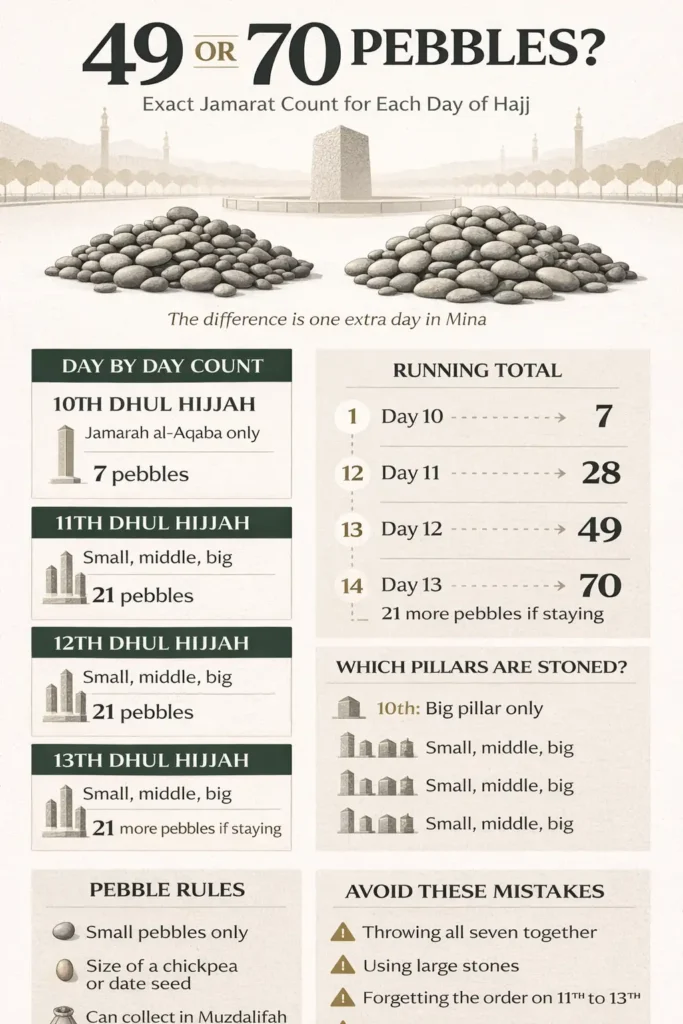
Pilgrims typically need a total of 49 to 70 pebbles for the stoning ritual. You need 7 on the 10th of Dhul Hijjah, 21 on the 11th, 21 on the 12th, and an additional 21 on the 13th if you stay longer in Mina. Pebbles should be small, roughly the size of a chickpea or date seed.
How Many Pebbles for Hajj?
49 pebbles for the 10th to 12th of Dhul Hijjah
49 pebbles for a three-day stay is the usual answer. That covers the 10th, 11th, and 12th of Dhul Hijjah. This is the normal count for many pilgrims who leave Mina after completing the rites on the 12th.
70 pebbles if staying for the 13th of Dhul Hijjah
70 pebbles if staying for the 13th of Dhul Hijjah means you are adding one more day of stoning in Mina. That extra day needs another 21 pebbles, so the total rises from 49 to 70.
How many pebbles for Hajj 49 or 70 explained simply
How many pebbles for hajj 49 or 70 comes down to one thing: are you staying for the 13th or not? If no, think 49. If yes, think 70. Many pilgrims still collect 70 from the start because some pebbles may drop or miss.
How Many Pebbles Are Needed on Each Day of Hajj?
10th Dhul Hijjah: 7 pebbles for Jamarah al-Aqaba
10th dhul hijjah 7 pebbles is the first count to remember. On Yawm al-Nahr, the Day of Sacrifice, pilgrims throw seven pebbles only at Jamarah al-Aqaba, also called Jamarah al-Kubra, the big pillar.
11th Dhul Hijjah: 21 pebbles for all three Jamarat
11th dhul hijjah 21 pebbles means seven at each of the three pillars: Jamarah al-Ula, Jamarah al-Wusta, and Jamarah al-Aqaba. That gives a total of 21 for the day.
12th Dhul Hijjah: 21 pebbles for all three Jamarat
12th dhul hijjah 21 pebbles follows the same pattern as the 11th. Again, pilgrims stone all three Jamarat, seven at each one, for another total of 21.
13th Dhul Hijjah: additional 21 pebbles if you remain in Mina
13th dhul hijjah additional 21 pebbles applies only if you stay in Mina one more day. The order remains the same, and the count is again seven at each pillar.
📚 You Can Also Read: What Happens Each Day of Hajj?
How Many Pebbles Do You Need for Jamarat in Total?
How many stones do you need for Hajj over three days?
How many stones do you need for hajj over the main three stoning days? The answer is 49. That is 7 + 21 + 21.
How many stones do you need for Hajj if you stay the fourth day?
If you stay the extra day in Mina, the full total becomes 70. That is 49 + 21.
Why many pilgrims collect 70 pebbles as a precaution
Collecting 70 is recommended as a precaution because pebbles can slip from your hand, get lost, or fail to land correctly. It is easier to carry a few extras than to panic later in the crowd.
Small preparation. Big relief.
What Is Rami al-Jamarat in Hajj?
What the stoning ritual means
Rami al-jamarat is the rite in which pilgrims throw small pebbles at the Jamarat in Mina. It is often called the stoning of the devil, but the deeper meaning is not rage. It is disciplined obedience.
Why pilgrims throw stones at the Jamarat
Why do we throw stones at the jamarat? The ritual recalls the trial of Prophet Ibrahim عليه السلام when Shaytan tried to turn him away from obeying Allah. Ibrahim remained firm, and the rite remembers that rejection of temptation.
Why it is called the symbolic rejection of evil
The Jamarat are not “Shaytan trapped in a wall.” That is a beginner misunderstanding. The rite is symbolic stoning, a sign of rejection of evil, whisperings, and inner weakness.
📖 Hadith Box
خُذُوا عَنِّي مَنَاسِكَكُمْ
Transliteration: Khudhu ‘anni manasikakum.
Translation: “Take your rituals from me.”
This hadith is the simple rule behind Hajj details: follow the ritual as taught by the Prophet ﷺ, not by guesswork or crowd emotion.
What Are the Three Jamarat?
Jamarah al-Ula or al-Sughra explained
Jamarah al-Ula, also called al-Sughra, is the small pillar. On the Days of Tashreeq, it is stoned first.
Jamarah al-Wusta explained
Jamarah al-Wusta is the middle pillar. It is stoned second on the 11th, 12th, and 13th for those staying.
Jamarah al-Aqaba or al-Kubra explained
Jamarah al-Aqaba, also called al-Kubra, is the big pillar. On the 10th of Dhul Hijjah, this is the only one stoned.
📚 You Can Also Read: Mina in Hajj
How Many Times Do You Stone Jamarat?
Seven pebbles at each pillar explained
How many times do you stone jamarat? At each pillar, you throw seven pebbles. Not six. Not eight. The count is fixed.
Which pillar is stoned on the 10th of Dhul Hijjah
On the 10th, only Jamarah al-Aqaba is stoned. That is why the first day needs just 7 pebbles.
Which order to follow on the Days of Tashreeq
On the 11th, 12th, and 13th, the order is: small pillar, then middle pillar, then big pillar. My students always ask about this because the count is easy but the order is where people get confused.
Where Do You Collect Pebbles for Hajj?
Can you collect pebbles in Muzdalifah?
Pebbles in Muzdalifah are very common. Many pilgrims gather them there after leaving Arafat. This is the most familiar place to collect them.
Can you collect pebbles in Mina?
Collect pebbles in Mina? Yes, you can. Pebbles do not have to come only from Muzdalifah. If needed, they can be gathered in Mina as well.
Can you pick up extra pebbles later if needed?
Yes. If you run out, you may pick up more later. It is still wise to avoid scrambling near the Jamarat area itself when it is crowded. Take extras early and save yourself stress.
📚 You Can Also Read: Muzdalifah Guide
What Size Should the Pebbles Be for Hajj?
Pebbles the size of a chickpea or date seed
What size pebbles for hajj? The pebbles should be small, roughly the size of a chickpea or date seed. That is the simple description many teachers use because it is easy to picture.
Why large stones and harmful objects should not be used
Do not use large stones, shoes, bottles, or anything harmful. This is worship, not anger theatre. The point is to throwing stones in hajj the right way, without harming yourself or others.
How to Perform Rami al-Jamarat Step by Step
What to do before you start throwing stones
Before you begin, stay calm, know your count, and keep your pebbles ready. Many scholars mention being in wudhu as part of the proper method, though the core act itself is the throwing.
How to throw each pebble correctly
How to perform rami al-jamarat step by step starts with a simple method: throw one pebble at a time. Do not toss a handful together. Each pebble is its own throw.
What to say during each throw
With each throw, say:
🕋 What to say during Rami
اللَّهُ أَكْبَرُ
Transliteration: Allahu Akbar.
Translation: “Allah is the Greatest.”
When to stop the Talbiyah
For the first stoning on the 10th, many scholars mention stopping the Talbiyah when beginning the Rami of Jamarah al-Aqaba.
When to make dua after stoning
On the Days of Tashreeq, after stoning the small pillar and the middle pillar, it is from the known sunnah practice to move aside and make dua facing the qibla. After the big pillar, you move on without stopping there for dua.
- Hold one pebble at a time
- Throw it properly, not drop it
- Say “Allahu Akbar” with each throw
- Count carefully to seven
- Move aside for dua after the small and middle pillars on the Days of Tashreeq
📚 You Can Also Read: Rami al-Jamarat Guide
What Is the Timing of Rami During Hajj?
Timing of Rami on Yawm al-Nahr
Timing of rami on the 10th is broader than many beginners think. The known fiqh discussion allows the rite within its proper time on that day, and many teachers explain the sunnah-preferred time while also noting ease for those facing hardship and crowd pressure.
Timing of Rami on Ayyam al-Tashreeq
On Ayyam al-Tashreeq, the familiar teaching is that stoning is done after midday. This is why pilgrims plan carefully on the 11th, 12th, and 13th.
Best time to avoid dangerous crowding
The safest practical advice is simple: avoid peak crush times if your group allows it, especially for the elderly, women, and those who tire easily. The ritual is not helped by panic.
What If You Forget the Count or Miss the Target?
What to do if you are unsure whether you threw six or seven
If you are still in the act and unsure whether you threw six or seven, go with the lower number you are sure about and complete the count. That is the safer path.
What to do if the pebble hits but does not land correctly
If the pebble hits but does not land properly in the target area, throw another. If you miss or are unsure whether you hit the target, throw again. I used to see beginners get stuck in doubt here. Don’t spiral. Fix it and move on.
What to do if you run out of pebbles
If you run out, pick up more from a suitable place and continue. Sharing pebbles is also fine. You do not need “your own special pebbles” for the ritual to count.
Can Someone Perform Rami on Behalf of Another Person?
Who may need help with stoning
Rami on behalf of others may be needed for someone very weak, sick, elderly, or genuinely unable to manage the ritual safely.
What to know about Rami on behalf of others
The basic point is that help is connected to real inability, not laziness. This should be handled according to sound guidance from the group scholars or qualified teachers with the pilgrim.
📚 You Can Also Read: Hajj with Elderly Parents
Important Jamarat Tips for Safety and Ease
How to avoid peak crowd times
Try not to push into the busiest surge if your group has a safer schedule. The crowd moves like a river. Fighting it is usually a bad idea.
Walking to the Jamarat and staying hydrated
Walking to the jamarat can be tiring, especially in heat. Keep water with you, wear suitable footwear when no longer in Ihram, and do not turn dehydration into a “test of patience.” Take care of your body so you can finish the rite calmly.
How to stay safe on Jamarat Bridge
Jamarat bridge safety begins with simple habits: stay with your group, do not stop in the middle of moving crowds, do not bend dangerously over barriers, and do not throw from wild distances.
Common mistakes pilgrims should avoid
- Using large stones instead of small pebbles
- Throwing all seven together instead of one by one
- Forgetting the order on the Days of Tashreeq
- Hurting others by throwing carelessly
- Turning symbolic stoning into anger
📊 how many pebbles for hajj: exact count table
Use this table when you want the fastest answer to how many pebbles for jamarat and how many stones to collect for jamarat.
🪨 Show Pebble Count Table
| Day | Which Jamarat? | Pebbles needed | Running total |
|---|---|---|---|
| 10th Dhul Hijjah | Jamarah al-Aqaba only | 7 | 7 |
| 11th Dhul Hijjah | Small, middle, big | 21 | 28 |
| 12th Dhul Hijjah | Small, middle, big | 21 | 49 |
| 13th Dhul Hijjah | Small, middle, big | 21 | 70 |
How Many Pebbles for Hajj FAQs
📘 how many pebbles for hajj FAQs
How many pebbles are required for Hajj?
Show Answer
Most pilgrims need 49 pebbles through the 12th of Dhul Hijjah. If they stay until the 13th, they need 70 in total.
How many pebbles do I need for Jamarat?
Show Answer
You need 7 on the 10th, 21 on the 11th, 21 on the 12th, and 21 more on the 13th if you remain in Mina.
How many stones are thrown at each Jamarat?
Show Answer
Seven pebbles are thrown at each Jamarah. On the 10th, only the big Jamarah is stoned. On the following days, all three are stoned.
How many pebbles for Hajj on 10th 11th and 12th Dhul Hijjah?
Show Answer
The total is 49: 7 on the 10th, 21 on the 11th, and 21 on the 12th.
How many pebbles for Hajj if staying 13th Dhul Hijjah?
Show Answer
If you remain in Mina for the 13th, add 21 more pebbles, bringing the total to 70.
Where do the pebbles go after Hajj?
Show Answer
The pebbles fall into the Jamarat facility below and are later collected and handled by the authorities. Pilgrims do not need to worry about retrieving or tracking them.
Can you collect pebbles in Muzdalifah for Hajj?
Show Answer
Yes. Muzdalifah is the most common place pilgrims collect pebbles, though they may also be collected in Mina.
What size should Hajj pebbles be?
Show Answer
They should be small, roughly the size of a chickpea or date seed, not large stones or dangerous objects.
What if I forget how many stones I have thrown?
Show Answer
If you are unsure during the act, go with the lower number you are certain of and complete the count from there.
Can someone do Rami on behalf of another person?
Show Answer
Yes, this may be done for someone who is genuinely unable to perform the rite safely, such as a very weak or ill pilgrim, based on proper guidance.
How Many Pebbles for Hajj Day by Day

Farrukh Farooqi has been living in Sharaya, Makkah, Saudi Arabia since 2010. With over 14 years of firsthand experience witnessing the sacred journey of millions of pilgrims, Farrukh specializes in providing practical, insider tips for Hajj and Umrah travelers. His work blends real-world observations, the latest Saudi updates, and essential crowd management strategies — helping pilgrims and worshippers plan smarter, stay safer, and experience a spiritually fulfilling journey across the Holy Cities.


