

Hady in Hajj: Rules, Timing, Animals, Fasting, and Key Differences
Hady in Hajj is the sacrificial offering linked to the pilgrimage, and for many pilgrims the first practical question is simple: what is hady in hajj, who must do it, where does it happen, and what if you cannot afford it?
The short answer is this: hady during hajj is the sacrifice due for the pilgrim of Hajj Tamattu and Hajj Qiran, while the pilgrim of Hajj Ifrad does not have the same requirement. It is done within the Sacred Precinct during the days of sacrifice, not replaced by handing over the cash value instead.
If you also want the wider ritual order around it, read Hajj Day by Day Guide.
✅ TL;DR – hady in hajj
What is hady in Islam during Hajj? It is the pilgrim’s sacrificial animal linked to specific Hajj forms. It is due for Hajj Tamattu and Hajj Qiran, not required in the same way for Hajj Ifrad. It is performed in the Haram during the days of sacrifice. If a pilgrim truly cannot afford it, the Qur’anic fallback is fasting three days during Hajj and seven after returning home.
What Is Hady in Hajj?
What does hady mean in Islam during Hajj?
What is hady in islam during hajj? Hady is the sacrificial offering connected to the rites of pilgrimage. In plain words, it is the animal a pilgrim offers for Allah during Hajj under specific rulings. The word is often explained through the idea of a gift or offering led toward the Sacred House.
Think of it like this: not every sacrifice is the same in Islam. Some are tied to Eid for Muslims everywhere. Some are tied to mistakes and expiation. Hady sacrifice in hajj is the one tied to the pilgrimage itself.
Why hady is part of the Hajj pilgrimage
Hady in islam during hajj is part of the pilgrimage because Hajj is not only movement between holy sites. It is obedience in action. A pilgrim leaves comfort, enters ihram, follows a fixed order, and then finishes certain rites with sacrifice. That sacrifice shows submission, gratitude, and willingness to obey Allah even when worship is costly.
Who must offer hady in Hajj?
The core group is the pilgrim doing Tamattu‘ or Qiran. That is where the direct obligation discussion sits. A pilgrim doing Ifrad does not carry the same hady requirement, though an extra sacrifice can still be offered voluntarily.
📖 Qur’an Box
فَمَا اسْتَيْسَرَ مِنَ الْهَدْيِ ۚ فَمَن لَّمْ يَجِدْ فَصِيَامُ ثَلَاثَةِ أَيَّامٍ فِي الْحَجِّ وَسَبْعَةٍ إِذَا رَجَعْتُمْ
Transliteration: Fama istaysara mina al-hady, faman lam yajid fasiyamu thalathati ayyamin fi al-hajji wa sab‘atin idha raja‘tum.
Translation: “…offer whatever sacrificial animal is easy to obtain. But whoever cannot find one must fast three days during Hajj and seven when you return…”
This is the central verse people need to remember when asking about what if i can’t afford the hady.
📚 You Can Also Read: What Are Fard, Wajib, and Sunnah of Hajj?
Is Hady Obligatory in Hajj?
Is hady obligatory for Hajj Tamattu?
Yes. For the pilgrim of Tamattu‘, hady for tamattu is the standard ruling when the pilgrim is able. If the pilgrim cannot find or afford it, then the fallback is fasting, not simply skipping the rite.
Is hady obligatory for Hajj Qiran?
Yes. The same basic ruling applies to hady for qiran. A Qiran pilgrim remains in one combined state for Hajj and ‘Umrah, and hady is part of that path.
Is hady required for Hajj Ifrad?
No, not in the same obligatory way. Hady for ifrad is not required as it is for Tamattu‘ and Qiran. A voluntary sacrifice is still possible, but that is different from the binding hady of the other two forms.
When Is Hady Performed During Hajj?
When to slaughter hady from the 10th to the 13th of Dhul Hijjah
When is hady performed during hajj? The main slaughter window starts on the Day of Nahr, the 10th of Dhul Hijjah. Scholars discuss the ending point, and a well-known view extends it through the Days of Tashreeq, up to the 13th.
What is the first valid time for hady?
The first valid time is the Day of Eid al-Adha, the 10th to 13th of dhul-hijjah window beginning with the Day of Nahr. That is the starting line most pilgrims need to know.
What is the last valid time for hady?
There is a known scholarly difference here. One major view counts three days total, while another extends the end to sunset on the third Day of Tashreeq, meaning the 13th. For a practical pilgrim guide, the safe path is not to delay without need.
Leave this rite to the last minute, and confusion starts multiplying.
Where Should Hady Take Place?
Should hady be done in Mina or anywhere in the Haram?
Where should hady take place? The sacrifice must be done within the Sacred Precinct, the Haram. Mina is excellent and closely tied to the pilgrimage rites, but the legal point is not “Mina only.” It is “inside the Haram.”
Why slaughtering inside the Sacred Precinct matters
This matters because where to slaughter hady is not random. Hady is linked to sacred space, sacred time, and sacred rite. Once you move it outside that frame, you are no longer talking about the same act in the same legal sense.
📚 You Can Also Read: Mina in Hajj
What Animals Are Allowed for Hady?
What counts as a valid hady animal?
Allowed animals for hady include a sheep, a goat, a cow, or a camel, with the known rules of age and soundness. The animal must be valid as a sacrificial animal and free from clear defects that invalidate sacrifice.
Age and health rules for sheep, goats, cows, and camels
For practical fiqh writing, the common guide is:
- Sheep: valid age threshold as recognized in sacrificial rulings
- Goat: at least one year
- Cow: at least two years
- Camel: at least five years
The animal should be sound, healthy, and not obviously defective. Blindness, severe sickness, or major weakness are not small details here. They matter.
Can a camel or cow be shared by seven people?
Yes. A camel or a cow may be shared by up to seven people. That is one of the most practical rulings in hady animal rules, especially for pilgrims planning cost and booking.
How to Arrange Hady During Hajj
How to book hady through an approved hady service
How to arrange hady during hajj? Today, many pilgrims use an approved hady service. This is often the easiest and safest route. The official Saudi Adahi project provides booking channels and manages slaughter, processing, and distribution within a regulated system.
📦 Approved Hady Service Box
What an approved hady service usually gives you:
- Booking channel through official outlets
- Sharia and veterinary checks
- Execution on your behalf during the valid window
- Processing and distribution to eligible recipients
- Better protection from fraud than random street intermediaries
How to arrange hady yourself
How to perform hady yourself is possible if the pilgrim has proper access, a valid animal, the right location, and a lawful process. But in real Hajj conditions, most pilgrims do not have the practical room to manage every part cleanly on their own.
Why giving the cash value instead of slaughter is not enough
This is one of the biggest beginner mistakes. Ruling of giving the value of a hady in charity: paying the cash value instead of actual slaughter is not the same rite. Charity is good, but it does not replace the sacrificial act that hady requires.
📚 You Can Also Read: Authorized Hajj Service Providers
How to Perform Hady Yourself Step by Step
How to prepare the animal correctly
Choose a valid animal, make sure it meets the rules, and ensure the slaughter will happen within the Sacred Precinct and the valid time. Face the act with intention, calm, and seriousness. This is worship, not a rough routine.
What to say at the time of slaughter
The most important words are Bismillah and Allahu Akbar. Many people also recite verses and supplications connected to sacrifice. Keep it simple if needed, but do not leave out the essential remembrance of Allah.
🕋 At the Time of Slaughter
بِسْمِ اللَّهِ، اللَّهُ أَكْبَرُ
Transliteration: Bismillah, Allahu Akbar.
Translation: “In the name of Allah, Allah is the Greatest.”
What to do after the sacrifice is completed
Once the sacrifice is done, the pilgrim moves on with the linked Hajj rites in order. In the real Hajj flow, hady is not a floating ritual by itself. It sits inside a larger sequence of acts.
Can Women Perform Hady?
Can women arrange or perform hady during Hajj?
Can women perform hady? Yes. Women can arrange hady, pay for it, appoint a valid service, or perform it if the conditions are met. There is no separate hady obligation system for women that erases the rite itself.
Is the ruling of hady the same for men and women?
Yes, in the core obligation related to the Hajj type. If a woman performs Tamattu‘ or Qiran and meets the conditions, the hady ruling follows the Hajj form, not a special lower category.
What If I Cannot Afford the Hady?
Who is excused from offering hady?
The person who genuinely cannot find or afford the hady moves to the Qur’anic fallback. This is one of the clearest rulings in the topic.
What to do if you cannot find or afford a hady animal
What if i can’t afford the hady? Then the ruling is fasting, not switching to random cash charity. This point is often mixed up online, but the verse is very direct.
Three days of fasting during Hajj and seven after returning home
The basic replacement is three days of fasting during Hajj and seven after returning home. That makes ten in total. Many scholars liked those three to be completed before ‘Arafah when possible so the pilgrim is not fasting on the Day of ‘Arafah itself.
Can you fast the Days of Tashreeq if unable to offer hady?
Normally the Days of Tashreeq are not days of fasting. But the pilgrim of Tamattu‘ or Qiran who could not find hady has a known concession in this issue according to strong scholarly discussion. This is a special case, not a general rule for everyone.
What If You Miss the Hady or Delay It?
What happens if the days of slaughter pass?
If the valid slaughter days pass and the pilgrim had not done the rite, the issue becomes one of missed obligation and correction. Hajj is not automatically destroyed by that mistake, but the person is not meant to shrug it off either.
Can the missed fasting days be made up later?
Yes. If the three fasts due during Hajj were missed, the responsibility does not simply vanish. They are still owed and can be made up later.
Do you need another expiation for delaying the fast?
A well-known view says the delayed fast itself remains due, without another separate expiation just for the delay. The pilgrim should still correct the missed duty instead of treating it lightly.
Can You Eat From Your Hady?
Ruling on eating from an optional hady
Yes, eating from an optional hady is allowed and recommended. This is one of those nice fiqh details that people forget because they assume all sacrifice meat works the same way.
Ruling on eating from the hady of Tamattu and Qiran
For the hady of Tamattu‘ and Qiran, eating from it is generally treated as permissible and recommended by many scholars. This is different from certain expiatory sacrifices.
Which types of hady meat should not be eaten by the pilgrim?
The pilgrim should not eat from hady that became due as expiation for certain violations or omissions in the same way people may eat from voluntary sacrifice. This is where eating from one’s hady needs fiqh detail, not assumptions.
What Is the Difference Between Hady and Udhiyah?
Hady vs udhiyah in purpose, timing, and location
What is the difference between hady and udhiyah? Hady is linked to Hajj and must be done in the Sacred Precinct as part of pilgrimage rulings. Udhiyah is the Eid sacrifice for Muslims generally, whether they are on Hajj or not, and it may be performed outside Makkah.
Difference between hady qurban and udhiyah qurban
Difference between hady qurban and udhiyah qurban: hady belongs to pilgrimage law, while udhiyah belongs to Eid sacrifice law. They may involve similar animals, but they are not interchangeable acts.
Why hady is linked to Hajj but udhiyah is for Muslims everywhere
This is the cleanest memory line: hady and udhiyah meet in sacrifice, but they part in purpose. One is a Hajj rite. The other is a broader Eid worship act for Muslims everywhere.
What Is the Difference Between Hady and Fidya?
Hady vs fidya explained simply
Difference between hady and fidya is easier than people think. Hady is a sacrificial rite tied to Hajj in specific cases. Fidya is compensation tied to certain inability or violations in other rulings.
When fidya is due instead of hady
Fidya appears in different legal situations, such as specific violations or inability cases depending on the issue. It is not the fallback simply because a pilgrim found hady expensive.
Why inability to afford hady leads to fasting, not fidya
This is one of the most important corrections in the whole topic. If a Tamattu‘ or Qiran pilgrim cannot afford hady, the fallback is the Qur’anic fast of ten days in the known split. It is fasting, not fidya.
Why Is Hady Important in Hajj?
How hady reflects obedience, gratitude, and submission to Allah
Importance of hady is not only legal. It is spiritual. A pilgrim spends money, follows time and place limits, and offers an animal for Allah alone. That teaches obedience with cost attached to it.
How hady connects to Prophet Ibrahim and Prophet Ismail
The sacrifice also carries the memory of Prophet Ibrahim and Prophet Ismail, peace be upon them. That is why hady is never just “animal management.” It is a living reminder of surrender to Allah.
How hady supports people in need through meat distribution
There is also a social beauty here. Hady meat distribution feeds people in need. Worship rises upward, and mercy spreads outward.
Using a Hady Service During Hajj
What an approved hady service does for pilgrims
Hady service during hajj helps pilgrims fulfil the rite without getting trapped in messy logistics. The service handles the approved process, and the pilgrim avoids guesswork in a crowded Hajj environment.
How hady meat is processed and distributed
In the regulated Saudi system, slaughter, processing, freezing, packaging, and distribution are handled through structured facilities. That is one reason official channels matter so much now.
Why pilgrims should avoid illegal intermediaries
Do not hand this rite to random unofficial brokers just because they sound convenient. Fraud, invalid handling, and false claims are real risks here. A bargain that breaks the rite is not a bargain.
📚 You Can Also Read: Hajj al-Tamattu
📊 Hady in Hajj: quick comparison table
Use this one table to keep the key rulings straight without mixing up hady, udhiyah, and fidya.
🧾 Show Hady Comparison Table
| Type | Who it is for | Where | Fallback if unable |
|---|---|---|---|
| Hady | Tamattu‘ and Qiran pilgrims | Inside the Haram | Three fasts during Hajj, seven after return |
| Udhiyah | Muslims generally at Eid | Anywhere valid | No Hajj-specific fallback structure |
| Fidya | Specific compensation cases | Depends on ruling | It is not the fallback for inability to afford hady |
Hady in Hajj FAQs
What is hady in Islam during Hajj?
Hady in Hajj is the pilgrim’s sacrificial offering tied to specific Hajj forms, especially Tamattu‘ and Qiran.
When is hady performed during Hajj?
It starts on the 10th of Dhul Hijjah, and many scholars allow it through the Days of Tashreeq.
Where should hady take place?
Inside the Sacred Precinct, the Haram. Mina is highly connected to the rite, but the legal point is the Haram boundary.
Allowed animals for hady
Sheep, goats, cows, and camels with the right age and health conditions.
Can women perform hady?
Yes. Women can arrange or perform hady, and the ruling follows the Hajj type, not gender.
What if I cannot afford the hady?
The fallback is fasting three days during Hajj and seven after returning home.
What is the difference between hady and udhiyah?
Hady is linked to pilgrimage. Udhiyah is the Eid sacrifice for Muslims generally.
What is the difference between hady and fidya?
Hady is a sacrificial rite. Fidya is compensation in other specific cases. They are not the same thing.
Can you split a hady?
Yes, a camel or cow can be shared by up to seven people.
Can you give the value of hady in charity instead?
No. Giving the price in charity does not replace the actual hady sacrifice.
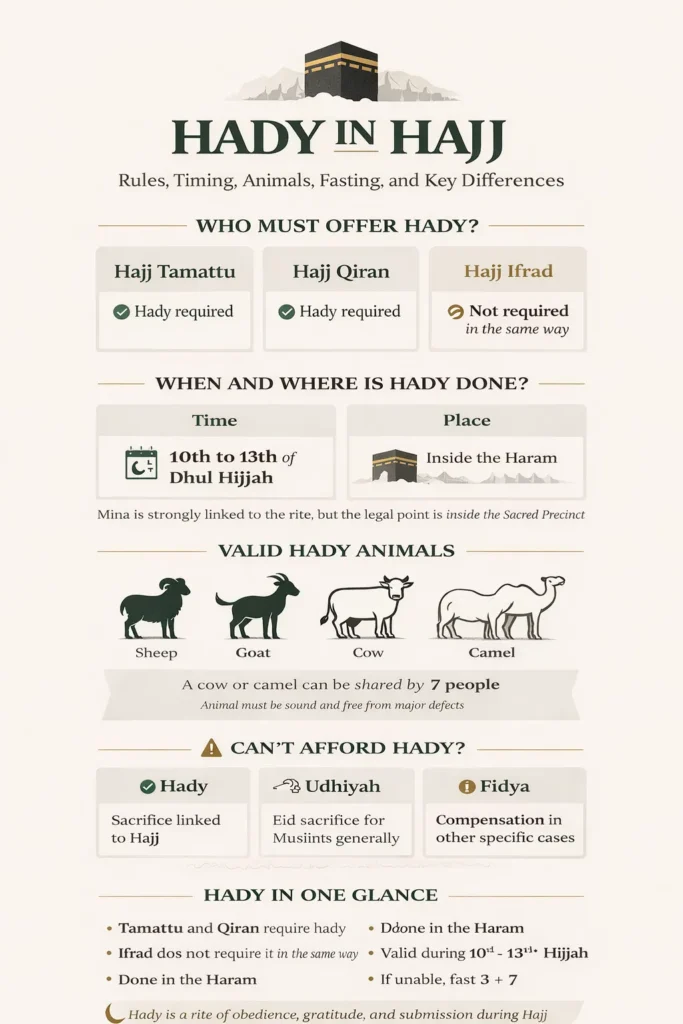
Hady in Hajj Infographic: Rules, Timing, Animals, and Fasting
Related Articles
- Hajj al-Qiran
- · Hajj al-Ifrad
- · Udhiyah/Qurbani in Islam
- · How Many Pebbles for Hajj
- · What Happens Each Day of Hajj
- · Niyyah for Hajj and Umrah
- · Hajj Mistakes to Avoid
You Can Also Check
- nafl tawaf guide
- tawaf al umrah guide
- tawaf al wada guide
- tawaf al qudum guide
- tawaf al ifadah guide
- tawaf al ziyarah guide
- tawaf faqs guide

Farrukh Farooqi has been living in Sharaya, Makkah, Saudi Arabia since 2010. With over 14 years of firsthand experience witnessing the sacred journey of millions of pilgrims, Farrukh specializes in providing practical, insider tips for Hajj and Umrah travelers. His work blends real-world observations, the latest Saudi updates, and essential crowd management strategies — helping pilgrims and worshippers plan smarter, stay safer, and experience a spiritually fulfilling journey across the Holy Cities.


