
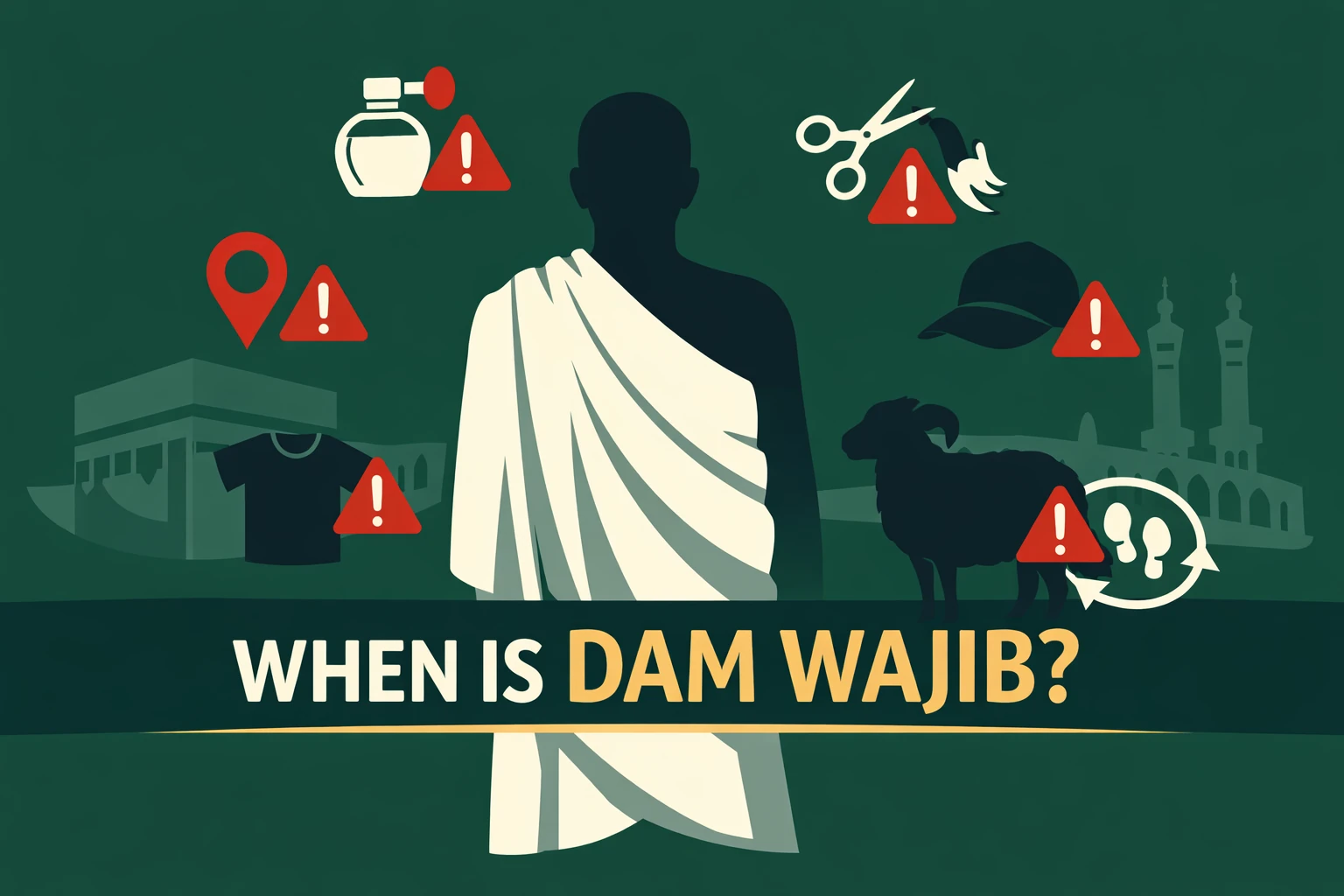
Dam in Hajj: Rules, Reasons, Penalties, and How to Fulfill It
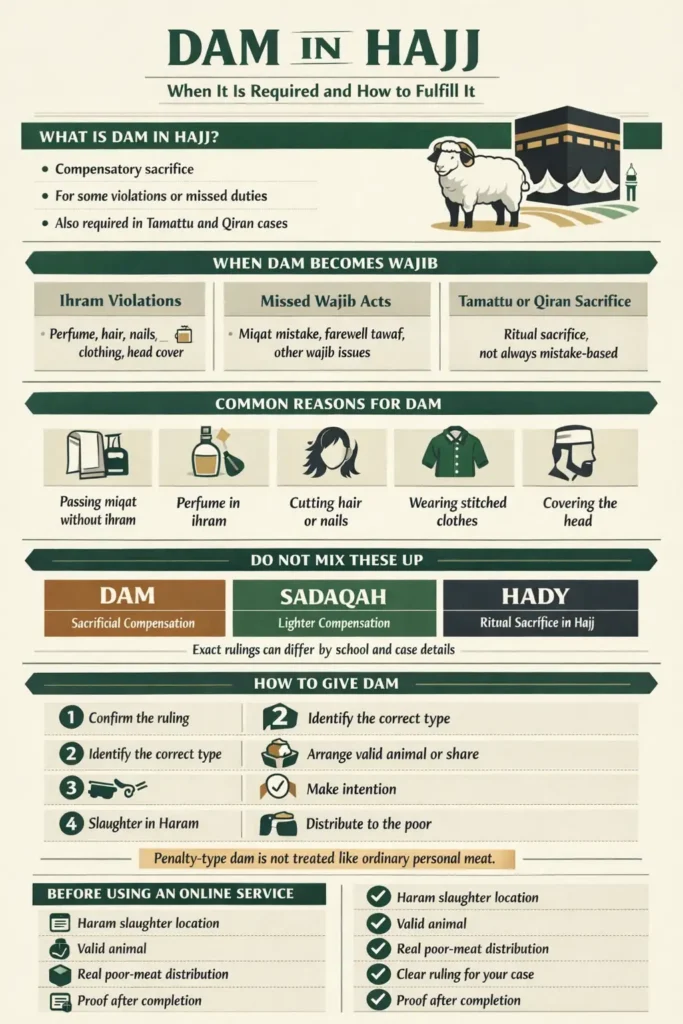
Dam in hajj is a compensatory sacrifice that may become necessary when a pilgrim breaks certain Hajj or Umrah rules, misses some wajib acts in hajj, or needs to offer a required sacrifice in cases like hajj al-tamattu and hajj al-qiran.
In plain words, what is dam in hajj? It is usually a required animal sacrifice done within the haram boundaries of makkah as a form of correction, atonement, or completion of a ritual duty.
This matter can get technical very fast, especially when people mix up damm in hajj, fidyah in hajj, and hady. For the wider Hajj timeline around these rulings, read this Hajj Day by Day Guide.
✅ TL;DR – dam in hajj
Dam in hajj usually means a required sacrifice for certain violations, missed obligations, or as part of hajj al-tamattu and hajj al-qiran. It must usually be done within the haram boundaries of makkah, with the meat distributed to the poor. Some minor cases require sadaqah instead of full damm, and some rulings differ by school, so confirm your exact case with a qualified scholar.
What Is Dam in Hajj?
What does dam in hajj mean?
What does dam in hajj mean? In Hajj language, it usually means a sacrificial penalty or required offering linked to a violation, a missed duty, or a ritual obligation. The literal Arabic root points to blood, but in pilgrimage use it refers to the slaughter itself.
Think of it like repairing a tear in a garment. The Hajj remains sacred, but a mistake may need a corrective act.
Is dam in hajj a penalty or an act of repentance?
Dam for hajj is often described as both. It is a legal penalty in the fiqh sense, but it also carries the spirit of repentance and correction. It is not there to humiliate a pilgrim. It is there to restore what was broken or left incomplete.
That matters.
What is the difference between dam, damm, and fidyah in hajj?
Dam and damm are usually just spelling variations in English writing. People often use both for the same thing. Fidyah in hajj, however, is a broader word for compensation. In some cases the compensation is a sacrifice, in other cases it may involve fasting or feeding the poor, depending on the mistake and the school of law.
So not every compensation is exactly the same kind of payment.
📖 Qur’an box
فَمَا اسْتَيْسَرَ مِنَ الْهَدْيِ
Transliteration: Fa-mastaysara mina al-hady.
Translation: “Then offer what can be obtained with ease of sacrificial animals.”
This phrase appears in the Qur’an regarding pilgrimage sacrifice and is one of the core texts behind discussions of hady, required sacrifice, and some penalty-related rulings.
📚 You Can Also Read: Hady in Hajj
When Does Dam Become Wajib in Hajj?
When is dam required for violations of ihram?
When does dam become wajib in hajj? One major category is violations of ihram. This can include things like perfume, hair removal, nail cutting, wearing prohibited clothing for men, or head covering for men in ways that cross the ruling threshold in that school of law.
Not every slip leads to the same outcome. Some mistakes need full damm penalty in hajj. Some need only charity. Some may be excused if done in ignorance, forgetfulness, or under compulsion, according to many scholars.
When is dam required for missing wajib acts in hajj?
Dam in hajj can also become necessary for missing mandatory duties in hajj. Common examples discussed by jurists include crossing the miqat without ihram and not correcting it, missing or invalidating parts of tawaf in certain ways, or omitting acts treated as wajib in that madhhab.
This is why pilgrims should not casually self-diagnose fiqh penalties from social media clips.
When is dam required as part of hajj al-tamattu and hajj al-qiran?
In hajj al-tamattu and hajj al-qiran, the required sacrifice is not necessarily because of a mistake. It may be part of the ritual itself. This is closer to hady than a violation penalty, even though people often loosely call all of it dam for hajj.
📚 You Can Also Read: Hajj al-Qiran
What Mistakes Require Dam in Hajj?
Dam for passing miqat without ihram
Dam for passing miqat without ihram is one of the most mentioned cases. If someone crosses the miqat without entering Ihram and does not return to correct it according to the relevant ruling, damm for mistakes in hajj or umrah may become due.
This is one of those mistakes that sounds small in conversation but is not small in law.
Dam for perfume in ihram
Dam for perfume in ihram depends on amount, extent, and circumstance. Applying fragrance to a substantial part of the body can trigger full penalty in some rulings, while a lighter or smaller violation may fall under charity instead.
If a pilgrim uses scented wipes or deodorant without realizing, the details matter. Timing, amount, and excuse all matter.
Dam for cutting hair or nails in ihram
Dam for cutting hair in ihram and nail cutting are classic examples in this topic. Cutting enough hair or nails to meet the threshold may require a full sacrifice, while fewer nails or a smaller amount of hair can fall under sadaqah instead of full damm in some rulings.
Dam for wearing stitched clothes in ihram
Dam for wearing stitched clothes in ihram usually refers to men wearing regular fitted clothing while in Ihram. The ruling often depends on duration and whether it was done knowingly or out of necessity. That is why scholars sometimes separate minor violations from major violations.
Dam for covering the head in ihram
Dam for covering the head in ihram is another well-known male Ihram issue. Again, the details matter. A brief accidental cover is not the same as a prolonged intentional one.
Dam for improper tawaf or missing farewell tawaf
Dam for improper tawaf may apply in some situations, especially if the tawaf was not valid and not repeated correctly. Farewell tawaf is another major discussion point. In many schools, omitting it without a valid excuse may require compensation.
If the tawaf can still be repeated properly, that may remove the need for penalty in some cases. This is why timing matters so much.
Dam for mistakes in sa’i and cutting hair
Mistakes in sa’i and mistakes in cutting hair are also discussed in fiqh manuals. Missing substantial parts of Sa’i, cutting hair too early, or doing hair removal outside the proper stage can lead to serious consequences depending on the rite and the school.
📚 You Can Also Read: Miqat for Hajj
Which Mistakes Need Sadaqah Instead of Full Dam?
Minor violations that require sadaqah
Minor violations sadaqah required is a useful way to remember the lighter category. Examples often mentioned include small-scale fragrance use, fewer nails, shorter clothing violations, or brief prohibited covering when the full threshold is not met in that fiqh view.
Major violations that require dam
Major violations dam required usually includes broader or more complete breaches: larger fragrance use, more serious hair removal, crossing miqat improperly without fixing it, and similar acts that meet the threshold for a full sacrifice in that school.
Grave violations where multiple penalties may apply
Grave violations multiple penalties apply is where the topic gets heavy. Some acts are far more serious than ordinary Ihram mistakes. In certain cases, the consequence may not be a simple sheep or goat. It may involve a larger sacrifice, repeating the rite, or other serious legal outcomes depending on the exact act.
Do not guess here.
What Animal Is Valid for Dam in Hajj?
Can dam be a sheep, goat, camel, or cow share?
Yes, discussions of valid animal criteria for dam usually include a sheep, goat, or in some cases a share in a cow or camel, depending on the type of dam and the school’s ruling.
What age and health conditions must the animal meet?
The animal must be valid for sacrifice under the relevant rules. In practical terms, it must be a sound and acceptable animal, not one that is obviously defective. Many guides summarize this by saying it must be a healthy animal.
Can one-seventh of a cow or camel count for dam?
In many rulings, one-seventh of a cow or camel count for dam can be valid, but this depends on the type of sacrifice and the school followed. This is one reason pilgrims should not treat group-share sacrifice as automatically interchangeable in every case.
📚 You Can Also Read: Udhiyah and Qurbani Rules
Where Should Dam Be Given in Hajj?
Why dam must be done within the haram boundaries of makkah
Where should dam be given in hajj? The basic answer given in many fiqh discussions is that it should be slaughtered within the haram boundaries of makkah. This includes the sacred zone, not just any place in Saudi Arabia.
Can dam be done in makkah, mina, or muzdalifah?
Yes, if the place is inside the Haram zone, the slaughter can be done there. That is why people often mention makkah, mina, and sometimes muzdalifah in practical explanations, though the key legal point is the Haram boundary.
Where to give dam in makkah
Where to give dam in makkah today often means using authorized slaughter arrangements, banks, official voucher systems, or trusted services that arrange slaughter in the Haram and meat distribution properly. The important thing is not the marketing. It is the fiqh validity.
📍 Quick location box
Dam in hajj should normally be slaughtered inside the Haram zone. A service based outside the Haram is not enough if the actual slaughter is not completed in the correct sacred boundary.
📚 You Can Also Read: Tawaf al-Wida
How to Fulfill Dam in Hajj Correctly
How to give dam for hajj step by step
How to give dam for hajj in a simple order usually looks like this:
- Confirm the need for dam with a qualified scholar.
- Identify the correct type of penalty for your exact violation.
- Arrange a valid animal or valid share if allowed.
- Make the niyyah for the specific dam.
- Ensure slaughter happens in the Haram.
- Make sure the meat is distributed to the poor.
- Keep proof or confirmation if using an agent or service.
How to make niyyah for dam
Niyyah for dam does not need complicated wording. It is the heart’s intention that this sacrifice is being offered to fulfill the due dam for a specific Hajj or Umrah violation or obligation.
How the meat should be distributed to the poor
Meat distribution is not a side issue. The standard explanation is that the meat should be distributed to the poor and needy. That is part of the validity and purpose.
Can the person offering the dam eat the meat?
Many practical guides state that the person offering the damm cannot eat the meat when it is a penalty dam. This is an important distinction because people sometimes confuse it with ordinary personal sacrifice. Since fiqh details can vary by type, it is safest to confirm the ruling in your exact case before treating any meat as yours.
📚 You Can Also Read: Niyyah for Hajj and Umrah
Can You Give Dam for Hajj Online?
How to give dum for hajj online
How to give dum for hajj online is one of the most searched questions now. The short answer is yes, many pilgrims appoint a trusted service or agent. But convenience does not automatically equal correctness.
What to check before using an online dam service
Before using any online provider, check these points:
- Shariah clarity about the type of dam they are handling
- Valid slaughter location inside the Haram
- Valid animal criteria and health condition
- Real meat distribution to eligible poor recipients
- Proof or confirmation after completion
- Timing that matches the obligation
How to confirm the slaughter happened inside the haram
How to confirm the slaughter happened inside the haram comes down to documentation, trust, and transparency. A serious provider should be able to explain where the slaughter is done, how distribution is handled, and what proof is given. A vague promise is not enough.
🧾 Online dam checklist
The safest online service is not the one with the prettiest page. It is the one that clearly states the ruling, the Haram slaughter location, the animal type, and the poor-meat distribution method.
📚 You Can Also Read: Authorized Hajj Service Providers
What If You Cannot Afford Dam in Hajj?
When fasting 3 days and 7 days may apply
Fasting 3 days and 7 days is mentioned in Qur’anic discussion of sacrifice in some pilgrimage cases, especially around Tamattu and Qiran for the one who cannot find the offering. But not every penalty case automatically shifts into that same alternative in the same way.
Can fidyah replace dam in every case?
Can fidyah replace dam in every case? No, this should not be assumed. Some violations have different options. Some do not. Some allow feeding or fasting. Some require actual sacrifice. Some need repetition of the rite instead. This is exactly why broad internet shortcuts can mislead pilgrims.
Why you should confirm the ruling before choosing an alternative
A pilgrim may think, “I cannot afford the animal, so I will just donate something back home.” But that may not fulfill the legal duty. The safe path is to confirm the ruling before choosing any alternative.
Dam in Hajj vs Fidyah vs Hady
What is the difference between dam and fidyah?
What is the difference between dam and fidyah? In simple language, dam is often a specific sacrificial form of compensation, while fidyah is the wider category of compensation that can include sacrifice, feeding, or fasting depending on the issue.
What is the difference between dam and hady?
What is the difference between dam and hady? Hady is the sacrifice associated with the pilgrimage ritual itself in cases like Tamattu and Qiran. Dam in hajj is often used for mistake-related compensation, though everyday speech mixes the terms.
When the sacrifice is for a mistake and when it is part of the ritual
This is the cleanest way to remember it: sometimes the sacrifice is because you did a valid Hajj type that requires it; other times it is because something went wrong and needed atonement.
📚 You Can Also Read: Hajj al-Tamattu
Dam in Umrah and Hajj: What Changes?
What is a dam in umrah?
What is a dam in umrah? The basic idea is similar. It is a compensatory sacrifice when certain Umrah violations occur, such as crossing miqat wrongly, major Ihram violations, or certain invalid mistakes that are not corrected in time.
Damm in hajj and umrah explained simply
Damm in hajj and umrah explained simply: it is the corrective sacrifice used in pilgrimage law when a rule is broken, a duty is missed, or a required sacrificial obligation must be completed. The difference is that the exact triggers may differ between Hajj and Umrah.
Common umrah mistakes that require dam
Dam in umrah may be discussed in cases like miqat without ihram, major fragrance use, substantial hair removal, and other serious Umrah-state violations depending on the ruling details. So if you are asking, i made a mistake in umrah what do i do, the first step is not panic. The first step is accurate diagnosis.
📚 You Can Also Read: Masjid Aisha
What Should You Do If You Made a Mistake in Hajj or Umrah?
How to confirm the need for dam
How to confirm the need for dam is simple in principle: explain the exact act, timing, duration, and circumstances to a reliable scholar who understands pilgrimage rulings. Tiny details can change the ruling completely.
When to repeat the missed act instead of paying a penalty
Sometimes the missed act can still be corrected, and repeating it correctly may remove the need for penalty. This often comes up in discussions about tawaf or Sa’i. So do not assume that slaughter is always the first answer.
Why consulting a scholar matters in dam cases
Because this field is full of thresholds, conditions, excuses, and madhhab differences. One pilgrim says, “I used scented soap by mistake.” Another says, “I wore normal clothes for half a day.” Another says, “I crossed the miqat and fixed it later.” These are not one-size-fits-all cases.
That is why consultation matters.
Most Common Reasons for Dam in Hajj
Ihram violations
The most common bucket is ihram violations: perfume, hair removal, nail cutting, prohibited clothing, and head covering issues.
Missed obligations wajib
The second bucket is missed obligations wajib: cases like miqat errors, omission of certain required acts, or failing to complete some rites correctly according to the school followed.
Hajj type penalty for tamattu and qiran
The third bucket is the hajj type penalty for tamattu and qiran, where sacrifice is part of the pilgrimage form itself rather than a punishment for a mistake.
📊 dam in hajj: common cases and general penalty direction
This table gives a beginner-friendly summary only. Exact rulings can differ by school and by details of the case.
🕌 Show Dam Penalty Table
| Case | General category | Usual direction |
|---|---|---|
| Passing miqat without ihram | Missed wajib / entry mistake | Often full dam in hajj if not corrected |
| Perfume in ihram | Ihram violation | Minor or major depending on extent |
| Cutting hair or nails | Ihram violation | Can be sadaqah or full damm |
| Wearing stitched clothes | Ihram violation | Depends on duration and excuse |
| Missing farewell tawaf | Missed obligation | Often compensation in many schools |
| Tamattu or Qiran sacrifice | Ritual obligation | More like hady than mistake penalty |
FAQs About Dam in Hajj
📘 dam in hajj FAQs
What is dam in hajj and when is it required?
Show Answer
Dam in hajj is a compensatory or required sacrifice linked to certain Ihram violations, missed mandatory acts, or required sacrificial duties in pilgrimage types like Tamattu and Qiran.
Can you eat the meat of dam in hajj?
Show Answer
For penalty-type dam, many scholars and practical Hajj guides state that the pilgrim should not eat the meat and that it should be given to the poor. Because details can vary by type, confirm your exact case before acting.
Where to give dam in makkah?
Show Answer
It should generally be arranged inside the Haram zone of Makkah. In practice, people often use official or trusted slaughter arrangements that carry out the sacrifice within the correct sacred boundary.
How to give dam for hajj?
Show Answer
First confirm the ruling, then arrange a valid animal or valid share, make the niyyah, ensure slaughter takes place in the Haram, and confirm the meat is distributed to the poor.
What if I made a mistake in umrah?
Show Answer
Do not guess. Describe the exact mistake to a reliable scholar. Some Umrah mistakes need correction only, some need charity, and some may require dam in umrah.
Can I give dam for hajj online?
Show Answer
Yes, many pilgrims appoint an online or remote service, but you should check that the slaughter really happens inside the Haram, with a valid animal and proper poor-meat distribution.
Is dam in hajj the same as fidyah in hajj?
Show Answer
Not always. Fidyah in hajj is broader. Dam is often one specific sacrificial form within that wider compensation discussion.
Can fidyah replace dam in every case?
Show Answer
No. Some cases allow alternatives, but others do not. The exact violation, school of law, and ability of the pilgrim all matter.
What is a dam in umrah?
Show Answer
What is a dam in umrah? It is a compensatory sacrifice that may become due if certain serious Umrah rules are broken or not corrected properly.
What should I check before choosing an online dam service?
Show Answer
Check the ruling they are applying, the Haram slaughter location, the animal type, the meat distribution process, and what proof they give after completion.
Dam in Hajj Explained: When It Becomes Required and What to Do
Related Articles
Ihram Rules for Hajj Hajj Mistakes to Avoid What Are Fard, Wajib, and Sunnah of Hajj? Sa’i Between Safa and Marwah How Many Pebbles for Hajj? Hajj al-Ifrad Hajj with Elderly Parents
Farrukh Farooqi has been living in Sharaya, Makkah, Saudi Arabia since 2010. With over 14 years of firsthand experience witnessing the sacred journey of millions of pilgrims, Farrukh specializes in providing practical, insider tips for Hajj and Umrah travelers. His work blends real-world observations, the latest Saudi updates, and essential crowd management strategies — helping pilgrims and worshippers plan smarter, stay safer, and experience a spiritually fulfilling journey across the Holy Cities.


