

Dam in Umrah: Rules, Mistakes, Penalties, and How to Fulfil It
Dam in Umrah is a mandatory religious sacrifice used as compensation for violating ihram rules or for missing an obligatory act in Umrah. In simple words, if you made a mistake during umrah, the fix may be damm in umrah, dum for umrah, dum fidya for umrah, or in smaller cases, sadaqah instead of a full sacrifice.
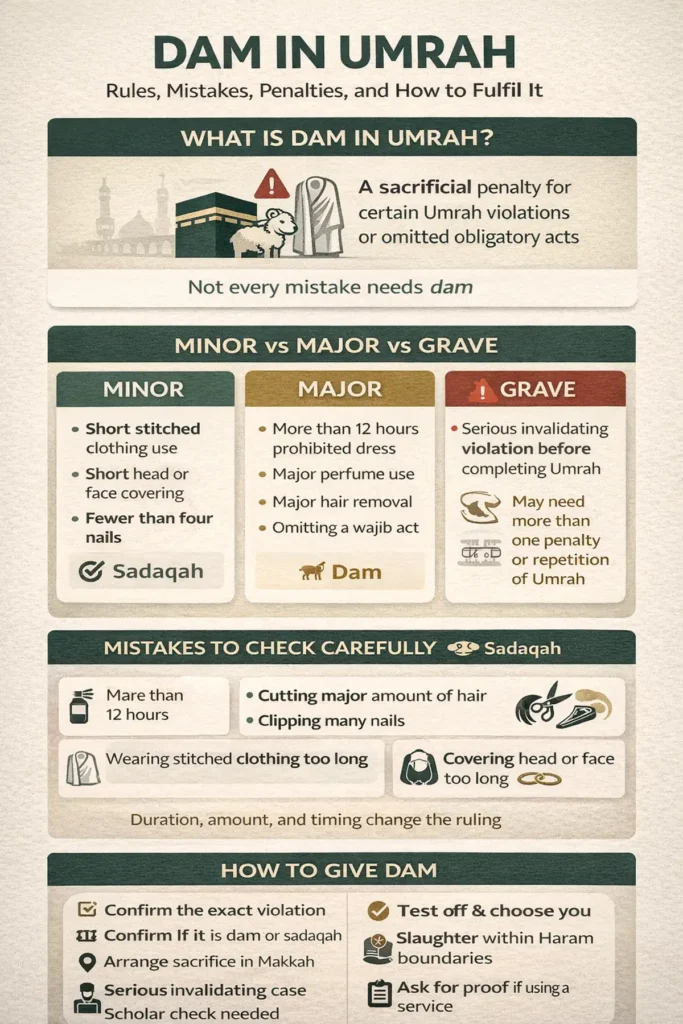
The direct answer is this: not every mistake needs dam, not every mistake breaks Umrah, and not every case is solved by just giving cash. The ruling depends on types of violations and their penalties, whether the act was minor, major, or grave, and whether it involved violating ihram prohibitions or omitting a wajib act.
If you are unsure about Ihram boundaries before starting, first review Miqat for Hajj.
✅ TL;DR – dam in umrah
What is dam in umrah? It is usually a sheep or goat, or a share in a larger animal in some cases, sacrificed in Makkah as a penalty for certain Umrah mistakes. Minor violations sadaqah required. Major violations dam required. Some grave violations may invalidate Umrah and need more than just dam.
📖 Qur’an box
فَمَن كَانَ مِنكُم مَّرِيضًا أَوْ بِهِ أَذًى مِّن رَّأْسِهِ فَفِدْيَةٌ مِّن صِيَامٍ أَوْ صَدَقَةٍ أَوْ نُسُكٍ
Transliteration: Faman kāna minkum marīḍan aw bihi adhan min ra’sihi fafidyatun min ṣiyāmin aw ṣadaqatin aw nusuk.
Translation: “And whoever among you is ill or has an ailment of the head must offer a ransom of fasting or charity or sacrifice.”
This verse is one of the key foundations behind fidyah for mistakes in hajj or umrah and helps explain why some violations are corrected through sacrifice, feeding, or fasting depending on the case.
What Is Dam in Umrah?
What does dam in Umrah mean?
What is dam in umrah? In Umrah, dam means a sacrificial penalty. The word sounds heavy because it is meant to be. Worship is not a random trip. When a person breaks a sacred rule, Islam does not leave him confused. It gives him a path to repair what happened.
Think of it like tearing part of a garment. You do not throw the whole garment away every time. But you also do not pretend the tear is not there. Dam is that repair for certain cases.
Is dam in Umrah a penalty or a form of correction?
It is both. It is a penalty in umrah in the sense that it becomes due after certain violations. But it is also a form of correction, purification, and completion. That is why many scholars explain it with seriousness but not hopelessness.
A mistake does not always mean your whole worship is gone.
What is the difference between dam, damm, dum, and fidyah in Umrah?
Dam in Umrah, damm in umrah, and dum for umrah are often used for the same general idea: a sacrificial penalty. What is dum fidya? It is compensation due after certain violations. Sometimes people use “fidyah” broadly for compensation, while “dam” or “damm” points more specifically to sacrifice. In practical articles and services, the spellings dam, damm, and dum often point to the same issue.
📚 You Can Also Read: Dam in Hajj
When Is Dam Required in Umrah?
When is dam required for violating ihram rules?
When is dam required in umrah? Dam is required when the violation is major enough under the fiqh discussed for Umrah. Examples include prolonged use of prohibited dress, major use of fragrance, significant hair removal, and similar cases under violations of ihram.
When is dam required for missing an obligatory act in Umrah?
Dam may also become due for missing an obligatory act or omitting a wajib act. One common example repeatedly discussed is crossing the miqat without ihram. The pilgrim did not enter properly, so correction becomes necessary.
When does a mistake require dam instead of sadaqah?
The short rule is this: minor and limited violations often lead to sadaqah, while broader, longer, or heavier violations lead to dam. That is where the question of dam vs sadaqah becomes so important.
What Mistakes in Umrah May Require Dam?
Crossing the miqat without ihram dam in Umrah
Crossing miqat without ihram dam in umrah is one of the most repeated examples in this topic. If a person passes the miqat without entering Ihram properly, this is not a small slip. It touches the start line of the act itself.
Using perfume in ihram dam in Umrah
Using perfume in ihram dam in umrah can require dam when the use is major enough, such as applying fragrance in a way treated as substantial. This is especially discussed under using scented products and applying perfume.
Cutting hair in ihram dam in Umrah
Cutting hair in ihram dam in umrah becomes serious when enough hair is removed to cross the minor threshold and enter major violation territory. Hair in Ihram is one of those areas where the details matter a lot.
Clipping nails in ihram dam in Umrah
Clipping nails in ihram dam in umrah depends on how many nails were clipped and whether it reaches the level where dam becomes due instead of separate smaller charity.
Wearing stitched clothing in ihram dam in Umrah
Wearing stitched clothing in ihram dam in umrah is a classic example, especially for men, when the clothing is worn long enough to become a major violation rather than a short slip requiring sadaqah.
Covering the head or face in ihram dam in Umrah
Covering the head or face in ihram dam in umrah is another example where duration matters. Shorter use may fall under sadaqah. Longer use may require dam.
Engaging in marital relations before completing Umrah rituals
This is among the gravest areas in the topic. Depending on when it happens, it may not just require dam. It may harm the Umrah itself in a much more serious way.
⚠️ Quick reality box
The same outward act can have different rulings based on duration, amount, and timing. That is why two people may both say “I used perfume,” but one needs sadaqah and the other needs dam.
What Is the Difference Between Dam and Sadaqah in Umrah?
Minor violations and when sadaqah is required
Minor violations and penalties usually involve smaller acts, shorter time, or less severe forms of violation. These often lead to charity rather than a full animal sacrifice.
Major violations and when dam is required
Major violations dam required. That is the clean summary. When the violation becomes broad, prolonged, or weighty enough, the ruling moves from simple charity to a sacrificial penalty.
Grave violations and when multiple penalties may apply
Grave violations multiple penalties apply in some discussions. In the most serious cases, the issue is no longer just “pay dam and move on.” The act may affect the validity of Umrah itself.
📚 You Can Also Read: Ihram Rules Hajj
What Is the Penalty for Minor Violations in Umrah?
Wearing stitched clothes for less than 12 hours
In the material you provided, wearing stitched clothes for less than 12 hours is treated under the minor side, where sadaqah is discussed rather than full dam.
Covering the head or face for less than 12 hours
Covering the head or covering the face for a shorter period is also commonly placed under smaller penalties.
Applying perfume on less than an entire limb
Applying perfume or fragrance on less than a full limb is usually discussed under the lesser side of penalty rather than full dam.
Clipping fewer than four nails
Cutting hair or nails is not one flat category. Clipping fewer than four nails is usually mentioned under minor cases where separate or smaller charity is discussed.
What Is the Penalty for Major Violations in Umrah?
Wearing stitched clothes for more than 12 hours
Wearing stitched clothes for more than 12 hours is commonly listed under major violations needing dam.
Covering the head or face for more than 12 hours
Covering the head or face for more than 12 hours moves into the stronger penalty side in the competitor material you gave.
Applying perfume or scented products on an entire limb
Using fragrance in a substantial way, including applying perfume or scented products on an entire limb, is commonly treated as a dam-level issue.
Removing hair from one quarter or more of the head
Removing hair from one quarter or more of the head is another major example given for dam.
Omitting a wajib act in Umrah
Omitting a wajib act in Umrah is one of the clearest reasons a person may owe dam. This is why the question of missing miqat, missing required sequence, or not completing an obligatory component must be checked carefully.
Can a Mistake Invalidate Umrah Completely?
Which grave violations may invalidate Umrah?
Some of the gravest cases, especially intimate relations before completing Umrah properly, may move beyond a simple compensatory sacrifice and affect the Umrah itself.
When is a large animal penalty mentioned?
In the competitor material you provided, a large animal penalty is mentioned for the gravest types of violation, especially cases treated as breaking the sanctity of the act in a much deeper way.
When do you need to repeat the pilgrimage instead of only paying dam?
If the violation reaches the level of invalidating Umrah, then a person may need more than just dam. This is one of those moments where a direct scholar check is not optional. It is necessary.
Do not guess here.
How to Fulfil Dam in Umrah Correctly
Which animal is sacrificed for dam in Umrah?
The common answer in your source material is a sheep or goat, and sometimes a share in a larger animal is mentioned in broader discussions. For practical dam qurbani, people usually think of a sheep or goat.
Where must the sacrifice be performed?
The sacrifice must be performed within the haram boundaries of makkah. This point is repeated again and again because it is central to the ruling.
Where will the meat be distributed?
Distribution the meat must be distributed to the poor in the haram area. It is not meant to become a personal meat delivery. The benefit goes to the poor and needy there.
Why dam must be done within the haram boundaries of Makkah
Because the correction belongs to that sacred setting. The violation happened in connection to those rites and those sanctities, so the sacrifice is tied to the same sacred zone.
📦 Dam fulfilment checklist
- Check the violation carefully
- Confirm if it is dam or sadaqah
- Arrange the sacrifice in Makkah
- Ensure slaughter within the haram boundaries
- Ensure distribution to the poor in Makkah
- Ask for proof if using a service
How to Give Dum for Umrah
Can you arrange dam through a slaughterhouse in Makkah?
Yes. One practical route is arranging it through a slaughterhouse in Makkah. That is one of the plain answers to how to give dum for umrah.
Can you appoint someone in Makkah to do it on your behalf?
Yes. If you are not able to do it directly, you can appoint someone there to fulfil it on your behalf. This becomes especially important if you already left Saudi Arabia.
How to pay for fidya using adahi
How to pay for fidya using adahi is one of the problem-solving searches people make. The material you provided mentions the Adahi platform as a practical route people use for fidya and sacrifice arrangements tied to Makkah.
📚 You Can Also Read: Udhiyah Qurbani in Islam Rules
Where to Give Dum Fidya for Umrah?
Where to pay damm and fidyah in Makkah
Where to give dum fidya for umrah? In practice, the answer is Makkah, inside the Haram boundaries, through a proper slaughter arrangement. That is also the answer to pay damm and fidyah in makkah.
Can dam be done online through a trusted service?
Yes, many people ask this exact thing now. A trusted service can arrange the sacrifice in Makkah for you, as long as the actual slaughter and distribution are done correctly there.
Will you receive proof of the damm?
Some services offer proof such as confirmation or video. Your competitor material specifically mentions video proof as something some services provide on request.
Can You Still Offer Dam If You Have Returned Home?
Can you fulfil dam after leaving Saudi Arabia?
Can you still offer dam if you have returned home? Yes. The key point is that the sacrifice still happens in Makkah, even if you arrange it from home.
What to do if you cannot return to Makkah
If you cannot return, appoint someone or use a trusted arrangement there. Do not let shame or delay turn one mistake into two.
Why the sacrifice still must happen in Makkah
Because this is not just general charity. It is a specific sacred correction tied to Umrah and the Haram.
Can You Give Money Instead of Dam in Umrah?
Can cash replace an animal sacrifice?
Can I just give money instead of an animal sacrifice? For a case that truly requires dam, the basic point in your source material is no: the obligation is tied to an actual sacrifice in Makkah, not just handing over money as a substitute charity somewhere else.
When is feeding the poor used instead?
Feeding the poor is discussed under cases of fidyah or lesser compensation depending on the type of violation. This is where the topic becomes technical, so the exact ruling should match the exact mistake.
When is fasting mentioned as an alternative?
Fasting as an alternative is mentioned in some compensation cases, rooted in the fiqh of fidyah. But it is not a lazy shortcut a person picks for himself without first knowing the category of the violation.
Made a Mistake During Umrah: What Should You Do Now?
How to identify whether your mistake needs dam or sadaqah
Made a mistake in umrah what do i do? First, identify the act clearly. Was it about wearing stitched clothes, using scented products, crossing the miqat without ihram, covering the face, or something else? Then check whether it was short, minor, major, or grave.
Why you should not delay fulfilling the penalty
Timing it should be done as soon as possible. Delay does not make the duty disappear. It only leaves the issue hanging over your worship and your heart.
When to ask a scholar about your specific case
If the mistake involved intimacy, invalidity questions, sequence issues, or multiple overlapping violations, ask a scholar. This is one of those parts where confidence without knowledge is dangerous.
How to Avoid Common Mistakes During Umrah
Ihram mistakes first-time pilgrims often make
First-time pilgrims often slip in simple areas: wrong timing at miqat, fragrance on body or cloth, head covering, face covering, nail clipping, and forgetting that Ihram is a state, not only a dress code.
Tawaf and sa’i errors that can create bigger problems
Tawaf and sa’i mistakes can become bigger when people rush, lose count, or end rites without checking what was actually completed. I have seen beginners get more confused after finishing than before starting because they were copying the crowd instead of following the sequence.
Simple checks before leaving miqat and before exiting ihram
Use this short check before starting and before ending:
- Confirm your ihram before miqat
- Check your scent products before use
- Know your rite order before tawaf and sa’i
- Do not cut hair early before the proper stage
- Ask when unsure before acting
📚 You Can Also Read: Hajj Mistakes to Avoid
📊 dam in umrah: minor vs major vs grave
This table gives the cleanest beginner view of dam vs sadaqah in umrah using the exact problem types you provided.
🕋 Show Dam vs Sadaqah Table
| Violation type | Example | Typical correction |
|---|---|---|
| Minor | Short use of stitched clothing, short head/face cover, fewer than four nails, light fragrance use | Sadaqah required |
| Major | More than 12 hours in prohibited dress/covering, major perfume use, major hair removal, omitting a wajib act | Dam required |
| Grave | Serious invalidating violations before completion of Umrah | May require more than one penalty or repetition of Umrah |
Dam in Umrah FAQs
📘 dam in umrah FAQs
What is dam in Umrah?
Show Answer
Dam in Umrah is a sacrificial penalty, usually a sheep or goat, offered in Makkah to correct certain violations of Ihram or omitted obligatory actions.
When is dam required in Umrah?
Show Answer
Dam is required in major violations such as prolonged prohibited dress use, major fragrance use, major hair removal, or missing a wajib act like passing miqat without proper Ihram.
How to give dum for Umrah?
Show Answer
How to give dum for umrah? Arrange a sacrifice in Makkah through a slaughterhouse or a trusted service that performs the sacrifice within the Haram and distributes the meat to the poor there.
Where to give dum fidya for Umrah?
Show Answer
Where to give dum fidya for umrah? In Makkah, inside the Haram boundaries. That is where the sacrifice must be carried out.
Made a mistake in Umrah what do I do?
Show Answer
First identify the exact mistake, then check whether it falls under minor sadaqah, major dam, or a grave violation. If the case is serious or unclear, ask a scholar without delay.
Can you still offer dam if you have returned home?
Show Answer
Yes. You can still arrange it after going home, but the sacrifice itself must still be performed in Makkah.
Can I just give money instead of an animal sacrifice?
Show Answer
If your case truly requires dam, the basic ruling presented in your source material is that you cannot simply replace it with general cash charity. The required sacrifice must be fulfilled properly.
What are some examples of actions that would require damm?
Show Answer
Examples include crossing the miqat without Ihram, major perfume use, prolonged stitched clothing use, significant hair removal, clipping a full set of nails in the major category, and omitting a wajib act.
Related Articles
- Niyyah for Hajj and Umrah
- Sa’i Between Safa and Marwah
- Hady in Hajj
- Hajj Day by Day Guide
- What Happens Each Day of Hajj
- Hajj with Elderly Parents
- Hajj Vaccine Requirements 2026
Dam in Umrah Penalties Guide: Minor, Major, and Grave Mistakes
You Can Also Check
- nafl tawaf guide
- tawaf al umrah guide
- tawaf al wada guide
- tawaf al qudum guide
- tawaf al ifadah guide
- tawaf al ziyarah guide
- tawaf faqs guide

Farrukh Farooqi has been living in Sharaya, Makkah, Saudi Arabia since 2010. With over 14 years of firsthand experience witnessing the sacred journey of millions of pilgrims, Farrukh specializes in providing practical, insider tips for Hajj and Umrah travelers. His work blends real-world observations, the latest Saudi updates, and essential crowd management strategies — helping pilgrims and worshippers plan smarter, stay safer, and experience a spiritually fulfilling journey across the Holy Cities.


