
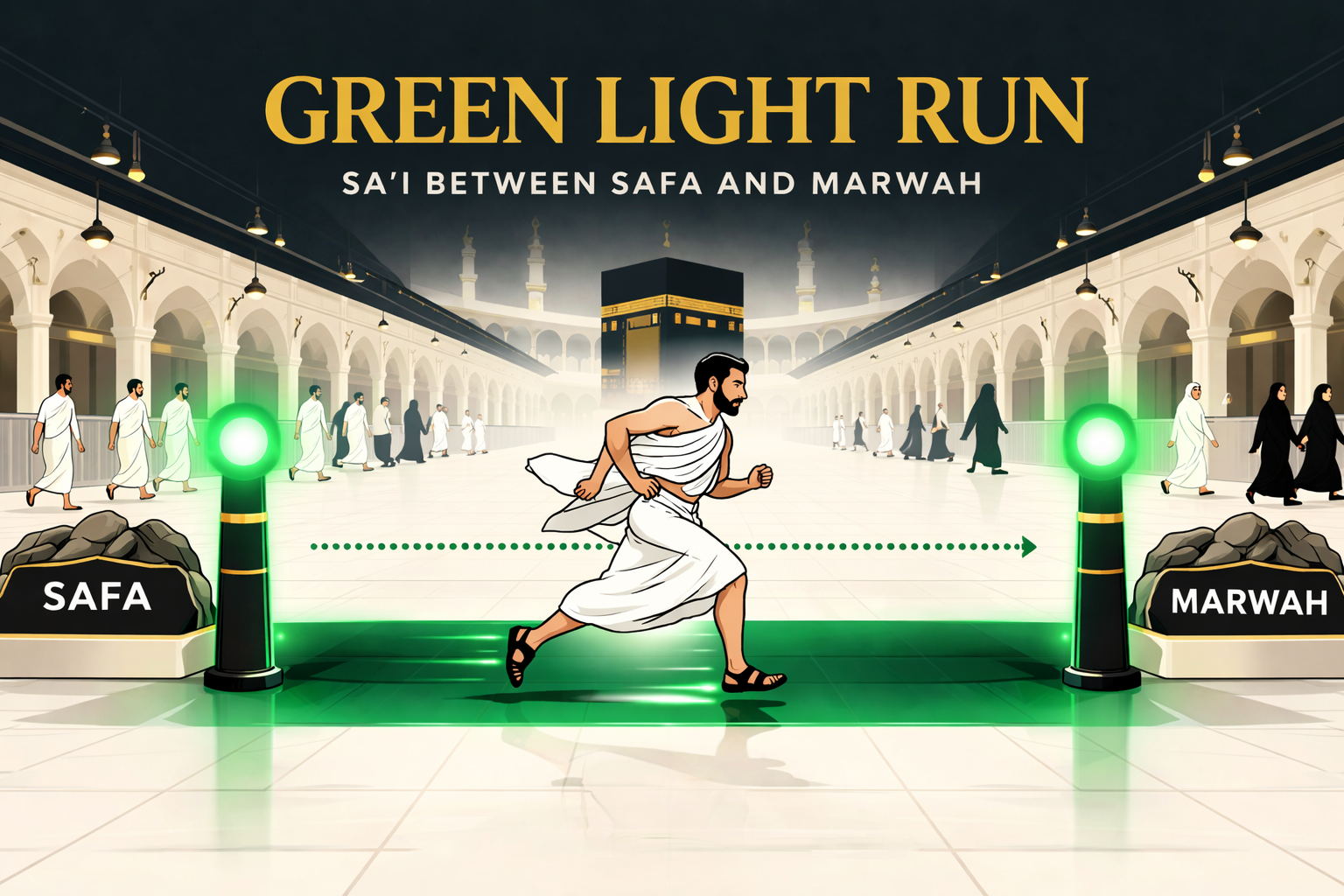
Sai Between Safa and Marwah: Step-by-Step Guide for Umrah and Hajj
Sai between Safa and Marwah is one of the core rites of Umrah and Hajj. It means walking back and forth seven times between the two blessed points of Safa and Marwah inside Masjid al-Haram, after tawaf.
If you want the shortest direct answer: what is sa’i between safa and marwah? It is the ritual that remembers Hajar’s search for water for Ismail, and it starts at Safa and ends at Marwah.
This sa’i between safa and marwah complete guide will show you the order, the duas, the green lights, the lap count, the distance, and the rules in plain words. For the step before this ritual, read Niyyah for Hajj and Umrah.
✅ TL;DR – sai between safa and marwah
Sa’i between Safa and Marwah is the ritual of walking seven times between the hills of Safa and Marwah after tawaf. It begins at Safa, ends at Marwah, covers about 3.15 km in total, and includes men running between green lights while women walk normally. Wudhu is recommended, but not required for validity.
What is sai between safa and marwah?
Sai between Safa and Marwah is the ritual of walking seven times between the two hills inside Masjid al-Haram
What is the sai of safa and marwa? It is the act of going back and forth seven times between Safa and Marwa inside Masjid al-Haram. This rite comes after tawaf and is part of both Umrah and Hajj. In simple words, it is worship through movement, dua, patience, and remembrance.
It is not just walking.
It is walking with a memory, a purpose, and a lesson.
Why Muslims perform Sa’i: Hajar’s search for water and the story of Zamzam
Why do Muslims perform sa’i? This ritual honors Hajar, the wife of Ibrahim, when she searched desperately for water for her baby Ismail. She went between the two points again and again with full trust in Allah. After her effort, Allah brought out the blessed water of Zamzam.
That is why what is sa’i cannot be explained like a dry definition from a dictionary. It is like watching a mother’s panic turn into worship, and her struggle turn into mercy.
Where Sai happens, how many laps it has, and where it starts and ends
Where Sai happens, how many laps it has, and where it starts and ends is simple to remember: it takes place in the Mas‘aa area of Masjid al-Haram, it has seven laps, it starts at Safa and ends at Marwah, and Safa to Marwah is 1 lap while Marwah to Safa is 2nd lap.
📚 You Can Also Read: Miqat for Hajj
How to Perform Sai Between Safa and Marwah Step by Step
Step 1 — Perform Sai after Tawaf
How to perform sa’i between safa and marwah begins with one key rule: Sa’i is performed after tawaf. For Umrah, it comes after Tawaf al-Umrah. For Hajj, the timing depends on whether the pilgrim is doing Hajj al-Tamattu, Hajj al-Qiran, or Hajj al-Ifrad.
If you are tired after tawaf, you may rest before starting. I used to think many beginners got confused because the ritual was hard. Most of the time, they are confused because they started tired and rushed.
Step 2 — Go to Safa and recite the opening verse and dua
As you approach Safa, recite the Qur’anic verse about Safa and Marwah, then say the opening line that you are beginning with what Allah began with. This is said when starting, not at the beginning of every lap.
📖 Opening Verse for Sa’i
إِنَّ الصَّفَا وَالْمَرْوَةَ مِنْ شَعَائِرِ اللَّهِ
Transliteration: Inna ṣ-Ṣafā wa l-Marwata min shaʿā’iri Llāh.
Translation: “Indeed, Safa and Marwa are among the symbols of Allah.”
Then say:
أَبْدَأُ بِمَا بَدَأَ اللَّهُ بِهِ
Transliteration: Abda’u bimā badā’ Allāhu bih.
Translation: “I begin with that which Allah has begun with.”
Step 3 — Face the Kaaba and make dua at Safa
When you reach Safa, face the Kaaba, raise your hands, praise Allah, and make dua at Safa. You may say takbir, tahlil, salawat, and your personal dua. The Sunnah words here are well known and beautiful.
🤲 Dua at Safa and Marwah
اللّٰهُ أَكْبَرُ، اللّٰهُ أَكْبَرُ، اللّٰهُ أَكْبَرُ، وَلِلّٰهِ الْحَمْدُ
Transliteration: Allāhu akbar, Allāhu akbar, Allāhu akbar, wa li Llāhi l-ḥamd.
Translation: “Allah is the Greatest, Allah is the Greatest, Allah is the Greatest, and to Allah belongs all praise.”
لَا إِلٰهَ إِلَّا اللّٰهُ وَحْدَهُ لَا شَرِيكَ لَهُ، لَهُ الْمُلْكُ وَلَهُ الْحَمْدُ، وَهُوَ عَلَى كُلِّ شَيْءٍ قَدِيرٌ
Transliteration: Lā ilāha illa Llāhu waḥdahu lā sharīka lah, lahu l-mulk wa lahu l-ḥamd, wa huwa ʿalā kulli shay’in qadīr.
Translation: “There is no god but Allah alone, with no partner. To Him belongs all dominion and praise, and He has power over everything.”
Step 4 — Walk from Safa to Marwah for lap 1
Then start walking. Walk between Safa and Marwah. The first trip from Safa to Marwah is lap 1. When you reach Marwah, one lap is done. Then you return, and that becomes lap 2.
Many beginners overcomplicate the count. Do not do that. Think of it like this: every time you arrive somewhere, a lap ends there.
Step 5 — Men run between the green lights, women walk normally
Men running between green lights is Sunnah in the marked section called milayn al-akhdharayn, the two green mileposts. Women walk normally the whole way. Men do not run the entire Mas‘aa. Only the green-light section is for the quicker pace.
That one detail causes a lot of avoidable mistakes.
Step 6 — Make dua at Marwah and continue until 7 laps are complete
At Marwah, face the Kaaba, raise your hands, make dua at Marwa, and continue. Repeat the same pattern until you reach the completion of seven laps. The seventh lap ends at Marwah.
Step 7 — End at Marwah and know what to do after Sai
The end of sa’i is at Marwah after lap 7. After sa’i, what happens next depends on whether you are doing Umrah or Hajj. In Umrah, hair cutting or shaving follows. In Hajj, the next step depends on your Hajj type and timing.
📚 You Can Also Read: Tawaf al-Wida
What to Recite Between Safa and Marwa
The verse to recite before starting Sai at Safa
What to recite between safa and marwa starts with the verse of Surah al-Baqarah about Safa and Marwah and the line: “I begin with what Allah began with.” This is read at the start when approaching Safa.
Dua to say on Safa and Marwah
The known Sunnah dhikr at Safa and Marwah includes takbir, tahlil, praise of Allah, and then personal dua. You may repeat the remembrance and make your own supplications between repetitions.
What to recite while walking between Safa and Marwah
There is no single fixed text required while walking. You can make dhikr, say SubhanAllah, Alhamdulillah, Allahu Akbar, send salawat, or make personal dua. Some people also recite:
🌿 Common Dua During Sa’i
رَبِّ اغْفِرْ وَارْحَمْ، تَجَاوَزْ عَمَّا تَعْلَمْ، إِنَّكَ أَنْتَ الْأَعَزُّ الْأَكْرَمُ
Transliteration: Rabbi ghfir warḥam, tajāwaz ʿammā taʿlam, innaka anta l-aʿazzu l-akram.
Translation: “My Lord, forgive and have mercy, overlook what You know, for You are the Most Mighty, the Most Noble.”
Is there any fixed dua during Sai or can you make personal dua?
Is there any fixed dua during Sai or can you make personal dua? You can make personal dua. There is no single compulsory script for every step of the walk. That matters because many first-time pilgrims worry that if they forget a dua booklet, they will ruin their Sa’i. They will not.
📚 You Can Also Read: Ihram Rules for Hajj
Sai Between Safa and Marwah Rules
Does Sai have to start at Safa and end at Marwah?
Yes. One of the main requisites of sa’i is to commence from safa. If someone starts from Marwah, that first movement does not count as a proper first lap.
How are the 7 laps counted correctly?
The count is simple:
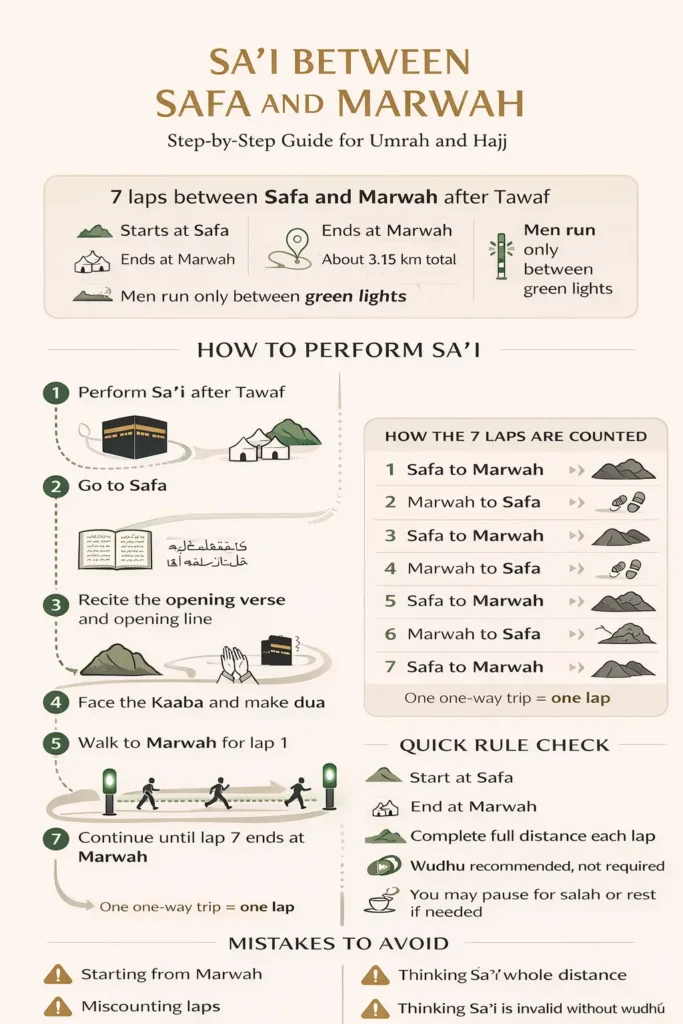
- Lap 1: Safa to Marwah
- Lap 2: Marwah to Safa
- Lap 3: Safa to Marwah
- Lap 4: Marwah to Safa
- Lap 5: Safa to Marwah
- Lap 6: Marwah to Safa
- Lap 7: Safa to Marwah
If you become unsure, go with the lower number you are certain about.
Do you need wudhu for Sai?
Do I need wudhu for sa’i? Wudhu is recommended, but not required for the validity of Sa’i. That means the state of wudhu is Sunnah here, not a strict شرط for validity like tawaf. This is one of the most common points people misunderstand.
Is Sai valid if it is delayed after Tawaf?
Yes, Sa’i is valid if delayed after tawaf. It is better to do it soon after tawaf, but if a person rests because of fatigue or crowd pressure, the Sa’i remains valid.
Can Sai be paused for salah, rest, or necessity?
Yes. Sa’i can be paused for obligatory salah, rest, bathroom need, or real necessity. Then the pilgrim continues from where he stopped. If the exact point is forgotten, repeating the lap is the safer choice.
📚 You Can Also Read: Hajj Mistakes to Avoid
Green Lights in Safa Marwa — What Do They Mean?
What is the green light area in Sai?
What is green light in safa marwa? The green lights mark the area where Hajar ran more quickly in the valley. These are the two green mileposts, also called milayn al-akhdharayn.
Why do men run between the two green markers?
What is the reason why men run in sa’i between as-safa and al-marwah? Men run in that marked section because that part used to be the low valley area. It also preserves the memory of Hajar’s urgent movement while searching for water.
Is running mandatory during Sai?
Is running mandatory during sa’i? No. It is Sunnah for men in the green-light area, not a condition for validity. Women walk normally. Men who are weak, elderly, or helping others may also leave the running without making the Sa’i invalid.
Sai Distance and Time
How long is the walk between Safa and Marwah?
How long is the walk between safa and marwa? One way is about 450 metres. That means a single trip from one end to the other is not very long, but it feels different when the area is crowded and your legs are already tired from tawaf.
Total distance of 7 rounds between Safa and Marwah
Safa marwa 7 rounds distance is about 3.15 km in total. You must cover the full distance between Safa and Marwa. Leaving part of the path uncovered means the Sa’i remains incomplete.
How long Sai usually takes for most pilgrims
For many pilgrims, Sa’i takes around 45 minutes to a little over 1 hour, depending on crowd level, walking speed, rest, age, and whether the pilgrim is using an upper level or wheelchair area.
My students always ask whether they are “too slow.” Usually, they are just being normal human beings in a crowded sacred place.
Sai in Hajj vs Umrah
Sai in Umrah: when it is done and what happens after it
In Umrah, Sa’i comes after tawaf. Once the pilgrim finishes the seventh lap at Marwah, hair cutting or shaving follows, and Umrah is completed.
Sai in Hajj al-Tamattu, Qiran, and Ifrad
Sa’i in hajj vs umrah changes mainly in timing. In Hajj al-Tamattu, Sa’i is done once with the Umrah part and again after the Hajj tawaf. In Hajj al-Qiran and Hajj al-Ifrad, it may be done after Tawaf al-Qudum or delayed until Tawaf al-Ziyarah, depending on the case described in the books of fiqh.
When hair cutting or shaving happens after Sai
After Sa’i in Umrah, men shave or shorten the hair and women trim a small amount. In Hajj, hair cutting is tied to the later Hajj sequence, not simply to Sa’i alone in every case.
📚 You Can Also Read: Halq and Taqsir Ritual Head Shaving
Significance of Sai Between Safa and Marwah
How Sai honors the patience of Hajar and her trust in Allah
Significance of sa’i begins here: it honors the patience of Hajar and her trust in Allah. She did not sit still and wait in hopelessness. She moved. She searched. She trusted. Sa’i teaches effort with faith.
Spiritual lessons of Sai: tawakkul, struggle, and hope
The spiritual lesson is not “walk because Hajar walked.” It is deeper. It is: keep moving even when the answer has not appeared yet. That is why Sa’i is really a lesson in tawakkul, struggle, and hope at the same time.
Life feels like that sometimes. One step. Then another. Then another. Then Allah opens what you could not see.
Quran verse about Safa and Marwah and what it means
The Qur’an makes Safa and Marwah part of the signs of Allah. That means these two points are not random old landmarks. They are symbols tied to obedience, memory, and sacred meaning.
📚 Qur’an Box — Safa and Marwah
إِنَّ الصَّفَا وَالْمَرْوَةَ مِن شَعَائِرِ اللَّهِ ۖ فَمَنْ حَجَّ الْبَيْتَ أَوِ اعْتَمَرَ فَلَا جُنَاحَ عَلَيْهِ أَن يَطَّوَّفَ بِهِمَا
Transliteration: Inna ṣ-Ṣafā wa l-Marwata min shaʿā’iri Llāh, fa-man ḥajja l-bayta awiʿtamara fa-lā junāḥa ʿalayhi an yaṭṭawwafa bihimā.
Translation: “Indeed, Safa and Marwa are among the symbols of Allah. So whoever makes Hajj to the House or performs Umrah, there is no blame upon him for walking between them.”
Common Mistakes During Sai
Starting from Marwah instead of Safa
This is one of the classic beginner mistakes. Sa’i must begin at Safa. Starting at Marwah breaks the correct opening order.
Miscounting laps between Safa and Marwah
People often count one full back-and-forth as one lap. That is wrong. One one-way trip is one lap.
Thinking wudhu is compulsory for Sai
This mistake causes needless panic. Wudhu is recommended, but Sa’i is still valid without it.
Running the whole distance instead of only the green-light section
Another common error. Men do not run the whole Mas‘aa. Only the marked green-light section is for the faster pace.
Leaving part of the distance uncovered
The pilgrim must cover the full distance between Safa and Marwa. Cutting corners or stopping short makes the Sa’i incomplete.
📊 sai between safa and marwah — quick rule table
Use this table when you want the fastest beginner check before starting your Sa’i.
🕋 Show Sa’i Rules Table
| Point | Correct rule | Common mistake |
|---|---|---|
| Starting point | Begin at Safa | Starting from Marwah |
| Ending point | Finish lap 7 at Marwah | Ending at Safa by mistake |
| Lap count | Safa to Marwah = 1 | Counting full return as 1 |
| Green lights | Men run only there | Running whole distance |
| Wudhu | Recommended, not required | Thinking Sa’i breaks without wudhu |
| Distance | Complete full path each lap | Leaving part uncovered |
FAQs About Sai Between Safa and Marwah
📘 sai between safa and marwah FAQs
What is sai between safa and marwah?
Show Answer
It is the ritual of walking seven times between Safa and Marwah inside Masjid al-Haram after tawaf during Umrah or Hajj.
How to perform sa’i between safa and marwah?
Show Answer
Start at Safa after tawaf, recite the opening verse, make dua, walk to Marwah for lap 1, return for lap 2, continue until seven laps are complete, and end at Marwah.
What to recite between safa and marwa?
Show Answer
At the start, recite the verse about Safa and Marwah and “Abda’u bima bada’ Allahu bih.” At Safa and Marwah, make the known dhikr and personal dua. During the walk, there is no compulsory fixed text.
Is running mandatory during sa’i?
Show Answer
No. Running is Sunnah for men only in the green-light section. Women walk normally.
What is green light in safa marwa?
Show Answer
The green lights mark the section where Hajar ran more quickly. Men are encouraged to increase pace there.
How long is the walk between safa and marwa?
Show Answer
One way is about 450 metres. Seven laps together are about 3.15 km.
Do I need wudhu for sa’i?
Show Answer
Wudhu is recommended but not required for the validity of Sa’i.
What happens after sa’i?
Show Answer
After Sa’i in Umrah, men shave or shorten the hair and women trim a small amount. In Hajj, the next step depends on the Hajj type and timing.
Why do Muslims perform sa’i?
Show Answer
Muslims perform Sa’i to honor Hajar’s search for water, her patience, and her trust in Allah.
Why is safa marwa 7 times?
Show Answer
Because the ritual was taught in that exact way and follows the prophetic form of the rite. The pilgrim follows the worship as transmitted, not personal preference.
Is Sai valid if delayed after Tawaf?
Show Answer
Yes. It is better to perform it soon after tawaf, but resting or delaying for a valid reason does not cancel it.
Can Sai be paused for salah, rest, or necessity?
Show Answer
Yes. You may pause for salah, rest, or need, then continue from where you stopped.
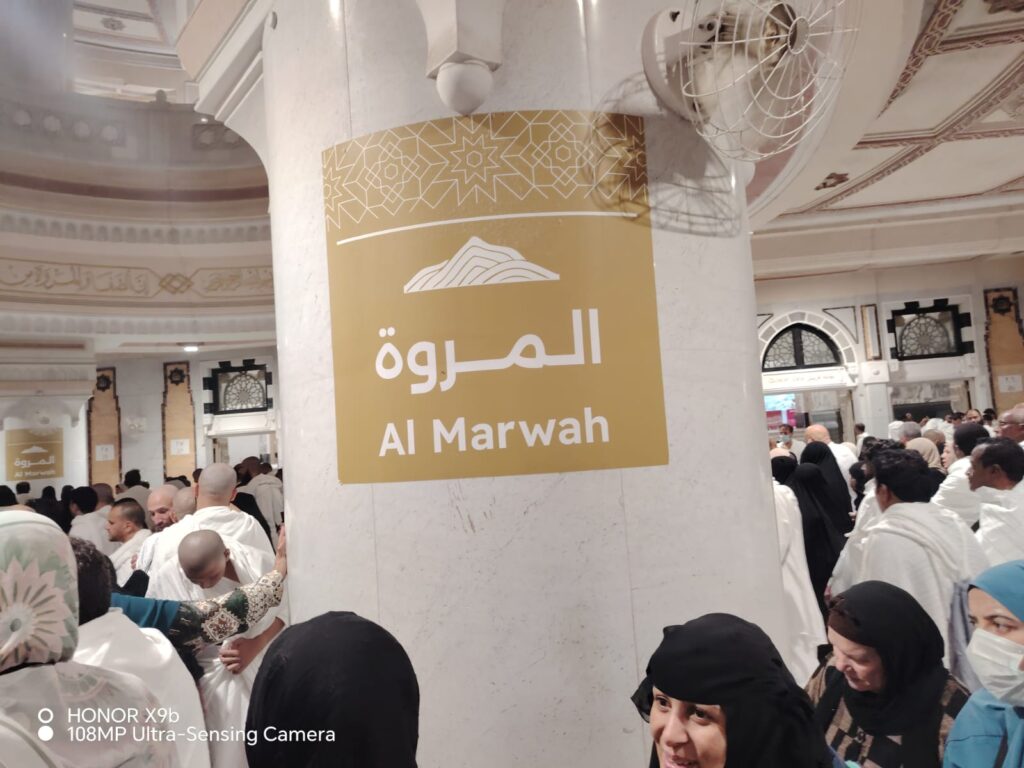
Sai Between Safa and Marwah Step-by-Step Infographic
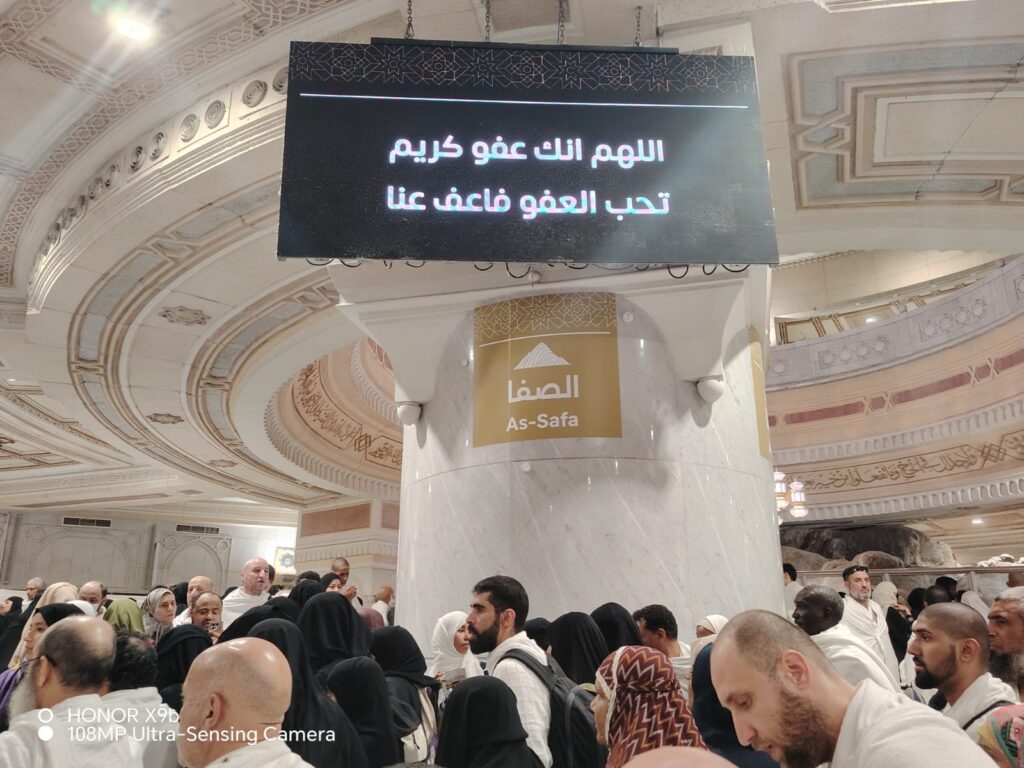
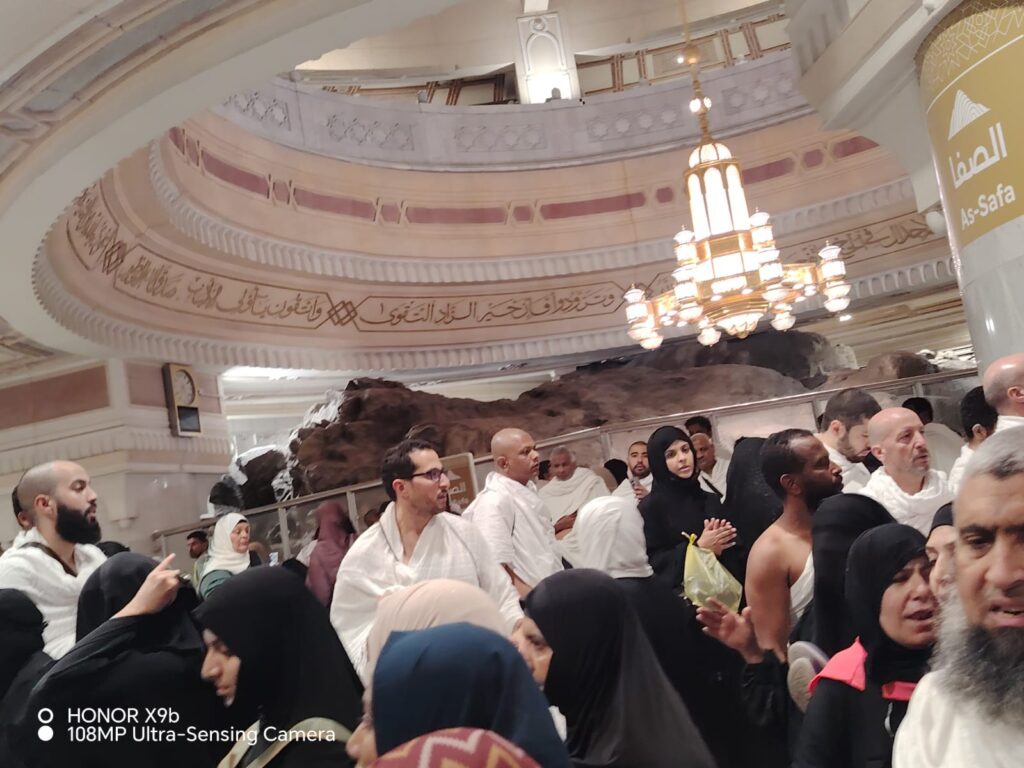
You Can Also Check
- nafl tawaf guide
- tawaf al umrah guide
- tawaf al wada guide
- tawaf al qudum guide
- tawaf al ifadah guide
- tawaf al ziyarah guide
- tawaf faqs guide

Farrukh Farooqi has been living in Sharaya, Makkah, Saudi Arabia since 2010. With over 14 years of firsthand experience witnessing the sacred journey of millions of pilgrims, Farrukh specializes in providing practical, insider tips for Hajj and Umrah travelers. His work blends real-world observations, the latest Saudi updates, and essential crowd management strategies — helping pilgrims and worshippers plan smarter, stay safer, and experience a spiritually fulfilling journey across the Holy Cities.


