
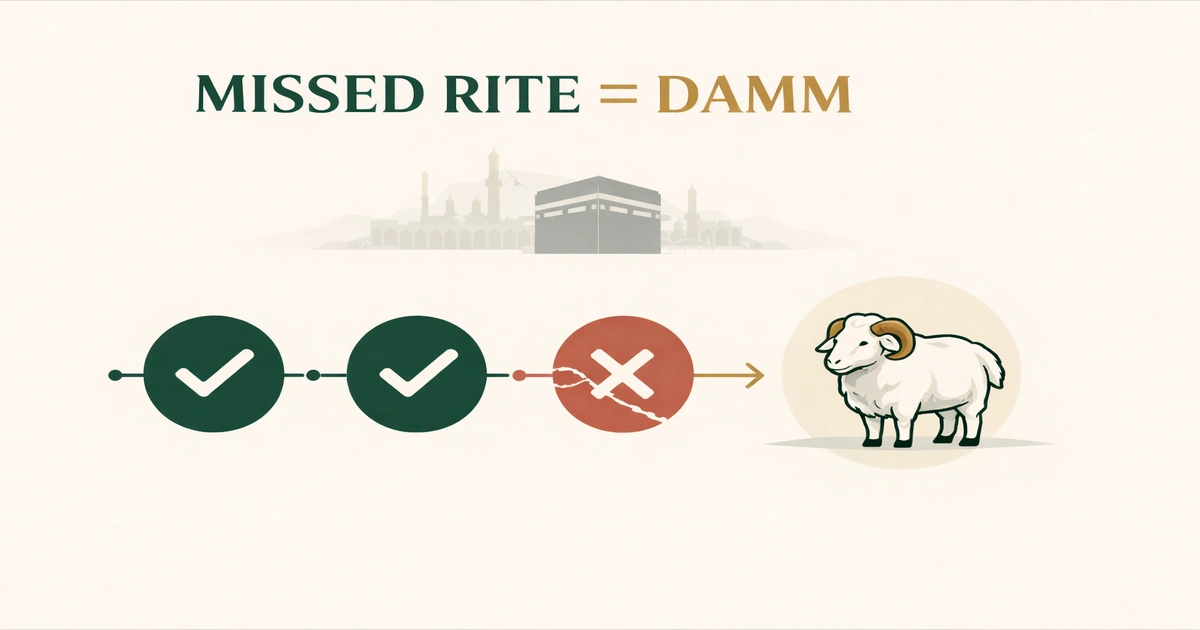
Damm for Omitting Mandatory Rites: Rules, Mistakes, and How to Pay
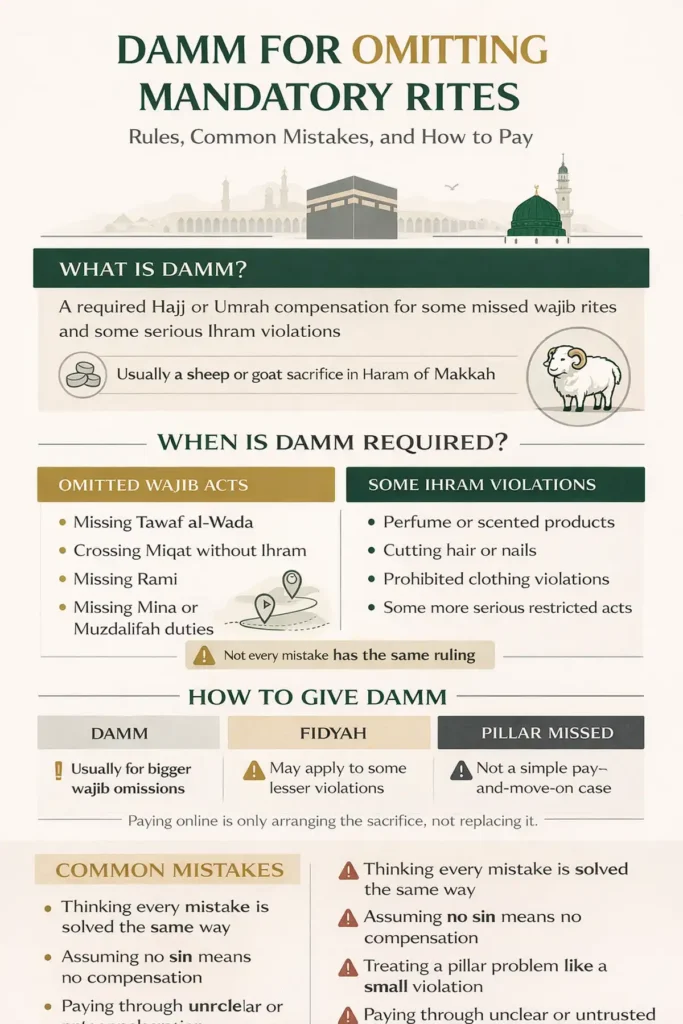
Damm for omitting mandatory rites means a required compensation in Hajj or Umrah when a pilgrim misses a wajib act or commits certain serious violations of Ihram. In many cases, it means sacrificing a sheep or goat within the Haram boundary of Makkah and giving the meat to the poor. For a broader foundation first, read dam in umrah.
Damm for violating Ihram and damm for omitting mandatory rites are connected topics, but they are not always the same kind of mistake. One may involve violations of ihram restrictions. The other may involve omitting a wajib act, such as missing tawaf al-wada, passing the miqat without entering into the state of ihram, skipping tawaf or sa’i, rami omission, or not spending the night in muzdalifah or mina.
If you are asking what is damm in islam, when is damm required during umrah or hajj, or how to give damm for umrah or hajj, the short answer is simple: some mistakes are fixed by repeating the rite, some need damm or fidyah, and some mistakes are so serious that the pilgrimage itself is damaged.
✅ TL;DR – damm for omitting mandatory rites
Damm is a mandatory penalty required in hajj or umrah for some missed wajib rites and some major violations of ihram restrictions. It usually means sacrificing a small animal such as a sheep goat within the haram boundary of makkah, with distribution to the poor and needy in makkah. Some lesser mistakes may need fidyah instead.
What Is Damm for Omitting Mandatory Rites?
Damm for omitting mandatory rites explained simply
Damm for omitting mandatory rites in hajj or umrah is a compensatory sacrifice when a pilgrim leaves out a wajib duty or commits a serious mistake that does not always cancel the whole pilgrimage but still leaves a real shortfall. Think of it like a missing brick in a wall. The wall may still stand, but the gap must be dealt with.
That gap matters.
What Damm means in Hajj and Umrah
Damm in hajj and damm in umrah both refer to expiation linked to pilgrimage mistakes. In ordinary speech, people often say “damm” for many penalties. In fiqh, though, the details can differ depending on what exactly was missed, when it happened, and whether the mistake relates to a wajib act, an Ihram restriction, or a pillar.
Why Damm is required when a wajib act is missed
When a wajib act is left out, the pilgrim has not completed the rite in the proper way. That is why when damm is obligatory, it acts as compensation for the lack of action. It is not just a fine. It is a religious correction.
📖 Qur’an Box
وَأَتِمُّوا۟ ٱلْحَجَّ وَٱلْعُمْرَةَ لِلَّهِ ۚ فَإِنْ أُحْصِرْتُمْ فَمَا ٱسْتَيْسَرَ مِنَ ٱلْهَدْىِ
Transliteration: Wa atimmul-hajja wal-‘umrata lillah, fa in uhsirtum fama istaysara minal-hady.
Translation: “And complete the Hajj and Umrah for Allah. But if you are prevented, then offer what can be obtained with ease of sacrificial animals.”
This verse is one of the foundations scholars discuss when explaining sacrifice and compensation in pilgrimage matters.
📚 You Can Also Read: What Are Fard, Wajib, and Sunnah of Hajj?
What Is Damm in Islam?
Damm meaning and definition
Damm meaning and definition in pilgrimage law usually refers to the slaughter of a valid animal as an expiation for certain Hajj or Umrah mistakes. In plain words, it is a religious payment made through sacrifice, not through cash alone. Cash is only a means to arrange the sacrifice if a trusted service does it for you.
Why Damm is called sacrificial blood
Damm sacrificial blood comes from the Arabic root connected to blood. That is why older books and many teachers explain it as a blood sacrifice. The phrase can sound harsh in English, but the meaning is simple: a lawful sacrificial animal is slaughtered as expiation.
Why the sacrifice must be within the Haram boundary of Makkah
The sacrifice has to be done within makkah and then given to the poor, more precisely within the sacred boundary of the Haram. This is not a random location rule. The expiation is tied to the pilgrimage itself, so its place is also restricted. A goat slaughtered somewhere else may be charity, but it would not count as the required pilgrimage damm.
📚 You Can Also Read: Dam in Hajj
When Is Damm Required During Umrah or Hajj?
When Damm becomes obligatory for omitted wajib acts
When is damm required during umrah or hajj? One of the clearest cases is when a wajib act is left out. Examples often mentioned by scholars include missing tawaf al-wada, certain Mina and Muzdalifah omissions, and crossing the miqat without proper Ihram.
When Damm is required for violations of Ihram restrictions
Violations of ihram restrictions can also lead to expiation. But not every violation is exactly the same. Some acts may call for fidyah. Some may require damm. And some serious acts, especially sexual intercourse before completion in certain cases, can do far more damage than a simple penalty issue.
When Damm applies even if the mistake was unintentional
A common confusion is this: “If I forgot, do I still owe anything?” In some cases, yes. Sin and compensation are not always identical questions. A person may be excused from sin due to forgetfulness or ignorance, yet still need compensation because the rite itself was left incomplete in practice.
My students always pause at this part.
They think “no sin” must always mean “no consequence.” Hajj is more delicate than that.
📚 You Can Also Read: Hajj Mistakes to Avoid
Which Mandatory Rites Commonly Require Damm?
Missing Tawaf al-Wada during Hajj
Missing tawaf al-wada is one of the best-known examples tied to damm in many fiqh discussions. This farewell tawaf is a wajib act for many pilgrims, so leaving it without a valid excuse can require compensation.
Passing the Miqat without entering the state of Ihram
Passing the miqat without entering into the state of ihram is another classic case. Many beginners wrongly think they can just make Ihram later in Jeddah or Makkah. That mistake can carry real consequences. This is one reason miqat violation is discussed so often.
Skipping Tawaf or Sa’i
This heading needs care. Skipping tawaf or sa’i is not one simple rule in every case. If the skipped act is actually a pillar, then the pilgrimage is not complete without it. That is bigger than a damm issue. Some people loosely say “skipping tawaf or sa’i requires damm,” but the safer beginner rule is this: if it is a pillar, you cannot just patch it with sacrifice.
Missing Rami at the Jamarat
Rami omission or missing the pelting of jamarat can require compensation when the rite is left out in a way that counts as omitting a wajib duty. Details can differ by school and by how much was missed.
Not spending the night in Mina or Muzdalifah
Not spending the night in muzdalifah or mina, or skipping the nights in mina, is also discussed among the common wajib omissions. This is why many pilgrims ask about the stay in muzdalifah and night duties in Mina so carefully.
📚 You Can Also Read: Tawaf al-Wida Dam
Common Mistakes During Umrah That May Require Damm or Fidyah
Entering Ihram after crossing the Miqat
Entering ihram after crossing the miqaat is one of the most common Umrah mistakes. Many pilgrims on flights miss the announcement, sleep through the timing, or assume they can fix it later without consequence. This is one reason people search umrah me dam kab wajib hota hai.
Forgetting to shave or trim hair after Sa’i
Forgetting to shave trim hair after completion of sa’iy is another mistake that confuses beginners. If you finish Sa’i and change clothes without properly exiting Ihram through hair cutting, you may have created a problem that needs correction. If fixed immediately, the ruling can be simpler. If delayed badly, the issue becomes heavier.
Leaving the Umrah incomplete after hardship or crowding
Leaving the umrah incomplete because of exhaustion, fear of the crowd, or simple frustration is not something a pilgrim should treat casually. Removing Ihram clothes does not magically end the state of Ihram. A teacher once described it to me like this: you cannot walk out of a contract with Allah just by changing your shirt.
Wearing stitched clothes during Ihram for men
Wearing stitched clothes for men during Ihram is a well-known violation. Men sometimes wear an undershirt, socks, or fitted garments because they think “it is only for a short time.” But short does not always mean trivial, and the details matter.
Wearing a face covering or mask in a prohibited way
Wearing mask for women during Ihram is one of the questions that keeps returning. The issue is not ordinary health caution in a broad sense, but whether the face covering is used in a prohibited way that directly rests on the face like a niqab. This area needs careful fiqh-based handling, not social media shortcuts.
📚 You Can Also Read: Miqat for Hajj
What Ihram Violations Can Lead to Damm?
Applying perfume or scented products in Ihram
Applying perfume or scent, or using wearing cologne fragrant soaps or deodorants, is one of the most repeated Ihram mistakes. People forget that even “fresh” products can be scented. The pilgrim who packs carefully before travel usually saves himself a lot of trouble here.
Cutting hair or nails during Ihram
Cutting hair or nails during ihram is another classic issue. Sometimes it happens from habit. Sometimes from stress. Sometimes from not knowing where the line is. A person bites one nail or pulls one hair and thinks nothing happened. But pilgrimage rules often care about details the everyday mind ignores.
Covering the head for men or face for women
Covering the head for men and covering the face for women in a prohibited way is discussed widely in pilgrimage fiqh. This is one of those areas where beginners should be especially careful with “someone on WhatsApp told me” rulings. Small wording changes can create big legal differences.
Intimate contact or intercourse during Ihram
Intimate contact or intercourse during Ihram is among the most serious topics. Not every level of contact has the same ruling. But intercourse in particular can go far beyond ordinary damm issues and may even invalidate the pilgrimage in certain cases. This is the part where guessing becomes dangerous.
📜 Hadith Box
مَنْ حَجَّ فَلَمْ يَرْفُثْ وَلَمْ يَفْسُقْ رَجَعَ كَيَوْمِ وَلَدَتْهُ أُمُّهُ
Transliteration: Man hajja فلم yarfuth wa lam yafsuq raja‘a kayawmi waladat-hu ummuh.
Translation: “Whoever performs Hajj and does not engage in obscene speech or sinful conduct returns like the day his mother gave birth to him.”
This hadith shows why protecting the sanctity of Ihram is not a small side matter.
📚 You Can Also Read: Damm for Violating Ihram
Damm vs Fidyah: What Is the Difference?
Are Damm and Fidyah the same
Are damm and fidyah the same? People use the words loosely, but they are not always identical. In broad beginner language, both are forms of expiation. In actual rulings, though, the type of mistake affects whether the expiation is called damm, fidyah, or something else.
When Damm is required for major violations
When Damm is required for major violations, it usually points to more serious omissions or breaches linked to pilgrimage duties. This is why major violations are often discussed under damm rather than under lighter charity-based answers.
When Fidyah applies to lesser violations
When Fidyah applies to lesser violations, it may involve alternatives like feeding the poor or, in some cases, fasting for three days. Some texts also mention food fidya to six poor people in certain penalty discussions. The exact ruling depends on the type of violation, so this is not a place for copy-paste answers.
Damm or Fidyah for Umrah mistakes explained simply
Damm or fidyah for umrah mistakes explained simply: bigger violations often need an animal sacrifice; smaller violations may be covered by charity or fasting; and if a pillar is missing, the answer may not be “pay and move on” at all. That is the real difference between damm and fidyah.
Does Missing a Ritual Invalidate Hajj or Umrah?
What happens if a wajib act is omitted
If a wajib act is omitted, the pilgrimage may still be basically valid, but it is deficient and can require compensation. This is why people say the pilgrimage may remain pilgrimage valid, but not properly complete without addressing the shortfall.
What happens if a pillar like Tawaf or Sa’i is skipped
If a pillar is left out, the issue is heavier. A pillar is not just a recommended or secondary act. It is a load-bearing part of the worship. Missing a pillar like core Tawaf or core Sa’i is not usually solved by a simple damm shortcut.
Pilgrimage valid versus spiritually complete
This is a useful distinction: something may be technically valid in a narrow sense yet not spiritually complete, especially if the person was careless, dismissive, or never bothered to fix what could be fixed. Hajj is not a game of legal minimums. It is worship.
📚 You Can Also Read: Sai Between Safa and Marwah
How to Give Damm for Umrah or Hajj
Choosing a valid sheep or goat for Damm
How to give damm for umrah or hajj begins with the animal. A valid damm usually involves a healthy goat or a sheep that meets the basic sacrificial conditions. Some discussions also mention contributing to the sacrifice of a larger animal like a camel or a cow, but the simple beginner answer usually centers on a goat or sheep.
Where to pay Damm in Makkah
Where to pay damm in makkah is one of the most searched questions. Pilgrims usually arrange it through trusted slaughter services, authorized channels, or reliable local representatives inside Makkah. The most important thing is not flashy advertising. It is whether the service is actually trustworthy and Shariah-aware.
Can someone else pay Damm on your behalf
Can someone else pay damm on my behalf? Yes, arranging the sacrifice through another person or service is generally possible, provided the obligation is fulfilled correctly on your behalf. This is especially helpful for elderly, sick, confused, or already-returned pilgrims.
How to verify the sacrifice and receive proof
Verifying the sacrifice and receiving proof matters because many pilgrims now pay remotely. Ask for a proper receipt, confirmation, or other clear evidence. A message that simply says “done” without real trust is not comforting. In worship, peace of mind matters.
💠 Damm Service Checklist
Before you pay any service, check these 5 points:
- Trusted identity of the provider
- Haram-area performance of the sacrifice
- Valid sacrificial animal used
- Meat distribution to poor people in Makkah
- Receipt and evidence or confirmation afterward
📚 You Can Also Read: Udhiyah and Qurbani Rules Guide
Can You Pay Damm Online?
Online options to pay Damm or Fidyah
Can you pay damm online? In practical terms, yes, many pilgrims now use trusted services for online options to pay damm fidyah. But the actual religious act is still the slaughter and distribution, not the click on a payment page. The payment is only the arrangement.
What to check before using an online Damm service
Before using any online provider, check whether it clearly states the location of sacrifice, the kind of animal used, the distribution method, and what proof you receive. This is especially important if you are searching how to give dum for umrah online or damm fidyah makkah.
How to confirm the meat was distributed correctly
How to confirm the meat was distributed correctly is part of trust. A decent provider should be able to tell you that the meat goes to eligible poor recipients within Makkah. This should not be vague. If they sound blurry, move on.
How Much Is Damm or Fidyah for Umrah?
How much Damm may cost in Makkah
How much is damm or fidyah for umrah does not have one permanent answer because livestock prices and service costs change. That is why it is safer not to memorize a fixed number from an old post. The real answer is that the amount varies by provider, animal type, season, and local market conditions.
When fasting or feeding the poor may apply instead
Alternative fasting or feeding poor people may apply in some lesser violation cases tied to fidyah. But not every damm issue can be swapped casually for fasting. A person should not rewrite pilgrimage law just because the cheaper option sounds nicer.
What if you cannot afford the Damm amount
If you truly cannot afford the required expiation, ask a qualified scholar about your exact case. Some cases have alternatives. Some do not. Some are simple. Some are not. This is where honest case-specific guidance matters more than internet certainty.
📚 You Can Also Read: Different Categories of Damm
Rules About Meat Distribution After Damm
Who receives the meat from Damm
Who receives the meat from damm? The normal rule taught for this type of sacrifice is that it goes to the poor and needy of the Haram area. The purpose is not personal celebration. It is expiation joined with charity.
Can you eat from the Damm animal
Can you eat from the damm animal? This point is discussed differently across categories and details, so a beginner should not assume one blanket answer for every kind of sacrifice. The safer broad teaching for expiation damm is to focus first on lawful distribution, not on personal eating rights.
Why the meat must go to the poor and needy in Makkah
Why the meat must go to the poor and needy in makkah? Because the expiation is tied to the sacred pilgrimage zone, and the charitable distribution follows that same sacred setting. This keeps the act from becoming a detached donation with no pilgrimage connection.
When Should Damm Be Paid?
Why Damm should be paid as soon as possible
Paid as soon as possible is the safest general advice. A pilgrim should not act as though compensation is a casual item to remember six months later while sorting old photos.
Should Damm be paid before leaving Makkah
Before leaving makkah is the ideal practical approach in many cases because the sacrifice belongs there and the pilgrim is already in the place where the obligation is tied. This also removes later confusion.
Can Damm be delayed
Can i delay paying the damm? Delay is not something a pilgrim should choose lightly. If it happens because of genuine limitation, the matter may be manageable. But voluntary careless delay is not the spirit of repentance or correction.
📚 You Can Also Read: Hady in Hajj
Can Damm Be Avoided by Repeating the Action Correctly?
When correcting the action helps
Can damm be avoided by repeating the action correctly? Sometimes correcting the action immediately does help, especially when the rite can still be properly completed within its place and time. For example, if a counting mistake in Tawaf or Sa’i is caught early, the missing part may be completed.
When repeating the ritual does not remove Damm
But once a clear violation has fully happened, repeating the ritual later does not always erase the compensation. Think of spilling tea on a white sheet. Washing the cup again does not remove the stain already made. I know that sounds simple, but it helps people remember the rule.
What to do if you realize the mistake late
If you realize the mistake late, do not panic and do not invent your own ruling. Write down exactly what happened, when it happened, and what you had already completed. Then ask a qualified scholar who understands Hajj and Umrah rulings properly.
What to Do If You Make a Mistake in Umrah
Correct the mistake immediately if possible
What to do if you make a mistake in umrah? First, correct it immediately if it can still be corrected. This may be the difference between a simple fix and a later compensation issue.
When to seek a scholar for a specific ruling
Seek a scholar when the mistake involves missing a pillar, not knowing your order of rites, intimacy-related issues, miqat problems, or prolonged delay after the mistake. Those are not beginner-guess areas.
What to do after returning home with an uncorrected mistake
If you return home and then realize you left an uncorrected mistake, do not brush it off. Some matters can be handled by arranging sacrifice from afar. Some require return. Some require detailed case analysis. The biggest mistake after the first mistake is pretending it no longer matters.
📊 Damm for omitting mandatory rites: common cases at a glance
Use this table as a quick filter: some mistakes require compensation, some need immediate correction, and some are bigger than a simple damm answer.
🕋 Show Damm Summary Table
| Mistake | Typical category | Beginner-safe understanding |
|---|---|---|
| Crossing miqat without ihram | Wajib omission | Often discussed under damm |
| Missing Tawaf al-Wada | Wajib omission | Often requires compensation |
| Skipping a pillar of Tawaf or Sa’i | Pillar problem | Not a simple “pay and move on” case |
| Perfume or nail cutting in Ihram | Ihram violation | May involve damm or fidyah depending on details |
| Missing Mina or Muzdalifah night duties | Wajib omission | Commonly discussed under compensation |
| Intercourse during Ihram | Severe violation | Can be much more serious than ordinary damm |
Damm for Omitting Mandatory Rites FAQs
📘 damm for omitting mandatory rites FAQs
What is Damm in Islam
Show Answer
What is damm in islam? In pilgrimage rulings, it usually means a required sacrificial expiation for certain Hajj or Umrah mistakes, often through a sheep or goat slaughtered in the Haram and given to the poor.
When is Damm required during Umrah or Hajj
Show Answer
When is damm required during umrah or hajj? Common cases include omitting certain wajib acts, crossing the miqat without Ihram, some Mina or Muzdalifah omissions, and some major Ihram violations.
How to give Damm for Umrah or Hajj
Show Answer
How to give damm for umrah or hajj? Arrange a valid sacrificial animal through a trusted provider in Makkah, make sure the sacrifice is done in the Haram, and ensure the meat goes to poor recipients there.
How to pay Damm for Umrah and Hajj online
Show Answer
How to pay give damm for umrah and hajj online? Use a trusted service that clearly states the sacrifice location, animal type, meat distribution method, and proof of completion.
Where to give Damm in Makkah
Show Answer
Where to give dam in makkah? Through trusted slaughter or qurbani services operating within the Haram boundaries, or through a reliable agent acting on your behalf.
How much is Damm or Fidyah for Umrah
Show Answer
How much is damm or fidyah for umrah? There is no timeless fixed price. Damm cost changes with livestock and provider rates. Fidyah amounts also vary depending on the specific form of expiation required.
Can someone else pay Damm on my behalf
Show Answer
Yes. Can someone else pay damm on my behalf? In general, yes, another person or trusted service can arrange the sacrifice for you if it is done correctly.
Can Damm be avoided by repeating the action correctly
Show Answer
Can damm be avoided by repeating the action correctly? Sometimes immediate correction helps. But once a full violation has happened, repeating the act later does not always remove the need for compensation.
Is Damm the same as Fidyah
Show Answer
No. Are damm and fidyah the same? They are related forms of expiation, but they are not always identical. Damm usually points to heavier compensation than minor fidyah cases.
What should I do if I returned home with an Umrah mistake
Show Answer
Write down exactly what happened and seek a qualified ruling. Some mistakes can be corrected remotely through arranged sacrifice, while others need more than that.
Damm for Omitting Mandatory Rites Explained Simply
Related Articles
- Dam in Hajj
- Damm for Violating Ihram
- Tawaf al-Wida Dam
- Different Categories of Damm
- Ihram Rules Hajj
- Miqat for Hajj
- Hady in Hajj
You Can Also Check
- nafl tawaf guide
- tawaf al umrah guide
- tawaf al qudum guide
- tawaf al ifadah guide
- tawaf al ziyarah guide
- tawaf faqs guide

Farrukh Farooqi has been living in Sharaya, Makkah, Saudi Arabia since 2010. With over 14 years of firsthand experience witnessing the sacred journey of millions of pilgrims, Farrukh specializes in providing practical, insider tips for Hajj and Umrah travelers. His work blends real-world observations, the latest Saudi updates, and essential crowd management strategies — helping pilgrims and worshippers plan smarter, stay safer, and experience a spiritually fulfilling journey across the Holy Cities.


