Different Categories of Damm in Hajj and Umrah
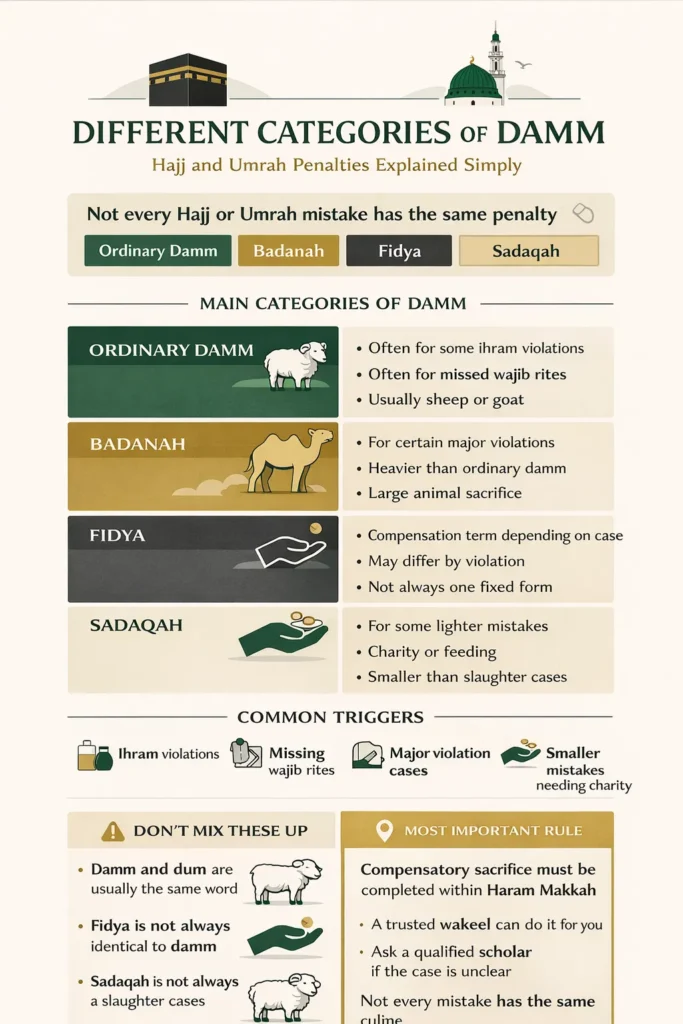
Different Categories of Damm are not all the same. Some mistakes need a sheep or goat, some need a larger penalty, some may involve fidya or sadaqah, and some mistakes are not fixed by dum alone at all.
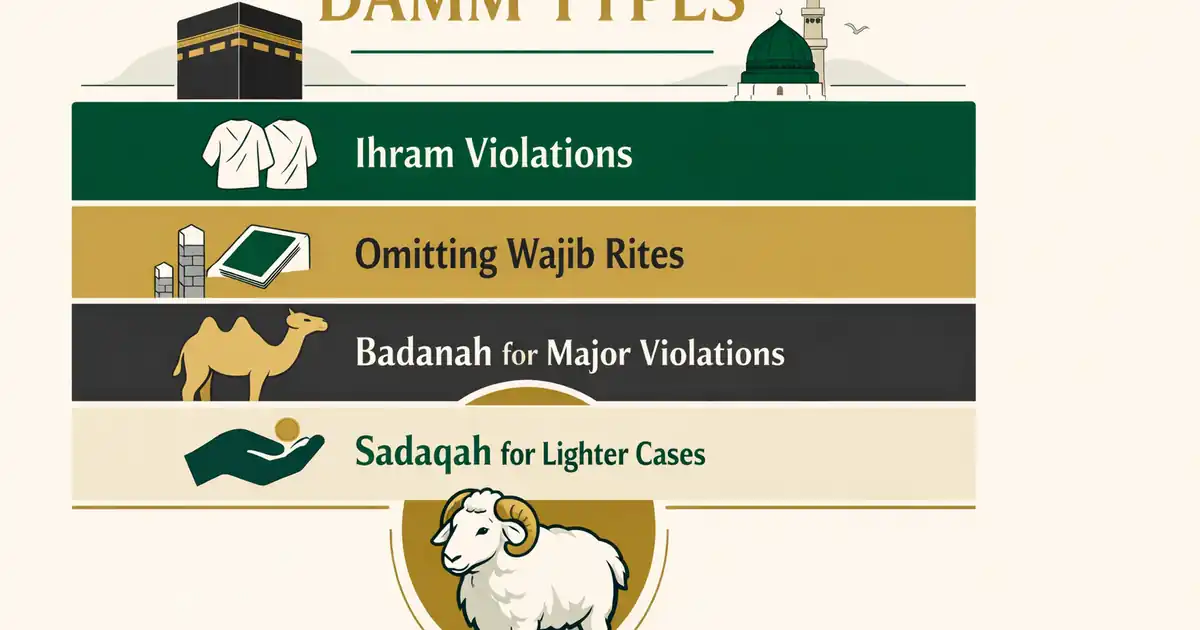
If you want the direct answer, damm in Hajj and Umrah usually comes up for violations of ihram and omission of mandatory rites. A more severe case can require badanah, while lighter cases may involve charity instead of a full penalty sacrifice.
This beginner-friendly guide explains what is damm in islam, what is dum fidya, when is the dum required, how to do damm, how to give dum for umrah, and how to pay for fidya using adahi without turning the topic into a fog of half-remembered terms.
For a related practical overview, see Dam in Hajj.
✅ TL;DR – different categories of damm
Damm usually covers two big areas: damm for violating ihram restrictions and damm for omitting obligatory rites. A more serious breach may require badanah, and a smaller case may involve sadaqah. As a safe beginner rule, the sacrifice must be completed within the boundaries of Haram Makkah, and if you are unsure which category applies, ask a qualified scholar before acting.
What Are the Different Categories of Damm?
Damm for violating Ihram restrictions
Damm for minor violations in ihram usually refers to mistakes like applying perfume, using scented products, cutting hair, clipping nails, wearing prohibited clothing, or similar breaches while in ihram. These are often grouped under violations of ihram jinaayaat.
Damm for omitting mandatory rites
Damm for omitting obligatory rites usually applies when a pilgrim misses a wajib act in Hajj or Umrah, such as a meeqat violation, missing a required rite, or failing to complete a wajib act properly. This is the second big category most people need to understand.
Badanah for major violations during Ihram
Badanah for major violations during ihram is the heavier category. It refers to a large animal sacrifice in certain major cases, not the ordinary sheep-or-goat type most people mean when they say damm.
Sadaqah for smaller mistakes and lighter penalties
Some lighter mistakes may lead to sadaqah or feeding instead of a full slaughter. This is where people often get confused and mix up damm fidya and sadaqa as if they always mean the same thing.
What Is Damm in Hajj and Umrah?
What damm means in Islam
What is damm in islam? In this Hajj and Umrah context, damm means a compensatory sacrifice given because of a violation or missed obligation connected to the rites. A simple way to picture it is this: when the pilgrimage path is damaged by a mistake, damm is one of the recognized ways of repairing that damage.
It is not random punishment.
It is a structured form of compensation in worship.
Difference between damm, dum, fidya, and sadaqah
Damm and dum are usually just different spellings of the same term in English writing. Fidya is often used broadly for compensation, while sadaqah points to charity or feeding in lighter cases. In everyday speech, people blur these together. In actual rulings, the category matters.
My students always ask about this part because one person says “pay fidya,” another says “give damm,” and a third says “just feed people.” Those words can overlap in casual speech, but they are not always identical in fiqh.
Penalty sacrifice for Hajj and Umrah explained simply
Penalty sacrifice for hajj and umrah means a sacrifice done in the name of Allah to make up for a specific mistake, where that ruling applies. For ordinary damm for hajj or damm for umrah, this is usually a healthy sheep or goat that meets valid sacrifice standards.
📖 Qur’an Box
فَمَا اسْتَيْسَرَ مِنَ الْهَدْيِ
Transliteration: Fama istaysara mina al-hady.
Translation: “Then offer what can be obtained with ease of sacrificial animals.”
This Qur’anic wording in Surah al-Baqarah 2:196 is part of the wider sacrificial rulings connected to pilgrimage. The detailed penalty rulings still need proper fiqh explanation, which is why asking a scholar matters when the case is not obvious.
📚 You Can Also Read: What Are Fard, Wajib, and Sunnah of Hajj?
When Is Dumm Required in Hajj and Umrah?
Missing any of the 6 wajib acts of Hajj
When is dum required in hajj and umrah? A common beginner summary says it becomes due when someone misses any of the 6 wajib acts of hajj. The exact fiqh breakdown can vary by school and by the exact act missed, but the broad rule remains: missing a wajib act can trigger compensation for hajj mistakes.
Missing any of the 2 wajib acts of Umrah
Likewise, people often summarize Umrah by saying missing either of the 2 wajib acts of umrah can lead to what is damm for umrah or fidyah for umrah mistakes. If the mistake is real and the rite cannot be corrected directly, compensation may be due.
Doing any of the 6 things that break Ihram
Another common summary is this: doing any of the 6 things that break ihram or seriously breach its rules may trigger damm for violating ihram restrictions. This covers things like scent, grooming, clothing restrictions, head covering for men, prohibited face covering details for women, and hunting.
Why there is no dum for missing a fard act
As a broad beginner-safe rule, a missed fard act is not simply repaired by paying dum. The act itself must be completed if possible, and in some cases the pilgrimage or rite is not sound without it. This is why people get into trouble when they treat every mistake as if one sheep fixes everything.
It doesn’t.
📚 You Can Also Read: Dam in Umrah
Damm for Violations of Ihram Restrictions
Applying perfume, scented soap, or oils
Applying perfume, scented soap, or perfumed oils while in Ihram is one of the best-known triggers for damm for violating ihram restrictions. It sounds small, but Ihram is built on discipline. A person can ruin that discipline through what seems like a tiny comfort choice.
Shaving hair, cutting nails, and grooming mistakes
Shaving hair, clipping nails, or making other grooming mistakes during Ihram may also lead to compensation. This is one of the most common beginner issues because tired pilgrims sometimes trim, scratch, or tidy themselves almost by habit.
Wearing stitched clothes or underwear for men
For men, wearing stitched clothes or underwear in the prohibited Ihram sense can trigger damm for minor violations. People hear “stitched” and get confused fast, but the practical point is simple: do not switch back into ordinary fitted clothing while you are still in Ihram.
Covering the head for men and covering the face in a prohibited way for women
Covering the head for men or covering the face in a prohibited way for women during Ihram can also fall into this category. Details here can get technical, so this is one of those topics where a calm question to a scholar saves a lot of damage.
Hunting wild animals while in Ihram
Hunting wild animals while in Ihram is another serious violation. It shows why Ihram is not only about clothes and perfume; it changes how you behave toward living things too.
Damm for Omitting Mandatory Rites
Crossing the Meeqat without Ihram
Damm for crossing the meeqat without ihram is one of the most discussed cases. If someone passes the miqat without entering Ihram when required, that is a classic meeqat violation. Sometimes the mistake can be corrected by going back and entering Ihram properly. If not corrected, compensation may become due.
Missing Rami or staying in Muzdalifah
Damm for missing rami or staying in muzdalifah is another common example under omission of mandatory rites wajib. The exact ruling can depend on what was missed, how much was missed, and whether it was corrected later.
Failing to perform Tawaf or Sa’i correctly
Damm for failing to perform tawaf or sa’i correctly is where many people panic because tawaf and sa’i include both fard-level and wajib-level details. That is exactly why you should not self-diagnose from random videos. The missing part matters.
Shaving the head before completing required rites
Damm for shaving the head before completing required rites can apply in the wrong sequence cases, especially when someone jumps ahead out of confusion or pressure from the group flow. I used to see people treat order as a minor detail. In pilgrimage, order can change the ruling.
📚 You Can Also Read: Miqat for Hajj
What Is Badanah in Major Violations?
When a large animal sacrifice is required
Badanah means a heavier penalty involving a large animal sacrifice, not the ordinary sheep-or-goat type. This sits in the more serious end of the penalty ladder.
Sexual relations after first release from Ihram but before Tawaf al-Ifadah
One major example often discussed is sexual relations after the first release from Ihram but before tawaf al-ifadah. This is the sort of case that moves beyond ordinary damm for major violations and into the more severe category.
Why badanah is more severe than ordinary damm
Why badanah is more severe than ordinary damm is simple: the violation itself is more severe, so the compensation is heavier too. The law of pilgrimage is not one flat shelf. It has levels.
What Is the Difference Between Damm, Fidya, and Sadaqah?
When a sheep or goat is required
In many ordinary cases of damm for hajj or damm for umrah, a sheep or goat is the required sacrifice. This is what most people mean when they ask, what is damm for umrah mistakes?
When charity or feeding may apply instead
In some lighter cases, charity or feeding may apply instead of a full slaughter. That is why sadaqah sits in this conversation. The mistake is thinking every penalty must always be a sheep.
Damm fidya and sadaqa explained without confusion
Damm fidya and sadaqa explained without confusion comes down to one simple habit: do not use the words as if they are always interchangeable. Ask what exactly happened, what category it falls into, and what the recognized compensation is.
📦 Quick Comparison Box
Damm / Dum: often a sheep or goat for a qualifying pilgrimage mistake.
Fidya: compensation term often used broadly, but details depend on the violation and the fiqh ruling.
Sadaqah: lighter charity-based compensation in some cases, not always a slaughter.
How to Give Damm for Umrah
Animal requirements for dum and fidya
How to give dum for umrah? The ordinary sacrifice must be a valid animal, usually a healthy sheep or goat, meeting the accepted sacrifice conditions. It cannot be a defective animal or one that fails the normal standards.
Why the slaughter must be within the boundaries of Haram Makkah
Damm must be slaughtered within the boundaries of haram makkah. This is one of the most important rules in the whole topic. Many people understand the penalty part but fail the location part, which means they miss the ruling while trying to follow it.
Can a wakeel perform the sacrifice on your behalf?
Yes, a wakeel can be appointed. In simple words, a representative can carry out the sacrifice on your behalf. That is why many people use a trusted service or the official system instead of standing inside a slaughterhouse themselves.
📚 You Can Also Read: Niyyah for Hajj and Umrah
Where to Give Dum in Haram Makkah
Using a slaughterhouse in Makkah
Where to give dum in haram makkah? One way is using a proper slaughterhouse in Makkah where the sacrifice is completed within the Haram. This is the old-school, direct route many pilgrims understand clearly.
Using the Adahi platform for fidya
The other route is using the Adahi platform, where the service acts as agent for the purchase, slaughter, and distribution process. This makes it easier for pilgrims who want a cleaner and more organized route for how to pay for fidya using adahi.
Where the sacrifice must be completed to be valid
The key rule does not change: the sacrifice must be completed in the haram of makkah. This is the point many rushed answers online skip.
How to Pay for Fidya Using Adahi
Step-by-step Adahi fidya payment process
How to pay fidya using adahi is usually straightforward:
- Open the official Adahi website.
- Select the ritual purchase section.
- Choose the fidya option if that is your correct category.
- Review the available animal options and quantities.
- Enter the required payer details.
- Pay and save the order confirmation.
- Track the order if tracking is available.
One important caution: live options and prices can change, so do not build your whole ruling around an old screenshot or a forwarded message.
Why many people choose African sheep
When the platform lists african sheep, many people choose that option because it is often treated as the lower-cost option in public walkthroughs. But availability and price can change, so the safe approach is to check the live listing rather than hard-code one old number into your mind forever.
Minimum fidya for Umrah and what happens after payment
You may see guides mentioning minimum fidya for umrah figures such as SR 440. Treat that as a changeable platform price point, not a timeless ruling. After payment, the order is submitted and the sacrifice is then completed through the service process. Keep the confirmation and do not assume every case is identical.
Important Rules for Damm in Hajj and Umrah
Location rule: slaughter within Haram only
The location rule is simple and strict: the compensatory sacrifice must be done inside the Haram of Makkah. This is not a casual preference. It is one of the core validity conditions.
Timing rule: better immediately but can be done later
The timing rule is that it is better not to delay. But if it was not done immediately, the duty does not simply evaporate. It should still be fulfilled properly. In real life, many people only understand the issue after returning home, then appoint a representative.
Delegation rule: appointing a representative wakeel
The delegation rule allows a trusted representative or platform to act as your wakeel. This is a mercy for people who are confused, physically weak, or already outside Makkah when they finally learn the ruling.
Why asking a scholar before acting is important
Because not every mistake leads to the same penalty. Some cases need sacrifice, some need feeding, some need correction of the rite itself, and some depend on details you may miss. A five-minute question can prevent a very expensive religious mistake.
Common Mistakes About Damm People Get Wrong
Thinking every Hajj or Umrah mistake needs dum
This is one of the biggest mistakes. Not every error requires dum. Some are lighter. Some are heavier. Some require fixing the act, not paying a sacrifice.
Confusing fard mistakes with wajib mistakes
People often hear “I made a mistake” and jump straight to “I need damm.” But confusing fard mistakes with wajib mistakes leads to bad answers fast. The level of the missed act matters.
Assuming damm can be done outside Makkah
Another major error is assuming damm can be done outside makkah. For this penalty sacrifice, the Haram location rule matters. This is not like a general charity donation from anywhere in the world.
Mixing up damm, fidya, and sadaqah
And yes, this confusion never seems to die. People mix up damm, fidya, and sadaqah as if one label fits every case. It does not.
📚 You Can Also Read: Ihram Rules in Hajj
Different Categories of Damm FAQs
📘 different categories of damm FAQs
What are the different categories of damm?
Show Answer
The main categories are damm for violating ihram restrictions, damm for omitting mandatory rites, badanah for certain major violations, and sadaqah or lighter compensation in some smaller cases.
What is damm for Umrah?
Show Answer
What is damm for umrah? It is a compensatory sacrifice that may become due when a pilgrim breaks an Ihram rule or misses a wajib part of Umrah in a way that requires compensation.
What is dum fidya in Hajj and Umrah?
Show Answer
What is dum fidya in hajj and umrah? In everyday speech, it usually means the compensation due for a qualifying pilgrimage mistake. But the exact form can differ depending on whether the case calls for a sacrifice, feeding, or another recognized correction.
When is the dum required?
Show Answer
When is the dum required? Broadly, it may be required when a pilgrim misses a wajib act or commits a qualifying Ihram violation. The exact ruling depends on the act, the timing, the correction attempt, and the school of fiqh.
How to do damm correctly?
Show Answer
How to do damm correctly? First confirm that your case truly needs damm. Then ensure the animal is valid, the slaughter is completed inside Haram Makkah, and the act is done directly or through a trusted wakeel.
How to give dum for Umrah in Makkah?
Show Answer
How to give dum for umrah in makkah? You can use a valid slaughter route in Makkah or appoint a representative. The critical point is that the sacrifice must occur within the Haram boundaries.
How to pay for fidya using Adahi?
Show Answer
How to pay for fidya using adahi? Go to the official Adahi ritual purchase page, choose the correct category, review the available options, complete the payment, and keep the confirmation. Always check the live platform because availability and price can change.
Where must damm be slaughtered?
Show Answer
It must be slaughtered within the Haram of Makkah. This location rule is one of the most important conditions for validity.
Can a representative wakeel perform the sacrifice?
Yes. A trusted wakeel can perform the sacrifice on your behalf, which is why official systems and organized services are widely used.
Can damm be delayed if I discover the mistake later?
It is better to do it quickly, but if the mistake becomes clear later, the obligation is still taken seriously. The safest next step is to ask a scholar, then fulfill it correctly through a valid Haram-based arrangement.
📊 different categories of damm: quick comparison table
Use this table to separate the main penalty types without mixing everything into one label.
🐑 Show Damm Comparison Table
| Category | Typical trigger | Usual form | Beginner-safe note |
|---|---|---|---|
| Ordinary damm | Some Ihram violations or missed wajib rites | Usually a sheep or goat | Must be done within Haram Makkah |
| Badanah | Certain major violations | Large animal sacrifice | Heavier than ordinary damm |
| Fidya | Compensation category depending on case | May involve sacrifice or other compensation | Do not assume one fixed form for every case |
| Sadaqah | Some lighter mistakes | Charity or feeding | Smaller than a full slaughter case |
Different Categories of Damm in Hajj and Umrah Explained Simply

Farrukh Farooqi has been living in Sharaya, Makkah, Saudi Arabia since 2010. With over 14 years of firsthand experience witnessing the sacred journey of millions of pilgrims, Farrukh specializes in providing practical, insider tips for Hajj and Umrah travelers. His work blends real-world observations, the latest Saudi updates, and essential crowd management strategies — helping pilgrims and worshippers plan smarter, stay safer, and experience a spiritually fulfilling journey across the Holy Cities.