Battle of Hunayn and Taif Events: Full Timeline, Summary, Causes, Results & Lessons (8 AH / 630 CE)
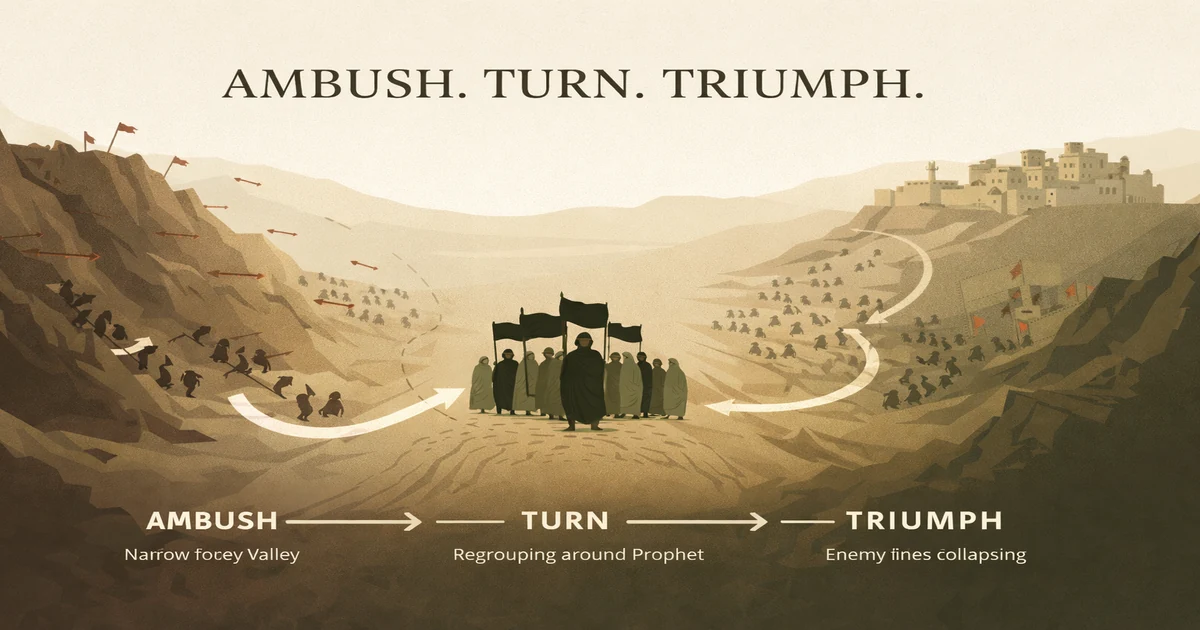
Battle of Hunayn and Taif events started shortly after the conquest of Makkah, when the tribes of Hawazin and Thaqif decided to confront the Muslims before Muslim authority became even stronger in Arabia. The Muslims entered Hunayn Valley, faced a sudden ambush at dawn, briefly fell into confusion, then regrouped around the Prophet Muhammad ﷺ and won the battle. After that, the defeated forces fled toward Autas, Nakhlah, and Taif, which led to the siege of Taif. In simple words, the battle of Hunayn and Taif was a two-part campaign: first the ambush and reversal at Hunayn, then the difficult siege of Taif. For nearby battlefield context, see Mount Uhud.
Summary Box: Key Takeaways
- Battle of Hunayn date: Shawwal 8 AH / 630 CE
- Battle of Hunayn location: Hunayn Valley between Makkah and Taif
- Who fought? Muslims vs Hawazin and Thaqif
- Main enemy leader: Malik ibn Awf
- Battle of Hunayn outcome: Muslim victory after an early retreat
- What happened after Hunayn? Pursuit to Autas and the siege of Taif
- Main Qur’anic lesson: numbers alone do not bring victory without Allah’s help
What happened in the battle of Hunayn and the siege of Taif?
One-paragraph summary of Hunayn + Taif (events in order)
Battle of Hunayn and Taif summary: after the conquest of Makkah, the Muslims marched against a confederation led by Hawazin and Thaqif. At Hunayn, the Muslims were hit by a surprise ambush in the valley and many fighters retreated at first. The Prophet Muhammad ﷺ stayed firm, called the believers back, and the battle turned into a Muslim victory. Huge spoils and captives were taken, while the defeated enemy split up and fled toward Autas, Nakhlah, and Taif. The Muslims then moved to Taif and began the siege of Taif, but because the city was fortified and heavily defended, the siege ended in a strategic withdrawal rather than immediate capture. That is the clearest answer to what happened in the battle of Hunayn and Taif.
Where did it happen? (Hunayn Valley and Taif — location in one line)
The battle of Hunayn location was Hunayn Valley, a valley between Makkah and Taif, while the second stage happened at the fortified city of Taif.
When did it happen? (Shawwal 8 AH / 630 CE — simple date note)
The battle of Hunayn date was in Shawwal 8 AH / 630 CE, shortly after the conquest of Makkah, and the battle of hunayn and siege of taif unfolded in that same post-Makkah campaign period.
Background — Why did the Battle of Hunayn happen after the Conquest of Makkah?
Who were Hawazin and Thaqif, and what did they fear?
Hawazin and Thaqif were powerful tribes in the region around Makkah and Taif. After the Muslims took Makkah, these tribes feared that Muslim influence would spread further and leave them politically and militarily weaker. This fear is central to the battle of hunayn causes and helps explain the battle of hunayn and taif history.
The key leader: Malik ibn Awf — what he decided and why
Malik ibn Awf became the leading figure on the opposing side. He pushed for a pre-emptive strike and gathered a confederation to attack the Muslims before Muslim power could fully settle after Makkah. His decision shaped the entire battle of hunayn and taif events timeline.
The strategic mistake Muslims made at the start (confidence in numbers)
One of the most important battle of hunayn facts is that the Muslim army was very large, around 12,000, and some people felt unusually confident because of those numbers. That overconfidence became part of the lesson of Hunayn, because the battle started with shock and retreat instead of an easy victory.
📚 You Can Also Read: Battle of Uhud date and significance
Battle of Hunayn Events (Timeline in Order)
Event 1 — The night approach into Hunayn Valley (how the trap was set)
The Muslim army advanced into Hunayn Valley after the conquest of Makkah. Meanwhile, Malik ibn Awf and his allied forces prepared an ambush by hiding men in narrow places, side routes, and concealed positions around the valley. This is the opening of the battle of hunayn and taif events in order.
Event 2 — The ambush at dawn (arrows, confusion, retreat)
At dawn, the Muslims were suddenly attacked. Arrows rained down and the enemy charged with force. This created confusion in the front lines and caused many Muslims to retreat. The ambush at Hunayn is the most dramatic part of the battle of hunayn events and the key reason many readers search for the battle of hunayn and taif story.
Event 3 — Who stayed firm with the Prophet (names + roles)
Although many fighters fell back in the first shock, a small group remained firm around the Prophet Muhammad ﷺ. Reports mention names such as Ali ibn Abi Talib, Al-‘Abbas ibn Abd al-Muttalib, Fadl ibn Al-‘Abbas, Abu Sufyan ibn al-Harith, Usamah ibn Zayd, and a few others. Their firmness became one of the defining battle of hunayn and taif details.
Event 4 — The call to regroup (what changed the battle momentum)
The turning point came when the Prophet ﷺ did not retreat. He called the believers back, and Al-‘Abbas, who had a powerful voice, called out to rally the Muslims. Once the army regrouped, the confusion began to fade. This moment is the clearest answer to the question: what changed the battle momentum?
Event 5 — The counterattack and collapse of the enemy lines
After regrouping, the Muslims launched a strong counterattack. The enemy lines broke, and the tribes that had set the ambush were forced into retreat. This reversal is the heart of the battle of hunayn summary and the main reason the battle of hunayn outcome ended as a Muslim victory.
Event 6 — Immediate results: casualties, captives, and spoils
After the victory, the Muslims captured large spoils, including animals, weapons, and many captives. This is why spoils of Hunayn and the later question of distribution became a major part of what happened after the battle. In many seerah summaries, the capture of property and people is one of the most remembered battle of hunayn and taif events facts.
Event 7 — Where the defeated forces fled (Autas / Nakhlah / Taif)
After defeat, parts of the opposing force fled toward Autas, others toward Nakhlah, and a major group took refuge in Taif. That flight is what directly connects the battle of hunayn and taif into one continuous campaign.
Battle of Hunayn Summary (Fast, Student-Friendly)
Who fought whom (Muslims vs Hawazin + Thaqif confederation)
The battle of hunayn and taif in islam was fought between the Muslims led by the Prophet Muhammad ﷺ and a tribal confederation led by Hawazin and Thaqif, under Malik ibn Awf.
What was the turning point (one clear sentence)
The turning point was when the Prophet ﷺ stayed firm during the retreat, the believers regrouped around him, and panic turned into organized counterattack.
Battle of Hunayn outcome (who won and why)
The battle of hunayn outcome was a Muslim victory because the initial shock did not become permanent defeat. Leadership, regrouping, and divine help turned the battle around.
Fast Student Notes
- Cause: fear of Muslim rise after Makkah
- Place: Hunayn Valley
- Opposition: Hawazin and Thaqif
- Leader: Malik ibn Awf
- Problem at start: ambush and retreat
- Turning point: the Prophet ﷺ stood firm and called people back
- Result: Muslim victory, then move toward Taif
Battle of Hunayn in the Qur’an — What do Surah At-Tawbah 9:25–26 teach?
The exact lesson: numbers didn’t benefit without Allah’s help
Battle of hunayn quran discussion always centers on one major lesson: large numbers did not help when people became impressed by them. The lesson is clear and powerful: victory does not come from numbers alone.
“Tranquility” and unseen support — what it means (plain explanation)
Surah Tawbah Hunayn teaches that Allah sent down tranquility on His Messenger and the believers. In plain language, this means that fear and disorder were replaced by calm, firmness, and confidence.
Practical takeaway for Muslims today (humility, reliance, discipline)
The practical lesson from battle of hunayn lessons is simple: never rely only on visible strength, never lose discipline in a crisis, and always remain humble before Allah.
Qur’an Box
لَقَدْ نَصَرَكُمُ اللَّهُ فِي مَوَاطِنَ كَثِيرَةٍ وَيَوْمَ حُنَيْنٍ إِذْ أَعْجَبَتْكُمْ كَثْرَتُكُمْ فَلَمْ تُغْنِ عَنْكُمْ شَيْئًا … ثُمَّ أَنْزَلَ اللَّهُ سَكِينَتَهُ عَلَىٰ رَسُولِهِ وَعَلَى الْمُؤْمِنِينَ
Transliteration: Laqad nasarakumu Allahu fi mawātina kathīratin wa yawma Hunaynin idh a‘jabatkum kathratukum falam tughni ‘ankum shay’an … thumma anzala Allahu sakīnatahu ‘alā rasūlihi wa ‘alā al-mu’minīn.
Translation: Allah had already given you victory in many battlefields, and on the Day of Hunayn, when your great number impressed you, it did not benefit you at all… Then Allah sent down His tranquility upon His Messenger and upon the believers.
What Happened After Hunayn? (Booty, Captives, and Reconciliation)
Spoils of Hunayn: what was captured and why it mattered
What happened after Hunayn included the collection of major spoils, including animals, weapons, and captives. These spoils mattered because how they were handled affected tribal politics, new Muslim loyalties, and post-battle reconciliation.
The captives and the Hawazin delegation (what changed later)
Later, a delegation of Hawazin came to request mercy and the return of captives. This became one of the most important after-effects of the campaign and showed that the story of Hunayn did not end only with battlefield victory.
Why some leaders received gifts (Mu’allafatul Qulub explained simply)
Some newly reconciled leaders received gifts from the spoils. This was part of softening hearts and building unity among tribes that had recently entered Islam or had only recently ended hostilities. In simple terms, it was wise social leadership after conflict.
📚 You Can Also Read: Historical events in Shawwal
Siege of Taif Events (Timeline in Order)
Why Taif was hard to conquer (fortifications + terrain)
The siege of taif events were very different from Hunayn because Taif was a fortified city. Strong walls, elevation, and skilled defenders made it difficult to capture by direct assault. This is why the search term battle of taif 8 ah usually refers to a siege, not a simple open battle.
How long did the siege last? (range + why sources differ)
Reports differ on the exact length of the Taif siege. Some mention roughly two weeks, while others mention closer to three or four weeks. The safest summary is that it lasted for a limited but serious period, and historians preserve different reports.
Tactics used: catapult and protective siege equipment (what they were)
The Muslims used siege tactics, including a catapult and protective covering to move closer to the walls. These tools show that the siege of Taif was not just a waiting period but a real military effort to pressure the defenders.
Key problem: arrows, walls, and why direct assault failed
The biggest problem was that defenders inside Taif had the advantage of walls and high positions. Heavy arrow fire made direct assault costly. This explains what was the result of the siege of taif and why the Muslims did not storm the city immediately.
Why the siege ended (strategic withdrawal, not defeat)
The siege ended because continuing it was not the wisest tactical move at that moment. This was a strategic withdrawal, not a military collapse. So when readers ask for the battle of hunayn and taif results, the correct answer is: victory at Hunayn, then a non-final siege at Taif that ended without immediate conquest.
The Prophet’s dua for Thaqif (what it shows about leadership)
One of the most beautiful lessons from this stage is that the Prophet ﷺ did not respond with bitterness. Instead, he made dua for guidance. That shows mercy, patience, and leadership beyond the battlefield.
Hadith / Dua Box
اللَّهُمَّ اهْدِ ثَقِيفًا
Transliteration: Allahumma ihdi Thaqīfan
Translation: O Allah, guide Thaqif.
Battle of Hunayn and Taif Results — What changed in Arabia?
Military result: Muslim authority strengthened after a setback
The military result of the battle of hunayn and taif was that Muslim authority became even stronger after surviving a dangerous ambush and then pressing the campaign forward toward Taif.
Political result: tribes re-calculated and delegations increased
Politically, the campaign showed that Muslim authority was now the strongest force in western Arabia. Tribes had to re-think their position, and many began moving toward acceptance, reconciliation, or alliance.
Social result: unity tested (new Muslims vs veterans)
Socially, Hunayn tested internal unity. The battle exposed differences between experience and inexperience, between long-standing believers and newer fighters, and between visible numbers and real steadiness in crisis.
Battle of Hunayn and Taif Lessons (Most Searched)
Lesson 1 — Pride in numbers can break discipline
This is the biggest lesson from battle of hunayn and taif according to quran: numbers can create false confidence, and false confidence can damage discipline.
Lesson 2 — Leadership in crisis: calm, clarity, and calling people back
When confusion spread, the Prophet ﷺ did not panic. He stayed firm, called people back, and restored order. This is one of the clearest leadership lessons in seerah.
Lesson 3 — Mercy after victory: reconciliation over revenge
From the treatment of captives to the dua for Thaqif, the aftermath shows that mercy and reconciliation mattered greatly after victory.
Lesson 4 — Strategy: when to persist and when to withdraw
The end of the Taif siege teaches an important strategic principle: not every strong campaign must end in immediate capture. Sometimes withdrawal at the right time is wisdom, not weakness.
📚 You Can Also Read: Shawwal
Common Confusions
Did Muslims lose at Hunayn? (clear answer + what “initial retreat” means)
No. Muslims did not lose Hunayn. There was an initial retreat after the ambush, but the final result was a Muslim victory. This distinction is very important when explaining the battle of hunayn and taif events explanation.
Is the “Battle of Taif” the same as the Siege of Taif (8 AH)?
In this Islamic history context, people usually mean the Siege of Taif that followed Hunayn. So yes, in common search use, battle of taif 8 ah usually refers to the same campaign stage as the siege.
Where is Hunayn Valley today?
Hunayn Valley is in present-day Saudi Arabia between Makkah and Taif, which is why it is often described as part of the route linking the two areas.
What is Autas and how is it linked to Hunayn?
Autas was one of the places where defeated enemy groups fled after Hunayn. That makes it part of the wider post-Hunayn campaign and an important term in the battle of hunayn and taif timeline.
What were the causes and events of the battle of Hunayn and Taif (one list)
- Cause: fear among Hawazin and Thaqif after the conquest of Makkah
- Event 1: movement into Hunayn Valley
- Event 2: dawn ambush and arrow attack
- Event 3: early Muslim retreat
- Event 4: regrouping around the Prophet ﷺ
- Event 5: Muslim counterattack and victory
- Event 6: flight to Autas and Taif, followed by siege
Battle of Hunayn and Taif Events
10-bullet timeline recap (Hunayn → Taif → aftermath)
- Conquest of Makkah changes the balance of power.
- Hawazin and Thaqif fear Muslim expansion.
- Malik ibn Awf leads a confederation.
- The Muslims march toward Hunayn.
- An ambush hits the Muslim army at dawn.
- Many fighters retreat at first.
- The Prophet ﷺ remains firm and calls people back.
- The Muslims regroup and win the battle.
- The defeated enemy flees to Autas and Taif.
- The siege of Taif follows and ends in strategic withdrawal.
Key names to remember (Hawazin, Thaqif, Malik ibn Awf, Al-‘Abbas)
For battle of hunayn and taif for students, the key names are Hawazin, Thaqif, Malik ibn Awf, Al-‘Abbas, and the Prophet Muhammad ﷺ.
Key terms glossary (ghazwa, siege, spoils, etc.)
- Ghazwa Hunayn: another name for the Battle of Hunayn
- Siege: surrounding and pressuring a fortified city
- Spoils: property captured after victory
- Captives: prisoners taken after battle
- Autas: one of the places linked to the fleeing enemy after Hunayn
- Al-Ji‘ranah / Jirana: linked to the later distribution of spoils
Battle of Hunayn and Taif Events: Final Answer
Battle of Hunayn and Taif events summary: the campaign began after the conquest of Makkah, when Hawazin and Thaqif under Malik ibn Awf prepared to fight the Muslims. At Hunayn Valley, the Muslims faced a surprise dawn ambush and briefly retreated. The Prophet Muhammad ﷺ remained firm, the Muslims regrouped, and they won the battle. The defeated enemy fled toward Autas and Taif, leading to the siege of Taif. Taif’s strong fortifications prevented immediate conquest, so the siege ended in a strategic withdrawal. The biggest lessons were humility, discipline, trust in Allah, and wise leadership in crisis. That is the clearest and most complete explanation of the battle of hunayn and taif events, the battle of hunayn and taif significance, and the battle of hunayn and taif results.
Battle of Hunayn and Taif Events FAQ
Frequently Asked Questions
Was the Battle of Hunayn a defensive war or an offensive campaign?
It is usually explained as a pre-emptive campaign in the conquest of Mecca aftermath. The Muslims did not face a random clash. The tribes of Hawazin and Thaqif were preparing for confrontation, so the campaign developed into a major regional conflict rather than a small border fight.
Why is the Battle of Hunayn considered one of the most important post-Makkah campaigns?
The battle of hunayn and taif significance comes from its timing. It happened right after Makkah came under Muslim control, so it tested whether Muslim authority would truly hold. The early shock at Hunayn, the recovery, and the later siege of Taif made it one of the clearest turning points in early Islamic history.
Why did Malik ibn Awf bring families and property with the army?
In many seerah reports, Malik ibn Awf brought women, children, and wealth to push his side to fight harder and avoid retreat. His idea was simple: if everything was behind the army, the fighters would feel forced to stand their ground. But in the end, that decision increased the scale of loss after the Muslim victory.
Why do some sources call it Ghazwa Hunayn, Yawm Hunayn, or Waq’at Hawazin?
These are naming variations. Ghazwa Hunayn means the expedition or campaign of Hunayn. Yawm Hunayn means the Day of Hunayn. Waq’at Hawazin connects the battle to the Hawazin side. They point to the same core event, but each label emphasizes a different angle of the story.
What makes Hunayn different from Uhud in terms of lessons?
Both battles teach discipline, but the lesson is framed differently. At Uhud, the mistake is often tied to leaving a strategic position too early. At Hunayn, the main lesson is that visible strength and large numbers can create false confidence. So the battle of hunayn lessons focus more on humility, steadiness, and reliance on Allah during sudden crisis.
Did the new Muslims of Quraysh affect the course of the battle?
Yes, the campaign also tested the strength of a rapidly changing Muslim community. The army included many recent converts, so Hunayn became a moment that exposed the difference between numbers and battle readiness. This is one reason the battle of hunayn and taif in islam is also studied as a lesson in community-building, not just warfare.
Why did Taif not fall immediately after the Muslim victory at Hunayn?
The answer is military, not spiritual weakness. Taif was fortified, elevated, and defended from behind walls. Open-field victory at Hunayn did not automatically translate into quick success against a defended city. That is why the battle of hunayn and siege of taif summary must be read as two connected but very different phases.
What role did Al-Ji‘ranah play after Hunayn and Taif?
Jirana / Al-Ji‘ranah is mainly linked with the later handling and distribution of spoils after the campaign. So if a reader asks about the battlefield, Ji‘ranah is not the place of the ambush itself. Its value in the story is more connected to aftermath, organization, and reconciliation.
What is the simplest way to remember the full battle of Hunayn and Taif timeline?
A simple memory line is this: fear after Makkah → ambush at Hunayn → retreat → regrouping → Muslim victory → flight to Autas and Taif → siege of Taif → strategic withdrawal → later reconciliation. This is the easiest way to remember the battle of hunayn and taif events timeline for revision or student notes.
What is the one-line significance of the Battle of Hunayn and Taif for students?
The one-line answer is this: the battle of hunayn and taif events in islam show that an early setback does not decide the final result if faith, leadership, and discipline return at the right moment.
Battle of Hunayn and Taif Events at a Glance — Quick Comparison Table
Battle of Hunayn and Taif Events: Side-by-Side Comparison
| Point | Battle of Hunayn | Siege of Taif |
|---|---|---|
| Type of conflict | Open-field battle with a sudden ambush at Hunayn | Fortified city siege with walls, archers, and prolonged pressure |
| Main search intent answered | Why did the battle of Hunayn happen and how did the early retreat turn into victory? | What was the result of the siege of Taif and why was it not captured immediately? |
| Main terrain challenge | Hunayn Valley terrain allowed hidden positions and a surprise attack | Taif had fortifications, elevation, and defensive walls |
| Main military problem for Muslims | Confusion, broken formation, and overconfidence in numbers | Arrow fire, protected defenders, and difficulty reaching the walls |
| Turning point | The Prophet ﷺ stood firm, Muslims regrouped, and momentum reversed | Realization that direct assault was too costly, so strategy shifted from force to patience |
| Best keyword fit | battle of hunayn summary, battle of hunayn facts, battle of hunayn causes | siege of taif events, taif siege, battle of taif 8 ah |
| Key people linked to this stage | Prophet Muhammad, Malik ibn Awf, Al-‘Abbas, Ali ibn Abi Talib | Thaqif defenders and the Prophet’s leadership during the siege phase |
| After-effect | Spoils of Hunayn, captives, pursuit to Autas, wider political impact | Strategic withdrawal, later reconciliation, and eventual weakening of resistance |
| Qur’anic / spiritual angle | Battle of Hunayn in Quran — Quran 9:25-26 teaches that numbers alone do not benefit | Shows patience, mercy, and leadership after military pressure did not produce instant capture |
| Best lesson for students | Victory can come after shock if discipline returns | Not every strong campaign ends with immediate conquest; sometimes withdrawal is wise |
This table helps readers quickly understand the difference between the battle of Hunayn events and the siege of Taif events. It also answers high-intent searches like battle of Hunayn and Taif timeline, battle of Hunayn and Taif key events, battle of Hunayn and Taif significance, and what happened after the battle of Hunayn without repeating the same paragraph content.

Farrukh Farooqi has been living in Sharaya, Makkah, Saudi Arabia since 2010. With over 14 years of firsthand experience witnessing the sacred journey of millions of pilgrims, Farrukh specializes in providing practical, insider tips for Hajj and Umrah travelers. His work blends real-world observations, the latest Saudi updates, and essential crowd management strategies — helping pilgrims and worshippers plan smarter, stay safer, and experience a spiritually fulfilling journey across the Holy Cities.