
Battle of Uhud Date and Significance: Exact Date (7 Shawwal 3 AH), Summary, Results & Lessons
Battle of Uhud date and significance can be answered in one line: the Battle of Uhud took place on 7 Shawwal 3 AH, commonly matched to Saturday, 23 March 625 AD, near Mount Uhud, Madinah, and it remains one of the most important lessons in early Islamic history because it showed how obedience, discipline, patience, and leadership can decide the outcome of a battle. The Muslims began strongly, but the momentum flipped after the archers left their posts, allowing a Khalid ibn al-Walid counterattack from the rear. For battlefield context, see Mount Uhud. The core Qur’anic explanation links the setback to dispute, disobedience, and love of worldly gain, while also turning the event into a lasting lesson for believers.
Key Takeaways
- Battle of Uhud date: 7 Shawwal 3 AH, commonly given as 23 March 625 AD.
- Battle of Uhud location: a valley near Mount Uhud, north of Madinah/Medina.
- Who fought: the Muslims of Madinah against the Quraysh of Makkah, with Abu Sufyan leading the Quraysh force.
- What went wrong: the archers on the hill left their positions too early.
- Battle of Uhud results: heavy Muslim losses, around 70 martyrs, including Hamza ibn Abd al-Muttalib; the Prophet ﷺ was wounded.
- Who won the Battle of Uhud: a temporary Quraysh victory in the field, but not a decisive strategic destruction of the Muslim community.
- Battle of Uhud significance in Islam: a lasting lesson in obedience, steadfastness, faith and endurance.
What is the battle of Uhud date and significance?
Battle of Uhud date (Hijri + Gregorian): 7 Shawwal 3 AH = 23 March 625 AD (Saturday)
The strongest mainstream date used in modern reference works is 7 Shawwal 3 AH, which is commonly matched with Saturday, 23 March 625 AD. This is why many people searching when was the Battle of Uhud, battle of Uhud date in Hijri and Gregorian calendar, or battle of Uhud date 7 Shawwal 3 AH meaning keep seeing that exact pairing.
One-line significance: a painful setback that taught discipline, obedience, and resilience
Battle of Uhud significance is not just that it was a pivotal battle or the second major battle in Islam. Its real importance is that it turned military pain into moral guidance. It taught that victory is not automatic, that believers are tested, and that even one breach in discipline can reverse an entire battlefield.
Battle of Uhud Summary (Fast, Accurate Overview)
Who fought: Muslims of Madinah vs Quraysh of Makkah
The Battle of Uhud was a Muslims and Quraysh battle fought between the Muslim community of Madinah and the Quraish/Quraysh of Mecca/Makkah. The Muslim side was led by the Prophet Muhammad ﷺ, while the Meccan force was led by Abu Sufyan. The Quraysh marched with about 3,000 men, while the Muslim force was reduced to around 700 after a group withdrew before the fighting.
Where it happened: near Mount Uhud, Madinah
The battle of Uhud location was a valley near Mount Uhud, just north of Madinah. This battlefield mattered because the Muslim army used the terrain to protect its rear and flanks, and a small hill was assigned to the archers to block any cavalry movement from behind. That makes battlefield strategy central to understanding what happened.
What happened in 60 seconds
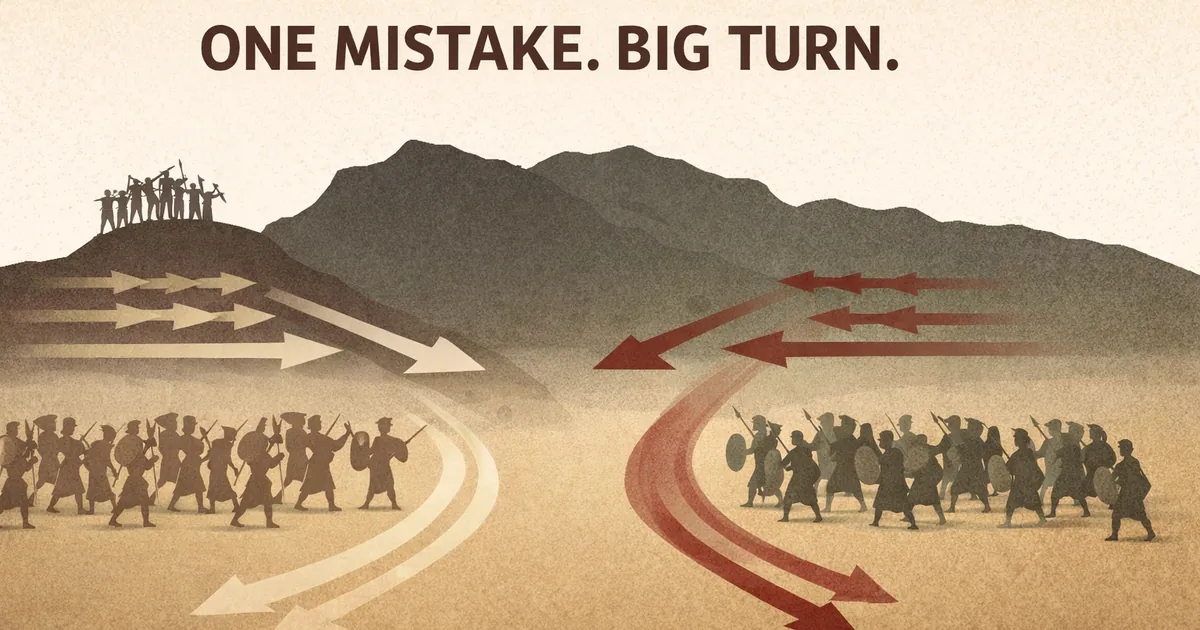
The Muslims began with an early advantage and pushed the Quraysh back. Then the turning point came: many of the archers on the hill believed the battle was already won and left their positions. That opened the rear. Khalid ibn al-Walid, then fighting on the Quraysh side, used the gap to launch a rear attack. Confusion spread, the Muslim lines broke, many were martyred, and the battle ended as a severe setback for Muslims rather than a final collapse.
📚 You Can Also Read: Historical Events in Shawwal
When Was the Battle of Uhud? (Date, Day, and “7 Shawwal” Meaning)
Why sources mention 7 Shawwal 3 AH
7 Shawwal 3 AH means the seventh day of Shawwal in the third year after Hijrah. Because Shawwal is the month after Ramadan in the Hijri calendar, this battle sits in a very important period of early Muslim community history. In most modern summaries, that date is aligned with 23 March 625 AD.
Common confusion: “3 Shawwal” vs “7 Shawwal”
Some competitor pages and secondary websites mention 3 Shawwal 3 AH, while stronger mainstream references commonly give 7 Shawwal 3 AH. For SEO and reader clarity, the safest move is to lead with 7 Shawwal 3 AH = 23 March 625 AD, then briefly note that some secondary pages show a different Shawwal day because of historical conversion inconsistencies and simplified retellings.
Battle of Uhud Causes (Why It Happened)
The main cause: Quraysh revenge for Badr
The clearest answer to what caused the Battle of Uhud is this: the Quraysh wanted revenge after Badr. Their earlier defeat at Badr damaged their prestige, cost them major leaders, and pushed them to return with a larger force under Abu Sufyan. So the battle after Badr became Uhud, and the next major milestone after that would be the battle before trench sequence that later culminated in the Battle of the Trench.
Why the Muslims met outside Madinah
The Muslims did not simply wait inside the city. They moved out and positioned themselves near Mount Uhud, using the terrain as protection. This was not random. It was a deliberate battlefield choice shaped by consultation and strategy, especially because the Quraysh had stronger cavalry.
Qur’an Box — Why the setback happened
أَوَلَمَّآ أَصَـٰبَتْكُم مُّصِيبَةٌۭ قَدْ أَصَبْتُم مِّثْلَيْهَا قُلْتُمْ أَنَّىٰ هَـٰذَا ۖ قُلْ هُوَ مِنْ عِندِ أَنفُسِكُمْ ۗ إِنَّ ٱللَّهَ عَلَىٰ كُلِّ شَىْءٍۢ قَدِيرٌۭ
Transliteration: Awa lammā aṣābatkum muṣībatun qad aṣabtum mithlayhā qultum annā hādhā, qul huwa min ʿindi anfusikum, innallāha ʿalā kulli shay’in qadīr.
Translation: “Why is it when you suffered casualties ˹at Uḥud˺—although you had made your enemy suffer twice as much ˹at Badr˺—you protested, ‘How could this be?’ Say, ‘It is because of your own selves.’ Surely Allah is Most Capable of everything.”
Reference: Surah Aal ‘Imran 3:165.
What Went Wrong at Uhud?
The archers’ hill: the exact instruction
The Prophet ﷺ placed 50 archers under Abdullah ibn Jubayr and ordered them not to leave their position, even if the Muslims seemed to be winning or losing. This is the heart of the battle of Uhud lessons. The issue was not lack of courage. It was a breakdown in obedience at the exact point where discipline mattered most.
Hadith Box — The archers were told not to move
إِنْ رَأَيْتُمُونَا تَخْطَفُنَا الطَّيْرُ فَلَا تَبْرَحُوا مِنْ مَكَانِكُمْ هَذَا حَتَّى أُرْسِلَ إِلَيْكُمْ، وَإِنْ رَأَيْتُمُونَا هَزَمْنَا الْقَوْمَ وَأَوْطَأْنَاهُمْ فَلَا تَبْرَحُوا حَتَّى أُرْسِلَ إِلَيْكُمْ
Transliteration: In ra’aytumūnā takhṭafunā al-ṭayru falā tabraḥū min makānikum hādhā ḥattā ursila ilaykum, wa in ra’aytumūnā hazamnā al-qawma wa awṭa’nāhum falā tabraḥū ḥattā ursila ilaykum.
Translation: “If you see birds snatching us away, do not leave your place until I send for you; and if you see that we have defeated the people and overrun them, still do not leave until I send for you.”
Reference: Sahih al-Bukhari 3039.
Khalid ibn al-Walid counterattack: how the momentum flipped
Once many archers moved, the Muslim flank and rear became exposed. That was the opening for the Khalid ibn al-Walid counterattack. This single tactical shift explains why people search terms like why did the Muslims lose the Battle of Uhud and what happened in the Battle of Uhud and why it matters. The answer is simple: the battlefield turned because a crucial command was not held.
Was it defeat or setback?
The balanced answer is this: militarily, it was a temporary Quraysh victory and a painful strategic setback for the Muslims. But strategically in the long run, the Quraysh still failed to destroy the Muslim community, kill the Prophet ﷺ, or seize Madinah. So the event is best described as a battlefield setback with deep moral and strategic consequences, not the end of the Muslim community.
📚 You Can Also Read: Shawwal
Battle of Uhud Results (Who Won and What Changed After)
Immediate outcome
The most direct answer to who won the Battle of Uhud is that the Quraysh ended the day with the upper hand in the field. The Muslims suffered heavy losses, and around 70 martyrs are widely mentioned in the major retellings and hadith-linked summaries.
Strategic outcome
Even so, the Quraysh did not achieve total victory. They did not eliminate the Muslim leadership, occupy Madinah, or finish the conflict. That is why many historians describe Uhud as a severe blow but not a decisive strategic end.
Key casualties: Hamza ibn Abd al-Muttalib martyred
Among the most painful losses was the martyrdom of Hamza ibn Abd al-Muttalib. The Prophet ﷺ himself was also wounded. These two facts alone explain much of the emotional force behind the search terms battle of Uhud importance and battle of Uhud historical and religious significance. The battle was not just military history. It was a deeply personal and communal wound.
Battle of Uhud Significance in Islam (Why It Still Matters)
Lesson 1 — obedience and discipline
The strongest lesson from Ghazwat Uhud is that success can collapse after one mistake. The Muslims had momentum. The field looked favorable. But discipline broke first, and then the line broke. This is why the consequences of disobedience are central to every serious explanation of Uhud.
Lesson 2 — victory is not automatic
Why was the Battle of Uhud important for Muslims? Because it corrected false confidence. After Badr, some may have expected another easy victory. Uhud taught that faith and endurance, patience, and right action matter, and that believers are tested in difficult moments.
Lesson 3 — leadership under pressure
The Prophet ﷺ regrouped the believers in chaos, controlled panic, and prevented total collapse. That makes Uhud a case study in discipline and leadership, not only a battle narrative.
Lesson 4 — sincerity vs hypocrisy
The Qur’an also highlights those who withdrew and exposed weakness in commitment. This makes Battle of Uhud in Quran important because the revelation does not only describe enemy action; it also exposes internal weakness and turns history into guidance for every generation.
Battle of Uhud in the Qur’an (Aal-Imran) — The Exact Themes
Qur’an message: disobedience + dispute + love of dunya caused the setback
Surah Aal ‘Imran directly connects the setback to human weakness inside the ranks: losing courage, disputing over the command, and wanting worldly gain. That is why Battle of Uhud in Quran is one of the clearest examples of the Qur’an turning a seerah event into moral teaching.
Qur’an Box — The clearest verse linked to Uhud’s turning point
وَلَقَدْ صَدَقَكُمُ ٱللَّهُ وَعْدَهُۥٓ إِذْ تَحُسُّونَهُم بِإِذْنِهِۦ حَتَّىٰٓ إِذَا فَشِلْتُمْ وَتَنَـٰزَعْتُمْ فِى ٱلْأَمْرِ وَعَصَيْتُم مِّنۢ بَعْدِ مَآ أَرَىٰكُم مَّا تُحِبُّونَ ۚ مِنكُم مَّن يُرِيدُ ٱلدُّنْيَا وَمِنكُم مَّن يُرِيدُ ٱلْـَٔاخِرَةَ
Transliteration: Wa laqad ṣadaqakumullāhu waʿdahu idh taḥussūnahum bi-idhnih, ḥattā idhā fashiltum wa tanāzaʿtum fil-amri wa ʿaṣaytum min baʿdi mā arākum mā tuḥibbūn; minkum man yurīdu al-dunyā wa minkum man yurīdu al-ākhirah.
Translation: “Indeed, Allah fulfilled His promise to you when you were overwhelming them by His Will, until you lost courage, disputed in the matter, and disobeyed after He had shown you what you loved. Some of you desired this world, and some desired the Hereafter…”
Reference: Surah Aal ‘Imran 3:152.
Why these verses are not “history only”
The Qur’an does not present Uhud as a dead timeline. It presents it as living guidance: how communities fail, how believers recover, and how steadfastness matters after loss. That is the deeper battle of Uhud significance in Islam.
📚 You Can Also Read: Importance of Shawwal
Key Facts (Fast Skimmable Block)
Battle of Uhud Facts
| Fact | Answer |
|---|---|
| Date | 7 Shawwal 3 AH / 23 March 625 AD |
| Location | Near Mount Uhud, Madinah |
| Sides | Muslims of Madinah vs Quraysh of Makkah |
| Quraysh leader | Abu Sufyan |
| Turning point | Archers left their posts |
| Counterattack | Khalid ibn al-Walid rear attack |
| Major martyr | Hamza ibn Abd al-Muttalib |
| Prophet ﷺ | Wounded but survived |
| Result | Temporary Quraysh field victory; Muslim strategic setback |
These are the core battle of Uhud facts most readers actually need: date, place, sides, turning point, result, and why the battle still matters.
Battle timeline: pre-battle → opening success → archers leave → rear attack → regroup
The simplest battle of Uhud overview is this sequence: Quraysh revenge after Badr, battlefield setup near Mount Uhud, Muslim opening success, archers leaving early, rear attack, confusion, martyrdom, regrouping, and Quraysh withdrawal without destroying the Muslim community.
FAQs — Battle of Uhud Date and Significance
FAQs
When was the Battle of Uhud?
The Battle of Uhud date is commonly given as 7 Shawwal 3 AH, matching 23 March 625 AD.
Why was the Battle of Uhud important?
Its importance lies in its lessons: obedience, test of faith, leadership under pressure, and steadfastness after loss.
Did Muslims lose the Battle of Uhud?
In battlefield terms, the Muslims suffered a painful setback and the Quraysh held the advantage that day. But the Quraysh still failed to destroy the Muslim community or take Madinah.
What caused the Battle of Uhud?
The main cause was Quraysh revenge for Badr and their desire to recover prestige and strike back at the growing Muslim community.
What happened to the archers at Uhud?
Many left their assigned hill too early, despite clear orders to remain, and that opened the rear for the Quraysh cavalry attack.
Where did the Battle of Uhud take place?
It took place near Mount Uhud, north of Madinah, in present-day Saudi Arabia.
Which Qur’an surah talks about Uhud?
Surah Aal ‘Imran, especially verses around 3:152 and 3:165–168, directly address the lessons of Uhud.
How many Muslims were at the Battle of Uhud?
The Muslim force was originally around 1,000, but after a group withdrew before the battle, the fighting force was reduced to about 700.
How many Quraysh soldiers were at the Battle of Uhud?
The Quraysh army is commonly described as having around 3,000 men, which gave them a strong numerical advantage over the Muslims.
Who led the Quraysh army at Uhud?
The Quraysh army at Uhud was led by Abu Sufyan ibn Harb, who marched from Makkah to avenge the defeat at Badr.
Who led the Muslim army at Uhud?
The Muslim army was led by Prophet Muhammad ﷺ, who carefully chose the battlefield near Mount Uhud and assigned archers to guard a key position.
How many archers were placed on the hill at Uhud?
The Prophet ﷺ placed 50 archers on the hill to protect the Muslim army from a rear or flank attack and ordered them not to leave their position without instruction.
Why did the archers leave their posts at Uhud?
Many of the archers thought the battle had already been won and left their place to collect spoils. That decision exposed the Muslim rear and changed the course of the battle.
Who led the counterattack at Uhud?
The famous rear counterattack was led by Khalid ibn al-Walid, who was then fighting on the Quraysh side and used the opening left by the archers.
How many Muslims were martyred at Uhud?
The most widely mentioned number is around 70 Muslim martyrs, making Uhud one of the most painful losses in early Islamic history.
Was Hamza martyred in the Battle of Uhud?
Yes, Hamza ibn Abd al-Muttalib رضي الله عنه, the beloved uncle of the Prophet ﷺ, was martyred in the Battle of Uhud.
Was Prophet Muhammad ﷺ injured at Uhud?
Yes, the Prophet Muhammad ﷺ was injured during the battle, but he survived and continued to guide and regroup the المسلمين in the middle of the chaos.
Did the Quraysh capture Madinah after Uhud?
No, although the Quraysh gained the upper hand on the battlefield, they did not enter and seize Madinah or destroy the Muslim community.
Why is Uhud called the second major battle in Islam?
Uhud is often called the second major battle in Islam because it came after Badr and before the later major conflict of the Battle of the Trench.
What is the meaning of 7 Shawwal 3 AH?
7 Shawwal 3 AH means the seventh day of Shawwal in the third year after the Hijrah, using the Islamic Hijri calendar.
What is the historical significance of the Battle of Uhud?
The historical significance of Uhud lies in its role as a defining seerah event that taught the early Muslim community lessons about obedience, sacrifice, resilience, and leadership under pressure.
What is the religious significance of the Battle of Uhud?
The religious significance of Uhud is that the Qur’an used the event to teach believers about patience, sincere faith, discipline, and the danger of disobedience and worldly distraction.
Which verses in Surah Aal-Imran refer to Uhud?
The Battle of Uhud is especially discussed in Surah Aal-Imran, particularly in verses such as 3:152 and 3:165–168, which explain the setback and its lessons.
Was Uhud a complete defeat for the Muslims?
No, Uhud was a painful setback for Muslims, but not a complete destruction. The Muslim community survived, regrouped, and remained politically and spiritually strong.
What happened after the Battle of Uhud?
After the battle, the Muslims buried their martyrs, returned to Madinah, and remained alert. The Quraysh withdrew without finishing their campaign, and the conflict continued in later events.
Who is buried in Uhud Martyrs Cemetery?
The Uhud Martyrs Cemetery is associated with the martyrs of the battle, including the most famous among them, Hamza ibn Abd al-Muttalib رضي الله عنه.
Why do Muslims still remember the Battle of Uhud today?
Muslims still remember Uhud because it is a timeless lesson in faith and endurance, discipline and leadership, martyrdom, and standing firm after loss.
📚 You Can Also Read: Six Days of Shawwal

Farrukh Farooqi has been living in Sharaya, Makkah, Saudi Arabia since 2010. With over 14 years of firsthand experience witnessing the sacred journey of millions of pilgrims, Farrukh specializes in providing practical, insider tips for Hajj and Umrah travelers. His work blends real-world observations, the latest Saudi updates, and essential crowd management strategies — helping pilgrims and worshippers plan smarter, stay safer, and experience a spiritually fulfilling journey across the Holy Cities.


