
Historical Events in Shawwal (2026): Complete Islamic Timeline + What’s Authentic
Key Takeaways
Historical events in Shawwal include Eid al-Fitr on 1 Shawwal, the report of the Prophet ﷺ marrying and entering with Aisha (RA) in Shawwal, the Battle of Uhud in Shawwal in 3 AH, the Battle of Hunayn in Shawwal and Siege of Taif in Shawwal in 8 AH, and the commonly cited birth of Imam Bukhari in Shawwal on 13 Shawwal 194 AH.
- Strongest events: Eid al-Fitr, Uhud, Hunayn, Ta’if
- Important religious links: six fasts of Shawwal, Hajj months begin in Shawwal
- Main warning: many pages mix verified history with weak or disputed reports
Historical events in Shawwal matter because this month after Ramadan is not only about celebration. It also carries some of the most searched and most misunderstood moments in Islamic history. The clearest and safest timeline starts with 1 Shawwal and Eid al-Fitr, then moves to the report about marriage of Prophet Muhammad to Aisha in Shawwal, then the major Prophetic-era battles: Battle of Uhud, Battle of Hunayn, and Siege of Taif. After that come later scholarly and historical dates often included in Shawwal month history, such as the birth of Imam Bukhari in Shawwal.
This page gives you the clean version of important events in Shawwal without turning into a messy copy-paste list. It separates major events in Shawwal from general worship topics, corrects common timeline confusion, and shows where careful wording matters. If you also want something useful for Eid sharing, try this Eid Greeting Message Generator.
What are the most important historical events in Shawwal?
The most important and most searched Shawwal historical events are:
- 1 Shawwal: Eid al-Fitr
- Shawwal: report of the Prophet ﷺ marrying and entering with Aisha (RA)
- 7 Shawwal, 3 AH: Battle of Uhud in Shawwal
- Shawwal, 8 AH: Battle of Hunayn in Shawwal
- Shawwal, 8 AH: Siege of Taif in Shawwal
- 13 Shawwal, 194 AH: Birth of Imam Bukhari in Shawwal
- 25 Shawwal: the commonly cited date of Ja‘far al-Sadiq in many later historical lists
The biggest problem with many pages about Islamic events in Shawwal is simple: they mix together solid historical reports, general virtues of the month, later devotional calendars, and even wrong-month events. That makes readers think every item has the same strength when it does not.
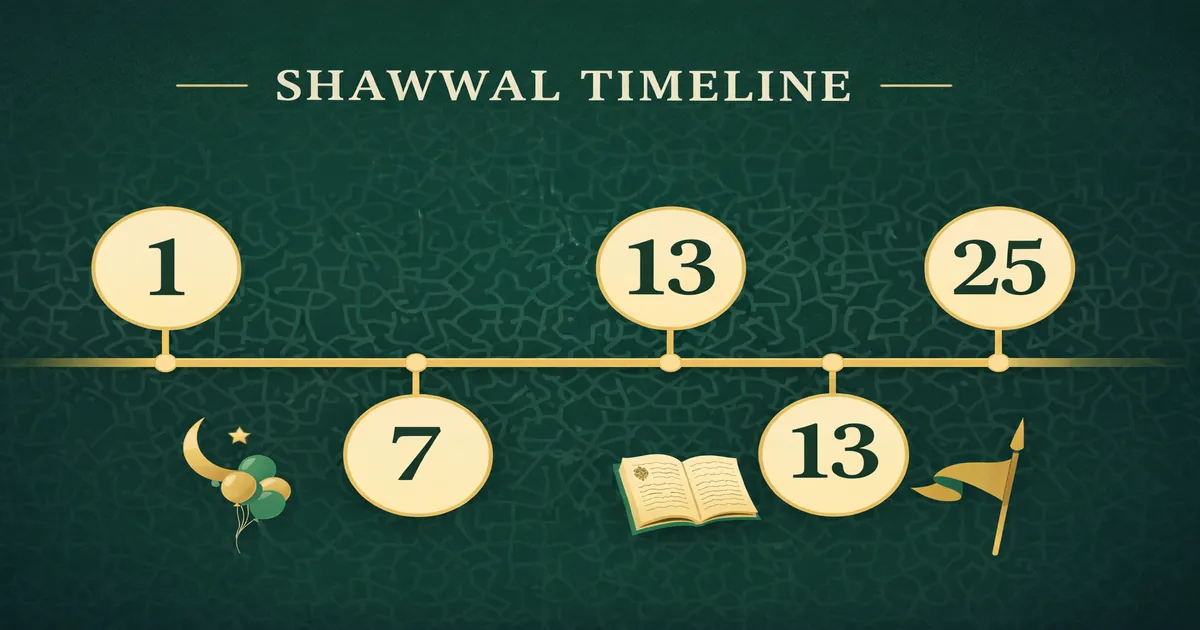
Shawwal timeline (1–25 Shawwal)
Timeline of Historical Events in Shawwal
| Date | Event | Why it matters |
|---|---|---|
| 1 Shawwal | First day of Shawwal / Eid al-Fitr | Marks the end of Ramadan and the beginning of one of the most joyful days in Islam |
| Shawwal | Marriage of Prophet Muhammad to Aisha in Shawwal | Important for correcting old pre-Islamic marriage superstitions |
| 7 Shawwal, 3 AH | Battle of Uhud | A defining test of obedience, patience, and resilience |
| Shawwal, 8 AH | Battle of Hunayn | Shows that victory does not come from numbers alone |
| Shawwal, 8 AH | Siege of Taif | A key continuation after Hunayn in the Prophetic timeline |
| 13 Shawwal, 194 AH | Birth of Imam Bukhari | A major milestone in the history of hadith scholarship |
| 25 Shawwal | Ja‘far al-Sadiq | Often cited in later Muslim historical calendars with neutral wording needed |
This table keeps the historical timeline clean and avoids weak additions that often bloat low-quality events in Shawwal Islamic calendar pages.
1 Shawwal: Eid al-Fitr — what started in Madinah and what it means
1 Shawwal is the day of Eid al-Fitr, the festival that marks the completion of Ramadan fasting. This is the clearest answer to what happened on 1 Shawwal in Islam. It is also the strongest entry in any list of notable islamic dates in Shawwal. The day itself is not for fasting. It is for gratitude, prayer, joy, family, and community.
Many readers search first Eid al Fitr in Islamic history. The safe wording is that the first Eid after the obligatory Ramadan fast took place after the Muslim community settled in Madinah and began observing Ramadan there. That is the cleaner way to present it in a serious history of Shawwal in Islam article.
Marriage of Prophet Muhammad to Aisha in Shawwal — what the reports actually say
One of the most important reports linked to Shawwal importance in Islamic history is that the Prophet ﷺ married Aisha (RA) in Shawwal, and entered with her in Shawwal. This matters because it corrected a pre-Islamic superstition that treated marriage in Shawwal as unlucky.
Hadith Box
Arabic: تَزَوَّجَنِي رَسُولُ اللَّهِ ﷺ فِي شَوَّالٍ، وَبَنَى بِي فِي شَوَّالٍ
Transliteration: Tazawwajani Rasulullahi ﷺ fi Shawwal, wa bana bi fi Shawwal.
Translation: The Messenger of Allah ﷺ married me in Shawwal, and he entered with me in Shawwal.
That is why marriage in Shawwal in Islam is not a negative sign. In fact, many scholars mention this report precisely to show that old cultural fears should not be treated as religion. For readers searching marriage of aisha and prophet muhammad in shawwal, this is the key point to state simply and clearly.
📚 You Can Also Read: Marriage in Shawwal | Shawwal Misconceptions
7 Shawwal, 3 AH: Battle of Uhud in Shawwal
The Battle of Uhud in Shawwal is one of the strongest and most famous entries in major events in Shawwal. It happened in 3 AH near Madinah and became a powerful lesson in discipline, obedience, and patience. Many readers search battle of uhud in shawwal history because this battle was a turning point for the early Muslim community.
At Uhud, the Muslims initially gained strength, but the situation changed when instructions were not fully followed. This is why the battle is remembered not just as a military event, but as a spiritual and moral lesson. It is also strongly connected with martyrdom, because many Companions were killed, including Hamza ibn ‘Abd al-Muttalib.
Qur’an Box — Uhud
Arabic: وَلَقَدْ صَدَقَكُمُ اللَّهُ وَعْدَهُ إِذْ تَحُسُّونَهُم بِإِذْنِهِ حَتَّىٰ إِذَا فَشِلْتُمْ وَتَنَازَعْتُمْ فِي الْأَمْرِ وَعَصَيْتُم
Transliteration: Wa laqad sadaqakumullahu wa‘dahu idh tahussoonahum bi-idhnihi hatta idha fashiltum wa tanaza‘tum fil-amri wa ‘asaytum.
Translation: Allah certainly fulfilled His promise to you when you were defeating them by His permission, until you lost courage, disputed in the matter, and disobeyed.
If someone asks what happened in Shawwal 3 AH, this is the clearest answer. It also explains why Battle of Uhud is central to significant events in Shawwal and to the broader story of trials and resilience in Muslim history.
Shawwal, 8 AH: Battle of Hunayn in Shawwal
The Battle of Hunayn in Shawwal came after the Conquest of Mecca. This is one of the most important entries in what are the major events of Shawwal in Islamic history. Hunayn is often remembered for one deep lesson: large numbers do not guarantee victory. Confidence must remain tied to Allah, not just to visible strength.
Qur’an Box — Hunayn
Arabic: وَيَوْمَ حُنَيْنٍ إِذْ أَعْجَبَتْكُمْ كَثْرَتُكُمْ فَلَمْ تُغْنِ عَنكُمْ شَيْئًا
Transliteration: Wa yawma Hunaynin idh a‘jabatkum kathratukum falam tughni ‘ankum shay’a.
Translation: And on the day of Hunayn, when your large numbers pleased you, they did not benefit you at all.
This is why Battle of Hunayn is not only part of a Shawwal historical events list. It is also part of the moral and spiritual memory of Islam. For readers searching what happened in Shawwal 8 AH, Hunayn is one of the first answers that should appear.
Siege of Taif in Shawwal — what happened next
After Hunayn, the next linked event is the Siege of Taif in Shawwal. This sequence matters. Many low-quality pages mention both but do not explain what came first. The clean timeline is simple: after the events of Hunayn, the Muslim forces moved toward Taif. That is why battle of hunayn and siege of taif in shawwal are often discussed together.
For SEO and for reader clarity, it is better to present them as connected but separate entries. Hunayn teaches the lesson about numbers and reliance. Taif teaches persistence, strategic patience, and the continuing challenges faced by the early Muslim community even after major gains.
📚 You Can Also Read: Importance of Shawwal | Acts of Worship in Shawwal
13 Shawwal, 194 AH: Birth of Imam Bukhari in Shawwal
Among later scholarly milestones, the birth of Imam Bukhari in Shawwal is one of the most widely cited. It is often listed as 13 Shawwal, 194 AH. This matters because it connects the month of Shawwal not only with the Prophetic era, but also with the later development of hadith scholarship.
When people search famous events in Shawwal or notable events in Shawwal, this date appears often because Imam Bukhari is one of the most important hadith scholar figures in Sunni Islam. Including him gives the article a fuller historical range without filling it with weak later claims.
25 Shawwal: Ja‘far al-Sadiq — how to word it safely
The date 25 Shawwal is often linked in later historical calendars to Ja‘far al-Sadiq. The safest wording here is neutral. Instead of pretending every source frames it exactly the same way, it is better to say that this is a commonly cited later date in many Muslim historical lists. That keeps the article balanced and avoids turning a clean historical significance of Shawwal after Ramadan page into a sectarian argument.
Major events in Shawwal during the Prophetic era
The strongest historical events in Shawwal in Islam belong to the Prophetic era. These are the entries that should carry the most weight in the article:
- Eid al-Fitr on 1 Shawwal
- The report about Aisha (RA) in Shawwal
- Battle of Uhud in 3 AH
- Battle of Hunayn in 8 AH
- Siege of Taif in 8 AH
These events are enough to build a strong page around what happened in Shawwal without stuffing it with weak entries. That is important because many pages lose trust by trying to sound “complete” while actually becoming careless.
“Return of Muslim emigrants from Abyssinia” — what needs caution
The return of Muslim emigrants from Abyssinia is sometimes included in Islamic events that happened in Shawwal lists. But this point needs careful wording. It is better to present it as something mentioned in some seerah retellings rather than as one of the strongest fixed dates in the month. If you want a clean, trustworthy page, do not place this item at the same strength level as Uhud or Hunayn.
Six fasts of Shawwal — history, reward, and common confusion
Not every important thing in Shawwal is a battlefield or biographical event. One of the most famous religious practices linked to the month is the six days of Shawwal. These are voluntary fasts observed after Eid al-Fitr, and they are one reason many readers ask about the Shawwal significance of the month.
Hadith Box — Six Fasts of Shawwal
Arabic: مَنْ صَامَ رَمَضَانَ ثُمَّ أَتْبَعَهُ سِتًّا مِنْ شَوَّالٍ كَانَ كَصِيَامِ الدَّهْرِ
Transliteration: Man sama Ramadan thumma atba‘ahu sittan min Shawwal kana ka siyamid-dahr.
Translation: Whoever fasts Ramadan and then follows it with six days of Shawwal, it is as though he fasted for a lifetime.
For readers searching six fasts of Shawwal or six days of Shawwal, the simple answer is this: they are a Sunnah-based voluntary practice after Eid. Scholars differ about whether doing them consecutively is better, but the core reward is clearly established. This topic belongs in the article because it explains why is Shawwal important in Islamic history and religious life, even though it is different from a battlefield event.
📚 You Can Also Read: Six Days of Shawwal | Do Shawwal Fasts Have to Be Consecutive? | Fast Shawwal Before Making Up Missed Ramadan?
Hajj months begin in Shawwal — what this actually means
Another reason Shawwal month history matters is that Ash-hur al-Hajj, the Hajj months, begin with Shawwal. This is a major legal and spiritual marker in the Islamic calendar. So when readers search hajj months begin in shawwal, they are asking about a real and important transition point.
In plain words, once Shawwal begins, the Hajj season has started. That affects the legal timing of Hajj-related matters and explains why Umrah in Shawwal is often discussed in connection with tamattu‘. This is one more reason the month after Ramadan has lasting meaning beyond Eid day alone.
Authenticity filter — how to spot weak “events in Shawwal” lists
If you want a strong article on historical events in Shawwal, you need an authenticity filter. Here are the main red flags:
- Wrong month: an event is pushed into Shawwal even though it is better known in another month
- Wrong year: dates are copied without checking the timeline
- No early source: a claim is repeated with no reliable basis
- Copy-paste chains: identical lists spread from site to site
- Mixed categories: worship topics, biography, battles, and later devotional dates all thrown together
This matters because readers searching important historical events in the month of Shawwal are usually looking for something clean and trustworthy, not a random pile of dates. Safe wording helps. If a report is weak or disputed, say “commonly mentioned,” “often cited,” or “reported in some later lists.” Do not force certainty where it does not exist.
Why Shawwal is important in Islamic history
Why is Shawwal important in Islamic history? Because it brings together joy, worship, law, and struggle in one month. It begins with Eid al-Fitr. It includes the Sunnah-related discussion of the six fasts of Shawwal. It marks the beginning of the Hajj season. And it contains some of the most meaningful tests faced by the early Muslim community, especially in Uhud and Hunayn.
That makes Shawwal more than just the month after Ramadan. It becomes a month of transition. Ramadan ends, but spiritual effort continues. Celebration arrives, but discipline still matters. The Muslim community rejoices, then faces tests, then learns how to carry faith forward. That is the deeper meaning behind the historical significance of Shawwal after Ramadan.
FAQs Historical Events in Shawwal
What happened in Shawwal in Islamic history?
The strongest historical events in Shawwal are Eid al-Fitr, the report regarding Aisha (RA) in Shawwal, the Battle of Uhud, the Battle of Hunayn, the Siege of Taif, and the commonly cited birth of Imam Bukhari in Shawwal.
What happened on 1 Shawwal historically?
1 Shawwal is the day of Eid al-Fitr, the festival that marks the completion of Ramadan.
Was the Battle of Uhud in Shawwal?
Yes. The Battle of Uhud is classically placed in Shawwal, 3 AH.
Did the Battle of Hunayn and Siege of Taif happen in Shawwal?
Yes. They are usually discussed in sequence in Shawwal, 8 AH, with Hunayn first and Taif after it.
Was Aisha (RA) married in Shawwal?
Yes. The hadith states that the Prophet ﷺ married her in Shawwal and entered with her in Shawwal.
When was Imam Bukhari born in Shawwal?
The commonly cited date is 13 Shawwal, 194 AH.
Why is Shawwal important after Ramadan?
Because it begins with Eid al-Fitr, includes the six days of Shawwal, and marks the beginning of the Hajj months.
Are the six days of Shawwal Sunnah, and do they have to be consecutive?
They are a recommended voluntary fast after Ramadan. Scholars discuss whether consecutive fasting is better, but the main reward is established either way.
Do the Hajj months start in Shawwal?
Yes. Ash-hur al-Hajj begin with Shawwal.
FAQs
What are the most significant events in Shawwal?
The most significant events are Eid al-Fitr, the report about Aisha (RA) in Shawwal, Uhud, Hunayn, and Taif.
Why do people search Shawwal historical events so much?
Because Shawwal combines Eid, fasting, Hajj-season timing, and major historical events from the Prophetic era.
What is the safest way to write about events in Shawwal?
Focus on the strongest reports first, separate history from general virtues, and use cautious wording for disputed later dates.
📚 You Can Also Read: Shawwal | Importance of Shawwal | Umrah in Shawwal | Can You Fast on Eid? | Eid al-Fitr in Islam

Farrukh Farooqi has been living in Sharaya, Makkah, Saudi Arabia since 2010. With over 14 years of firsthand experience witnessing the sacred journey of millions of pilgrims, Farrukh specializes in providing practical, insider tips for Hajj and Umrah travelers. His work blends real-world observations, the latest Saudi updates, and essential crowd management strategies — helping pilgrims and worshippers plan smarter, stay safer, and experience a spiritually fulfilling journey across the Holy Cities.


