
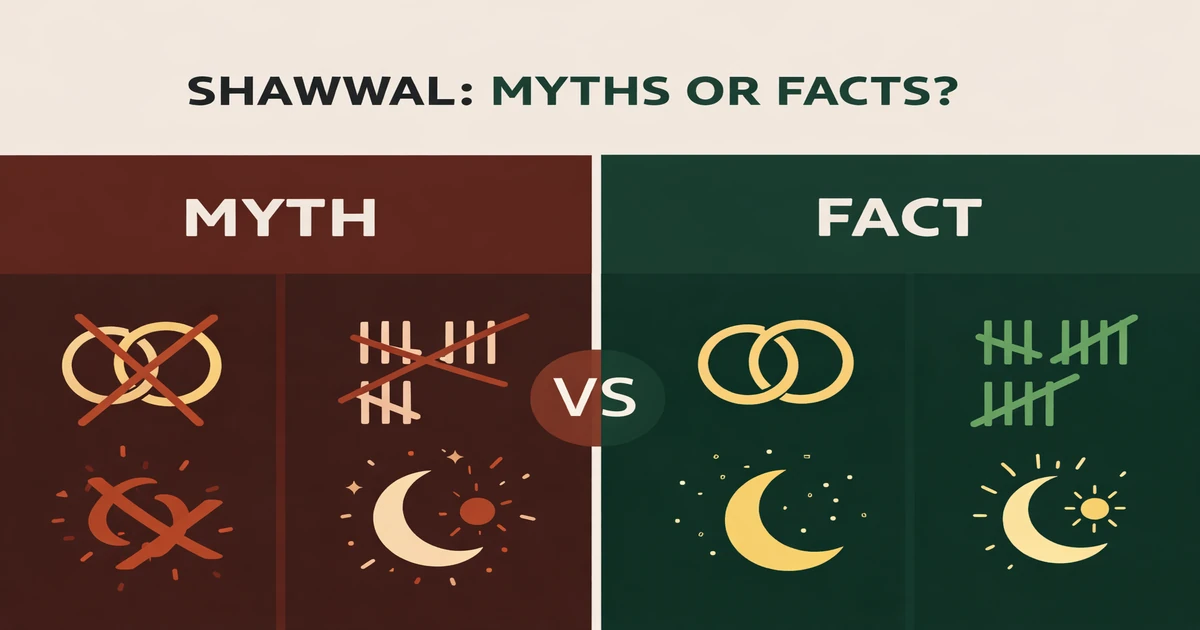
Shawwal Misconceptions (2026): Myths vs Facts About Marriage, Six Fasts, Qada, and Eid
Shawwal misconceptions confuse people every single year. Some Muslims still think marrying in Shawwal is unlucky, others think the six fasts of Shawwal are mandatory, and many still mix up the order of qada and Shawwal fasts. The simple truth is this: Shawwal is a blessed month, the six days are Sunnah not fard, fasting on Eid al-Fitr is forbidden, and not every printed calendar settles the matter for every place.
If you want something light and useful to share after Eid while you read, try our Eid greeting message generator for quick messages in different styles.
TL;DR: The biggest misconceptions about Shawwal are that marriage in Shawwal is unlucky, the six fasts are compulsory, they must be consecutive, Eid day can be fasted, qada always blocks Shawwal fasts, and calendars alone settle 1 Shawwal everywhere. Most of these are false beliefs, not facts.
What are the biggest Shawwal misconceptions?
What are the biggest misconceptions about Shawwal? The biggest common Shawwal misconceptions are these: marriage in Shawwal is unlucky, the six fasts are fard, they must be done back-to-back, fasting on the first of Shawwal is okay, qada and Shawwal always cancel each other out, women may fast while menstruating out of shyness, and printed calendars alone decide the month everywhere. These are some of the most repeated Shawwal myths and facts questions every year.
The short list: 9 common Shawwal myths Muslims repeat every year (and the one that can be haram)
- Myth 1: Can you marry in Shawwal? “No, it is unlucky.”
- Myth 2: The six fasts of Shawwal mandatory or not? “They are mandatory.”
- Myth 3: Do six Shawwal fasts have to be consecutive? “Yes, always.”
- Myth 4: First day of Shawwal fasting is fine. It is not.
- Myth 5: Can you fast Shawwal before qada? “Never, under any circumstance.”
- Myth 6: Can you combine qada and six Shawwal fasts? “You always get both automatically.”
- Myth 7: Women fasting during menstruation in Shawwal is okay if they feel embarrassed. It is not.
- Myth 8: Printed calendars alone settle Shawwal moon sighting rules everywhere.
- Myth 9: Shawwal has no special value after Eid. That one makes people waste the month.
And yes, one of them can slide into sin.
Fasting on Eid al-Fitr is not a “small technical mistake.” It is forbidden.
Misconception #1 — “Marriage in Shawwal is unlucky”
Is it unlucky to get married in Shawwal? No. This is one of the oldest Shawwal marriage myth ideas still floating around. Islam did not come to feed superstition. It came to break it.
Fact: Shawwal marriage is lawful and recommended (what the hadith actually says)
The plain answer: marrying in Shawwal is lawful, and many scholars mention it as recommended because of the report from Sayyidah Aishah رضي الله عنها that the Prophet ﷺ married her in Shawwal and entered upon her in Shawwal. That report directly crushes the false belief that Shawwal is an inauspicious time for marriage.
📖 Hadith Box
تَزَوَّجَنِي رَسُولُ اللَّهِ ﷺ فِي شَوَّالٍ، وَبَنَى بِي فِي شَوَّالٍ
Transliteration: Tazawwajani Rasulullahi ﷺ fi Shawwal, wa bana bi fi Shawwal.
Meaning: “The Messenger of Allah ﷺ married me in Shawwal and entered upon me in Shawwal.”
Where this superstition came from (pre-Islamic belief, not Islam)
This false belief came from pre Islamic superstition, not from revelation. Old cultures often attached fear to months, days, or seasons. Islam cut through that fog the way sunlight cuts through dusty glass. A month is not unlucky. A date on the calendar does not curse a marriage. What matters is taqwa, character, rights, and mercy between spouses.
I used to see this a lot in beginner classes: people feared the month and ignored the actual red flags in the marriage itself. Backwards, really.
Practical takeaway: how to respond when family says “don’t marry in Shawwal”
Keep it calm. Don’t turn a family discussion into a battlefield.
You can say: “Shawwal is not cursed. The Prophet ﷺ married in Shawwal, so we don’t treat it as unlucky.” Then move the discussion toward practical matters: compatibility, wali, finances, manners, and timing.
Micro-scenario: your aunt says, “Just wait one month to be safe.” A respectful answer is: “We’d rather follow evidence than fear. If the match is good, delaying for superstition does not help.”
📚 You Can Also Read: Marriage in Shawwal | Shawwal Month Guide
Misconception #2 — “The six fasts of Shawwal are mandatory (fard/wajib)”
Are the six fasts of Shawwal mandatory? No. They are six fasts of Shawwal Sunnah, not fard. That means they are voluntary fasts with huge reward, not an obligation like Ramadan.
Fact: they are Sunnah with huge reward (the exact meaning of the hadith)
The hadith gives these fasts real weight. The Prophet ﷺ said that whoever fasts Ramadan and follows it with six days of Shawwal gets the reward like fasting for a whole year. That is why Muslims love them. But love should not turn into pressure. Six days of Shawwal voluntary is still voluntary.
🌙 Shawwal Fasting Hadith
مَنْ صَامَ رَمَضَانَ، ثُمَّ أَتْبَعَهُ سِتًّا مِنْ شَوَّالٍ، كَانَ كَصِيَامِ الدَّهْرِ
Transliteration: Man sama Ramadan, thumma atba‘ahu sittan min Shawwal, kana ka siyamid-dahr.
Meaning: “Whoever fasts Ramadan, then follows it with six days of Shawwal, it is as though he fasted the whole year.”
This is reward language, not obligation language. Big difference.
What you still get if you can’t fast all six (no guilt, smart alternatives)
Some people are nursing a baby. Some are traveling. Some are making up missed fasts. Some are simply exhausted after Ramadan. Don’t turn a Sunnah into a stick to hit yourself with.
If you can do all six, beautiful. If you can do some, that is still خير. If you need to focus on qada first, do that. If illness or recovery blocks you, ask Allah for the reward you intended. The month is about steady worship, not panic.
Micro-scenario: a new Muslim hears friends speak as if missing the six fasts is a disaster. It isn’t. Missing a Sunnah is not the same as abandoning a fard.
📚 You Can Also Read: Six Days of Shawwal | Importance of Shawwal
Misconception #3 — “Six Shawwal fasts must be consecutive”
Do you have to fast six days of Shawwal consecutively? No. This is one of the most repeated misunderstandings about Shawwal. The six days can be consecutive or separate within the month.
Fact: you can fast them separately across Shawwal (how to schedule them easily)
The hadith says six days “from Shawwal.” It does not say they must be glued together. So yes, can you fast six days of Shawwal separately? Yes, you can. This makes the Sunnah easier for students, parents, shift workers, and anyone rebuilding energy after Ramadan.
Best simple patterns: 6 consecutive vs 2-2-2 vs Mondays/Thursdays
Three easy patterns work well for most people:
- 6 consecutive: good for people who want to finish early and move on.
- 2-2-2: good for busy weeks and family schedules.
- Mondays and Thursdays: good if you already like regular voluntary fasting.
My students always ask which one is “best.” The best one is often the one you will actually complete without crashing.
Intermittent practice is still valid. What matters is finishing six days within the Shawwal month.
📚 You Can Also Read: Do Shawwal Fasts Have to Be Consecutive? | Shawwal Fasting Intention
Misconception #4 — “You can fast on the first day of Shawwal (Eid day)”
Is it haram to fast on the first day of Shawwal? Yes. Fasting on Eid al Fitr forbidden is not a minor footnote. It is the rule. Eid is a day of gratitude, eating, joy, and open celebration of completing Ramadan.
Fact: fasting is prohibited on Eid al-Fitr (why it’s forbidden)
Eid al-Fitr is the day Allah gave after the month of fasting. Refusing food that day as a fast is like being handed a gift and pushing it back across the table. Worship has timing. Ramadan has timing. Eid has timing too.
📚 Fasting Rule Box
نَهَى رَسُولُ اللَّهِ صَلَّى اللَّهُ عَلَيْهِ وَسَلَّمَ عَنْ صَوْمِ يَوْمِ الْفِطْرِ
Transliteration: Naha Rasulullahi ﷺ ‘an sawmi yawmil-fitr.
Meaning: “The Messenger of Allah ﷺ forbade fasting on the day of Eid al-Fitr.”
What about fasting “the day after Eid”? (clear rule)
The day after Eid is fine. The prohibition is the Eid day itself. So if someone wants to start the six days of Shawwal immediately, they begin after Eid, not on it.
And here is a good spot for a useful resource on Eid wording and takbeer:
⬇️ Download Eid Takbeer PDF
Keep this handy for Eid day and the days around it.
Download the Eid Takbeer PDF📚 You Can Also Read: Can You Fast on Eid? | Eid Day Sunnah
Misconception #5 — “You must finish qada first or Shawwal fasts don’t count at all”
Can you fast Shawwal before qada? This one needs balance. Many scholars advise finishing qada fasts first because they are obligatory and because the wording of the hadith mentions fasting Ramadan, then following it with six from Shawwal. But some scholars allow doing the six first when a person has many missed fasts and fears losing the month. So this is not a one-line issue.
The balanced answer: what scholars commonly advise (best-first) vs what’s allowed when time is tight
Best-first: finish missed Ramadan fasts, then do the six of Shawwal if you can. That is the cleaner, safer order.
When time is tight: some scholars allow a person with many missed fasts to keep the six of Shawwal within the month, then continue qada later. This view is often discussed for women after Ramadan, or for those recovering from illness, pregnancy, or travel.
If you’re not sure, the safest path is easy: do qada first when reasonably possible.
If you have many missed fasts: the most realistic plan for Shawwal (without losing momentum)
A woman once told me she had a stack of missed fasts from pregnancy and breastfeeding and felt crushed by online comments. She thought she had “missed Shawwal forever,” so she almost gave up on all extra worship that month. We broke it into something small: qada on the days she could manage, ten minutes of Qur’an daily, and extra dhikr while feeding the baby. Two months later she said the shame had lifted. That is the thing people miss: fiqh should guide you, not suffocate you.
A realistic plan looks like this: start with qada if you can, add small worship daily, and if you follow the view that permits Shawwal first in tight cases, do it with knowledge, not laziness.
📚 You Can Also Read: Fast Shawwal Before Making Up Missed Ramadan? | Traveler Fasting Ramadan Rules
Misconception #6 — “You can combine qada + six Shawwal fasts and get both rewards automatically”
Can you combine qada and six Shawwal fasts? There is a real difference of opinion here. So don’t speak as if one short social post settles the whole matter.
View A (separate intentions): why some fatwa bodies say you can’t combine
Some scholars say the combining intentions in fasting here does not work because qada is an obligation owed to Allah, while the six of Shawwal are a separate voluntary act tied to the wording “whoever fasts Ramadan then follows it with six of Shawwal.” In this reading, one day cannot stand in for both in full.
View B (dual intention allowed): why some scholars say it counts and you may get both rewards
Other scholars allow a dual intention. They say the qada fast is valid as the main fast, and the person may also hope for the reward connected to Shawwal because the day falls within Shawwal and includes that intention. This view is often mentioned in some fiqh discussions, especially where hardship is real.
What to do if you want the safest option (and still realistic)
If you want the safest option, separate them. Make qada qada, and make the six days their own days. That removes doubt.
If your life is messy right now and you follow a scholar who permits dual intention, don’t act arrogant about it. Just say there is a difference of opinion and you are following a recognized view.
Micro-scenario: a sister has five qada fasts and wants the peace of a safer path. She can do five qada days, then six separate Shawwal days if time and health allow. That is clean. Another person with a harder case may follow a permissive view with proper guidance.
Misconception #7 — “Women can fast during menstruation if they feel shy”
Can women fast Shawwal during menstruation? No. Menstruation and fasting do not go together. A woman does not fast during her period, whether the fast is qada or voluntary.
Fact: fasting during menstruation isn’t allowed (what to do instead)
This is one of those topics where shame causes quiet mistakes. A woman may feel awkward if others around her are fasting, especially in a family house. But shyness does not change the ruling.
What should she do instead? She leaves the fast, waits until she is pure, and then makes up the missed obligatory fasts later. For voluntary Shawwal fasting, she resumes when she can. During those days, she can still make dua, dhikr, listen to Qur’an, give charity, and keep the spirit of the month alive.
Micro-scenario: if a girl hides her period and fasts anyway because guests are visiting, she is carrying a burden Allah did not ask her to carry.
Misconception #8 — “Printed calendars alone decide 1 Shawwal everywhere”
How is the first day of Shawwal determined? The start of Shawwal is tied to confirmed moon sighting or the recognized decision of proper Muslim authority in a place. That is why printed calendars are helpful tools, but they are not always the final judge by themselves.
Fact: Shawwal begins by confirmed moon sighting / recognized authority decision (why calendars can differ)
The Islamic calendar is lunar. It breathes with the moon, not with a wall chart. That is why new moon sighting matters and why countries may differ. Some follow local sighting. Some follow national religious authorities. Some adopt broader regional or global approaches. That is why your cousin abroad may celebrate on a different date without anyone “inventing a new Islam.”
What to follow in your country: local moonsighting vs global announcements (simple rule)
The simple rule for ordinary Muslims is this: follow the recognized authority, scholars, or official moonsighting process of your country or local Muslim body, and do not turn Eid into chaos. A clean community practice is better than everyone treating WhatsApp forwards like revelation.
📚 You Can Also Read: Eid al-Fitr in Islam | Eid Prayer Guide
Misconception #9 — “Shawwal is just ‘post-Eid downtime’ with no special value”
What is special about Shawwal? Shawwal is not a spiritual parking lot. It is a blessed month of Shawwal, a month of renewal, gratitude, and steady continuation after Ramadan. The six fasts are one part of that. The deeper value is that Shawwal tests whether Ramadan changed your habits or only your schedule.
Fact: Shawwal is a momentum month—how to keep Ramadan gains without burning out
Think of Ramadan as planting season and Shawwal as the first watering after you plant. Skip that watering and the soil dries fast. Keep it small and regular, and the roots hold.
So no, Shawwal is not just post-Eid drift. It is a month for spiritual growth, quiet discipline, and protecting what Ramadan built in your heart.
A simple 10-minute daily routine for Shawwal (Quran, dhikr, dua, charity)
Try this simple routine:
3 minutes: read a small portion of Qur’an.
2 minutes: say astaghfirullah slowly and with attention.
2 minutes: make dua for one personal need and one person you love.
2 minutes: send a small charity or prepare it.
1 minute: check one habit you want to keep from Ramadan.
That is only ten minutes.
It is also how people stay changed.
Five quirky beginner mistakes I keep seeing in Shawwal: calling the six fasts fard, treating Eid day like a bonus fast day, assuming one printed timetable settles the world, speaking harshly about valid scholarly differences, and burning out in the first week by trying to “do Ramadan all over again.”
📊 Shawwal misconceptions: myth vs fact at a glance
Use this as the quick filter: what is a superstition, what is a real ruling, and where there is a genuine difference of opinion.
🌙 Show Shawwal Misconceptions Table
| Misconception | Real ruling / fact | Beginner-safe takeaway |
|---|---|---|
| Marriage in Shawwal is unlucky | False belief; marriage in Shawwal is lawful and recommended by many scholars | Don’t fear the month; check the person and the marriage conditions |
| Six fasts are fard | They are Sunnah and voluntary with immense reward | Aim for them, but don’t treat them like Ramadan |
| They must be consecutive | They may be consecutive or intermittent within Shawwal | Choose the schedule you can actually keep |
| You can fast on Eid al-Fitr | Forbidden | Start after Eid, not on Eid |
| Qada always blocks Shawwal fasts | Safer view: qada first; some allow Shawwal first in tight cases | Follow a trusted scholar if your case is complicated |
| One intention always gets both qada + Shawwal | Difference of opinion | Safest path is to separate them |
FAQs — Shawwal Misconceptions
📘 Shawwal misconceptions FAQs
Are the six fasts of Shawwal mandatory or not?
Show Answer
They are not mandatory. The six days of Shawwal are Sunnah and voluntary, with great reward, but they are not fard like Ramadan.
Do you have to fast six days of Shawwal consecutively?
Show Answer
No. Do six Shawwal fasts have to be consecutive? No. They can be done separately across the month of Shawwal.
Can you fast Shawwal before making up missed Ramadan fasts (qada)?
Show Answer
Many scholars advise finishing missed Ramadan fasts before Shawwal. Some allow doing the six first if time is tight and the person has many missed days. The safer path is qada first when possible.
Can you combine qada and six Shawwal fasts? (difference of opinion explained)
Show Answer
There is a real difference of opinion. Some scholars do not allow combining because qada and Shawwal are separate acts. Others allow a dual intention. The safest option is to separate them.
Is it haram to fast on the first day of Shawwal (Eid al-Fitr)?
Show Answer
Yes. Fasting on Eid al-Fitr is prohibited. You can fast the day after Eid, but not Eid day itself.
Is it unlucky to get married in Shawwal?
Show Answer
No. That is a false belief and pre Islamic superstition, not Islam. Marriage in Shawwal is lawful and viewed by many scholars as recommended.
How is the first day of Shawwal determined (moon sighting vs calendars)?
Show Answer
It is determined by confirmed moon sighting or the recognized decision of proper religious authority. Printed calendars are useful, but not always the final word on their own.
What is special about Shawwal in Islam (one-paragraph answer)?
Show Answer
Shawwal significance in Islam includes Eid al-Fitr, the six voluntary fasts, and the chance to keep Ramadan’s spiritual gains alive. It is a month of gratitude, renewal, and steady worship without burnout.
Can women fast during menstruation in Shawwal if they feel shy?
Show Answer
No. A woman does not fast during menstruation. She resumes after purity and makes up any obligatory missed days later.
Are printed calendars enough to confirm Shawwal everywhere?
Show Answer
Not always. Are printed calendars enough to confirm Shawwal? They help with planning, but actual confirmation is tied to recognized moon-sighting decisions and scholarly authority.
What are the biggest misconceptions about Shawwal in one line?
Show Answer
Common misunderstandings about Shawwal in Islam mostly come from superstition, pressure, and confusion about voluntary fasts, qada, moon sighting, and Eid rules.
Related Internal Link Ideas
2. do shawwal fasts have to be consecutive
3. fast shawwal before making up missed ramadan
Final Self-Check
H1 starts with primary keyword: Pass
Meta title within target range and starts with keyword: Pass
Meta description within target range and starts with keyword: Pass
Exactly 1 table: Pass
1–3 lists used: Pass
All required headings covered in order: Pass
No sources or citations inside article body: Pass
No unverified claims stated as certainty: Pass
No robotic/corporate filler words: Pass
Sentence opening variety: Pass
Human tone with story, micro-scenarios, and beginner mistakes: Pass
🌍 Eid al-Fitr 2026 Country & Holiday Guides
Use these quick guides to check Eid al-Fitr 2026 dates, holiday rules, and country-specific updates.

Farrukh Farooqi has been living in Sharaya, Makkah, Saudi Arabia since 2010. With over 14 years of firsthand experience witnessing the sacred journey of millions of pilgrims, Farrukh specializes in providing practical, insider tips for Hajj and Umrah travelers. His work blends real-world observations, the latest Saudi updates, and essential crowd management strategies — helping pilgrims and worshippers plan smarter, stay safer, and experience a spiritually fulfilling journey across the Holy Cities.


