
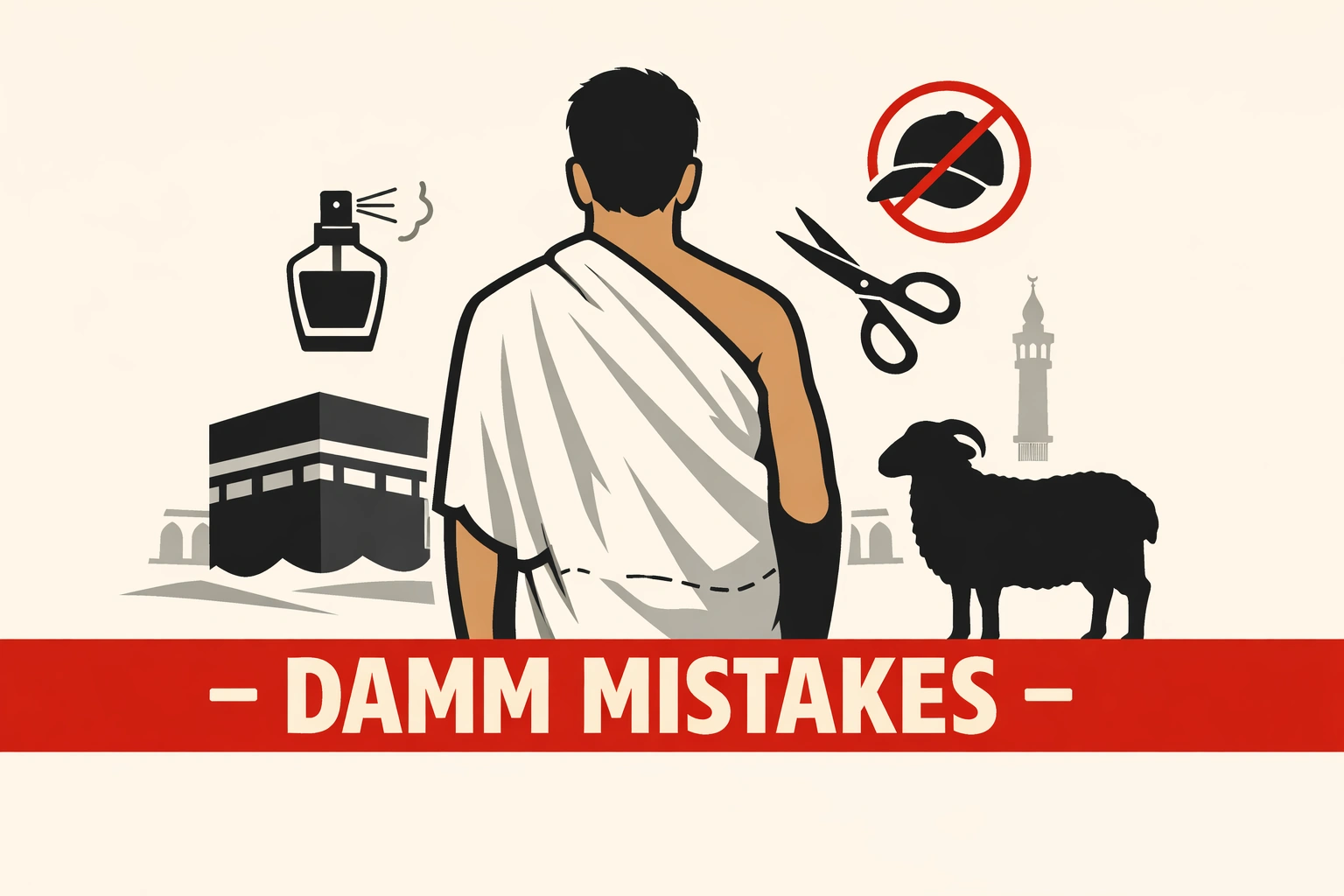
Mistakes About Damm: Common Errors, Rules, and What Requires Dam
Mistakes About Damm usually mean one of two things: either a pilgrim broke an Ihram restriction in a serious way, or missed a wajib act that cannot simply be brushed aside. In many of those cases, the correction is damm—a compensatory animal sacrifice inside the Haram of Makkah, not just a cash payment.
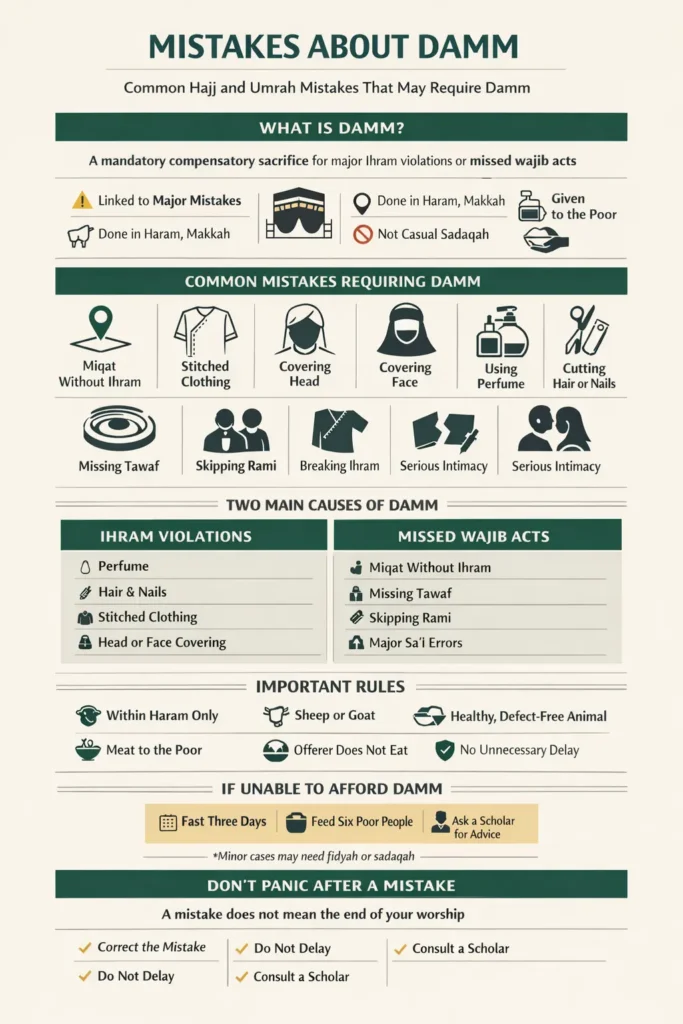
If you want the shortest direct answer, here it is: common mistakes requiring damm can include crossing miqat without ihram, wearing stitched clothing in Ihram for men, using strong scent deliberately, cutting hair or nails, missing certain wajib acts like missing tawaf al-wida or skipping rami, and some serious mistakes in Tawaf or Sa’i. For a fuller base first, read Dam in Umrah.
A mistake can be heavy.
But a mistake does not mean your worship is finished.
✅ TL;DR – Mistakes About Damm
Mistakes About Damm in Hajj and Umrah usually involve major ihram violations or missed wajib acts. Damm must be carried out within the sacred boundaries of the Haram in Makkah, it must be a real animal sacrifice, the person offering the damm cannot consume the meat, and it should be completed without delay. Minor violations can fall under lighter expiation instead.
What Are Mistakes About Damm?
What damm means in Hajj and Umrah
What damm means in Hajj and Umrah is simple in principle: it is a compensatory sacrifice for certain pilgrimage violations. Think of it like repairing a torn part of your worship. The cloth is still valuable, but the tear needs treatment.
This is why many pilgrims search for what is the dam in haram, what is dam in umrah, or how to do damm after realizing they made a mistake in Ihram, Tawaf, Sa’i, or a wajib act.
When a mistake requires damm instead of sadaqah
When a mistake requires damm instead of sadaqah depends on the type, seriousness, and sometimes duration of the violation. The broad pattern from your source material is this: major violations and missed wajib acts can require damm animal sacrifice, while smaller or partial cases may fall under lighter forms like charity or feeding.
This is where people get confused. They think every mistake has the same price. It does not.
Why a mistake does not mean the end of your worship
Why a mistake does not mean the end of your worship matters more than people admit. Pilgrims panic. They feel ashamed. Some even think, “My Umrah is ruined forever.” But the basic Islamic pattern is correction, not despair.
I’ve seen this with beginners many times. A person realizes they used scented soap or crossed Miqat wrongly, and suddenly their whole trip feels dark. The better response is calmer: find out the ruling, do the needed expiation, and keep your heart soft. Worship is not a glass cup that vanishes the second you touch it wrong. But yes, some mistakes are serious and must be corrected properly.
📚 You Can Also Read: Dam in Hajj
What Is Damm in Islam?
What is the dam in haram
What is the dam in haram means the required expiation carried out inside the sacred limits of Makkah for certain Hajj or Umrah violations. It is not something done anywhere in the world and then called “close enough.” The place matters.
Why damm is a compensatory animal sacrifice
Why damm is a compensatory animal sacrifice is tied to the nature of the violation. This is not just “donating something nice.” It is a defined compensatory sacrifice, a form of kaffara tied to specific pilgrimage rulings.
📖 Qur’an box
فَمَن تَمَتَّعَ بِالْعُمْرَةِ إِلَى الْحَجِّ فَمَا اسْتَيْسَرَ مِنَ الْهَدْيِ
Transliteration: Faman tamatta‘a bil-‘umrati ilal-hajji famastaysara minal-hady.
Translation: “Whoever performs ‘Umrah followed by Hajj shall offer whatever sacrificial animal is easy to obtain.”
This verse is part of the wider fiqh background around sacrificial compensation and pilgrimage duties.
Why damm must be done in Makkah
Why damm must be done in Makkah is not a minor detail. Your source content is direct: damm must be carried out within the sacred boundaries of the Haram in Makkah. The slaughter happens there, and the meat goes there to the eligible poor.
📚 You Can Also Read: Different Categories of Damm
Which Mistakes Commonly Require Damm?
Crossing Miqat without Ihram
Crossing miqat without ihram is one of the clearest and most repeated examples in this topic. It is not a tiny slip. If a person passes the Miqat without entering Ihram properly, that can require damm.
Wearing stitched clothing in Ihram for men
Wearing stitched clothing in Ihram for men is among the best-known ihram restrictions. Men in Ihram are not meant to wear tailored garments that fit the body in the usual way. That is why people search things like wearing stitched clothing in ihram for men requires damm.
Covering the head for men or covering the face for women
Covering the head for men or covering the face for women appears in your source content as a recognized violation category. Men do not cover the head in Ihram in the usual fitted way, and women do not wear a niqab that rests on the face while in Ihram.
Using perfume, fragrance, or strongly scented soap
Using perfume, fragrance, or strongly scented soap is one of the most common modern mistakes because people forget that scent hides in soap, lotion, wipes, creams, and travel kits. Your source content is direct here too: using strongly scented soap intentionally requires damm in serious cases.
Cutting hair, shaving, trimming, or cutting nails
Cutting hair, shaving, trimming, or cutting nails while in Ihram is another major area. Again, your source material states it plainly: cutting hair intentionally requires damm in the kind of complete violation being discussed.
Breaking Ihram early before completing the rites
Breaking ihram early before completing the rites is not a casual matter. A pilgrim cannot just decide the state is over while the required actions are still incomplete.
Missing Tawaf al-Wida, skipping Rami, or missing another wajib act
Missing Tawaf al-Wida, skipping Rami, or missing another wajib act falls under the missed-wajib side of this topic. This is where many key rules and scenarios for damm show up. Not every missed detail is the same, but leaving a wajib act can require compensation.
Mistakes in Tawaf or Sa’i that may require damm
Mistakes in Tawaf or Sa’i that may require damm are more detailed than many pilgrims realize. Some errors mean repeating the act. Others, if left uncorrected, may lead to kaffara.
📚 You Can Also Read: Damm for Omitting Mandatory Rites
Common Mistakes During Umrah That May Require Dam
Ihram violations during Umrah
Common mistakes during umrah that may require dam often begin in Ihram itself: scent, hair, nails, clothing, head or face covering, and intimacy-related violations. Pilgrims are often tired from travel, and that is when they forget their normal products are not always safe in Ihram.
Common mistakes in Tawaf during Umrah
Common mistakes in Tawaf during Umrah can include missing laps, not completing the act correctly, or leaving out a wajib of Tawaf that later needs correction. Some Tawaf problems are fixable by repeating the act. Others can become more serious if ignored.
Mistake in Sa’i and when omitting circuits becomes serious
Mistake in Sa’i and when omitting circuits becomes serious is one of those points beginners rarely expect. Your source content specifically mentions that omitting four or more circuits without valid reason can become a damm case, though redoing Sa’i may solve the problem.
Doing Halaq or Qasr incorrectly or not doing it
Doing Halaq or Qasr incorrectly or not doing it can also create a real issue. People sometimes act as if hair cutting is just the easy ending part. It is not just a haircut. It is part of how you come out of Ihram properly.
📚 You Can Also Read: Dam in Umrah
Which Mistakes in Ihram Require Kaffara?
Perfume and fragrance-related mistakes
Perfume and fragrance-related mistakes include cologne, strongly scented soap, scented creams, oils, wipes, and similar items. This is why perfume fragrance and fragrance-related mistakes keep appearing in these rulings.
Hair and nail violations in Ihram
Hair and nail violations in Ihram include trimming, shaving, plucking, or cutting. Some partial or accidental cases may be lighter. Some complete intentional cases can require damm. This is one of those areas where the phrase mistakes in ihram require kaffara becomes very practical, not theoretical.
Clothing and covering violations in Ihram
Clothing and covering violations in Ihram include wearing tailored garments for men, covering the head for men, and improper face covering situations for women in Ihram. Duration and circumstances can affect the ruling.
Sexual contact and the most serious violations
Sexual contact and the most serious violations sit at the top end of this topic. Lesser forms of intimacy are one level. Full sexual intercourse before the rites are completed is another level entirely, and it can invalidate Hajj or Umrah in some cases and require a much more severe penalty.
📚 You Can Also Read: Damm for Violating Ihram
Important Rules Regarding Damm
Damm must be carried out within the sacred boundaries of the Haram in Makkah
This is one of the clearest important rules regarding damm. Your source content phrases it directly: damm must be carried out within the sacred boundaries of the haram in makkah.
Damm must be an actual animal sacrifice not a monetary donation
Another core rule is just as clear: dam must be an actual animal sacrifice not a monetary donation. This is why the question can i just give money instead of an animal sacrifice is answered with no in the damm case itself.
The person offering the damm cannot consume the meat
Your source content is explicit: the person offering the damm cannot consume the meat. The point is not to get a private meal out of an expiation.
It must be slaughtered within the Haram boundaries and given entirely to the poor
Again, the wording matters: it must be slaughtered within the haram boundaries and given entirely to the poor. This covers both place and meat distribution.
Damm should be completed without delay
Damm should be completed without delay. That does not mean panic in an uncontrolled way. It means do not knowingly sit on the duty for no reason.
📦 Core Damm Rules Box
Location: Inside the Haram of Makkah
Type: Real animal sacrifice
Meat: Given to the poor, not eaten by the person offering damm
Timing: Complete it without unnecessary delay
What Are the Requirements for Slaughtering an Animal as Kaffara?
Which animals are valid for damm
Which animals are valid for damm according to your source content: sheep, goat, cow, or camel, depending on the case and type of required sacrifice.
Minimum age rules for sheep, goat, cow, and camel
Minimum age rules for sheep, goat, cow, and camel were also provided in your source material: sheep six months, goat one year, cow two years, and camel five years.
Why the animal must be healthy and defect-free
Why the animal must be healthy and defect-free is part of the basic sacrifice requirements. The animal should not be defective. This is not the place for a damaged, weak, or obviously unsuitable animal.
How one camel or cow may cover multiple kaffara cases
How one camel or cow may cover multiple kaffara cases also appears in your material: a camel or cow may satisfy up to seven cases that require slaughtering an animal.
📚 You Can Also Read: Udhiyah and Qurbani Rules
How to Do Damm Correctly
How to perform dam in Islam step by step
How to perform dam in islam in simple steps is this:
- Confirm the ruling for your exact mistake.
- Select a valid animal that meets the rules.
- Ensure slaughter in the Haram of Makkah.
- Give the meat to the poor in the Haram.
- Do not consume the meat yourself.
How to give dum for Umrah or Hajj
How to give dum for umrah or hajj often comes down to arranging the sacrifice correctly in Makkah, especially if you are no longer there yourself. The biggest mistake here is assuming “I sent some money somewhere, so I’m done.” The method must match the ruling.
Can you arrange damm through proxy or wakala
Can you arrange damm through proxy or wakala? Yes, your source content clearly allows the idea of doing it through proxy when needed, as long as the actual sacrifice is done correctly in the Haram.
Can you still offer damm if you have returned home
Can you still offer dam if you have returned home? Yes. This was stated plainly in your source content. The person may be back home, but the damm itself must still be carried out in Makkah through proper arrangement.
📚 You Can Also Read: Hady in Hajj
What If You Cannot Afford Damm?
Alternatives if unable to afford damm
Alternatives if unable to afford damm were given in your source content for certain kaffara situations: fasting or feeding the poor. This is one area where people must be very careful not to generalize blindly across every case.
Fasting for three days
Fasting for three days appears in your source material as one form of kaffara in relevant cases. Those days do not have to be consecutive according to the content you provided.
Feeding six poor people two meals each
Feeding six poor people two meals each also appears directly in your source material. This is one of the clearest phrases in the brief and should not be watered down.
When a scholar should be consulted for the correct expiation
When a scholar should be consulted for the correct expiation is especially important when the violation was partial, excused, accidental, repeated, or mixed with other errors. This is where your phrase requirements of fasting feeding the poor or sadaqa for kaffara becomes case-sensitive.
Damm vs Sadaqah: What Is the Difference?
Damm for major violations
Damm vs sadaqah starts with this distinction: damm for major violations, especially missed wajib acts or complete serious Ihram violations.
Sadaqah or fidyah for minor violations
Sadaqah or fidyah for minor violations is the lighter side of the subject. Your source content itself says minor violations can be compensated with less severe measures.
How intention, duration, and severity affect the ruling
How intention, duration, and severity affect the ruling is why two pilgrims can make what looks like the “same mistake” but not land on the exact same expiation. Intentional is not accidental. Complete is not partial. Serious is not minor.
Mistakes About Damm in Tawaf and Sa’i
Which Tawaf mistakes may require repeating the Tawaf
Which Tawaf mistakes may require repeating the Tawaf include missing core requirements that make the act incomplete. In those cases, repeating Tawaf may fix the problem better than jumping straight to kaffara talk.
When missing a wajib of Tawaf leads to kaffara
When missing a wajib of Tawaf leads to kaffara is where detail matters. Your source material states that if the wajibat of Tawaf are not done, then Tawaf may need repetition or kaffara.
When a mistake in Sa’i requires damm
When a mistake in Sa’i requires damm is not every slip in counting. But omitting major parts and leaving the act uncorrected can become serious, especially in the way your source material described incomplete circuits.
📚 You Can Also Read: Sa’i Between Safa and Marwah
Sexual Contact and Major Violations: When the Penalty Becomes More Severe
Kissing and lesser forms of intimacy
Kissing and lesser forms of intimacy are not treated as casually as people imagine in Ihram. They fall under the intimacy side of mistakes in ihram require kaffara.
Sexual intercourse and when Umrah or Hajj may be invalidated
Sexual intercourse and when Umrah or Hajj may be invalidated is the most severe side of this topic. Your source content says plainly that full intercourse before completion can invalidate Hajj or Umrah and require severe correction.
When a larger penalty than a sheep or goat may apply
When a larger penalty than a sheep or goat may apply comes up in the gravest cases. Your source brief itself mentions that sometimes a bigger penalty, even a camel, may apply in major violations.
📚 You Can Also Read: Badanah for Major Violations
Can Multiple Mistakes Require More Than One Damm?
When separate mistakes may need separate expiation
When separate mistakes may need separate expiation is one of the most stressful questions pilgrims ask after the trip. The general answer from your source material is yes, separate mistakes may need separate expiation.
Why some cases need individual scholarly review
Why some cases need individual scholarly review is obvious once you see how many variables are involved: complete or partial, excused or unexcused, one violation or several, corrected or left uncorrected.
I’ve seen people try to flatten all of this into one WhatsApp answer. That is risky.
📊 mistakes about damm: common cases and safest reading
Use this as a beginner summary only. It helps separate major, lighter, and review-needed cases without pretending every case is identical.
🐑 Show Damm Mistakes Table
| Mistake type | Common ruling direction | Beginner-safe note |
|---|---|---|
| Crossing Miqat without Ihram | Often a damm case | Do not treat it lightly |
| Strong perfume use in Ihram | Can require kaffara/damm | Intent and extent matter |
| Hair or nails cut in Ihram | Can require damm in complete cases | Partial cases may differ |
| Missing Tawaf al-Wida | Often linked to compensatory ruling | Treat as a wajib issue |
| Skipping Rami | Can require damm | Do not guess the ruling alone |
| Serious intimacy violation | May invalidate and require severe penalty | Needs direct scholar review |
Mistakes About Damm FAQs
📘 Mistakes About Damm FAQs
Which mistakes require the kaffara of slaughtering an animal?
Show Answer
Common examples include crossing Miqat without Ihram, serious scent violations, hair or nail cutting in complete violation, missing certain wajib acts, and some Tawaf or Sa’i errors left uncorrected.
Which mistakes in Ihram require kaffara and of what?
Show Answer
Perfume, stitched clothing for men, covering the head for men or face in the prohibited manner for women, cutting hair, and cutting nails can all trigger kaffara. The form may be damm, fasting, feeding, or charity depending on the case details.
Can I just give money instead of an animal sacrifice?
Show Answer
No, not when the ruling is actual damm. Your source material is direct: dam must be an actual animal sacrifice, not a monetary donation.
Can you still offer dam if you have returned home?
Show Answer
Yes. The sacrifice still has to happen in the Haram of Makkah, but it may be arranged through proxy or wakala after you return home.
What are the requirements for slaughtering an animal as kaffara?
Show Answer
The animal must be valid, old enough, healthy, and defect-free. It must be slaughtered inside the Haram boundaries, and the meat must go to eligible poor people there.
What are the requirements of fasting, feeding the poor, or sadaqa for kaffara?
Show Answer
Your source content mentions fasting three days, which need not be consecutive, and feeding poor people in the Haram in the form described, including two meals each in the cited framework.
What is dam in Umrah?
Show Answer
Dam in Umrah is compensatory sacrifice required for certain violations, such as serious Ihram breaches or omitted required acts that need this form of expiation.
How to give dum for Umrah or Hajj?
Show Answer
Confirm the exact ruling, arrange a valid animal, make sure the slaughter happens in the Haram, and ensure the meat is distributed to the poor there. Proxy is possible when needed.
Can multiple mistakes require more than one damm?
Show Answer
Yes, separate mistakes may require separate expiation. This is one of the main reasons individual review is often needed.
Does every Umrah mistake need damm?
Show Answer
No. Some mistakes are minor, partial, accidental, or correctable by repeating the act. Those may fall under lighter expiation instead of full damm.
Can the person offering damm eat the meat?
Show Answer
No. Your source content clearly states that the person offering the damm cannot consume the meat.
Mistakes About Damm and Common Hajj Umrah Violations
Related Articles
Damm Violating Ihram Damm Omitting Mandatory Rites Tawaf al-Wida Dam Hajj Mistakes to Avoid Miqat for Hajj Ihram Rules Hajj Sa’i Between Safa and Marwah Badanah Major ViolationsYou Can Also Check
- nafl tawaf guide
- tawaf al umrah guide
- tawaf al qudum guide
- tawaf al ifadah guide
- tawaf al ziyarah guide
- tawaf faqs guide

Farrukh Farooqi has been living in Sharaya, Makkah, Saudi Arabia since 2010. With over 14 years of firsthand experience witnessing the sacred journey of millions of pilgrims, Farrukh specializes in providing practical, insider tips for Hajj and Umrah travelers. His work blends real-world observations, the latest Saudi updates, and essential crowd management strategies — helping pilgrims and worshippers plan smarter, stay safer, and experience a spiritually fulfilling journey across the Holy Cities.


