

Wajibaat of Ihram: Core Obligations, Prohibitions, and Penalties for Hajj and Umrah
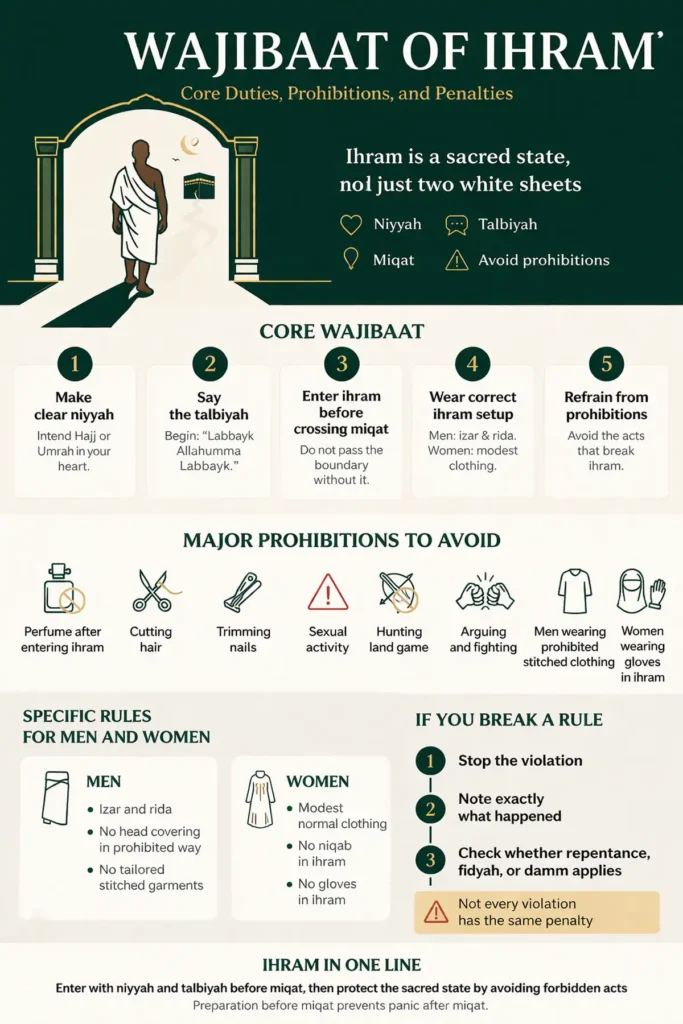
Wajibaat of Ihram are the core duties a pilgrim must take seriously when entering ihram for hajj or umrah. In simple words, the heart of the matter is this: making the intention niyyah, uttering the talbiyah, crossing the miqat in a state of ihram, following the proper rules of ihram, and refraining from prohibitions.
If you want the quickest direct answer, the wajibat of ihram are not just about clothing. They are about entering a sacred state properly and then not violating it carelessly. For miqat basics before you travel, read Miqat for Hajj.
Many beginners think Ihram is just two white sheets.
It is not.
It is more like stepping into a protected zone around your body, speech, and desires. Once you step in, some things that were normal a few minutes earlier are no longer allowed. That is why learning the obligations of ihram early can save a pilgrim from panic, penalties, and avoidable mistakes.
✅ TL;DR – wajibaat of ihram
The wajibat of ihram include entering Ihram properly with niyyah and talbiyah, respecting the miqat, and avoiding the major prohibitions of ihram. If a pilgrim breaks an Ihram rule, the result may be repentance only, or it may also require damm or fidyah, depending on the violation and the school of law.
What Are the Wajibaat of Ihram?
Niyyah, talbiyah, miqat, and avoiding prohibitions are the core wajibat of ihram
What are the wajibat of ihram? The short answer is: the pilgrim must enter Ihram deliberately, not casually. That means niyyah, talbiyah, respecting the miqat, and then staying away from the known prohibitions of ihram for men and women. For men, proper wearing ihram garments is also part of the basic practical setup of Ihram.
Why the wajibat of ihram matter for Hajj and Umrah
The core wajibat of ihram matter because Ihram is the doorway into pilgrimage. If the doorway is treated carelessly, the rest of the journey becomes messy. Some violations do not destroy the whole pilgrimage, but they can still require compensation, and they can turn a peaceful journey into a stressful one.
What happens if you miss a wajib of ihram
What happens if you miss a wajib of ihram? It depends on what was missed. Some mistakes require returning and correcting the act if possible. Some require expiation damm or fidyah penalty. Some matters differ between scholars, so a pilgrim should not play guesswork with sacred acts.
📖 Quran Box
ٱلْحَجُّ أَشْهُرٌۭ مَّعْلُومَـٰتٌۭ ۚ فَمَن فَرَضَ فِيهِنَّ ٱلْحَجَّ فَلَا رَفَثَ وَلَا فُسُوقَ وَلَا جِدَالَ فِى ٱلْحَجِّ
Transliteration: Al-hajju ashhurun ma‘lumat, faman farada fihinna al-hajja fala rafatha wa la fusuqa wa la jidala fi al-hajj.
Translation: “Hajj is during well-known months, so whoever has made Hajj obligatory upon himself therein, there is to be no sexual relations, no disobedience, and no arguing during Hajj.”
This verse captures the mood of Ihram: devotion with restraint.
📚 You Can Also Read: What Are Fard, Wajib, and Sunnah of Hajj?
What Is Ihram?
What is ihram in Hajj and Umrah
What is ihram? Ihram is the sacred entry state for pilgrimage. It is the state a muhrim enters before starting Hajj or Umrah. Think of it like crossing from ordinary time into worship time. The body is still the same body, but the rules around it change.
Why ihram is a state of consecration and not only clothing
Many people reduce Ihram to fabric. That is where confusion starts. The clothes matter, especially for men, but the real meaning of Ihram is a state of consecration. A pilgrim may be dressed correctly and still behave wrongly. That would mean he wore the uniform without entering the spirit.
I used to see beginners panic over folds in the cloth while speaking harshly to people beside them. That flips the whole lesson upside down.
What makes entering ihram valid
At the basic level, entering Ihram becomes valid through intention and entry into the pilgrimage state in the proper way. Scholars discuss details here, especially the relationship between niyyah and talbiyah. Because of that, the safest path for ordinary pilgrims is simple: make a clear intention for the exact rite you are performing and say the talbiyah properly.
📚 You Can Also Read: Niyyah for Hajj and Umrah
What Are the Core Wajibaat of Ihram?
Making the intention niyyah
Making the intention niyyah is the first core pillar-like step in practice. A pilgrim must know what he is entering: Hajj or Umrah, and in many cases which type of Hajj. Without this, the act becomes vague, and sacred acts are not meant to be handled vaguely.
Uttering the talbiyah
Uttering the talbiyah is treated with great weight in the fiqh of Ihram. Some scholars treat it as essential to formally entering Ihram together with intention, while others discuss it differently. For the average pilgrim, there is no reason to gamble here. Make the intention and say the talbiyah.
🕋 Talbiyah
لَبَّيْكَ اللَّهُمَّ لَبَّيْكَ، لَبَّيْكَ لَا شَرِيكَ لَكَ لَبَّيْكَ، إِنَّ الْحَمْدَ وَالنِّعْمَةَ لَكَ وَالْمُلْكَ، لَا شَرِيكَ لَكَ
Transliteration: Labbayka Allahumma labbayk, labbayka la sharika laka labbayk, innal-hamda wan-ni‘mata laka wal-mulk, la sharika lak.
Translation: “Here I am, O Allah, here I am. Here I am, You have no partner, here I am. Truly, all praise, favor, and kingship belong to You. You have no partner.”
Crossing the miqat in a state of ihram
Crossing the miqat in a state of ihram is one of the most important practical duties. If a pilgrim knowingly passes the miqat without entering Ihram, that is not a small slip. In many cases, he must return if able. If he does not, there may be a penalty.
Wearing ihram garments correctly
For men, wearing two unstitched white sheets as izar and rida is the well-known practical form of Ihram clothing. For women, the matter is different. They do not wear a special two-piece Ihram uniform. Their Ihram is entered through intention and rules, while they wear modest normal clothing.
Refraining from prohibitions of ihram
Refraining from prohibitions is part of the essence of Ihram. A person does not enter Ihram just to wear certain clothing and then ignore the limits. The sacred state is protected by what you do not do as much as by what you do.
How to Enter the State of Ihram Properly
Spiritual and physical preparation before ihram
How to enter the state of ihram properly starts before the actual moment. A pilgrim should clean up, calm down, and prepare mentally. This is the part many people rush. They pack chargers, money, and snacks, but forget to pack stillness.
Sunnah practices before entering ihram
The well-known sunnah practices before entering ihram include cleaning the body, arranging the hair and nails before entering the state, and preparing in a respectful way. These are not the same as the wajib acts, but they help the pilgrim enter properly and avoid later problems.
Taking a bath ghusl before ihram
Taking a bath ghusl before Ihram is from the recommended preparation. It is a physical wash that supports inner readiness. Like washing a cup before pouring clean water into it.
Two rak’ahs before entering ihram
Two rak’ahs are often mentioned in preparation discussions, though scholars speak about details differently. A beginner should treat this with calm: do not turn recommended preparation into a panic checklist, but do not ignore it carelessly either.
Making the niyyah intention and saying talbiyah
This is the moment the state begins. The pilgrim forms the intention clearly, says the talbiyah, and enters Ihram. From here onward, ordinary habits can suddenly become forbidden acts.
📚 You Can Also Read: Rules of Ihram Guide for Men and Women During Umrah and Hajj
What Is Forbidden in Ihram for Men and Women?
Using perfume on clothes or body
Using perfume on clothes or body after entering Ihram is among the well-known prohibitions. This includes obvious fragrance and scented products used in the ordinary beautification sense. People get confused here because perfume used before entering Ihram is discussed differently from applying perfume after entering it.
No cutting hair or nails
No cutting hair or nails is one of the most recognized rules. It sounds small, but it teaches restraint. The muhrim stops treating his body with ordinary trimming habits because he is in a sacred state.
No sexual activity in ihram
No sexual activity in ihram is a major restriction. This includes sexual relations and actions leading openly toward them. It is not just a matter of “technical sin.” It can affect the pilgrimage very seriously.
No hunting or killing animals
No hunting or killing animals refers to hunting land game in the known fiqh sense. Harmful creatures are discussed separately in the books of law, which is why a pilgrim should not invent rulings for himself in the field.
Avoid arguing or fighting
Avoid arguing or fighting is not decorative advice. It is part of the ethical protection of Hajj and Umrah. A person who keeps his cloth clean but his tongue filthy has missed a huge part of Ihram.
⚠️ Quick list: major prohibitions wajib to avoid in ihram
- Perfume after entering Ihram
- Cutting hair or trimming nails
- Sexual activity and its direct lead-ups
- Hunting land game
- Arguing, abusive speech, and fighting
- Men wearing stitched clothing in the prohibited sense
- Women wearing niqab or gloves in Ihram
Specific Ihram Rules for Men
Specific ihram rules for men
Specific ihram rules for men focus heavily on clothing and head covering. Men do not simply wear “anything white.” There are clear restrictions about what covers the body in the ordinary tailored sense.
Ihram clothing for men
Ihram clothing for men usually means izar for the lower body and rida for the upper body. The point is simplicity, not fashion.
Can men cover their heads or wear stitched clothing
Can men cover their heads or wear stitched clothing? In the normal fiqh explanation, men in Ihram should not cover the head in the prohibited way and should not wear tailored garments such as shirts, trousers, or similar body-fitted clothing. This is one of the most famous male-specific rules.
Prohibited acts for men during ihram
Prohibited acts for men during ihram include using fragrance, cutting hair, trimming nails, sexual activity, and male-specific clothing violations. The common beginner error is to focus only on cloth while forgetting speech and behavior.
Are sandals with stitching allowed
Are sandals with stitching allowed? Stitching on sandals themselves is not the main issue in the way people imagine. The real concern is whether the footwear becomes the kind of covering that violates the rule as explained by scholars. This is one of those “small questions” that causes big confusion in travel groups.
📚 You Can Also Read: Hajj Packing List
Specific Ihram Rules for Women
Specific ihram rules for women
Specific ihram rules for women are different in form from men’s rules. Women do not have the two-sheet dress code. Their focus is modest clothing, correct entry into Ihram, and avoiding the prohibited matters linked to adornment and face-hand coverings in the specific Ihram sense.
Ihram clothing for women
Ihram clothing for women is regular modest clothing, not a special costume. Loose, covering, and dignified clothing is the point. Women are not required to copy the men’s Ihram form.
Can women wear perfume, makeup, or jewelry in ihram
Can women wear perfume, makeup, or jewelry in ihram? Perfume is to be avoided in Ihram. Makeup used as beautification is also treated with caution and avoidance in this state. Simple jewelry is discussed more lightly, but a pilgrim should remember the spirit of the state: this is not a beautification season.
Can women wear niqab or gloves in ihram
Can women wear niqab or gloves in ihram? The well-known rule is that women in Ihram do not wear niqab or gloves. This does not mean modesty disappears. It means modesty is kept in the form taught for the Ihram state.
What if a woman gets her period in ihram
What if a woman gets her period in ihram? Her Ihram itself does not vanish. She remains in Ihram and follows the rulings for the rites affected by menstruation, especially tawaf. This is one of the questions women ask with real anxiety, and rightly so. It needs calm, not shame.
📚 You Can Also Read: Hajj with Elderly Parents
Permissible Acts in Ihram That People Often Doubt
Can you sleep shower or use the toilet in ihram
Can you sleep shower or use the toilet in ihram? Yes. These ordinary human needs do not cancel Ihram. The caution is about avoiding the prohibited acts while doing them, such as using fragrance carelessly or causing hair to be removed deliberately.
Can you wear sunglasses belts or watches in ihram
Can you wear sunglasses belts or watches in ihram? Generally, yes. These are from the commonly permitted practical items people use for travel and need. Beginners often overcomplicate this part.
Can women cover their feet or hands in salah
Can women cover their feet or hands in salah? This is discussed in the ordinary prayer rulings and should be understood separately from the specific prohibition of gloves in Ihram. A woman should not mix up “hands covered in prayer context” with “wearing gloves as an Ihram garment.”
Can you make wudu while in ihram
Can you make wudu while in ihram? Of course. In fact, wudu and cleanliness remain part of the believer’s life in pilgrimage. Ihram is not a pause button on purification.
Can I brush my teeth in ihram
Can I brush my teeth in ihram? In ordinary practical guidance, yes, while avoiding scented or perfumed items that would create a prohibited fragrance issue. A pilgrim should keep the mouth clean, especially in crowded worship spaces.
What Makes Ihram Invalid?
What makes ihram invalid
What makes ihram invalid? This topic needs careful wording because not every violation “invalidates” Ihram in the same sense. Some acts are sinful and require penalty. Some acts can invalidate the pilgrimage rite itself in major ways depending on when they occur, especially sexual intercourse. That is why loose language here causes real confusion.
Does skipping niyyah or talbiyah affect ihram
Does skipping niyyah or talbiyah affect ihram? Yes, this affects the validity discussion deeply. Scholars differ on some details, but no sensible pilgrim should try to separate intention from proper verbal entry in practice. The safe path is to do both clearly.
Does crossing the miqat without ihram require penalty
Does crossing the miqat without ihram require penalty? If done knowingly and the pilgrim does not return to correct it, this can require a penalty according to the well-known fiqh discussions. This is one of the most important practical mistakes to avoid before travel.
What happens with major violations in ihram
What happens with major violations in ihram? Major violations are not all equal. Some bring sin and compensation. Some, like sexual intercourse at certain stages, are treated far more seriously. This is one of those areas where a pilgrim should ask a reliable scholar fast, not a random group chat.
📚 You Can Also Read: Miqat Violation Dam
What Happens If You Break a Rule in Ihram?
What happens if you break a rule in ihram
What happens if you break a rule in ihram? The answer depends on the act, whether it was deliberate or mistaken, and how the school of law classifies it. Some matters require repentance only. Some require compensation.
Expiation damm and fidyah penalty explained
Expiation damm and fidyah penalty explained: damm usually refers to sacrificial compensation in the Hajj and Umrah penalty context, while fidyah may include forms like feeding the poor or fasting, depending on the violation. The books of fiqh are detailed here because sacred acts deserve detail.
Breaking a major rule requires offering a sacrificial animal
Breaking a major rule requires offering a sacrificial animal is a phrase often used in simplified guides, but the exact ruling depends on the violation. It should not be pasted onto every mistake blindly. Still, the broad warning is correct: some Ihram violations are serious enough to require sacrifice.
Minor violations require fasting or feeding the poor
Minor violations require fasting or feeding the poor is also a broad summary that appears in many practical guides. The exact number and form can vary by case and school, which is why pilgrims should not self-prescribe penalties with false confidence.
📦 Penalty help box
Common situation: a pilgrim breaks an Ihram rule and is not sure whether it needs damm, fidyah, or simple repentance.
Best response: write down exactly what happened, when it happened, and whether it was deliberate or accidental.
Then check: a qualified scholar or trusted Hajj guide who can place the act in the correct penalty category.
📚 You Can Also Read: Damm for Violating Ihram
Are the Wajibat of Ihram Different for Hajj and Umrah?
The wajibat of ihram for hajj or umrah
The wajibat of ihram for hajj or umrah are largely the same at the entry-state level. The pilgrim still needs proper intention, talbiyah, correct miqat handling, and avoidance of prohibitions.
Which ihram rules stay the same in both
The core restrictions stay the same in both: perfume, hair and nail cutting, sexual activity, and the basic rules tied to the sacred state. A muhrim in Umrah is still a muhrim. The state does not become casual just because the rite is shorter.
Where pilgrims usually get confused
Pilgrims usually get confused between the rules of Ihram itself and the wider steps of Hajj or Umrah. They also confuse “same Ihram rules” with “same total pilgrimage structure.” Those are not the same thing.
Differences of Opinion on the Wajibat of Ihram
Is niyyah alone enough to enter ihram
Is niyyah alone enough to enter ihram? Scholars differ on this. Some schools treat intention as enough for entering Ihram in principle, while others require intention together with a verbal act such as talbiyah. A beginner should not chase the narrowest loophole here.
Is talbiyah required with niyyah
Is talbiyah required with niyyah? This is one of the classic fiqh differences. Because it is such a known point of difference, the safest beginner path is obvious: intend clearly and say the talbiyah clearly.
Why scholars differ on some details of ihram
Why scholars differ on some details of ihram? Because they weigh texts, wording, and legal principles differently. That does not mean the religion is confused. It means fiqh is careful work. A mature pilgrim learns the safe path and respects valid disagreement without turning every issue into a fight.
Pre-Ihram Tips to Avoid Mistakes
Pre-ihram tips before reaching the miqat
Pre-ihram tips matter because many Ihram mistakes happen before the pilgrim even starts. The best time to avoid a miqat problem is before the plane, not after the announcement.
How to avoid common ihram violations
- Trim nails and unwanted hair before entering Ihram.
- Learn your miqat before you travel.
- Keep unscented items ready in a small bag.
- Memorize the talbiyah before the trip.
- Ask about women’s period-related scenarios early, not mid-panic.
- Know your penalty contacts if something goes wrong.
- Stay gentle; many violations begin with stress and anger.
What to prepare before entering ihram
Prepare your clothes, unscented wash items, a belt or pouch if needed, sandals you understand the ruling of, and a simple note of the key rules. My students always ask complicated questions first, but the real lifesaver is often a tiny checklist in your pocket.
Frequently Asked Questions About Wajibaat of Ihram
What are the wajibat of ihram
What are the wajibat of ihram? They include proper intention, talbiyah, respecting the miqat, and staying away from the known prohibitions of Ihram. The practical details differ slightly across schools, but this core framework stays clear.
What is forbidden in ihram for men and women
What is forbidden in ihram for men and women? Perfume, cutting hair or nails, sexual activity, hunting land game, and fighting or sinful argument are among the well-known restrictions. Men and women also each have some specific clothing-related rules.
How to enter the state of ihram properly
How to enter the state of ihram properly? Prepare physically, know your miqat, make a clear intention, say the talbiyah, and enter the state before crossing the boundary.
What happens if you break a rule in ihram
What happens if you break a rule in ihram? The result may be sin only, or sin plus compensation such as damm or fidyah, depending on the rule broken and the legal school followed.
What makes ihram invalid
What makes ihram invalid? Not every violation invalidates Ihram in the same way. Some actions seriously damage the pilgrimage rites, while others require compensation but do not void the whole state. This needs case-based fiqh, not blanket statements.
📊 wajibaat of ihram: duties, prohibitions, and common confusion
This table gives a simple beginner-safe map of the wajibat of ihram for men and women, what they mean, and where pilgrims usually slip.
🕋 Show Wajibaat of Ihram Table
| Area | What it means | Common mistake |
|---|---|---|
| Niyyah | Clear intention for Hajj or Umrah | Being vague about the rite |
| Talbiyah | Verbal entry into the sacred state | Forgetting it in travel confusion |
| Miqat | Do not cross without Ihram | Passing the boundary unprepared |
| Men’s clothing | Izar and rida, no tailored dress style | Thinking any white outfit is enough |
| Shared prohibitions | No perfume, hair cutting, nail trimming, hunting, sexual activity | Treating “small” grooming acts lightly |
| Women’s specific rules | No niqab or gloves in Ihram | Mixing ordinary modesty rules with Ihram-specific rules |
| Penalty awareness | Some mistakes require damm or fidyah | Self-guessing the ruling without asking |
Conclusion: Wajibaat of Ihram Every Pilgrim Should Know
The core wajibat of ihram to remember
The wajibat of ihram to keep in your head are simple: know your rite, make your intention, say the talbiyah, respect the miqat, and do not step into the sacred state carelessly. Then protect that state by avoiding the forbidden acts.
Why careful preparation helps avoid penalties
Most Ihram mistakes do not happen because pilgrims are evil. They happen because pilgrims are rushed, confused, tired, or shy to ask. Careful preparation fixes most of that before the journey even begins.
That is the quiet wisdom of Ihram.
You prepare before the boundary, so you do not break at the boundary.
FAQs
📘 wajibaat of ihram FAQs
What are the wajibat of ihram?
Show Answer
The main wajibat of Ihram are proper intention, talbiyah, respecting the miqat, and staying away from the known prohibitions of Ihram. Men also have specific clothing rules tied to their state of Ihram.
What is forbidden in ihram for men and women?
Show Answer
Perfume, hair cutting, nail trimming, sexual activity, hunting land game, and argument or sinful behavior are among the main shared prohibitions. Men and women also each have specific clothing-related restrictions.
How to enter the state of ihram properly?
Show Answer
Prepare physically, know your miqat, make a clear niyyah, say the talbiyah, and enter Ihram before crossing the boundary. This is the safest simple method for most pilgrims.
What happens if you break a rule in ihram?
Show Answer
Some Ihram mistakes require repentance only, while others require damm or fidyah. The exact ruling depends on the type of violation and the school of law.
What makes ihram invalid?
Show Answer
Not every violation invalidates Ihram in the same way. Some acts are major and can affect the pilgrimage seriously, especially sexual intercourse at certain stages. Others require compensation but do not void the whole act.
Can you sleep shower or use the toilet in ihram?
Show Answer
Yes. Sleeping, showering, and using the toilet are allowed in Ihram. The caution is to avoid prohibited things like applying fragrance or deliberately removing hair.
Can men cover their heads or wear stitched clothing?
Show Answer
Men in Ihram should not cover the head in the prohibited way and should not wear tailored garments such as shirts and trousers. This is one of the clearest men-specific rules.
Can women wear perfume makeup or jewelry in ihram?
Show Answer
Perfume should be avoided in Ihram. Makeup used as beautification is also avoided. Simple jewelry is discussed more lightly, but pilgrims should keep the spirit of simplicity in mind.
Can women wear niqab or gloves in ihram?
Show Answer
The well-known rule is that women in Ihram do not wear niqab or gloves. That does not remove modesty; it just means modesty is practiced in the form taught for the Ihram state.
Does crossing the miqat without ihram require penalty?
Show Answer
It can. If a pilgrim knowingly crosses the miqat without Ihram and does not return to correct it, a penalty may be required according to well-known fiqh discussions.
Are the wajibat of ihram different for hajj and umrah?
Show Answer
The basic Ihram-entry rules are largely the same for both Hajj and Umrah. The wider structure of the pilgrimage differs, but the sacred state of Ihram follows the same general framework.
Can you make wudu while in ihram?
Show Answer
Yes. Wudu is allowed in Ihram and remains part of ordinary purification during pilgrimage.
Wajibaat of Ihram Duties, Prohibitions, and Penalties Guide
Related Articles
Spatial vs Temporal Miqat Masjid Aisha Masjid al-Jiranah Masjid al-Hudaibiyah Dam in Umrah Fidya for Umrah Kaffarah in Islam
Farrukh Farooqi has been living in Sharaya, Makkah, Saudi Arabia since 2010. With over 14 years of firsthand experience witnessing the sacred journey of millions of pilgrims, Farrukh specializes in providing practical, insider tips for Hajj and Umrah travelers. His work blends real-world observations, the latest Saudi updates, and essential crowd management strategies — helping pilgrims and worshippers plan smarter, stay safer, and experience a spiritually fulfilling journey across the Holy Cities.


