
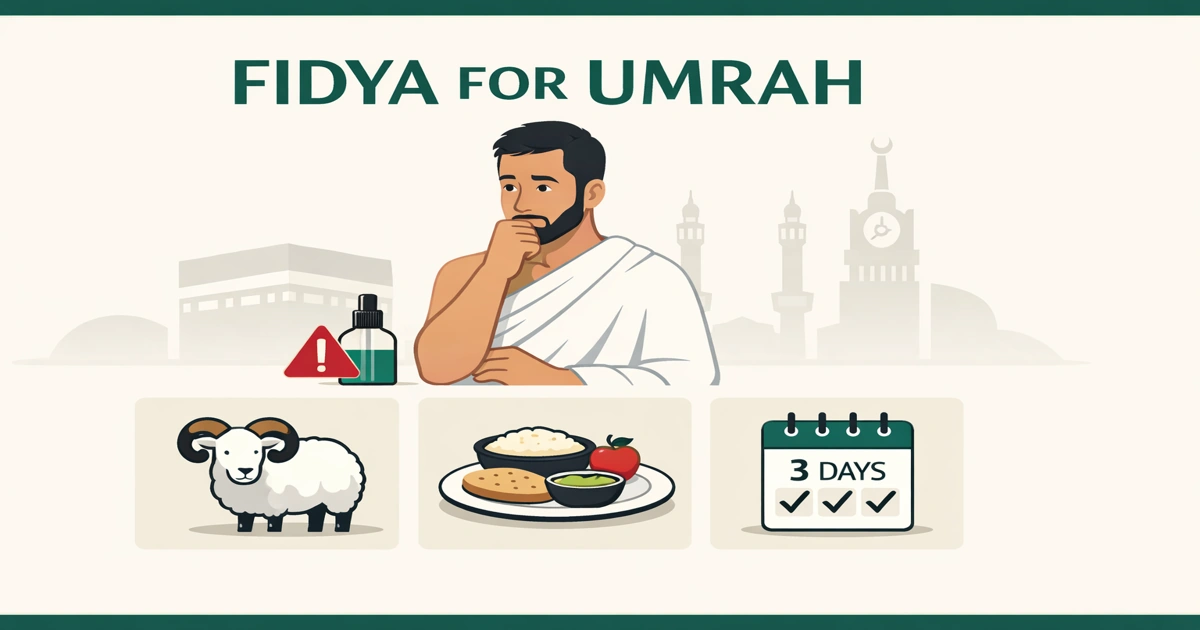
Fidya for Umrah: Rules, Mistakes, Damm, and How to Pay
Fidya for Umrah is the compensation due for certain Umrah mistakes, especially breaking Ihram restrictions, missing an obligatory action, or being prevented from finishing the rites correctly.
The short answer is this: not every mistake has the same ruling. Some violations give you a choice between sacrificing a sheep, feeding 6 poor people, or fasting 3 days. Some missed wajib acts usually require damm. Some mistakes bring no fidyah at all. For a separate explainer focused only on sacrifice rulings, see dam in Umrah.
That is why pilgrims get confused. They hear “just pay a penalty” and think every Umrah mistake works the same way.
It doesn’t.
✅ TL;DR – fidya for Umrah
Fidyah for Umrah is a mandatory religious compensation for some Ihram violations and missed wajib acts. Minor Ihram violations often fall under the well-known three-option fidyah: fasting 3 days, feeding 6 poor people, or sacrificing a sheep. Missing a wajib act like assuming Ihram from the Miqat is usually treated as damm. Some cases, like being prevented from completing Umrah, follow a different route and require hady before properly exiting Ihram.
What Is Fidya for Umrah?
What fidya for Umrah means in simple words
What is fidya for Umrah? In simple words, it is the way a pilgrim repairs certain damage done during Umrah. Think of it like tearing a garment on a sacred journey. You do not pretend nothing happened. You fix it in the way the Shariah allows.
So fidyah for Umrah is not random money, and it is not a shortcut. It is a religious way of putting right what was broken.
Why fidya for Umrah is a compensation, not just a penalty
Many people hear words like penalty, expiation, or ransom and imagine something cold and legal. But the point is not humiliation. The point is correction. A pilgrim slipped, missed something, or violated one of the prohibitions of Ihram, so a form of compensation is due.
That is why careful teachers explain fidyah as repair, not just punishment.
What is the fidya for Umrah in practical terms
What is the fidya for Umrah in practical terms? It usually means one of these three when the violation falls under the well-known Ihram category:
- Sacrificing a sheep or goat
- Feeding 6 poor people
- Fasting 3 days
But here is the part many people miss: this choice does not apply to every Umrah mistake. Some cases require damm. Some follow hunting-game rules. Some serious violations have heavier consequences. Some mistakes bring no fidyah at all.
📚 You Can Also Read: Common Mistakes About Damm
When Is Fidyah Required for Umrah?
When breaking Ihram restrictions requires fidyah
When is fidyah required? One major category is when a pilgrim deliberately does one of the ordinary prohibited actions in the state of Ihram, such as cutting hair, cutting nails, applying perfume, or wearing the forbidden type of clothing.
This is the category most people mean when they ask about fidya for Umrah mistake.
When missing an obligatory action in Umrah requires damm
The second major category is missing an obligatory action of Umrah, such as assuming Ihram from the Miqat or failing to complete the required hair removal that ends the rite. In this kind of case, scholars commonly speak of damm for Umrah, meaning a sacrificial offering rather than the flexible three-option fidyah.
So if someone asks, “I failed to perform a wajib act of Umrah. Is the ruling the same as perfume?” the answer is usually no.
When being prevented from completing Umrah requires hady
The third major category is being prevented from completing your Umrah. This is different from simply getting tired, frustrated, or changing your mind. If a real barrier stops you from completing the rites, then the ruling moves into hady territory.
That case has its own path, and it is not fixed by just taking off Ihram clothes and walking away.
📖 Qur’an Box
فَمَن كَانَ مِنكُم مَّرِيضًا أَوْ بِهِ أَذًى مِّن رَّأْسِهِۦ فَفِدْيَةٌ مِّن صِيَامٍ أَوْ صَدَقَةٍ أَوْ نُسُكٍ
Transliteration: Fa man kaana minkum mareedan aw bihi adhan min ra’sihi fa fidhyatun min siyaamin aw sadaqatin aw nusuk.
Translation: “But if any of you is ill or has an ailment of the scalp, then a ransom: fasting, charity, or sacrifice.”
This verse is the foundation behind the famous three-option fidyah for certain Ihram violations.
What Actions During Umrah Can Make Fidya Necessary?
Cutting hair or trimming nails in Ihram
Cutting hair, shaving hair, or trimming nails in Ihram are classic examples. This includes the pilgrim who removes hair before reaching the proper exit point of Umrah. Many people ask after a salon visit, accidental haircut, or nervous nail clipping.
My students always ask about this one first. It is common because tired pilgrims do small habits without thinking.
Applying perfume or using scented soap in Ihram
Applying perfume and using scented soap after entering Ihram are also well-known violations. A pilgrim may spray perfume, use scented wipes, or borrow someone’s soap without even noticing what is in it.
If the label says fragrance and you used it knowingly after Ihram, do not brush that off as nothing.
Wearing stitched clothes, covering the head, niqab, or gloves
For men, wearing stitched clothes or covering the head in the prohibited way can trigger fidyah. For women, wearing a fixed niqab or gloves in Ihram is also discussed in this category. The point is not fabric by itself. The point is the rule tied to the pilgrim’s state.
Touching a spouse with desire while in Ihram
Touching or kissing a spouse with desire while in Ihram is not a small matter. It is one of the cases scholars discuss under Ihram violations. It does not always carry the same ruling as full intercourse, but it is not something to treat lightly.
One small step can open the door to a bigger one. Pilgrims should be wise here.
Hunting or violating the sanctity of the Haram
Hunting game and actions that transgress the sanctity of the Haram fall into another serious area. These do not always follow the simple sheep-or-feed-or-fast formula. Hunting has its own compensation logic in fiqh, and the ruling can depend on what was harmed.
📚 You Can Also Read: Damm for Violating Ihram
What Are the Obligatory Acts of Umrah That Matter for Fidya?
Assuming Ihram from the Miqat
Assuming Ihram from the Miqat is one of the big practical issues in Umrah. If someone crosses the miqat without entering Ihram properly and does not return to fix it, this is commonly treated as a wajib-related violation requiring damm.
This is one of the most common modern mistakes because people are distracted by flights, buses, and travel groups.
Shaving or trimming the hair to complete Umrah
Ending Umrah properly requires shaving the head or trimming the hair. This is not a decorative final touch. It is part of what takes you out of the ritual state correctly.
Some pilgrims do everything else, get tired, then delay this part casually. That is a mistake.
What happens if a wajib act of Umrah is missed
If a pilgrim missed Wajib in Umrah, the usual language used by scholars is compensation for missed obligatory actions, and that often points to damm, not the simple three-way choice used for certain ordinary Ihram violations.
That is why difference between damm and fidyah matters so much in real life.
📚 You Can Also Read: Miqat Violation Dam
Difference Between Damm and Fidyah in Umrah
What damm means in Umrah
Damm literally refers to blood, but in Umrah rulings it means a sacrificial offering. In plain words, it usually points to an animal sacrifice due for a missed wajib act or certain heavier violations.
What fidyah means in Umrah and Hajj
Fidyah is the wider word. It can include sacrifice, but it can also include sadaqah or fasting three days depending on the kind of violation. So what is fidyah in Umrah and Hajj? It is the broader umbrella of compensation.
When damm is one form of fidyah
This is the part that confuses beginners. Sometimes people say “fidyah” and mean the whole topic. Sometimes they say “damm” and mean the specific sacrifice inside that larger topic. So yes, damm can be one form of fidyah.
Difference between damm and fidyah explained simply
Here is the easiest way to hold it in your head: fidyah is the big box; damm is one item inside the box.
Simple image. Easy memory.
What Are the Three Main Fidya Options for Umrah Violations?
Sacrificing a sheep or goat
The first option in the famous three-option fidyah is sacrificing a sheep or goat. This is the most visible form, so many pilgrims assume it is the only one. It is not.
Feeding 6 poor people
The second option is feeding 6 poor people. This is why some pilgrims ask whether they can convert the issue into meals rather than sacrifice. For this category of violation, the answer may be yes, because this option comes directly from the well-known fidyah framework.
Fasting 3 days
The third option is fasting 3 days. These may be done consecutively or separately according to many scholars. This option helps the pilgrim who cannot arrange the other two easily.
📘 Hadith Box
احْلِقْ رَأْسَكَ وَصُمْ ثَلَاثَةَ أَيَّامٍ، أَوْ أَطْعِمْ سِتَّةَ مَسَاكِينَ، أَوِ انْسُكْ بِشَاةٍ
Transliteration: Ihliq ra’sak wa sum thalathata ayyam, aw at‘im sittata masakin, aw unsuk bi shaat.
Translation: “Shave your head and fast three days, or feed six poor persons, or sacrifice one sheep.”
This hadith about Ka‘b ibn ‘Ujrah is the clearest proof for the famous three fidyah options in the ordinary Ihram-violation category.
When Do You Have a Choice Between the Three Fidya Options?
Hair, nails, perfume, clothing, and head-covering violations
The standard three-way choice usually applies to ordinary prohibited actions like removing hair, clipping nails, using perfume, a man wearing forbidden clothing, a man covering his head, or a woman wearing niqab or gloves in the prohibited way.
Cases where fasting, feeding, or sacrifice may all apply
In these cases, many scholars explain that the pilgrim may choose between the three: sacrifice, feeding, or fasting. This is why not every Umrah penalty must be paid in exactly the same form.
Cases where the ruling is not the same for every mistake
But this choice does not automatically extend to every violation. Missing the miqat is not the same as using scented soap. Hunting is not the same as clipping a nail. Full sexual relations are not the same as ordinary touching with desire.
The rulings split. That is the whole point of careful fiqh here.
When Is a Full Damm Required in Umrah?
Missing Miqat and other wajib-related violations
Missing Miqat is one of the clearest examples where scholars commonly speak of full damm if the pilgrim did not return and correct the mistake. Other wajib-related issues can also fall into this lane.
Leaving Umrah incomplete and not exiting Ihram correctly
Some people become exhausted, leave the rites halfway, remove their clothes, shower, and assume that means they have exit the Ihram. It does not. Leaving Umrah incomplete without following the proper ruling can keep the person in a serious state of error.
Serious violations that require sacrifice in Makkah
There are also serious cases where the ruling is a sacrifice in Makkah rather than a casual payment elsewhere. In practice, this is where pilgrims start asking about trusted teams, slaughter details, and where the meat goes.
📚 You Can Also Read: Damm for Omitting Mandatory Rites
What If You Break Ihram Restrictions by Mistake?
If you forgot, were ignorant, or were forced
If the pilgrim forgot, did not know the ruling, or was forced, many scholars state that there is no fidyah in that case for the ordinary Ihram-violation category. But the person must stop the violation as soon as they remember or learn.
If you acted deliberately with an excuse
If the pilgrim acted deliberately but had a real excuse, then the sin may fall away, but the fidyah may still remain depending on the case. This is why medical need and compulsion do not always erase the compensation itself.
If you acted deliberately without an excuse
If it was deliberate, with no excuse, then the matter is more serious. Sin is involved, and the compensation is still due where that category requires it. The pilgrim should repent and correct the mistake properly.
Does Every Umrah Mistake Require the Same Fidya?
Why not every violation has the same ruling
Does every Umrah mistake require the same fidya? No. The fiqh is not one flat rule. Ordinary Ihram violations, omitted wajib acts, hunting, and intimate violations do not all sit in one bucket.
When there is no fidyah
Some cases do not carry fidyah at all, such as when the person forgot, was ignorant, or was forced in the ordinary violation category. Some jurists also mention cases like a marriage contract separately from the usual fidyah structure.
When a camel, sheep, feeding, or fasting may apply
This is where the topic gets technical. A sheep, feeding, or fasting may apply in the ordinary category. Hunting has equivalent-value logic. Some very grave intimate violations are discussed separately with much heavier consequences in the books of fiqh.
So never assume every mistake equals one sheep. That shortcut creates more mistakes.
What Happens If You Cannot Complete Your Umrah?
Being prevented from completing Umrah
Being prevented from completing your Umrah is called a real obstruction, not simple inconvenience. Serious illness, an authority barrier, or a true blockage can move the pilgrim into this ruling.
How to exit Ihram correctly in that situation
In that case, the pilgrim offers hady and then shaves or trims to exit properly. The order matters. You do not just declare yourself “done.”
Why removing Ihram clothes alone is not enough
This is one of the quirkiest beginner mistakes. People think Ihram is like a uniform, so once the uniform comes off, the state is over.
It is not.
Ihram is a legal and spiritual state, not just two sheets of cloth.
How to Pay Fidya for Umrah Correctly
How to pay fidya for Umrah step by step
How to pay fidya for Umrah step by step is simple once you know your category:
- Identify the exact mistake
- Check whether it is ordinary fidyah, full damm, or hady
- Confirm whether you have a choice or a fixed duty
- Arrange the payment or sacrifice correctly
- Make sure distribution reaches the right recipients
- Repent and do not repeat the mistake knowingly
How to arrange fidyah through a trusted team in Makkah
How to arrange fidyah through a trusted team in Makkah usually means using a service that can confirm the slaughter happens within the Haram boundary, the animal is valid, and the meat reaches the poor and needy.
Do not treat this like ordering dinner from an app. Ask what exactly they are doing.
How to give dum for Umrah online
How to give dum for Umrah online depends on using a trustworthy provider. The key is not the website design. The key is whether they can actually carry out the right sacrifice, in the right place, for the right recipients.
Can someone else pay fidya on your behalf
Yes, someone else can usually arrange it on your behalf with your permission. This is especially useful when you have already traveled home or cannot manage the details yourself.
📚 You Can Also Read: Different Categories of Damm
Where Must Fidya for Umrah Be Given?
Why damm must be offered within the Haram boundaries
When the compensation is in the form of damm or sacrificial fidyah, the strong practical rule is that it must be carried out within the Haram boundary of Makkah. This is one of the most important compliance points.
Who should receive the meat of the sacrifice
The meat is for the poor and needy. The person offering this sacrifice should not treat it like personal meat distribution or a family barbecue. This sacrifice is tied to expiation, not celebration.
When sadaqah can be given elsewhere
For the charity side of fidyah, some scholars allow broader flexibility. This is why you will hear that sadaqah can be given anywhere in the world in some situations, while fidyah in the form of damm must be given in Makkah.
Rules and Regulations of Fidyah for Umrah
Why fidyah should not be used intentionally to replace a rite
Fidyah rules and regulations are not there so a pilgrim can say, “I will skip the rite and just pay later.” That mindset is wrong. Fidyah is a repair, not a paid replacement plan.
When fidyah should be paid
It does not have to be done in a panicked five-minute window, but it should not be ignored either. A person should fulfill it as soon as reasonably possible and not keep postponing it carelessly.
Why the sacrifice animal must meet valid conditions
The sacrifice animal must be valid in age and free from serious defects. A cheap invalid animal does not become valid because the website looked professional. That is a mistake people do not think about enough.
Why the person offering fidya cannot eat from that meat
Because this meat is tied to expiation and is meant for the poor. The pilgrim should not treat it as personal benefit meat. This is one of the clearest boundary lines in the topic.
📦 Quick Compliance Box
Before paying online, check 4 things: the sacrifice is inside the Haram boundaries, the animal is valid, the meat reaches the poor and needy, and the service understands whether your case is ordinary fidyah, full damm, or hady.
What Is the Difference Between Fidya, Kaffara, and Hady?
What is the kaffara of Umrah
What is the kaffara of Umrah? In common speech, people use kaffara loosely for any religious expiation. But in careful fiqh language, this is not always the most precise word for every Umrah violation.
How fidya differs from kaffara
How fidya differs from kaffara is mainly about legal category and usage. Fidyah in Hajj and Umrah usually refers to the compensations tied to rites and Ihram violations. Kaffara is a broader expiation term used in other areas too.
How hady differs from damm and fidyah
Hady is the sacrificial offering tied to certain pilgrimage contexts, including the case of being prevented from completion. Damm is sacrifice used as compensation. Fidyah is the wider umbrella term that can include sacrifice, food, or fasting depending on the case.
📚 You Can Also Read: Hady in Hajj Explained
Common Fidya for Umrah Mistakes Pilgrims Ask About
Fidya for Umrah mistake after using perfume
This is one of the most common questions. If someone knowingly used perfume after entering Ihram, that usually falls into the ordinary Ihram-violation category with the well-known three fidyah options.
Fidya for Umrah mistake after cutting hair or nails
Hair and nail cases are similar. A pilgrim clips nails in the hotel out of habit, or scratches and removes hair without thinking. These are exactly the cases that make people search fidya for Umrah mistake late at night after panic sets in.
Fidya for Umrah mistake after missing Miqat
This one is heavier. Missing the miqat and not returning to correct it is usually treated as a wajib-related issue and commonly points to damm, not simply whichever of the three options feels easiest.
Fidya for Umrah mistake after leaving Umrah incomplete
Leaving Umrah incomplete is serious because the person may still be in Ihram until the proper exit is done. This is not fixed by “going home and forgetting it.” The pilgrim needs to learn the exact ruling and correct it properly.
Can Fidya for Umrah Be Paid Online?
How online damm services usually work
Can fidya for Umrah be paid online? Yes, in practice many people arrange it online. Usually the service takes the payment, performs the slaughter or food distribution through a local team, and then confirms completion.
What to check before paying online
Check the service’s clarity about location, recipients, animal conditions, and type of compensation. A vague “we do Islamic charity” statement is not enough when your case specifically requires damm for Umrah.
How to ensure the sacrifice is done in Makkah
Ask direct questions: Is the slaughter inside the Haram? Is the meat distributed to the poor there? Do they understand the difference between damm, fidyah, and hady? The answers should be clear, not slippery.
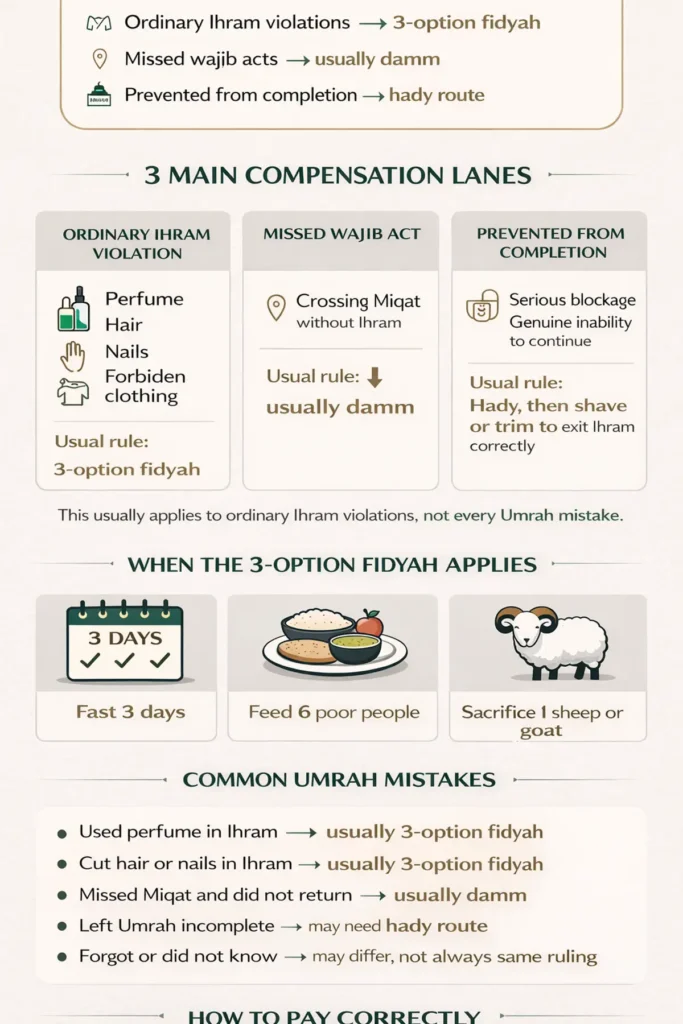
📊 fidya for Umrah: which mistake usually points to which type of compensation?
Use this as a beginner-friendly map. It is not a replacement for fiqh detail, but it helps stop the biggest confusion: not every Umrah mistake falls under the same payment rule.
🕋 Show Fidya for Umrah Comparison Table
| Type of issue | Common example | Usual compensation lane | Key note |
|---|---|---|---|
| Ordinary Ihram violation | Perfume, nails, hair, forbidden clothing | Three-option fidyah | Fast 3 days, feed 6 poor people, or sacrifice a sheep |
| Missed wajib act | Crossing Miqat without Ihram | Usually damm | Not the same as an ordinary perfume violation |
| Prevention from completion | Blocked or genuinely unable to continue | Hady route | Then shave or trim to exit Ihram correctly |
| Forgetfulness / ignorance / compulsion | Used perfume unknowingly | May carry no fidyah in ordinary category | Stop the violation as soon as known |
| Hunting / Haram violation | Hunting game in Ihram or Haram | Separate detailed rulings | Not always the same sheep/feed/fast formula |
Fidya for Umrah FAQs
📘 fidya for Umrah FAQs
What is fidya for Umrah?
Show Answer
Fidya for Umrah is the compensation due for certain Ihram violations, missed obligatory acts, or being prevented from completing the rites correctly. It is a repair, not a casual fee.
When is fidyah required for Umrah?
Show Answer
When is fidyah required? Usually when a pilgrim breaks ordinary Ihram restrictions deliberately, misses a wajib act such as Miqat-related duty, or is prevented from completion and needs the proper exit route.
How to pay fidya for Umrah?
Show Answer
First identify the exact mistake. Then confirm whether your case is ordinary fidyah, full damm, or hady. After that, arrange the sacrifice, feeding, or fasting in the right way.
How to arrange fidyah for Umrah?
Show Answer
Use a trusted team that understands Hajj and Umrah rulings, can perform the sacrifice in Makkah when needed, and can confirm the meat or food goes to the poor and needy properly.
Difference between damm and fidyah in Umrah?
Show Answer
Damm usually refers to the sacrificial offering itself. Fidyah is the wider umbrella term for compensation, which may include sacrifice, feeding, or fasting depending on the mistake.
What is fidyah in Umrah and Hajj?
Show Answer
It is compensation offered for certain violations, errors, or missed duties connected to the rites. The exact form changes depending on what happened.
What is the kaffara of Umrah?
Show Answer
People often use kaffara loosely, but the more precise Umrah language is usually fidyah, damm, or hady depending on the exact case.
How to give dum for Umrah online?
Show Answer
Choose a provider that can confirm the sacrifice is done within the Haram boundaries, with a valid animal, and distributed to the poor there. Do not rely on vague wording.
Can someone else pay fidya on my behalf?
Show Answer
Yes, this is usually allowed with your permission, especially when you have returned home or cannot manage the process yourself.
Where must damm for Umrah be done?
Show Answer
When the compensation is sacrificial damm, it should generally be carried out within the Haram boundaries of Makkah, and its meat should go to the poor and needy.
Fidya for Umrah: Which Mistake Needs Fasting, Feeding, or Damm
📘 More fidya for Umrah FAQs
Does every case of breaking Ihram restrictions require fidyah for Umrah?
Show Answer
No. Not every case of breaking Ihram restrictions has the same ruling. If a pilgrim forgot, did not know, or was forced, there may be no fidya for Umrah in that ordinary violation category. But if the action was done knowingly and without excuse, then fidyah for Umrah may become due depending on the exact mistake.
Is how to pay fidya for Umrah the same as paying for a missed wajib act?
Show Answer
Not always. How to pay fidya for Umrah depends on the category of mistake. Ordinary Ihram violations may allow the three known options. But if the pilgrim has failed to perform a wajib act of Umrah, the ruling often points to damm for Umrah instead of a free choice between all options.
Can performing tawaf without wudhu lead to damm or fidyah?
Show Answer
Performing tawaf without wudhu is treated seriously in fiqh, but the exact ruling can depend on the school and on which tawaf is involved. It should not be brushed off as a small slip. In practical terms, a pilgrim should not guess here and should check the exact case before assuming whether damm, repetition, or another correction is required.
What if I used using scented soap once and then stopped immediately?
Show Answer
If the pilgrim knowingly used using scented soap after entering Ihram, that usually falls under ordinary Ihram violations. But if it happened from forgetfulness or ignorance, the ruling may differ. The key point is to stop as soon as you realize it and then judge the case by its real details, not by panic.
Does wearing niqab or gloves in Ihram always mean the same fidyah?
Show Answer
The basic discussion places wearing niqab or gloves for women within the ordinary Ihram-violation category. That means it is often discussed under the same three-option fidyah structure. But details still matter, such as duration, intent, and whether the person had a real excuse.
Can a man who wore wearing stitched clothes briefly in Ihram ignore it because it was only a short time?
Show Answer
No, he should not ignore it automatically. Wearing stitched clothes for men in Ihram is one of the known prohibited actions. A short duration does not make the issue disappear by magic. The real ruling depends on whether it was deliberate, forgetful, excused, or truly accidental.
What if a pilgrim was only covering head face because of weather or crowd conditions?
Show Answer
If covering head face happened because of a real excuse, the sin may not apply, but compensation may still remain depending on the case. This is one of those areas where “I had a reason” does not always mean “nothing is due.” Excuse and compensation are not always the same question.
Does touches a woman with desire carry the same ruling as full sexual relations in Ihram?
Show Answer
No. If someone touches a woman with desire, that is discussed under a serious prohibited action in Ihram, but it is not always the same as full sexual relations. The latter is far more severe in the books of fiqh. So a pilgrim should never collapse all intimacy-related rulings into one line.
Is tawaf al-wada part of Umrah like it is in Hajj?
Show Answer
No, tawaf al-wada is mainly discussed as a Hajj rite, not as a standard wajib of ordinary Umrah. This is one reason pilgrims must separate Umrah rulings from Hajj rulings instead of merging them carelessly.
Does transgressed sanctity of the Haram always mean a sheep must be sacrificed?
Show Answer
Not always. If someone has transgressed sanctity of the Haram, especially by harming game or violating protected limits, the compensation may follow a more specific ruling. It is not always the same as the simple sheep-or-feed-or-fast category used for ordinary Ihram violations.
What if I was being prevented from completing your Umrah because I became very sick?
Show Answer
If you were truly being prevented from completing your Umrah by serious illness or another real barrier, then the case moves into the ruling of obstruction. That means the question is no longer “Which easy fidyah for Umrah option do I pick?” Instead, the issue becomes how to complete the proper hady and exit Ihram correctly.
Can I just remove my clothes and say I have exit the Ihram after stopping Umrah halfway?
Show Answer
No. You do not simply exit the Ihram by changing clothes. That is one of the biggest beginner misunderstandings. If you are leaving Umrah incomplete, the legal state of Ihram is not canceled by fabric. It ends through the proper rite and ruling, not by convenience.
Is how to arrange fidyah only about paying money online?
Show Answer
No. How to arrange fidyah is first a fiqh question, then a payment question. You need to identify the exact category, confirm whether the case requires sadaqah, fasting 3 days, sacrificing a sheep, or damm, and only then arrange the method. The money part comes after the ruling part.
Can how to give dum for Umrah be fulfilled by sending cash to any random person in Makkah?
Show Answer
That is not a safe way to think about how to give dum for Umrah. The issue is not just transferring money to someone in Makkah. The sacrifice must actually be carried out correctly, inside the proper area when required, with the right animal, and distributed to the correct recipients.
Can feeding the poor in Makkah replace every kind of damm for Umrah?
Show Answer
No. Feeding the poor in Makkah is part of some fidyah situations, but it does not automatically replace every type of damm for Umrah. Some cases are fixed around sacrifice. Others allow the famous choice. That difference must be respected.
Does offering charity to the poor and needy in cash count the same as food?
Show Answer
This depends on the exact ruling and how the service is carrying it out. In many practical discussions, the benchmark is actual feeding or arranging food value properly for the poor. So offering charity to the poor and needy should not be handled casually without understanding what your school or trusted scholar requires in that exact case.
Is fasting three days always the easiest option for fidyah for Umrah?
Show Answer
Not always. Fasting three days is one of the three famous options in the ordinary violation category, but it is not a universal escape door for every mistake. A pilgrim must first know whether the case really belongs to that category before choosing it.
Can offering a camel or cow apply in some serious pilgrimage violations?
Show Answer
Yes, in the broader fiqh of pilgrimage, very serious violations can lead to discussions of offering a camel or cow or their equivalent share. That is why pilgrims should not flatten every topic into one line called “fidya for Umrah.” Some rulings are much heavier than ordinary grooming or clothing mistakes.
What is the safest way to think about difference between damm and fidyah without getting lost?
Show Answer
The safest beginner rule is this: fidyah is the wider word for compensation, while damm usually points to the sacrificial part. So when learning the difference between damm and fidyah, picture a big circle and a smaller circle inside it. That simple picture saves a lot of confusion.

Farrukh Farooqi has been living in Sharaya, Makkah, Saudi Arabia since 2010. With over 14 years of firsthand experience witnessing the sacred journey of millions of pilgrims, Farrukh specializes in providing practical, insider tips for Hajj and Umrah travelers. His work blends real-world observations, the latest Saudi updates, and essential crowd management strategies — helping pilgrims and worshippers plan smarter, stay safer, and experience a spiritually fulfilling journey across the Holy Cities.


