
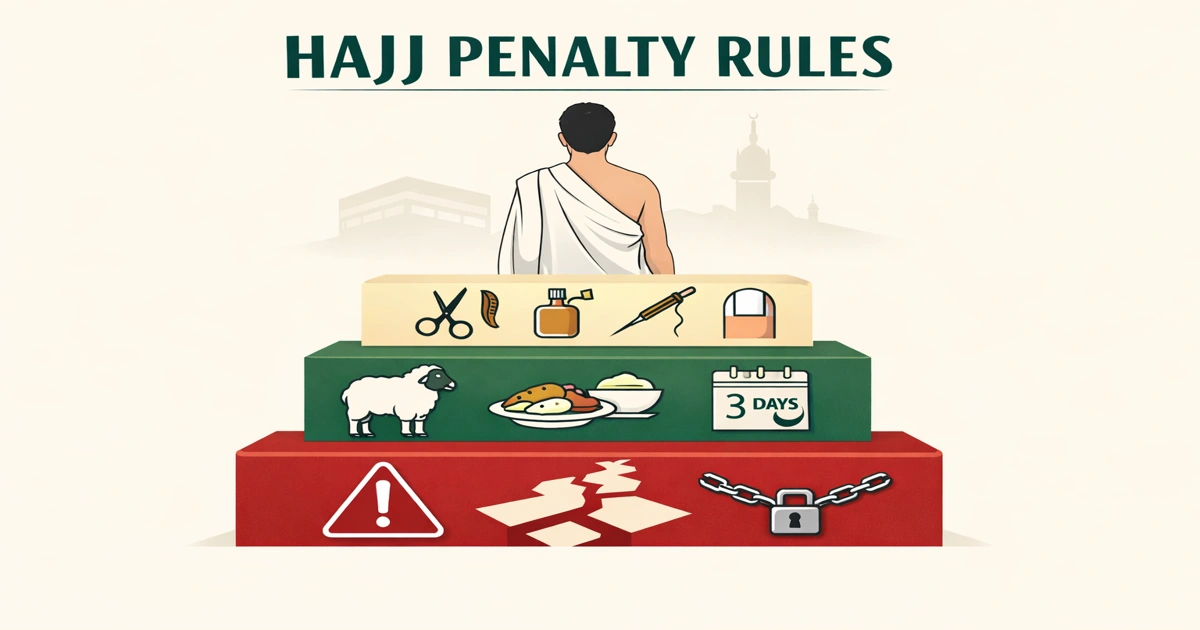
Kaffarah for Hajj: Mistakes, Penalties, Damm, and Rules
Kaffarah for Hajj is the correction due for certain Hajj mistakes, especially kaffarah for violating ihram restrictions, missing some wajib acts, or making a serious mistake during the rites.
The direct answer is this: what is the kaffarah penalty for mistakes in hajj? It depends on the violation. Sometimes it is damm, meaning a sacrifice of a sheep or goat. Sometimes it is feeding six poor people. In some cases, fasting three days applies. In other cases, fasting 10 days belongs to a different Hajj sacrifice issue, not the usual everyday Ihram mistake.
This is where many pilgrims get confused. They hear one penalty and assume it covers every case.
It doesn’t.
For a broader background on the general meaning of expiation in Islam, see Kaffarah in Islam.
✅ TL;DR – kaffarah for hajj
Kaffarah for Hajj is a mandatory penalty for some Hajj mistakes. Common cases include violating ihram restrictions and missing a wajib act of hajj. The correction may be damm, feeding the poor, or fasting, depending on the violation and your madhhab. Serious violations can go beyond ordinary kaffarah and may even invalidate hajj.
📖 Qur’an box
وَأَتِمُّوا الْحَجَّ وَالْعُمْرَةَ لِلَّهِ … فَفِدْيَةٌ مِّن صِيَامٍ أَوْ صَدَقَةٍ أَوْ نُسُكٍ
Transliteration: Wa atimmul-hajja wal-‘umrata lillah … fafidyatun min siyamin aw sadaqatin aw nusuk.
Translation: “Complete the Hajj and ‘Umrah for Allah … then a ransom: fasting, charity, or sacrifice.”
This verse is the base behind many expiation discussions in Hajj. It is why not every mistake has the same correction.
What Is Kaffarah for Hajj?
What kaffarah for Hajj means in simple words
What is kaffarah in Hajj? It is the correction owed when a pilgrim breaks a sacred Hajj rule that carries a legal consequence. In plain words, it is how Islamic law tells you to clean up a mistake instead of pretending nothing happened.
Think of it like damage repair after a sacred breach. Not a fee. Not a shortcut. A repair.
Why kaffarah for Hajj is a correction, not just a punishment
The goal of kaffarah is not just to punish. It is to clean the mistake, restore respect for the worship, and push the pilgrim toward repentance and honesty. Hajj is not casual travel. It is worship under special rules, in a special time, in a special state.
My students always ask about this part. “If Allah is Merciful, why is there a penalty?” Because mercy in Islam is not chaos. Mercy also teaches responsibility.
When kaffarah for Hajj becomes necessary
When kaffarah for Hajj becomes necessary is the real fiqh question. In broad terms, it comes up when someone breaks a prohibited Ihram rule, misses a wajib act, or commits a more serious violation during the Hajj rites. The exact ruling depends on what happened, how serious it was, and which school of law you follow.
📚 You Can Also Read: What Are Fard, Wajib, and Sunnah of Hajj?
What Is the Kaffarah Penalty for Mistakes in Hajj?
When the penalty is damm or sacrificing a sheep
In many common cases, the kaffarah penalty for hajj is damm, meaning sacrificing a sheep or goat. This often comes up with some Ihram violations and some missed wajib acts. The animal must usually be slaughtered in the Haram area and distributed to the poor.
When feeding six poor people may apply
For some violations, especially from the class of prohibited acts in Ihram, the ruling may allow feeding six poor people as one of the options. This is one reason people mix up rulings. They hear “feed six poor people” and start applying it to every Hajj mistake. That is not safe fiqh.
When fasting is required instead of sacrifice
Sometimes fasting is part of the expiation. For some Ihram-related violations, scholars mention a choice that may include fasting. In a different Hajj context, Qur’an 2:196 mentions the well-known fasting 10 days pattern for the person who cannot afford the required offering connected to Tamattu or Qiran. That is not automatically the answer for every Hajj mistake.
When serious violations require a bigger penalty
Some cases go beyond ordinary compensation for mistakes in hajj. The classic example is sexual intercourse before the first tahallul. That is treated far more seriously than cutting a nail or using scent. In some fiqh discussions, it can invalidate the Hajj and require completing the rites, offering a major sacrifice, and repeating the Hajj later.
What Are the Mistakes That Require Kaffarah in Hajj?
Violating Ihram restrictions
What are the mistakes that require kaffarah? The first big group is violating ihram restrictions. That includes things like using perfume, cutting hair or nails, some forms of wearing stitched clothes for men, covering the head for men, some face-covering details, and hunting.
Missing a wajib act of Hajj
The second big group is missing obligatory acts, meaning a wajib act rather than a pillar. This can include issues like not spending the night in Muzdalifah, not throwing the pebbles, not staying in Mina during Tashreeq days, or not doing Tawaf al-Wadaa, depending on the case and school.
Breaking the order of rituals without a valid excuse
Breaking the order of rituals can also create problems. Some sequence issues are excused in certain circumstances, and some are treated more lightly than pilgrims fear. But not every order mistake is trivial. This is one of those places where a pilgrim should stop Googling and ask a qualified scholar with the exact details.
Serious violations that may invalidate Hajj
Then there are the serious cases. Not every sin during Hajj invalidates it, but some violations are treated as major breaches. The biggest example is marital relations before first tahallul. That is why this topic cannot be reduced to one cheerful line like “just pay a sheep and move on.”
📚 You Can Also Read: Hajj Mistakes to Avoid
What Is the Penalty for Violating Ihram?
Kaffarah for cutting hair or nails in Ihram
What is the kaffarah for cutting hair or nails in ihram? This is one of the most asked questions. In many fiqh discussions, significant deliberate removal can trigger expiation, but details differ by madhhab and by amount. Some jurists distinguish between one nail, several nails, and full removal in one sitting. That is why broad one-size-fits-all charts can mislead people.
I used to see beginners treat this as tiny and harmless. Then they find out later that fiqh can be very specific here.
Kaffarah for using perfume in Ihram
What is the kaffarah for using perfume in ihram? Deliberately applying perfume after entering Ihram is commonly treated as an Ihram violation that can require expiation. The exact form of kaffarah again depends on the madhhab and details like amount, body area, and duration.
Kaffarah for wearing stitched clothes in Ihram
What is the kaffarah for wearing stitched clothes in ihram? For men, wearing tailored or body-fitted garments in Ihram is a classic violation discussed in fiqh books. In many cases, if it was deliberate and without excuse, it may require expiation. Women are not judged by the same clothing rule here, which is where a lot of beginner confusion starts.
Kaffarah for covering the head or face in Ihram
Covering the head for men during Ihram is a known issue. Face-covering details can also vary depending on who is being discussed and how it happened. Some rulings turn on whether the act was deliberate, prolonged, or due to genuine need. That is why this is not a good place for copied WhatsApp fatwas.
Kaffarah for hunting animals during Hajj
Hunting is one of the clearest prohibited acts in Ihram. The Qur’anic pattern here is serious and different enough that jurists discuss equivalent sacrifice, feeding, or fasting based on the game involved. So if someone asks, “Can I just do the same sheep for every hunting case?” the safe answer is no, not automatically.
Kaffarah for sexual relations before the first tahallul
What is the kaffarah for serious violations in hajj? This is one of the biggest. Having sexual relations before first tahallul is not treated like ordinary fragrance or clothing violations. In many scholarly discussions, it corrupts the Hajj, requires completing it, offering a major sacrifice, and then doing repetition of the hajj later.
What Is the Kaffarah for Missing a Wajib Act of Hajj?
Kaffarah for not spending the night in Muzdalifah
Kaffarah for not spending the night in muzdalifah is usually discussed under omission of wajib acts. In many rulings, missing it without a valid excuse can require damm. But again, some details differ on what counts as missing it and what counts as a valid excuse.
Kaffarah for not throwing the pebbles
Kaffarah for not throwing the pebbles is another classic case. Missing Ramy entirely, leaving days out, or handling it in a seriously deficient way can trigger expiatory rulings. The exact result may differ by extent and madhhab, especially when only part of the rite was missed.
Kaffarah for not staying in Mina during Tashreeq days
Kaffarah for not staying in mina during tashreeq days is often discussed as a wajib omission. This is one of those rulings people take lightly because the tents feel logistical, not spiritual. But Hajj law does not measure importance by how dramatic the moment feels.
Kaffarah for not doing Tawaf al-Wadaa
Kaffarah for not doing tawaf al-wadaa is treated by many scholars as requiring a sacrifice if a pilgrim leaves without it and is not excused. Menstruating women are a well-known exception. This is one reason pilgrims should not treat the final tawaf like a disposable extra at the end of a tiring trip.
📚 You Can Also Read: Tawaf al-Wida Dam
What Is Damm in Hajj and When Is It Required?
Sacrifice of a sheep or goat explained
Damm in Hajj usually refers to an expiatory sacrifice. In many ordinary Hajj violation cases, this means the sacrifice of a sheep or goat. Some bigger violations may involve a larger offering in certain rulings, which is why not all sacrificial penalties sit in the same box.
Where the sacrifice must be done
For Hajj-related expiation, the sacrifice is generally tied to the sacred area. In plain language, the animal should be slaughtered within the haram boundaries. This is not a random detail. The location is part of the ruling.
Why the meat must be distributed to the poor
The kaffarah sacrifice is not regular Eid sharing. It is an expiation tied to a violation. That is why many jurists state the meat must be distributed to the poor in the Haram area rather than treated like a celebratory family meal.
Why the person cannot eat from a kaffarah sacrifice
Many scholars explain that the meat from a kaffarah sacrifice cannot be eaten by the person who committed the violation. It is not your reward meal. It is your repair payment. That distinction matters.
🐑 Damm quick view
What it usually is: Expiatory sacrifice for certain Hajj mistakes
Common animal: Sheep or goat in many ordinary cases
Where: Slaughtered within the haram boundaries
Who receives it: Poor and needy in the Haram area
Personal use: Usually treated as no personal consumption in expiation cases
Can Kaffarah for Hajj Be Fasting or Feeding the Poor?
When fasting three days is mentioned
When fasting three days is mentioned, it often appears in the class of expiation choices tied to some Ihram violations. In beginner language, this is the “fasting, charity, or sacrifice” style ruling many people have heard about. But it should not be pasted onto every violation without checking.
When fasting 10 days applies
When fasting 10 days applies, this is the well-known Qur’anic case for the pilgrim who cannot afford the required offering in Tamattu or Qiran: three during Hajj and seven after returning home. People often mix this up with ordinary kaffarah for mistakes in hajj, but it is not the same category in every case.
When feeding six poor people applies
When feeding six poor people applies, it is usually in the fiqh of certain prohibited acts done in Ihram. That is why the phrase appears again and again in Hajj rulings. It is real. But it belongs in the right box.
How scholars differ on some penalties
This topic has real madhhab differences. Some rulings are broad and shared. Others are detailed and school-specific. So when people ask, “Can I just pay money equal to the value?” or “Does one hair count the same as full shaving?” the honest answer is often: check your madhhab and your exact facts.
What Are the Conditions for Kaffarah?
Intentional vs unintentional mistakes
What are the conditions for kaffarah? One of the first questions is intentional vs unintentional. Deliberate violations are more serious. Small accidental slips are often treated differently. But “I forgot” is not a magic eraser for every case.
When certainty about the mistake matters
You should not rush into expiation because of vague panic. The person should know what actually happened. Certainty matters. Real fiqh is not based on sweaty hotel-room guessing after Hajj. It is based on facts.
Why kaffarah should be done as soon as possible
The general rule is simple: the violation must be addressed as soon as possible. Delaying without reason is not the spirit of repentance. If a mistake happened, the pilgrim should quickly find the right ruling and do the proper correction.
Why sacrifice or feeding should be within the Haram boundaries
Because these are Hajj-linked expiations, many jurists tie sacrifice and feeding to the sacred area. That is why you often read that it should be done within the haram boundaries. The place is part of the legal shape of the act.
📚 You Can Also Read: Miqat Violation Dam
Do Small Unintentional Mistakes Always Require Kaffarah?
When repentance is enough
No. Small unintentional mistakes do not always require formal kaffarah. Sometimes repentance, regret, and care going forward are enough. This is one of the mercy points in Hajj law.
When only a small charity may apply
Some schools discuss smaller charity in certain minor cases, especially where the violation was limited. This is why it is not wise to assume every tiny slip demands the same sheep penalty.
How minor mistakes differ from serious violations
The difference is huge. A little accidental harm is not the same as a deliberate major breach. This is where wise fiqh saves people from both extremes: treating everything as nothing, or treating everything as disaster.
What Mistakes Can Invalidate Hajj Completely?
Sexual intercourse before the first tahallul
This is the biggest warning sign in the topic. Sexual intercourse before the first tahallul is commonly treated as a corruption of the Hajj, not just a routine kaffarah case. That is why books separate it from ordinary violating ihram rules.
When repetition of Hajj becomes necessary
When repetition of the hajj becomes necessary, this is usually the example scholars mention. The pilgrim may still need to continue and finish the rites outwardly, but the Hajj itself may need to be repeated in a later year.
Why this is different from ordinary kaffarah cases
This is different because the issue is not just a broken restriction. It is a breach that reaches the structure of the pilgrimage itself. That is why a beginner should never put this in the same mental drawer as trimming nails or wearing scent.
📖 Hajj discipline box
فَلَا رَفَثَ وَلَا فُسُوقَ وَلَا جِدَالَ فِي الْحَجِّ
Transliteration: Fa la rafatha wa la fusuqa wa la jidala fil-hajj.
Translation: “There is to be no sexual relations, no disobedience, and no arguing during Hajj.”
This is why some Hajj mistakes are treated as far more serious than others.
Kaffarah for Hajj vs Fidya: What Is the Difference?
Why people confuse kaffarah and fidya
People confuse these terms because both involve compensation. In everyday speech, many use them loosely. In fiqh, though, they are not always identical labels. One teacher says kaffarah, another says fidyah, and the beginner thinks both mean exactly the same thing everywhere.
When each term is used in Hajj rulings
In Hajj rulings, you will often see expiation language attached to specific prohibited acts, sacrifice, feeding, or fasting. Some writers use kaffarah broadly, while others reserve fidyah for certain Ihram violations. This is one reason your exact school matters.
Why checking your madhhab matters
If you follow a madhhab, this is where consistency matters. The safe path is not mixing random rulings from four schools and making your own Hajj penalty combo platter. Pick qualified guidance and stay with it.
📚 You Can Also Read: Fidya for Umrah
How to Avoid Kaffarah for Hajj in the First Place
Learn the rules of Hajj before going
Learn about the rules of hajj before going. That sounds obvious, but people really do travel with luggage full of snacks and almost no fiqh. Then one small mistake becomes a larger one because they do not know what to do next.
Know the main Ihram restrictions before entering Ihram
At minimum, know the main list: violating ihram rules like scent, hair removal, nail cutting, hunting, sexual activity, and the clothing/head-covering issues relevant to your case. This alone prevents a lot of mess.
Ask a qualified scholar about personal cases
Personal cases matter. Illness, forgetfulness, necessity, crowd pressure, agency arrangements, and timing all change the ruling. Ask someone qualified, not your tired roommate who heard something “probably Hanafi” on a bus.
Act quickly if a mistake happens
When someone breaks a rule or misses an important ritual, the person should quickly do the right kaffarah. Fast action prevents confusion, guilt, and years of “I think my Hajj might be invalid” anxiety.
📊 kaffarah for hajj: common mistakes and usual correction paths
Use this table as a simple map. It is not a replacement for personal fiqh, but it helps beginners see why not every Hajj mistake lands in the same penalty box.
🕋 Show Kaffarah for Hajj Table
| Mistake type | Usual fiqh direction | Beginner-safe note |
|---|---|---|
| Cutting hair or nails | Expiation may apply; detail varies by amount and madhhab | Do not assume one tiny case equals full shaving |
| Using perfume | Often treated as an Ihram violation with kaffarah/fidyah path | Check deliberate use, amount, and circumstance |
| Wearing stitched clothes | Common male Ihram violation | Do not apply the same clothing rule to women |
| Missing Muzdalifah, Mina, Ramy, or Tawaf al-Wadaa | Often discussed under wajib omission and damm | Excuses and extent of omission can matter |
| Hunting game | Special Qur’anic expiation pattern | Do not treat it as a generic sheep case automatically |
| Sexual relations before first tahallul | Major violation; may corrupt Hajj | This is not an ordinary kaffarah case |
What Is the Kaffarah Penalty for Mistakes in Hajj?
What is the kaffarah penalty for mistakes in Hajj? The answer depends on the type of mistake. Some violations require damm, meaning a sacrifice of a sheep or goat. Some cases may allow feeding six poor people or fasting. More serious violations can carry a bigger penalty and may go beyond ordinary kaffarah for hajj.
This is why pilgrims should never assume every Hajj mistake has the same ruling.
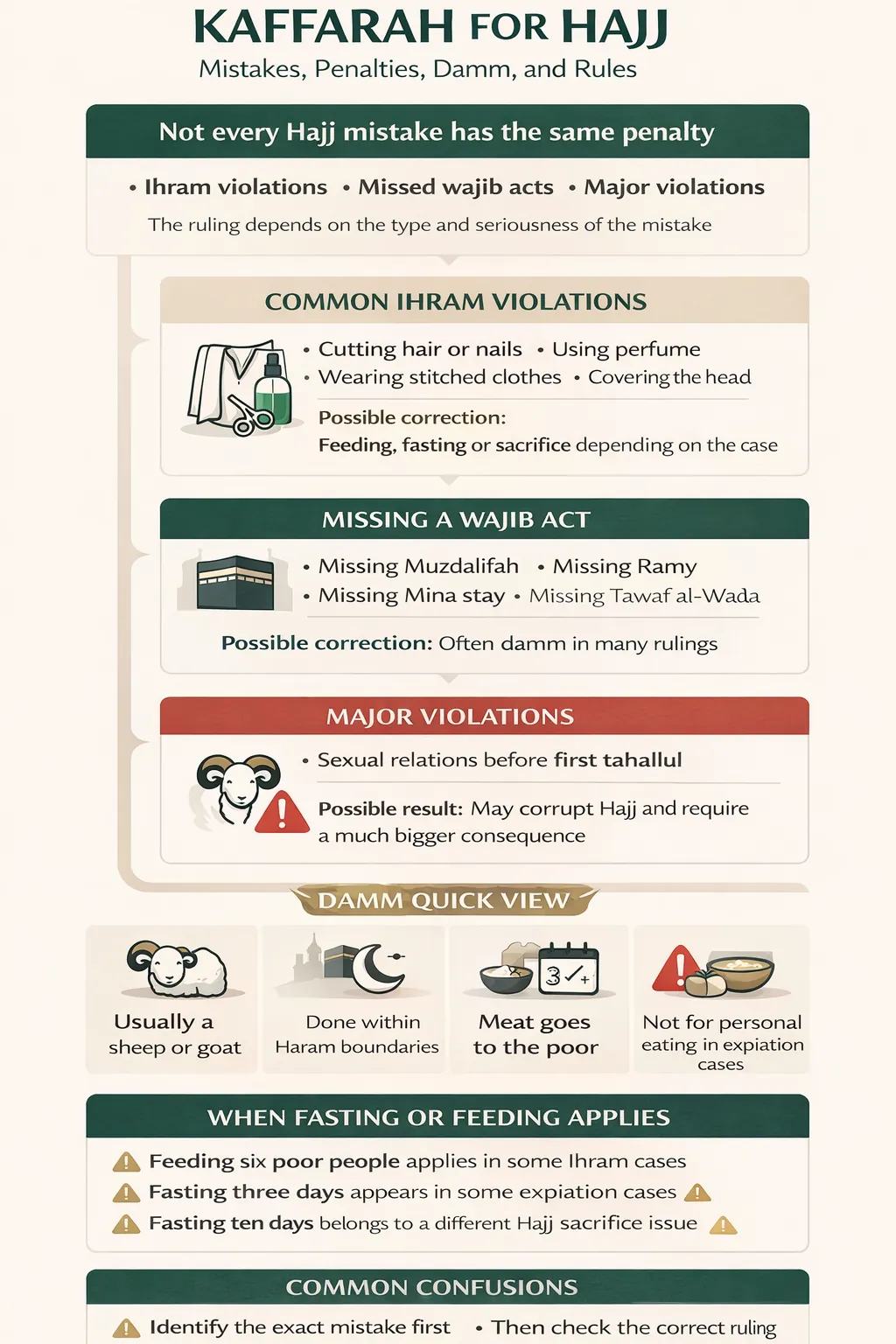
📊 Kaffarah penalty chart for common Hajj mistakes
This chart gives a simple visual summary of common kaffarah for mistakes in hajj, including damm, feeding six poor people, and fasting-related correction paths.
Kaffarah for Hajj FAQs
📘 kaffarah for hajj FAQs
What is the kaffarah penalty for mistakes in Hajj?
Show Answer
The penalty depends on the mistake. It may be damm, feeding six poor people, fasting, or in major cases something more serious. Not every Hajj mistake has the same ruling.
What are the mistakes that require kaffarah in Hajj?
Show Answer
Common examples include violating ihram restrictions, missing a wajib act of hajj, and some order-related or serious violations. The exact expiation depends on the case and madhhab.
What is the penalty for violating Ihram?
Show Answer
The penalty for violating Ihram may involve sacrifice, feeding, or fasting depending on the violation. Deliberate scent use, hair removal, nail cutting, hunting, and men’s clothing/head-covering issues are among the known discussions.
What are the conditions for kaffarah?
Show Answer
The key conditions include knowing what happened, checking whether it was deliberate or accidental, confirming the correct ruling, and doing the expiation as soon as reasonably possible.
What is the kaffarah for cutting hair or nails in Ihram?
Show Answer
It depends on how much was cut, whether it was deliberate, and your madhhab. Some schools distinguish between a small amount and a full deliberate removal.
What is the kaffarah for using perfume in Ihram?
Show Answer
Deliberate use of perfume in Ihram is commonly treated as a violation that can require expiation. The exact form depends on the fiqh details of the case.
What is the kaffarah for wearing stitched clothes in Ihram?
Show Answer
For men, deliberately wearing tailored clothing in Ihram can trigger expiation in many rulings. Women are not judged by the same clothing rule in this matter.
What is the kaffarah for serious violations in Hajj?
Show Answer
Some serious violations, especially sexual intercourse before the first tahallul, go beyond ordinary kaffarah and may lead to a corrupted Hajj, a major sacrifice, and the need to repeat Hajj later.
Can small unintentional mistakes happen without formal kaffarah?
Show Answer
Yes, some minor unintentional mistakes may only require repentance, and some schools discuss smaller charity in limited cases. They are not always treated like deliberate major violations.
Can the pilgrim eat from a kaffarah sacrifice?
Show Answer
Many jurists say no. In expiation cases, the meat is for the poor, not for the person who committed the violation.
Why does checking your madhhab matter in kaffarah for Hajj?
Show Answer
Because some details truly differ: the size of the violation, the exact expiation, whether feeding or sacrifice applies, and how small cases are judged. Mixing schools casually can make a bad situation worse.
📘 More kaffarah for hajj FAQs
Does kaffarah for hajj apply if the mistake happened by accident?
Show Answer
Not always. Some accidental or forgetful cases are lighter than deliberate ones. That is why intentional vs unintentional matters so much in conditions for kaffarah. In some small cases, repentance may be enough. In other cases, a form of compensation for mistakes in hajj may still apply depending on the madhhab and the exact act.
Is damm the same as kaffarah for hajj in every case?
Show Answer
No. Damm is one important form of kaffarah penalty for hajj, but it is not the answer for every violation. Some cases may involve feeding six poor people, some may involve fasting, and some very serious cases go beyond ordinary kaffarah for mistakes in hajj.
Can feeding the poor replace sacrificing a sheep in all Hajj mistakes?
Show Answer
No. Feeding the poor does not replace every sacrifice of a sheep or goat. Some rulings allow options, while others are more fixed. That is why a pilgrim should not assume that one charity method solves every penalty for mistakes in hajj.
Does kaffarah for violating ihram restrictions have to be done in Makkah?
Show Answer
If the ruling involves sacrifice or certain forms of charity tied to Hajj, scholars often say it should be done within the haram boundaries. This is especially important when the penalty is a Hajj-related damm that must be slaughtered within the haram boundaries and distributed to the poor.
What if someone forgot and used soap or scent while in ihram?
Show Answer
This falls under using perfume or scent-related violating ihram rules. The ruling depends on whether it was deliberate, how much was used, and your madhhab. A small accidental case is not judged the same way as deliberate repeated use. That is why this question belongs under what is the penalty for violating ihram.
Does covering the head and covering the face carry the same Hajj penalty?
Show Answer
Not automatically. Covering the head for men and covering the face can involve different fiqh details. The ruling may change based on who did it, how long it lasted, and whether there was a valid excuse. This is why scholars do not treat all violating ihram restrictions as one flat category.
Is there kaffarah for missing a wajib act of hajj because of crowding or illness?
Show Answer
Sometimes an excuse changes the ruling. Illness, severe crowd danger, weakness, or valid delegation issues can affect whether a person is sinful and whether kaffarah for missing a wajib act of hajj applies. The answer depends on the exact act, such as not throwing the pebbles or not spending the night in muzdalifah.
Can a pilgrim delay kaffarah for hajj until after returning home?
Show Answer
The safer rule is not to delay without reason. In general, the violation must be addressed as soon as possible. If the expiation is tied to sacrifice or feeding in the sacred area, the pilgrim should arrange it properly instead of treating it like a casual task for later.
Does breaking the order of rituals always require kaffarah for hajj?
Show Answer
No, not always. Some sequence changes are excused, and some are lighter than pilgrims think. But breaking the order of rituals without a valid excuse can still create a real fiqh problem. This is one of the clearest places where checking your madhhab matters.
Is kaffarah for cutting hair or nails in ihram the same for one nail and many nails?
Show Answer
Often no. Many scholars and fiqh texts distinguish between very small cases and larger deliberate removal. That is why what is the kaffarah for cutting hair or nails in ihram cannot be answered safely with one sentence for every situation.
Does not doing tawaf al-wadaa invalidate Hajj completely?
Show Answer
Usually it does not invalidate hajj completely, but it can require a penalty in many rulings because it is treated as a wajib act for those not excused. So kaffarah for not doing tawaf al-wadaa is serious, even though it is not the same as the biggest Hajj-breaking violations.
Is sexual intercourse before the first tahallul just another normal kaffarah case?
Show Answer
No. Sexual intercourse before the first tahallul is one of the gravest Hajj violations. It is not treated like ordinary kaffarah for violating ihram restrictions in hajj. In many rulings, it may lead to a corrupted Hajj, a major penalty, and repetition of the hajj.
Can minor unintentional mistakes during Hajj be ignored completely?
Show Answer
They should not be ignored, but they are not always treated as major violations. Some small unintentional mistakes may only need repentance, while others may involve a lighter correction. The key is not to guess. The key is to confirm the exact ruling.
Why do people confuse kaffarah for hajj and fidya so much?
Show Answer
Because both involve compensation, sacrifice, feeding, or fasting in some form. But in Hajj rulings, the terms are not always used in exactly the same way by every scholar. That is why kaffarah for hajj vs fidya becomes confusing for beginners.
Can someone just give money equal to the value of the mistake and finish?
Show Answer
Not in every case. Some people ask if they can simply give money equal to the value of the mistake, but Hajj expiation is not a free-form payment system. The ruling may require a specific kind of sacrifice, a specific feeding method, or another exact correction.
What is the safest way to avoid mistakes during hajj that require kaffarah?
Show Answer
The safest way is simple: learn about the rules of hajj before going, know the main ihram restrictions, stay with qualified guidance, and ask quickly if something goes wrong. Most mistakes during hajj that require kaffarah become worse because pilgrims delay the question instead of checking right away.
Related Articles
- Dam in Hajj
- Damm for Violating Ihram
- Damm for Omitting Mandatory Rites
- Badanah for Major Violations
- Rami Omission Dam
- Hady in Hajj
- Udhiyah/Qurbani Rules and Distribution

Farrukh Farooqi has been living in Sharaya, Makkah, Saudi Arabia since 2010. With over 14 years of firsthand experience witnessing the sacred journey of millions of pilgrims, Farrukh specializes in providing practical, insider tips for Hajj and Umrah travelers. His work blends real-world observations, the latest Saudi updates, and essential crowd management strategies — helping pilgrims and worshippers plan smarter, stay safer, and experience a spiritually fulfilling journey across the Holy Cities.


