
Rami Omission Dam: Rules, Penalty, and What to Do If You Miss Rami in Hajj
Rami Omission Dam means the compensatory sacrifice due when omitting the rami during hajj reaches a serious level. The direct answer is simple: if a pilgrim misses the whole Rami of a day, misses most of the pebbles, or leaves Mina without completing the rite properly, a dam for missing rami is usually required.
This is why pilgrims search for the real ruling on rami omission penalty, rami omission during hajj, rami penalty dam, missing rami penalty, rami omission and penalty, sacrifice required for missing rami, pelting omission dam, and stoning omission dam. The issue is not small. Rami is a wajib rite of Hajj, so a serious deficiency carries a real consequence.
If you need a base article on the broader idea of dam itself, read Dam in Hajj.
The easiest way to think about it is this: missing a pebble is not the same as missing a day, and tiredness is not the same as incapacity. Those details change the ruling.
✅ TL;DR – Rami Omission Dam
Rami Omission Dam is due when a pilgrim misses the entire rami of a day, misses most of the pebbles, or leaves Mina without performing Rami in a way that leaves the rite incomplete. A full dam is usually a small animal sheep or goat, or sometimes one seventh of a cow camel, and it must be sacrificed within the Haram boundaries. If only one to three pebbles are missed, a smaller penalty charity may apply instead.
What Is Rami Omission Dam?
When omitting the Rami during Hajj necessitates a dam
When omitting the Rami during Hajj necessitates a dam is the first thing most pilgrims want to know. The short answer is this: a dam becomes necessary when the deficiency is major, not minor. If a pilgrim completely misses a day’s Rami, or misses most of the stones in a way that leaves the rite seriously incomplete, the omission is treated as a real violation.
That is why scholars speak of it as more than a simple mistake.
Why missing Rami is treated as a serious violation
Why missing Rami is treated as a serious violation is tied to the place Rami holds in Hajj. Rami al Jamarat is not decoration around Hajj. It is one of the known rites of Mina. When a wajib rite is left in a serious way, a remedy is required.
Think of it like leaving a major brick out of a wall. The whole building may still stand, but it now needs repair.
What kind of sacrifice is required for missing Rami
What kind of sacrifice is required for missing Rami depends on the level of the omission. A full dam is generally a sheep or goat, and in some cases one seventh of a cow or camel counts. This is the normal ruling people mean when they ask, “What is dam?” in the context of Hajj violations and penalties.
📖 Hajj Rite Reminder
خُذُوا عَنِّي مَنَاسِكَكُمْ
Transliteration: Khudhu ‘anni manasikakum.
Translation: “Take your rites from me.”
That is the heart of this topic. Hajj rites are not random. Their order, timing, and completion matter.
📚 You Can Also Read: Rami al Jamarat
When Is Dam Required for Missing Rami in Hajj?
If a pilgrim misses the entire Rami of a day
If a pilgrim misses the entire Rami of a day, that is one of the clearest cases requiring dam. This includes the pilgrim who does not perform the pelting for that day at all and the rite ends up missed permanently. In the source material you gave, this is treated as a major omission, not a light slip.
If a pilgrim misses most of the pebbles
If a pilgrim misses most of the pebbles, the omission also moves into full-penalty territory. The working line in your source material is that once the deficiency reaches four or more missed pebbles, the omission is no longer treated as a tiny shortfall. It becomes a major نقص that brings a full damm.
That point matters because many pilgrims assume “some stones is close enough.” Not always.
If a pilgrim leaves Mina without performing Rami
If a pilgrim leaves Mina without performing Rami, and the rite can no longer be completed in its valid way, the dam becomes mandatory. This is one of the most practical cases because it happens when people depart too early, lose the timing, or wrongly assume a group shortcut fixed everything.
📚 You Can Also Read: Mina in Hajj
What Is the Penalty for Missing Only Some Pebbles?
When a smaller penalty or charity may apply
When a smaller penalty or charity may apply is when the omission stays minor. If only one, two, or three pebbles were missed, your source material points to a lighter consequence instead of a full dam. This is where people mention smaller penalty charity rather than a full sacrificial animal.
When 4 or more missed pebbles require a full dam
When 4 or more missed pebbles require a full dam is the sharp dividing line in the material you provided. Once the pilgrim misses four or more, the omission is treated as serious enough for a full compensatory sacrifice.
That is why the count matters so much during pelting.
Missing one to three pebbles: what your content says
Missing one to three pebbles: what your content says is that it does not reach the same level as omitting most of the rite. A smaller expiation may apply instead. So if you are unsure whether your mistake was minor or major, the number of missed pebbles becomes one of the first questions to settle.
What Is Dam for Rami Omission?
A sheep or goat as the compensatory sacrifice
A sheep or goat as the compensatory sacrifice is the standard form of dam in this issue. When pilgrims ask about the sacrifice required for missing rami, this is usually the first answer: one sheep or one goat.
When one seventh of a cow or camel may count
When one seventh of a cow or camel may count is another detail found in your material. That means the dam does not always have to be a whole sheep if a valid shared larger animal arrangement is used correctly.
Why the dam must be sacrificed within the Haram boundaries
Why the dam must be sacrificed within the Haram boundaries is simple: the compensatory sacrifice belongs to that sacred context. Your source material is clear that the dam must be done within the Haram boundaries. It is not something a pilgrim casually replaces with an unrelated donation back home.
🕋 Quick Dam Summary
Full dam: one sheep or goat
Also possible: one seventh of a cow or camel
Place: within the Haram boundaries
If already gone: hire a reliable person or organization in Makkah to arrange it
📚 You Can Also Read: Different Categories of Damm
Does Missing Rami on the 12th or 13th Require Dam?
Dam for missing Rami on 12th Dhul Hijjah
Dam for missing Rami on 12th Dhul Hijjah is due if that day’s Rami is left in a way that remains unperformed. The 12th is not “less important” just because the pilgrim is tired, eager to leave, or mentally already done with Mina.
Dam for missing Rami on 13th Dhul Hijjah
Dam for missing Rami on 13th Dhul Hijjah applies to the pilgrim who stayed for that day and then failed to complete its Rami properly. If the pilgrim was not staying for the 13th in the first place, that is another matter. But if the day became part of the person’s Hajj schedule, then its rite matters.
What happens if the missed Rami is permanent
What happens if the missed Rami is permanent is that the rite is no longer fixed by simple intention or regret. Once the valid chance is gone and the pilgrim has effectively left it behind, the penalty remains and the dam becomes the way to repair that deficiency.
📚 You Can Also Read: How Many Pebbles for Hajj?
Can Missed Rami Be Made Up Later?
What to do before leaving Mina
What to do before leaving Mina is the most useful practical question in this whole article. If the time is still valid and the pilgrim can complete the rite, that should be done before departure. In many cases, doing the rite late within the valid window is far safer than missing it completely.
What happens after leaving Mina without performing Rami
What happens after leaving Mina without performing Rami is that the omission may become final. Once the pilgrim has left and the rite can no longer be completed properly, the dam remains due. This is where panic starts for many people, but panic does not change the ruling.
When hiring a reliable person or organization becomes necessary for the sacrifice
When hiring a reliable person or organization becomes necessary for the sacrifice is after the pilgrim has already left and still owes a dam. In that case, the practical fix is to hire a reliable person or organization in Makkah to arrange the valid sacrifice there.
Is Proxy Rami Valid in Hajj?
When Rami on behalf of others is acceptable
When Rami on behalf of others is acceptable is when there is a recognized excuse. Your source material mentions sickness, old age, weakness, pregnancy, extreme heat, and fear of missing the rite altogether in a real and serious way. This is where rami on behalf of others can become valid.
When proxy did the Rami and no dam is required
When proxy did the Rami and no dam is required is when the proxy was authorized, the excuse was real, the stones were thrown at the correct Jamarat, and the rite was completed within valid time. In that case the act counts, and no separate dam is due.
When proxy Rami is not valid and a dam becomes necessary
When proxy Rami is not valid and a dam becomes necessary is when there was no valid excuse, or the person acting did not have proper authorization, or the rite was not actually completed as required. This is the danger zone for the pilgrim who says, “Someone probably did it for me,” but cannot show that the proxy was sound.
📚 You Can Also Read: Hajj with Elderly Parents
Can Someone Do Rami on Your Behalf Because of Tiredness?
Why tiredness alone is not a valid excuse in your source material
Why tiredness alone is not a valid excuse in your source material is stated very clearly: simple tiredness does not qualify. Hajj is tiring by nature. If plain fatigue alone opened the door to proxy for everyone, the rule would become meaningless.
This is one of the parts many first-time pilgrims get wrong.
What counts as a reasonable excuse for proxy niyabah
What counts as a reasonable excuse for proxy niyabah is a real inability or a serious hardship that makes proper performance too difficult or unsafe. That includes conditions like serious illness, real weakness, and situations where the rite may be missed altogether unless a proxy steps in.
Old age, sickness, weakness, heat, and fear of missing the rite
Old age, sickness, weakness, heat, and fear of missing the rite are the kinds of factors your source material treats seriously. The point is not mere discomfort. The point is recognized hardship.
One human detail here: pilgrims often compare themselves to stronger people in the group and feel ashamed to ask for help. They should not. If the excuse is real, the law already has room for them.
Does Crowd Difficulty Allow Proxy Rami?
When extreme heat and genuine difficulty can justify proxy
When extreme heat and genuine difficulty can justify proxy is when the situation becomes more than ordinary crowd stress. For a weak pilgrim, an elderly woman alone, or someone likely to miss the rite altogether, those conditions can become a valid excuse.
Why large crowds alone are not always an excuse
Why large crowds alone are not always an excuse is because crowds are expected in Hajj. Your source material says clearly that large crowds are not an excuse by themselves. If they were, proxy would become the default for half the pilgrims.
How this creates an important practical distinction for pilgrims
How this creates an important practical distinction for pilgrims is that the pilgrim must separate ordinary hardship from real inability. “It was crowded” is not always enough. “I was old, separated, weak, under severe heat, and likely to miss the rite” is a different case.
Is Dam Required If Rami Is Done Before Slaughtering?
Rami before dhabihah in Hajj explained
Rami before dhabihah in Hajj explained is one of the parts that confuses people because they hear different answers from different teachers. The material you provided includes a Hanafi fatwa stating that no dam is required in that case when relying on the leeway taken by the two companions, especially in modern crowd conditions.
Why your source says no dam is required in this case
Why your source says no dam is required in this case is because, in the source you pasted, tartib between these rites is not treated as strictly binding in the relied-upon practical answer being used there. So rami before slaughtering, rami before dhabihah, or rami before qurbani does not itself trigger a dam according to that answer.
How this differs from omission of Rami itself
How this differs from omission of Rami itself is very important. Doing Rami in a changed sequence is not the same as leaving Rami out. The first issue is about order. The second issue is about omission. A missed rite is much more serious than a sequence variation accepted in the leeway you quoted.
What Happens If Rami Is Performed Outside the Allowed Time?
Why timing of Rami matters
Why timing of Rami matters is because Rami is not just about throwing stones whenever convenient. It is tied to set windows. That is why the source material says pelting must be completed within the allotted timeframe, otherwise the question of penalty appears.
When pelting outside the allotted timeframe brings a penalty
When pelting outside the allotted timeframe brings a penalty is when the rite falls outside its valid period and is not corrected properly. In your material, outside the allowed time is not a small detail. Timing directly affects whether the act counts and whether penalty will be due.
How valid timing affects whether dam is due
How valid timing affects whether dam is due is straightforward: valid performance within its time protects the pilgrim from omission penalty, while invalid timing can turn the act into a deficient rite that needs repair.
📚 You Can Also Read: Hajj Day by Day Guide
What Is the Timing of Rami on Each Day of Hajj?
Timing on Yawm al Nahr
Timing on Yawm al Nahr, according to the material you provided, runs from after Fajr on the 10th until Fajr of the 11th, with some parts of the day more virtuous than others. On this day only Jamarah al Aqaba is pelted.
Timing on Ayyam al Tashreeq
Timing on Ayyam al Tashreeq begins after zawal and runs until Fajr of the next day, with daytime after Dhuhr being the sunnah slot and night remaining valid for some categories, especially weaker pilgrims. These are the days when all three Jamarat are pelted.
Why delay within the valid time may be safer than missing Rami
Why delay within the valid time may be safer than missing Rami is one of the most practical lessons here. Some pilgrims rush into the densest crowd because they think early is always better. But a delayed Rami within valid time is far better than a reckless attempt that ends in missing the rite or harming others.
What Is Rami al Jamarat in Hajj?
What the stoning of the Jamarat means
What the stoning of the Jamarat means is symbolic rejection of Shaytan’s whispering and a renewal of obedience to Allah. The pillars are not Shaytan himself. They mark places connected to the test of Ibrahim.
The three Jamarat explained simply
The three Jamarat explained simply are: Jamarah al Ula (small), Jamarah al Wusta (middle), and Jamarah al Aqaba (large). On the 10th, only the large one is pelted. On the Ayyam al Tashreeq, all three are pelted.
Why Rami is performed during Hajj
Why Rami is performed during Hajj is because it is part of the prophetic way of performing the rites in Mina. It carries memory, submission, and discipline together. In simple words, it teaches the body to obey what the heart claims to believe.
📦 Quick Rami Snapshot
10th Dhul Hijjah: 7 pebbles at Jamarah al Aqaba
11th–12th: 7 at each of the three Jamarat
13th: same again for those who remain
Main danger: not the rite itself, but missing it, mistiming it, or delegating it without a valid excuse
How Many Pebbles Must Be Thrown for Valid Rami?
Seven pebbles at each Jamarah
Seven pebbles at each Jamarah is the basic rule. On the 10th, that means seven at the big Jamarah only. On the 11th, 12th, and 13th for those staying, it means seven at each of the three.
What counts as missing most of the pebbles
What counts as missing most of the pebbles in the material you provided is when the deficiency reaches four or more. That is the point where the omission becomes major enough for full dam rather than minor charity.
What to do if you are unsure about the count
What to do if you are unsure about the count is to act on what is most likely. If uncertainty remains, go with the lower number you are sure of and complete the rest. My students always ask about this because the crowd can scramble your memory. The safest habit is to count calmly and not throw in panic.
How to Perform Rami Correctly to Avoid Penalty
Correct order of the Jamarat on the Days of Tashreeq
Correct order of the Jamarat on the Days of Tashreeq is small, then middle, then large. That means Jamarah al Ula, then Jamarah al Wusta, then Jamarah al Aqaba.
What to do if a pebble misses the target
What to do if a pebble misses the target is to throw another. If it strikes correctly and lands where it should, it counts. If it clearly falls short, it does not. This sounds obvious, but in the rush many people assume intention alone covers a failed throw.
Common mistakes that can lead to deficiency or penalty
- Missing the count and not correcting it
- Leaving Mina without performing Rami
- Using an invalid proxy just because of tiredness
- Ignoring timing of Rami and pelting outside the valid window
- Assuming one or two throws “close enough” fixes a major shortfall
- Forgetting which Jamarah comes first on Ayyam al Tashreeq
📚 You Can Also Read: Hajj Mistakes to Avoid
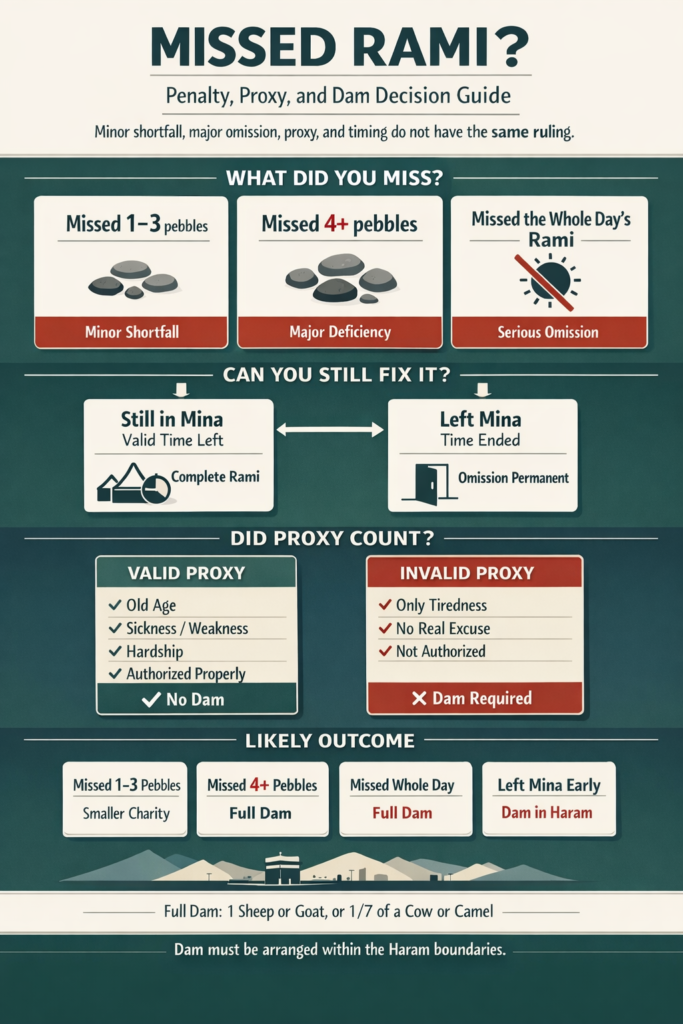
📊 Rami Omission Dam: when charity applies and when full dam is due
Use this table as the quick decision guide: minor shortfall, major omission, proxy validity, and timing problems do not all carry the same ruling.
🕋 Show Rami Omission Dam Table
| Situation | Basic ruling | Likely outcome |
|---|---|---|
| Missed 1–3 pebbles | Minor shortfall | Smaller charity penalty may apply |
| Missed 4 or more pebbles | Major deficiency | Full dam |
| Missed the entire Rami of a day | Serious omission | Full dam |
| Valid authorized proxy with real excuse | Rami counts | No dam |
| Proxy only because of tiredness | Invalid proxy | Dam may become necessary |
| Left Mina without doing Rami | Permanent omission | Full dam |
| Rami before slaughtering | Sequence issue, not omission | No dam in the source ruling you provided |
Rami Omission Dam FAQs
📘 Rami Omission Dam FAQs
Is dam required for omitting the Rami during Hajj?
Show Answer
Yes, if the omission is major. A full dam is generally required when a pilgrim misses the entire Rami of a day, misses most of the pebbles, or leaves Mina without performing Rami in a way that makes the omission permanent.
What is the penalty for missing Rami in Hajj?
Show Answer
The main penalty is a dam: usually a sheep or goat, or in some cases one seventh of a cow or camel, sacrificed within the Haram boundaries. Minor shortfalls of one to three pebbles may bring a smaller charity instead.
Does missing one day of Rami require dam?
Show Answer
Yes. Missing the entire Rami of a day is treated as a serious omission and normally requires a full dam.
If a pilgrim misses most of the pebbles is dam required?
Show Answer
Yes. In the material you provided, missing most of the pebbles reaches the level of full dam. A common working line given there is that four or more missed pebbles brings a full penalty.
Can a proxy perform Rami on behalf of a pilgrim?
Show Answer
Yes, but only when there is a recognized excuse, such as old age, sickness, real weakness, or serious hardship that makes proper performance too difficult or unsafe.
Is proxy Rami valid in Hajj?
Show Answer
It is valid when the proxy is authorized, the excuse is real, the stones are thrown correctly, and the rite is completed within valid time. Then no dam is required.
When is proxy acceptable for Rami?
Show Answer
Proxy is acceptable in cases like serious illness, old age, weakness, pregnancy, extreme heat with real hardship, or genuine fear of missing the rite altogether. Tiredness alone is not enough in your source material.
What happens if Rami is performed outside the allowed time?
Show Answer
Timing matters. If the pelting is done outside the valid timeframe and not corrected properly, a penalty may become due because the rite was not completed as required.
Where must the dam be sacrificed for Rami omission?
Show Answer
The dam must be sacrificed within the Haram boundaries. If the pilgrim has already left, they should arrange it there through a reliable person or organization.
Rami Omission Dam Decision Guide for Missed Pebbles, Proxy, and Penalty
📘 more rami omission dam FAQs
can missed rami be made up later in hajj?
Show Answer
Yes, if the valid time is still open and the pilgrim can still complete the rite before leaving Mina. But if the chance is gone and the missed Rami becomes permanent, the dam remains due.
what should you do before leaving mina if rami is still pending?
Show Answer
Do the pending Rami before departure if the valid time is still there. In many cases, doing it late within valid time is much safer than leaving Mina and turning the omission into a permanent deficiency.
if a pilgrim leaves mina without performing rami is dam mandatory?
Show Answer
Yes, if the pilgrim leaves Mina and the Rami is no longer completed in a valid way, the omission becomes serious and a dam for missing rami is generally mandatory.
can someone do rami on your behalf because of tiredness?
Show Answer
No. In the source material you gave, tiredness by itself is not treated as a valid excuse for proxy Rami. The excuse must be more serious, like old age, sickness, real weakness, or genuine hardship.
does crowd difficulty allow proxy rami?
Show Answer
Not always. Large crowds are not an excuse by themselves. But if the crowd combines with real weakness, old age, illness, extreme heat, or fear of missing the rite, proxy Rami may become valid.
what counts as a reasonable excuse for proxy rami?
Show Answer
A reasonable excuse for proxy includes serious illness, old age, clear physical weakness, pregnancy, severe heat with real danger, or a situation where the pilgrim is likely to miss the rite completely unless a proxy is used.
is dam required if rami is done before slaughtering?
Show Answer
According to the source material you pasted, no dam is required in that case. That issue is treated as a question of order, not a case of omitting the rami during hajj.
what is the difference between rami omission and rami before qurbani?
Show Answer
Rami omission means the rite was seriously left out or left incomplete. Rami before qurbani, rami before dhabihah, or rami before slaughtering is a sequence issue. In the source you gave, that sequence issue does not itself require dam, unlike a true omission.
what happens if rami is performed outside the allowed time?
Show Answer
If Rami is performed outside the allowed time and not corrected properly, a penalty may be due. Timing of rami matters because pelting is tied to specific windows during Hajj.
what is the timing of rami on yawm al nahr?
Show Answer
From the material you provided, Rami on Yawm al Nahr is done on the 10th of Dhul Hijjah, and only Jamarah al Aqaba is pelted that day. The valid window runs through that day into the night until Fajr of the 11th.
what is the timing of rami on ayyam al tashreeq?
Show Answer
On Ayyam al Tashreeq, the source material says pelting is done after Zawal and before Fajr. These are the days when all three Jamarat are pelted in order.
what is rami al jamarat in hajj?
Show Answer
Rami al Jamarat is the rite of throwing small pebbles at the three Jamarat in Mina during Hajj. It is a symbolic act connected to the trial of Ibrahim and his rejection of Shaytan’s whispers.
what are the three jamarat in mina?
Show Answer
They are Jamarah al Ula, Jamarah al Wusta, and Jamarah al Aqaba. On the 10th only the big Jamarah al Aqaba is pelted. On the Days of Tashreeq, all three are pelted.
how many pebbles must be thrown for valid rami?
Show Answer
Seven pebbles at each Jamarah is the rule. On the 10th, that means seven at Jamarah al Aqaba. On the 11th, 12th, and 13th for those staying, it means seven at each of the three Jamarat.
what counts as missing most of the pebbles in rami?
Show Answer
Based on the content you gave, once the deficiency reaches four or more missed pebbles, it is treated as a major omission that requires a full damm.
what if you are unsure how many pebbles you threw?
Show Answer
Act on what seems most likely. If you still cannot decide, go with the lower number you are sure of and complete the rest. That is safer than assuming the count was fine.
what is the correct order of the jamarat on the days of tashreeq?
Show Answer
The correct order is Jamarah al Ula first, then Jamarah al Wusta, then Jamarah al Aqaba. Keeping this order helps the pilgrim avoid confusion and deficiency.
what should you do if a pebble misses the target?
Show Answer
Throw another pebble. If the first clearly missed in a way that does not count, it should be replaced instead of ignored.
can women perform rami during menstruation?
Show Answer
Yes. From the source material you provided, menstruation does not excuse a woman from Rami, and she cannot appoint a proxy for that reason alone.
does proxy rami need permission from the pilgrim?
Show Answer
Yes. The source material says the proxy should have the pilgrim’s permission. Without proper authorization, the proxy act may be treated as invalid.
can one person pelt for themselves and then for someone else?
Show Answer
Yes, according to the method described in your source material. The person first performs their own seven throws, then performs seven throws for the person they are deputized for, then moves to the next Jamarah and repeats the process if needed.
what is the simplest way to avoid a rami omission penalty?
Show Answer
Know the day, know the timing, know the Jamarah order, count carefully, and do not use proxy unless there is a real excuse. Most rami omission penalty cases start with confusion, rushing, or wrong assumptions.

Farrukh Farooqi has been living in Sharaya, Makkah, Saudi Arabia since 2010. With over 14 years of firsthand experience witnessing the sacred journey of millions of pilgrims, Farrukh specializes in providing practical, insider tips for Hajj and Umrah travelers. His work blends real-world observations, the latest Saudi updates, and essential crowd management strategies — helping pilgrims and worshippers plan smarter, stay safer, and experience a spiritually fulfilling journey across the Holy Cities.


