
Ramadan fasting rules for special cases (medicine, travel, work): Ramadan Fasting in Real Life: Travel, Work, Medicine & Common Situations (KSA-Friendly Guide)
Most Ramadan questions don’t arrive in a calm study circle.
They hit you at an airport gate. In a clinic chair. On a long shift when your mouth feels dry and your head feels light.
And suddenly the “simple rule” feels complicated.
I’ve taught beginners for years, and I’ll tell you what I keep seeing: people aren’t trying to escape fasting. They’re trying to avoid making a mistake. They just want a clear, safe way to decide without panic.
✅ TL;DR – ramadan fasting rules for special cases
Ramadan fasting rules for special cases usually come back to two ideas: (1) what you intentionally take into your body in a “food/drink” way, and (2) when fasting becomes real harm due to travel, sickness, or medical need. Many tests and simple treatments don’t break the fast. If there’s risk to health, Islam gives room—then you make up the day later.
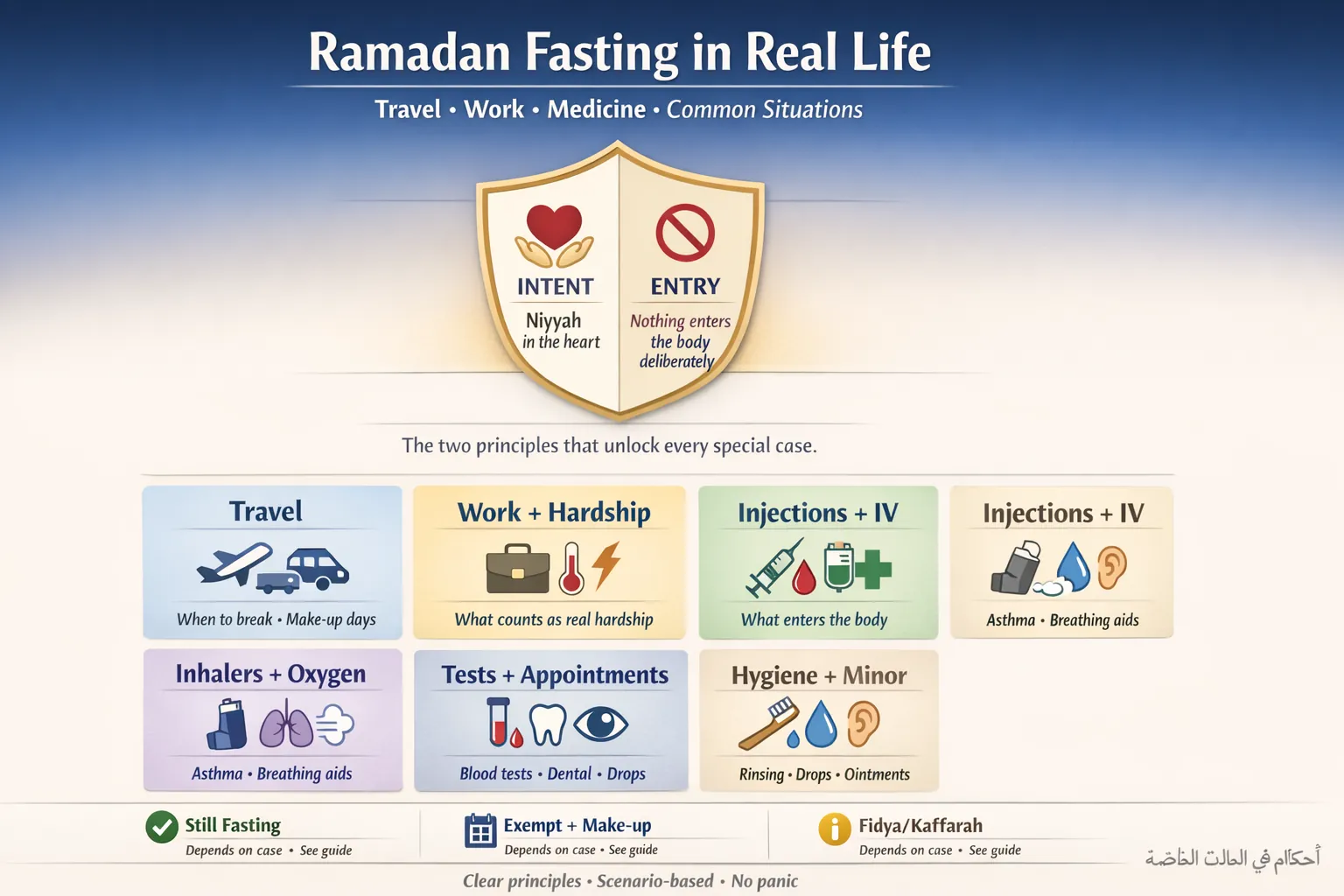
the core principle scholars use (intent + entry to the body)
The quick answer: scholars often look at intention and whether something reaches inside the body in a way similar to eating or drinking. That’s why “special cases” get sorted by: Did I do this on purpose? Did it nourish me like food? Was it unavoidable? Was there a real excuse like travel or illness?
Here’s my everyday analogy. Think of the fast like a “sealed jar” from Fajr to Maghrib. Food and drink clearly break the seal. Many medical things are more like touching the outside of the jar, or a tiny drop landing on the lid. It can still matter, but it isn’t automatically “you ate.”
But here’s what many forget: Islam isn’t asking you to play detective with your throat all day.
It’s asking you to keep the fast honest and safe.
Also, on a few medical details, scholars can differ. When that happens, a beginner shouldn’t speak with bold confidence. Choose the safer path when you can (like scheduling after iftar), and ask a trusted local scholar if your case is medical and ongoing.
Small confession: I used to overthink “taste” and “smell” like crazy when I was learning. It made me miserable. Calm beats panic.
exemptions vs “still fasting” situations (quick map)
Quick map: some situations are true exemptions (you may break the fast and make it up later), while many daily situations are still fasting (even if they feel “medical” or “hard”). The easiest way is to sort your day into three boxes: exemption, still fasting, and ask a scholar.
- Often an exemption: travel, temporary sickness, high risk of harm, urgent treatment that can’t wait
- Often still fasting: simple blood tests, non-nourishing injections, basic hygiene, most checkups (with care)
- Ask a scholar (especially if repeated): IV drips, ongoing chronic illness plans, complex procedures, sedation, anything that clearly replaces eating/drinking
Two one-sentence reminders.
Fasting is not meant to damage you.
Excuses are not meant to become your daily hobby.
If you’re working long shifts, one practical helper is to plan your day by fasting length. You can check your local fasting hours using the Ramadan fasting hours calculator and then plan sleep, suhoor, and hydration after Maghrib.
travel cases (when you can break, when to make up)
Direct answer: if you are genuinely traveling, you’re generally allowed to not fast and then make up the day later (qada). Some people still fast while traveling if it’s easy for them. If travel makes fasting harmful or severely difficult, taking the allowance can be the wiser choice.
Travel is one of those areas where people guilt-trip themselves for no reason. “If I break my fast, am I weak?” No. You’re using a permission Allah gave.
Still, travel is not a magic word you say to unlock snacks.
So what does “travel cases” look like in real life?
case 1: easy travel, easy fast
Short flight. Comfortable ride. You’re not getting dehydrated. You feel normal. Many people fast and it goes fine.
case 2: travel that turns risky
Long road trip. Heat. Delays. No rest. Headache. Dizziness. Dry mouth that feels “wrong,” not just “hungry.” That’s when the allowance is mercy, not laziness.
Micro-scenario: you’re in a car for hours and your driver is also fasting, getting sleepy and slow. In that case, safety isn’t “extra.” It’s part of religion. If breaking the fast protects life and avoids accidents, that matters.
case 3: “am i traveling or just running errands?”
People in KSA ask this a lot. The safe way: don’t stretch the meaning. A small local errand isn’t travel. A genuine trip with travel status is travel. If you’re unsure, choose the safer option and ask a local scholar for your exact situation.
when to make up (qada) after travel
Make-up fasting is like paying a small debt you don’t want hanging over your head. The earlier you do it, the lighter it feels. Many people delay, then the next Ramadan creeps in and stress doubles.
If you’re the “I’ll remember later” type, write the missed day down immediately. Seriously.
work + hardship cases (what counts as real hardship)
Direct answer: work itself isn’t automatically an exemption. But if fasting during work becomes a real risk of harm—like dangerous dehydration, fainting, or unsafe performance—then you may be allowed to break and make it up later. The key is real hardship that leads to harm, not normal tiredness.
Some days of Ramadan feel heavy. That’s part of fasting.
But “heavy” and “harmful” are not the same.
what counts as real hardship?
In plain terms: hardship counts when your body is showing you it’s not just uncomfortable—it’s unsafe. People often notice it as dizziness, confusion, shaky weakness, near-fainting, or signs of dehydration that keep getting worse.
Micro-scenario: you’re working outdoors, the sun is strong, and you start seeing spots when you stand. That’s not the moment to say, “I must suffer more.” That’s the moment to protect your health, then make up the day.
before you break the fast, try the “quiet fixes”
Many problems become manageable with small changes:
- Reduce exposure: shade, cooler area, slower pace if possible
- Take breaks: short rests can stop a spiral
- Plan sleep: lack of sleep makes fasting feel twice as hard
- Fix suhoor habits: salty foods and too much coffee can backfire
If you do all this and your body is still heading toward harm, then breaking the fast can be the responsible decision.
My students always ask: “What if my job is hard every day?” If it’s truly constant and fasting is medically unsafe for you, that becomes an illness/chronic condition discussion, not just “tough work.” Don’t carry that alone—get medical advice and a trusted scholar’s guidance together.
medical cases overview (injections, inhalers, iv, tests)
Direct answer: many medical tests and treatments don’t equal eating or drinking, so they’re often treated differently. Non-nourishing injections and simple blood tests are commonly discussed as not breaking the fast. Treatments that replace food or water (like nutrition or hydration support) are treated more strictly. In some items (like inhalers and certain drips), scholars can differ, so a cautious approach is smart.
Now the big ones people search during Ramadan in KSA.
does an injection break the fast in ramadan?
People often mean: vaccines, antibiotics, pain shots, B12, insulin, or allergy injections. Many scholars discuss non-nourishing injections differently from eating and drinking, because they aren’t taken through the mouth and aren’t “a meal.”
If you can schedule non-urgent injections after iftar, that’s the simplest path. Less worry, less debate, less stress.
Quirky beginner mistake #1: “needle = fast destroyed.” Quick fix: ask, “Is it feeding me like food? Is it urgent? Can I delay safely?”
asthma inhaler fasting
This is where you’ll hear different answers. Some treat inhalers as breaking the fast because something enters the body. Others focus on medical need and the tiny amount. If you rely on an inhaler, don’t put yourself in danger to avoid a disagreement.
Here’s the safest beginner approach:
If you can safely manage at night: use it at night and remove doubt.
If you need it in the day: use it. Health comes first. Then ask a trusted scholar how to handle makeup days based on your case.
Quirky beginner mistake #2: skipping necessary medicine to “prove iman.” Quick fix: iman also includes protecting life and not harming yourself.
blood test fasting
A blood test feels “medical,” but it’s not food or drink. Many treat simple blood draws as not breaking the fast. The concern is weakness, especially if you already struggle with low blood pressure or dehydration.
If a test makes you dizzy or unsafe, treat it as a health issue. Don’t stand there arguing with yourself while your body is begging for rest.
iv drip fasting
IV drips confuse people because they can do two very different things:
1) Nutrition support: something that feeds the body like food. Many scholars treat this like breaking the fast because it replaces eating.
2) Hydration/fluids: something that replaces drinking. Many treat this strictly as well, because it’s doing the job of water.
And here’s the practical point: if you truly need an IV drip, you’re usually already in an illness or harm-risk situation. That means the conversation becomes: “How do I make up the day later?” not “How do I force myself through danger?”
medication timing (the quiet struggle)
A lot of people don’t want to admit this: the hardest part isn’t the ruling, it’s the schedule. If you take regular meds, talk to your doctor about safe timing between iftar and suhoor. Don’t change doses on your own. Not worth it.
hygiene & appointments (dentist, drops, procedures)
Direct answer: hygiene itself doesn’t break the fast, but swallowing things does. Dental visits and drops often depend on what actually reaches the throat. If you can book after iftar, it removes doubt. If you can’t, you can still manage many appointments carefully while fasting.
dental visit fasting
Simple checkups and many dental treatments can often be done while fasting if you avoid swallowing water, paste, or materials. Tell the dentist you’re fasting so they can use suction well and keep rinsing minimal.
Micro-scenario: you taste something bitter at the back of your throat during a filling. If you tried hard not to swallow and it was unavoidable trace, that’s not the same as deliberately drinking. Stay calm, be careful, and if you’re still worried afterward, ask a trusted scholar.
Quirky beginner mistake #3: brushing like it’s a toothpaste ad at noon. Quick fix: use very little, rinse carefully, don’t swallow.
eye drops fasting
Some people taste eye drops in the throat and panic. Scholars discuss drops in different ways. If the drops are optional, use them at night and remove doubt. If they are needed for your eyes, don’t harm yourself by stopping.
Quirky beginner mistake #4: turning every “taste” into “I ate.” Quick fix: taste is not the same as a meal, and intention matters.
procedures and sedation
If a procedure includes sedation, deep treatment, or anything that clearly puts things into the stomach, you’re not in the “small hygiene” category anymore. That becomes a medical-exemption question. Don’t try to solve it with a 10-second social media answer.
Quirky beginner mistake #5: delaying urgent care “until Ramadan ends,” then the condition gets worse. Quick fix: treat urgent as urgent.
if you broke the fast: qada vs fidya vs kaffarah (high-level)
Direct answer: most special-case situations lead to qada (make up missed fasts later). Fidya is usually discussed for people who truly cannot fast long-term (case-by-case). Kaffarah is a serious category for deliberate breaking in specific ways, and people often misuse the word. If you’re unsure, don’t label your case with the heaviest term.
This is where beginners get overwhelmed, so let’s keep it clean.
qada (make-up fasts)
Travel, temporary sickness, medical appointments you couldn’t delay, harm-risk days—these often go to qada. You fast later when you’re able. A good habit is to pick a “qada plan” early (like one day a week) so it doesn’t pile up.
fidya (when fasting isn’t realistically possible)
Fidya comes up when someone truly cannot fast at all due to long-term illness or old age, and making up later isn’t realistic. This is personal and sensitive. Don’t treat it as the quick way out for a rough workday.
kaffarah (don’t throw this word around)
Kaffarah is discussed for deliberate breaking of a Ramadan fast in specific ways, and details can vary by school of thought. If your case is medical or travel-related, it’s usually not the same category. Ask a trusted scholar if this is your worry.
If you want a simple helper for common “what do I owe?” confusion, you can place this one widget in your article:
Fidyah + Kaffarah Calculator (Simple, User-Inputs Cost)
a short story of a beginner mistake (and the simple fix)
A young brother once messaged me during Ramadan, stressed out of his mind. He had a blood test, felt weak afterward, and then drank water because he thought he might faint.
After Maghrib he didn’t eat. He didn’t pray properly. He just sat in guilt.
I asked him one question: “Did you drink for fun, or for safety?”
He said, “Safety. I was scared.”
I told him, “Then stop beating yourself. Write the day down. Make it up later. And next time, sit down, rest, and don’t wait until you’re collapsing.”
He said something that stuck with me: “I thought Islam wanted me to suffer quietly.” It doesn’t.
common mistakes + quick fixes (keep this as your filter)
When Ramadan gets busy, mistakes repeat. Here are the most common ones I see:
- Turning every medical thing into “fast broken”: calm down and check what actually happened.
- Using hardship as a shortcut: discomfort isn’t the same as harm.
- Skipping necessary treatment: don’t harm yourself to win an argument.
- Not tracking missed days: write them down the same day.
- Speaking with certainty on debated issues: say “scholars differ” and choose the safer path.
quick checklist (a 30-second decision tool)
If you’re stuck, run this checklist:
- Is there real harm risk? If yes, protect health and handle qada later.
- Did I intentionally eat/drink? If yes, it’s clearly broken.
- Is this treatment like nourishment? If yes, it’s usually treated strictly.
- Can I safely delay to after iftar? If yes, do it and remove doubt.
- Is this a repeated medical condition? If yes, get a personal plan with a doctor + scholar.
quick FAQ hub (links to scenario pages)
Direct answer: the fastest way to stop Ramadan panic-searching is to keep a small hub of the scenarios people face every year: travel, hard work, injections, inhalers, tests, dentist, drops, IV, and makeup rules. Each can be its own short page so readers can jump straight to their case.
These are the scenario pages most people ask for:
- fasting while traveling ramadan: flights, road trips, “should I fast or not?”
- fasting while working hard ramadan: outdoor jobs, drivers, shift workers, dehydration risk
- injections fasting ruling: vaccines, insulin, antibiotics, pain injections
- inhaler breaks fast: asthma inhaler and what to do if needed in daytime
- blood test fasting: lab draws, weakness after tests
- dental visit fasting: cleaning, fillings, bleeding gums, swallowing concerns
- eye drops fasting: drops, taste in throat, night-time use
- IV drip fasting: nutrition vs fluids, urgent care days
- missed fasts qada: tracking, intention, and planning makeup days
If your readers keep asking “what time is iftar?” in the middle of these situations, you can also mention the iftar & suhoor timer naturally on your Ramadan pages (no need to embed it everywhere).
📊 ramadan special cases: quick map (safe, debated, needs help)
Use this table to explain the big idea gently: some cases are usually safe, some are debated, and some need a personal answer because health is involved.
🌙 Show Ramadan Special Cases Table
| Situation | What it usually is | Beginner-safe move |
|---|---|---|
| Travel day | Exemption is commonly allowed | If hard/risky, break and plan qada later |
| Long shift / heat exposure | Depends on harm risk | Try adjustments; if harm is likely, break and make up later |
| Simple blood test | Often still fasting | Do it; if you feel faint, treat safety seriously |
| Non-nourishing injection | Often treated differently than eating | Night scheduling removes doubt; urgent cases need a personal answer |
| Asthma inhaler | Often debated in details | Don’t risk health; ask scholar for your case if ongoing |
| Nutritional IV drip | Commonly treated like feeding | If needed, you’re in illness territory—qada later is common |
| Dental cleaning/filling | Often still fasting if nothing swallowed | Tell dentist you’re fasting; avoid swallowing water/material |
| Eye drops | Often debated in details | Use at night if possible; if needed in day, don’t harm yourself |
FAQs
📘 ramadan fasting rules for special cases FAQs
does an injection break the fast in ramadan?
Show Answer
Many scholars discuss non-nourishing injections differently from eating and drinking. If you can safely take it after iftar, that removes doubt. If it’s needed during the day, don’t endanger your health, and ask a trusted scholar if your case is ongoing.
can a traveler skip fasting in ramadan?
Show Answer
A traveler is generally allowed to not fast and then do qada later. Some still fast if travel is easy. If travel is hard or risky, taking the allowance can be the safer choice.
does a blood test break the fast?
Show Answer
A simple blood test isn’t food or drink. Many treat it as not breaking the fast. If you become weak or unsafe, treat it as a health issue and act responsibly.
does an asthma inhaler break the fast?
Show Answer
Scholars can differ on inhalers. If you can safely manage at night, that removes doubt. If you need it during the day, don’t risk your health, and ask a trusted scholar how to handle makeup days for your case.
does an IV drip break the fast?
Show Answer
IV drips vary. Nutrition support is commonly treated like feeding. Fluids that replace drinking are also treated strictly by many. If you truly need an IV, you’re usually in an illness/harm-risk situation, so qada later is commonly discussed.
can i visit the dentist while fasting?
Show Answer
Often yes, especially for checkups and many treatments, as long as you avoid swallowing water or materials. Tell the dentist you’re fasting so they can suction well. If a procedure is likely to push lots of liquid into the throat, after-iftar scheduling is easier.
do eye drops break the fast?
Show Answer
Some people taste drops and worry. Scholars discuss details and views can differ. If optional, use at night. If needed for health, don’t harm yourself by stopping—then ask a scholar if you need a personal plan.
i work a very hard job—can i break the fast?
Show Answer
Hard work alone isn’t automatically an exemption. If fasting creates real harm risk (dangerous dehydration, fainting, unsafe performance), you may break and make up later. Try work adjustments first, and treat safety seriously.
what if i missed fasts—qada or fidya?
Show Answer
Qada means you make up the missed day later. Fidya is usually discussed for people who truly cannot fast long-term (case-by-case). Many beginners mix them up, so if you can fast later, qada is usually the first answer.
what if i ate or drank by mistake while fasting?
Show Answer
If you truly forgot, then stopped as soon as you remembered, many scholars treat the fast as still valid. Don’t turn a human slip into a panic day. Continue fasting.
i have a chronic illness—what’s the safest approach?
Show Answer
Chronic illness needs a personal plan. Talk to your doctor about safety and medication timing, and ask a trusted scholar about the religious ruling for your situation. Don’t copy someone else’s plan just because it “sounds strong.”
does a nose spray or breathing treatment break the fast?
Show Answer
These can fall into the “ask a scholar” zone because details matter (what reaches the throat, medical need, and frequency). If you can safely use it at night, do that. If you need it during the day for health, don’t harm yourself, then ask for a personal ruling.
Related Tools
Ramadan fasting hours calculator
Related Articles
- Dua for health in Ramadan: easy duas for strength, healing, and patience
- Dua for rizq in Ramadan: simple duas for barakah, work, and debt
- Dua for parents in Ramadan: 12 heartfelt duas (Arabic + meaning)
- Dua for deceased in Ramadan: what to say (simple and sincere)
- Best time to make dua in Ramadan: 9 moments (with a simple plan)
- Dua When Angry While Fasting: the one line that stops the fight
- Umrah in Ramadan duas: what to say in tawaf, sa’i, and at the haram

Farrukh Farooqi has been living in Sharaya, Makkah, Saudi Arabia since 2010. With over 14 years of firsthand experience witnessing the sacred journey of millions of pilgrims, Farrukh specializes in providing practical, insider tips for Hajj and Umrah travelers. His work blends real-world observations, the latest Saudi updates, and essential crowd management strategies — helping pilgrims and worshippers plan smarter, stay safer, and experience a spiritually fulfilling journey across the Holy Cities.


