
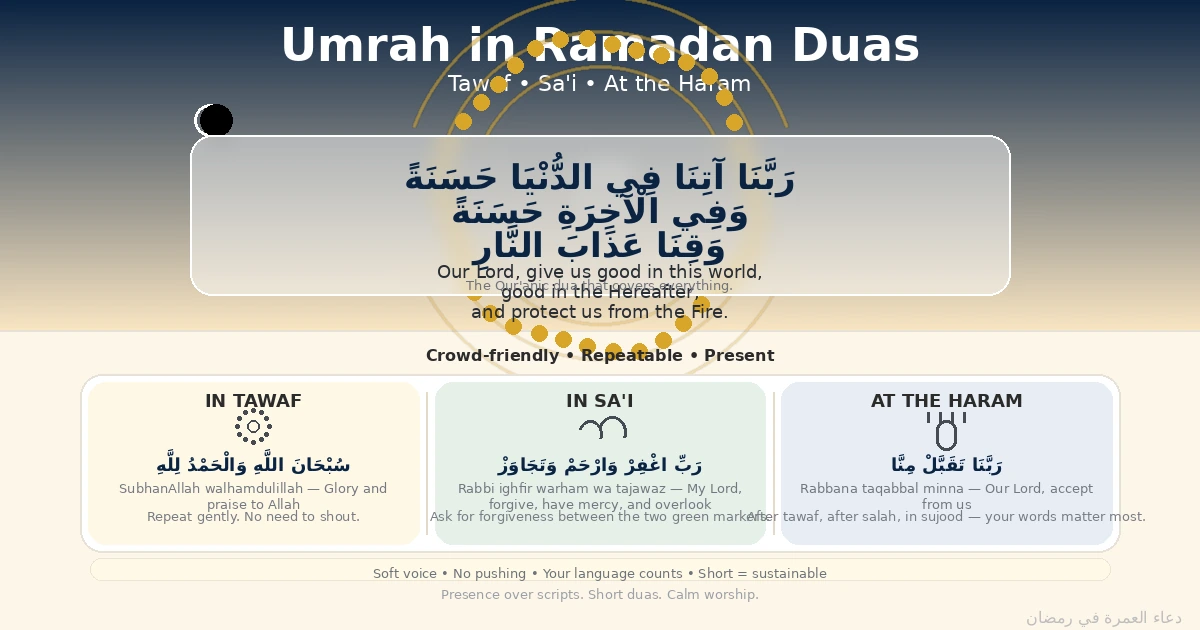
Umrah in Ramadan duas: what to say in tawaf, sa’i, and at the haram
Ramadan Umrah is beautiful… and intense.
The Haram feels like a heart that never sleeps. Crowds move like waves. Your phone loses signal. Your throat gets dry. And suddenly you realize: you don’t need a “perfect script.” You need a small set of du’as you can actually say while you’re walking, sweating, and trying not to bump into someone’s shoulder.
That’s what this page is.
A calm “dua card” approach—short, repeatable, and crowd-friendly.
✅ TL;DR – Umrah in Ramadan duas
Umrah in Ramadan duas don’t need a fixed script. The strongest approach is a few short lines you can repeat calmly in tawaf and sa’i, then personal du’a for your real needs. This guide gives crowd-friendly Arabic options with meaning, plus etiquette tips—so you worship with presence instead of chasing “special phrases.”
a simple “dua card” approach for Ramadan Umrah
Snippet answer: The easiest way to make du’a in Ramadan Umrah is choosing a few short lines you can repeat without losing focus. Use one line for tawaf, one for sa’i, one for forgiveness, and one for acceptance—then add personal du’a in your own language. This keeps you calm in crowds and consistent in worship.
Think of it like packing light for travel.
If your suitcase is full of “extra,” you’ll struggle at the airport. If your du’a list is full of long scripts, you’ll struggle in the crowd.
Light bag. Strong essentials.
Small aside: the first time I did Umrah in a packed season, I tried to read a long list from my phone. I nearly got separated from my group and I barely felt present. After that, I learned to keep it short and real.
before you start: intention, calm, and a clean start
Snippet answer: Before you begin Umrah, take 30 seconds to settle your heart: renew intention, ask Allah for acceptance, and remind yourself you won’t fight crowds or chase “perfect wording.” A calm heart makes your du’a sharper than any fancy script.
If you’re entering ihram and saying the talbiyah, keep it steady and soft. No need to compete with anyone.
Talbiyah (commonly said for Umrah)
لَبَّيْكَ اللَّهُمَّ لَبَّيْكَ، لَبَّيْكَ لَا شَرِيكَ لَكَ لَبَّيْكَ، إِنَّ الْحَمْدَ وَالنِّعْمَةَ لَكَ وَالْمُلْكَ، لَا شَرِيكَ لَكَ
Transliteration: Labbayka Allahumma labbayk, labbayka la sharika laka labbayk, inna al-hamda wan-ni‘mata laka wal-mulk, la sharika lak.
Meaning: Here I am, O Allah, here I am. Here I am, You have no partner, here I am. Truly all praise, favor, and sovereignty are Yours. You have no partner.
Micro-scenario: you feel emotional and want to cry, but people are pushing from behind. It’s okay. Whisper your du’a. Allah hears the quiet voice.
tawaf in Ramadan: what to say (without losing your place)
Snippet answer: In tawaf, there isn’t one “must-read” du’a for every round. The best approach is repeating a few short duas you understand, and adding personal requests as you walk. Keep your voice low, your steps safe, and your heart present—especially in crowded Ramadan nights.
Here are the crowd-friendly options I suggest to beginners:
1) One Qur’anic du’a you can repeat anytime (and many people repeat it during tawaf).
Qur’anic du’a (often recited in tawaf)
رَبَّنَا آتِنَا فِي الدُّنْيَا حَسَنَةً وَفِي الآخِرَةِ حَسَنَةً وَقِنَا عَذَابَ النَّارِ
Transliteration: Rabbana atina fi ad-dunya hasanah wa fi al-akhirati hasanah wa qina ‘adhab an-nar.
Meaning: Our Lord, give us good in this world and good in the Hereafter, and protect us from the punishment of the Fire.
2) A simple acceptance du’a (short, and it keeps you sincere).
Du’a for acceptance
اللَّهُمَّ تَقَبَّلْ مِنِّي
Transliteration: Allahumma taqabbal minni.
Meaning: O Allah, accept from me.
3) Your personal du’a (in your own language)
This is the part people forget. You can ask in English, Urdu, Arabic, or any language that makes you honest. Ask for what you actually need: a clean heart, forgiveness, family, relief from debt, healing, guidance.
Micro-scenario: you lose count of rounds because the crowd shifts. Don’t panic and don’t argue. Step to the side, breathe, and continue with calm.
sa’i in Ramadan: what to say between Safa and Marwa
Snippet answer: In sa’i, keep your du’a steady and simple. Many people begin at Safa and Marwa with praise of Allah and then make personal du’a. The core idea is not “finding rare words,” but repeating meaningful requests while you walk—especially patience, acceptance, and forgiveness.
Sa’i is a lesson in effort.
Not rushed effort. Not angry effort. Just steady steps—again and again.
At Safa and Marwa, many Muslims say a well-known dhikr and then make du’a. Keep it calm.
Dhikr commonly said at Safa/Marwa
لَا إِلٰهَ إِلَّا اللَّهُ وَحْدَهُ لَا شَرِيكَ لَهُ، لَهُ الْمُلْكُ وَلَهُ الْحَمْدُ، وَهُوَ عَلَىٰ كُلِّ شَيْءٍ قَدِيرٌ
Transliteration: La ilaha illa Allah wahdahu la sharika lah, lahul-mulku wa lahul-hamd, wa huwa ‘ala kulli shay’in qadir.
Meaning: None has the right to be worshiped but Allah alone, without partner. His is the dominion and His is the praise, and He has power over all things.
Then ask for your real needs. This is a beautiful place for du’a for parents, family, and acceptance.
Micro-scenario: your legs are aching and your throat is dry. Instead of complaining, make one honest du’a: “Ya Allah, make my effort accepted.” That’s worship too.
at the Haram in Ramadan: the best moments to ask
Snippet answer: At the Haram in Ramadan, you don’t need to chase “rare” moments. Use the moments that naturally soften the heart: after obligatory prayers, in sujood, before iftar, and in the quiet parts of the night. Keep your du’a low-voice and steady, especially in crowds.
Ramadan already gives the place a special atmosphere. Your job is to stay present.
Here are simple, repeatable themes that work anywhere in the Haram:
Short du’a for forgiveness
رَبِّ اغْفِرْ لِي
Transliteration: Rabbighfir li.
Meaning: My Lord, forgive me.
Short phrase for calm trust (often used in hardship)
حَسْبُنَا اللَّهُ وَنِعْمَ الْوَكِيلُ
Transliteration: Hasbuna Allahu wa ni‘mal-wakil.
Meaning: Allah is enough for us, and He is the best One to rely on.
One-sentence reminder: Quiet du’a in a crowded place can be more sincere than loud du’a in an empty room.
crowd etiquette: how to worship without harming anyone
Snippet answer: In crowded Ramadan Umrah, good manners are part of worship. Keep your voice low, avoid pushing, don’t block pathways for photos, and don’t turn du’a into performance. If you can’t reach a spot safely, you can still worship where you are—Allah isn’t “only in the front row.”
But here’s what many forget: you can lose the spirit of Umrah while trying to “win space.”
So keep these habits:
• If someone bumps you, forgive quickly.
• If you’re stuck, don’t panic—make du’a right there.
• If you feel anger rising, step aside and reset.
Micro-scenario: someone cuts in front of you during tawaf. Your ego wants to lecture them. Don’t. Whisper a du’a and keep moving. You came for Allah, not for “winning the lane.”
five quirky beginner mistakes (and quick fixes)
Snippet answer: Most Umrah du’a mistakes aren’t “bad intentions.” They’re practical mistakes: long scripts you can’t keep up with, loud du’a that disturbs others, pushing for space, and forgetting personal du’a because you’re busy copying. These five fixes keep your worship calm and clean.
Mistake 1: Saving all du’a for “later.” Quick fix: repeat one short line from the start.
Mistake 2: Reading a huge list from your phone in tawaf. Quick fix: memorize 2–3 lines and look up between rounds if needed.
Mistake 3: Raising your voice in a way that distracts others. Quick fix: whisper; Allah hears.
Mistake 4: Pushing to touch things when it’s unsafe. Quick fix: safety first—worship is not a wrestling match.
Mistake 5: Forgetting your real needs and only copying “generic words.” Quick fix: add one personal du’a every round.
a short story of a beginner mistake (and the simple fix)
A sister once told me she felt “nothing” during her Ramadan Umrah.
Her hands were full: phone, dua list, charger, water bottle.
In tawaf, she was so busy scrolling that she kept stopping—people got irritated, and she got flustered.
Afterward she said, “I think I ruined it.”
I told her: “You didn’t ruin it. You just carried too much.”
Next time she used one short du’a and her own words. She said, “That’s the first time I felt like I was actually talking to Allah.”
tools (optional) to keep your Ramadan duas organized
Snippet answer: If you want a ready place to keep short Ramadan du’as (with meanings) so you’re not searching while walking, a simple du’a tool helps. Use it before you go, or after Umrah when you want to keep the habit alive back home.
Quick Copy
📊 Umrah in Ramadan: tawaf + sa’i “dua card” table
This is the “one-screen” version. Pick a line, repeat calmly, then add your personal du’a in your own language.
🕋 Show Umrah Dua Card Table
| Where you are | What to repeat | Add personally |
|---|---|---|
| Tawaf (any round) | Rabbana atina… / Allahumma taqabbal minni | Forgiveness, guidance, family needs |
| Safa & Marwa | La ilaha illa Allah… | Acceptance, patience, parents du’a |
| In crowds | Hasbuna Allah… | Calm heart, good manners, safety |
| After salah | Rabbighfir li | One “big ask” you repeat daily |
📘 Umrah in Ramadan duas FAQs
best duas for Umrah in Ramadan—do I need a fixed script?
Show Answer
You don’t need a fixed script for every step. A few short, meaningful lines plus your personal du’a is often the strongest approach—especially in crowds.
what to say in tawaf Ramadan?
Show Answer
Repeat a short Qur’anic du’a you understand, ask for acceptance, and add personal du’a as you walk. Keep your voice low and your steps safe.
what to say in sa’i Ramadan?
Show Answer
Many people begin at Safa and Marwa with praise of Allah, then make personal du’a. Keep it calm and repeatable—patience, forgiveness, and acceptance are great themes.
can I make du’a in my language in the Haram?
Show Answer
Yes. Ask in the language that makes you sincere. Short Arabic phrases are also fine—especially when you understand the meaning.
دعاء العمرة في رمضان مختصر: ما أفضل شيء أكرره؟
Show Answer
اختر دعاءً قصيرًا تفهم معناه وكرره بهدوء، ثم ادعُ بحاجاتك أنت. الأهم هو الخشوع وعدم إيذاء الناس في الزحام.
short dua list for crowded Umrah—what works best?
Show Answer
A short repeat set works best: one Qur’anic du’a, one acceptance du’a, one forgiveness du’a, and your personal requests. Short beats long in crowded movement.
dua at Safa and Marwa—do I have to say it out loud?
Show Answer
No. Keep your voice low. The Haram is full of worshipers; your calm helps you and respects others.
dua etiquette in crowded Haram—what should I avoid?
Show Answer
Avoid pushing, shouting du’a over people, blocking paths for photos, and turning worship into performance. Safety and manners are part of worship.
dua for acceptance of Umrah Ramadan—what can I say simply?
Show Answer
A simple du’a is asking Allah to accept from you, and to forgive you. Keep it sincere and repeat it often.
printable Umrah dua card Ramadan—do I need to carry papers?
Show Answer
You can, but many people find it easier to memorize 2–3 short lines. In crowds, hands-free worship is often calmer.
common mistakes in Umrah du’as during Ramadan?
Show Answer
The common ones: reading long lists while walking, raising your voice, pushing for space, and forgetting personal du’a because you’re busy copying.
Related Articles
- Dua for health in Ramadan: easy duas for strength, healing, and patience
- Dua for rizq in Ramadan: simple duas for barakah, work, and debt
- Dua for parents in Ramadan: 12 heartfelt duas (Arabic + meaning)
- Dua for deceased in Ramadan: what to say (simple and sincere)
- Best time to make dua in Ramadan: 9 moments (with a simple plan)
- Dua When Angry While Fasting: the one line that stops the fight

Farrukh Farooqi has been living in Sharaya, Makkah, Saudi Arabia since 2010. With over 14 years of firsthand experience witnessing the sacred journey of millions of pilgrims, Farrukh specializes in providing practical, insider tips for Hajj and Umrah travelers. His work blends real-world observations, the latest Saudi updates, and essential crowd management strategies — helping pilgrims and worshippers plan smarter, stay safer, and experience a spiritually fulfilling journey across the Holy Cities.


