
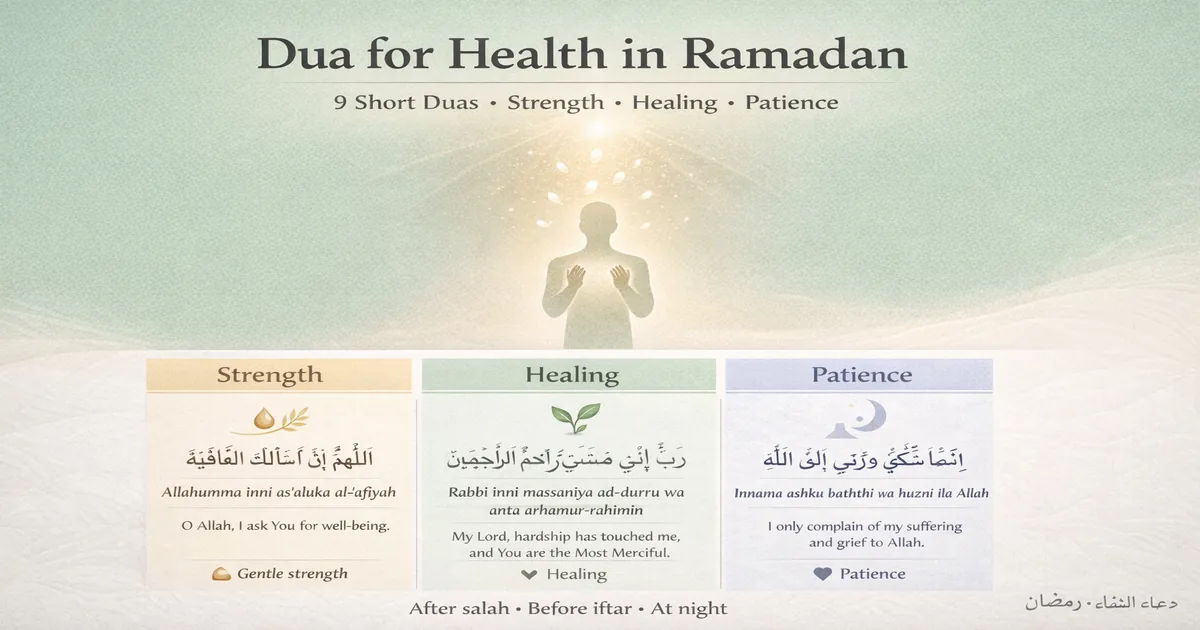
Dua for health in Ramadan: easy duas for strength, healing, and patience
Some Ramadans feel light.
Others feel heavy—because your body is tired, your sleep is messy, or you’re dealing with sickness while fasting.
If that’s you, you’re not “weak in faith.” You’re human.
And du’a for health in Ramadan is one of the gentlest ways to ask Allah for help without turning your pain into a performance.
✅ TL;DR – dua for health in Ramadan
Pick 2–3 short shifā’ du’as and repeat them daily: after salah, before iftar, and at night. Add your personal words for your real symptoms—weakness, anxiety, sleep, pain. This page gives 9 easy du’as with Arabic, transliteration, and meaning, plus a simple routine that doesn’t overwhelm you.
what “shifā’” means (and what we should not promise)
Snippet answer: Shifā’ means healing. In Ramadan, asking for shifā’ is asking Allah for cure, relief, strength, and patience—without making guarantees about outcomes. You can pray for full healing, and you can also pray for ease, calm, and the ability to worship with whatever health you have today.
I explain shifā’ like this: it’s not only the finish line.
It’s also the little steps—less pain, better sleep, calmer breathing, a heart that doesn’t panic.
And yes, you still do the normal things. Food, water planning, rest, and medical advice when needed. Du’a doesn’t fight reality; it helps you carry it.
when to say these du’as (simple “repeat plan”)
Snippet answer: The easiest routine is three touchpoints: after salah (short healing du’a), before iftar (ask for strength and ease), and at night (sleep, anxiety, pain relief). In sujood, add one personal line. These moments are already in your day, so the habit sticks.
Micro-scenario: you feel weak an hour before maghrib and your mind starts spiraling. Whisper one du’a, breathe slowly, and keep it simple.
Micro-scenario: you’re taking medicine on a schedule (as advised). Make du’a right after—calmly—without turning it into fear.
Micro-scenario: you can’t sleep because your legs ache. Don’t fight the night. Ask Allah for ease, then rest your phone and let your body settle.
9 short duas for healing, strength, and patience (Arabic + transliteration + meaning)
Snippet answer: These 9 du’as are short and repeatable. Some focus on shifā’ (شفاء), some on protection, and some on patience when illness tests you. Choose 3 as your “daily set,” and rotate the others when your heart needs fresh words. Keep it steady, not dramatic.
Du’a 1 (ask for healing)
اللَّهُمَّ اشْفِنِي شِفَاءً لَا يُغَادِرُ سَقَمًا
Transliteration: Allāhumma ishfinī shifā’an lā yughadiru saqamā.
Meaning: O Allah, heal me with a healing that leaves no illness behind.
Du’a 2 (relief and well-being)
اللَّهُمَّ عَافِنِي فِي بَدَنِي
Transliteration: Allāhumma ʿāfinī fī badanī.
Meaning: O Allah, grant me well-being in my body.
Du’a 3 (strength to keep going)
اللَّهُمَّ قَوِّنِي وَأَعِنِّي
Transliteration: Allāhumma qawwinī wa aʿinnī.
Meaning: O Allah, strengthen me and help me.
Du’a 4 (protection from harm)
اللَّهُمَّ احْفَظْنِي مِنْ كُلِّ سُوءٍ
Transliteration: Allāhumma iḥfaẓnī min kulli sū’.
Meaning: O Allah, protect me from every harm.
Du’a 5 (patience during illness)
اللَّهُمَّ ارْزُقْنِي الصَّبْرَ وَالْأَجْرَ
Transliteration: Allāhumma urzuqnī aṣ-ṣabra wal-ajra.
Meaning: O Allah, grant me patience and reward.
Du’a 6 (calm for anxiety)
اللَّهُمَّ أَنْزِلِ السَّكِينَةَ فِي قَلْبِي
Transliteration: Allāhumma anzil as-sakīnah fī qalbī.
Meaning: O Allah, send tranquility into my heart.
Du’a 7 (sleep ease)
اللَّهُمَّ ارْزُقْنِي نَوْمًا هَادِئًا وَرَاحَةً
Transliteration: Allāhumma urzuqnī nawman hādi’an wa rāḥah.
Meaning: O Allah, grant me calm sleep and rest.
Du’a 8 (for a sick family member)
اللَّهُمَّ اشْفِ مَرِيضَنَا وَارْحَمْ ضَعْفَنَا
Transliteration: Allāhumma ishfi marīḍanā warḥam ḍaʿfanā.
Meaning: O Allah, heal our sick one and have mercy on our weakness.
Du’a 9 (good outcome)
اللَّهُمَّ اخْتِمْ لِي بِالْخَيْرِ وَعَافِنِي
Transliteration: Allāhumma ikhtim lī bil-khayr wa ʿāfinī.
Meaning: O Allah, grant me a good ending and well-being.
quick habits that support your du’a (without medical claims)
Snippet answer: Keep health du’a practical: plan suhoor and hydration, don’t waste your sleep with late scrolling, and ask family for support. If you have medical needs, follow your doctor’s advice and keep your worship flexible. Du’a works best when your day isn’t chaotic.
- Hydration plan: drink steadily between iftar and suhoor.
- Suhoor simple: keep it filling, not heavy.
- Night calm: reduce screen time before sleep.
- Ask for help: don’t carry sickness alone if family can assist.
One sentence, because someone needs to hear it: If you’re sick, Islam doesn’t ask you to torture yourself.
five quirky mistakes people make (and quick fixes)
Snippet answer: Health du’a goes wrong when people panic, copy long scripts, or treat illness like shame. The fix is to keep du’a short, repeat it daily, and ask for both healing and patience. Also, don’t ignore basic rest and hydration—your body has rights too.
Mistake 1: Only making du’a when the pain spikes. Quick fix: make one du’a after each salah.
Mistake 2: Feeling guilty for being weak. Quick fix: ask Allah for strength and accept your limits.
Mistake 3: Treating sleep like “optional.” Quick fix: protect your rest so fasting doesn’t crush you.
Mistake 4: Turning du’a into a long performance every night. Quick fix: short and steady, then quiet rest.
Mistake 5: Forgetting patience is worship too. Quick fix: add the patience du’a daily.
a short story: the “weak fasting day” that taught a better du’a
Snippet answer: When you feel weak while fasting, don’t force long worship. A better response is a short healing du’a, a sip plan for after iftar, and a calm night routine. One person I taught repeated a two-line du’a daily and stopped judging themselves—this lowered panic and made worship feel doable again.
A sister once said, “I feel dizzy every Ramadan afternoon, and then I feel guilty.”
She kept pushing herself until she crashed at iftar.
I asked her to switch the goal: not “be strong,” but “be steady.”
After salah she repeated Du’a 2. Before iftar she repeated Du’a 3. At night she asked for calm sleep.
She later told me, “My body didn’t become perfect… but my heart stopped panicking.”
That calm is a kind of healing too.
More Ramadan du’as (for your daily routine)
If you want extra Ramadan du’as to rotate—especially short ones you can repeat easily—use the tool below. It helps when you’ve picked your “daily set” and you just want a few more options over the month.
Quick Copy
A simple “health du’a routine” (daily, realistic)
| Time | What to say | Simple support habit |
|---|---|---|
| After salah | Du’a 2 or 1 | 10 seconds, no pressure |
| Before iftar | Du’a 3 + personal words | Plan hydration after maghrib |
| At night | Du’a 6 or 7 | Reduce screen time; aim for calmer sleep |
| When pain spikes | Du’a 5 (patience) | Breathe slowly; ask family for help |
📘 dua for health in Ramadan FAQs
what is the best dua for healing in Ramadan?
Show Answer
The best one is short enough to repeat daily. Ask Allah for shifā’ (healing) and well-being, then add your personal words for your exact illness.
دعاء الشفاء في رمضان — هل يوجد دعاء قصير؟
Show Answer
نعم. اختر دعاءً قصيرًا وكرره يوميًا بعد الصلاة وقبل الإفطار، مع طلب الشفاء والراحة والصبر.
dua for sickness while fasting—what if I feel too weak?
Show Answer
Keep du’a short and ask Allah for strength and ease. Take your health seriously and seek proper advice if needed. Don’t turn weakness into shame.
what to say when you feel weak fasting?
Show Answer
Ask Allah to strengthen you and help you. Then plan a calm iftar, hydrate steadily afterward, and protect your sleep.
dua for energy while fasting—should I ask for “more energy” or “ease”?
Show Answer
Ask for both. Strength helps, and ease helps. Ramadan worship isn’t meant to crush you; it’s meant to guide you.
dua for sleep in Ramadan—what can I repeat?
Show Answer
Keep it simple: ask Allah for calm sleep and rest. Reduce late scrolling and avoid heavy food right before bed when possible.
dua for anxiety Ramadan—does du’a help even if anxiety is strong?
Show Answer
Yes. Ask Allah for sakīnah (tranquility) and keep it consistent. If anxiety feels overwhelming, also seek support—faith and help can go together.
dua before iftar for health—what should I ask?
Show Answer
Ask for healing, strength, and a calm heart. Then mention your specific symptom: pain, weakness, sleep, anxiety, or appetite.
dua after salah for healing—how long should it be?
Show Answer
10–20 seconds is enough. Short du’a that you repeat daily is stronger than long du’a you abandon.
common mistakes people make with health du’as?
Show Answer
Panic, guilt, long scripts that don’t last, neglecting rest and hydration, and feeling ashamed of needing help.
Related Articles
- Authentic Iftar Dua: What To Say When Breaking The Fast
- Ramadan Dua Routine: A Simple System From Moon Sighting To Eid
- Dua Before Iftar Accepted: Why it’s Special And What to Say
- Suhoor Dua Authentic: Is There An Authentic One (or just bismillah)?
- Niyyah For Fasting In Ramadan: What it is (and what it isn’t)
- Crescent Moon Dua Ramadan: What to Say When You See The Hilal
- Allahumma ballighna Ramadan: is it authentic (and what to say instead)?
- Dua For Forgiveness in Ramadan: 5 short duas to repeat daily
- Dua Etiquette In Ramadan: 12 small things that improve focus
- Ramadan duas for kids: 10 short duas (Arabic + easy English)

Farrukh Farooqi has been living in Sharaya, Makkah, Saudi Arabia since 2010. With over 14 years of firsthand experience witnessing the sacred journey of millions of pilgrims, Farrukh specializes in providing practical, insider tips for Hajj and Umrah travelers. His work blends real-world observations, the latest Saudi updates, and essential crowd management strategies — helping pilgrims and worshippers plan smarter, stay safer, and experience a spiritually fulfilling journey across the Holy Cities.


