
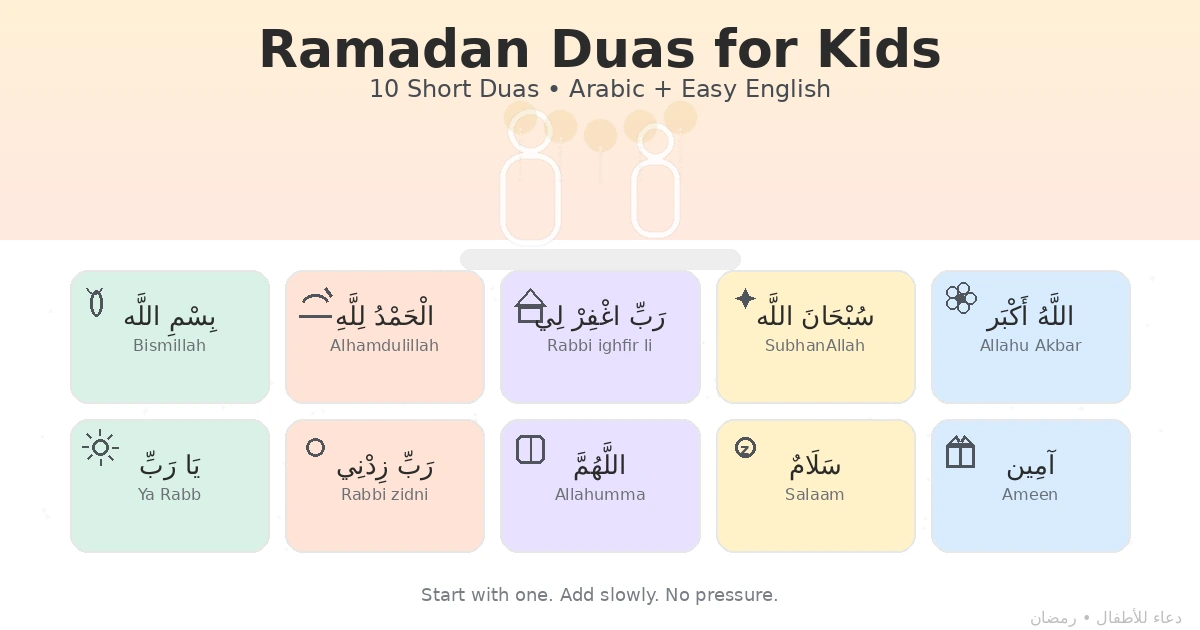
Ramadan duas for kids: 10 short duas (Arabic + easy English)
Kids don’t need a long du’a list.
They need short words they can actually remember… and meanings that feel real to them.
Because when a child understands a du’a, they don’t “perform” it. They feel it.
And that’s the whole point.
✅ TL;DR – Ramadan duas for kids
Start with 3: one du’a before eating, one at iftar, and one for forgiveness. Add the rest slowly. This page gives 10 kid-friendly du’as with Arabic, easy transliteration, and simple meanings—plus a tiny family routine that works even on busy school nights.
what makes a du’a “kid-friendly”?
Snippet answer: A kid-friendly du’a is short, easy to say, and clear in meaning. Kids remember feelings more than vocabulary. So the best du’as for children sound simple, match a moment in their day (iftar, bedtime, school), and repeat often—without pressure.
Think of du’a like teaching a child to brush teeth.
You don’t give a lecture about enamel. You give one small habit, repeated daily, until it becomes normal.
Same with du’a: one line, one moment, again and again.
Small note from experience: my younger students always mix up “when to say it” more than “how to say it.” So we tie each du’a to a moment: food, sleep, school, forgiveness.
the easiest mini routine for families (suhoor + iftar)
Snippet answer: Keep a tiny routine: one du’a before eating at suhoor, one du’a at iftar, and one du’a before sleep. That’s enough for a child to feel “I did Ramadan du’a today,” without turning the house into a classroom.
Here’s a routine that doesn’t fight your real life.
- Suhoor (before the first bite): Du’a #1
- Iftar (first sip or date): Du’a #4
- Bedtime (two minutes): Du’a #6 + one personal ask (school, friends, parents)
Micro-scenario: your child is cranky before maghrib. Don’t start a “repeat after me” battle. You say it once softly. They catch it over time.
10 short duas kids can learn in Ramadan
Snippet answer: These 10 du’as cover the most common kid moments in Ramadan: eating, iftar, forgiveness, parents, guidance, knowledge, and calm. Pick 2–3 for Week 1, then add one more every few days. Repetition is the secret.
Two one-sentence reminders.
Meaning first.
Perfection later.
Du’a #1 (before eating)
بِسْمِ اللَّهِ
Transliteration: Bismillāh.
Easy meaning: In the name of Allah.
Du’a #2 (after eating)
الْحَمْدُ لِلَّهِ
Transliteration: Alhamdulillāh.
Easy meaning: All praise is for Allah.
Du’a #3 (quick forgiveness)
أَسْتَغْفِرُ اللَّهَ
Transliteration: Astaghfirullāh.
Easy meaning: I ask Allah to forgive me.
Du’a #4 (iftar du’a)
ذَهَبَ الظَّمَأُ وَابْتَلَّتِ الْعُرُوقُ وَثَبَتَ الْأَجْرُ إِنْ شَاءَ اللَّهُ
Transliteration: Dhahaba al-ẓama’u wabtallatil-ʿurūq, wa thabatal-ajru in shā’ Allāh.
Easy meaning: The thirst is gone, the veins are refreshed, and the reward is confirmed—if Allah wills.
Du’a #5 (for parents)
رَبِّ ارْحَمْهُمَا كَمَا رَبَّيَانِي صَغِيرًا
Transliteration: Rabbi irḥamhumā kamā rabbayānī ṣaghīrā.
Easy meaning: My Lord, have mercy on my parents as they raised me when I was small.
Du’a #6 (simple “forgive me”)
رَبِّ اغْفِرْ لِي
Transliteration: Rabbighfir lī.
Easy meaning: My Lord, forgive me.
Du’a #7 (for guidance)
اهْدِنِي
Transliteration: Ihdinī.
Easy meaning: Guide me.
Du’a #8 (for knowledge)
رَبِّ زِدْنِي عِلْمًا
Transliteration: Rabbi zidnī ʿilmā.
Easy meaning: My Lord, increase me in knowledge.
Du’a #9 (good in this life + next)
رَبَّنَا آتِنَا فِي الدُّنْيَا حَسَنَةً وَفِي الْآخِرَةِ حَسَنَةً وَقِنَا عَذَابَ النَّارِ
Transliteration: Rabbanā ātinā fid-dunyā ḥasanah, wa fil-ākhirati ḥasanah, waqinā ʿadhāban-nār.
Easy meaning: Our Lord, give us good in this life and good in the next, and protect us from the Fire.
Du’a #10 (when angry)
أَعُوذُ بِاللَّهِ مِنَ الشَّيْطَانِ الرَّجِيمِ
Transliteration: Aʿūdhu billāhi min ash-shayṭānir-rajīm.
Easy meaning: I seek Allah’s protection from Shaytan.
Micro-scenario: your child says Du’a #4 at iftar and stumbles. Smile. Don’t correct mid-sentence. Let them finish first. Then help gently.
how to teach kids du’a meaning (without boring them)
Snippet answer: Teach meaning with one simple line and one example. Kids learn fast when du’a connects to a real moment: “We say this before we eat,” “We ask Allah to forgive us after we make a mistake,” “We make du’a for Mama and Baba.” Keep it short and repeat it daily.
Here’s a trick that works: ask them one question.
“What are you asking Allah for in this du’a?” Then let them answer in their own words, even if it’s messy.
Micro-scenario: your child says, “Ihdinī means… help me be good.” Perfect. That’s the meaning in kid language.
One longer story (because it happens a lot): A mother once told me her son refused du’a because he thought he had to “sound like an imam.” At iftar, she asked him to pick one du’a and say it in a whisper. He chose “Rabbighfir lī.” Then she asked, “What does it mean?” He said, “Allah forgive me for shouting.” That night he didn’t become a scholar—he became honest. And the house got calmer too.
five quirky teaching mistakes (and quick fixes)
Snippet answer: Most kid-du’a problems come from pressure, not from the du’a. Keep it light, tie each du’a to a daily moment, and praise effort. Fix mistakes gently, after they finish speaking. Ramadan du’a should feel safe, not like a test.
Mistake 1: Teaching 10 du’as in one night. Quick fix: teach 1 du’a per week.
Mistake 2: Correcting pronunciation harshly. Quick fix: correct softly, later.
Mistake 3: Only Arabic, no meaning. Quick fix: one meaning sentence every time.
Mistake 4: Comparing siblings. Quick fix: each child has their pace.
Mistake 5: Turning du’a into a performance in front of guests. Quick fix: let kids whisper privately.
a calm “family du’a circle” that kids enjoy
Snippet answer: A kid-friendly family du’a circle is 2 minutes long: one child says a short du’a, everyone says “ameen,” then each person makes one personal ask (even in English). Keep it warm and predictable. Kids like routines they can trust.
Keep it tiny. Keep it happy.
My small tip: let the child “choose the du’a of the night.” Choice makes them feel involved, not forced.
Micro-scenario: you’re at a group iftar and your child is shy. Don’t push. Let them say “Alhamdulillah” quietly after eating. That still counts.
More Ramadan Du’as (copy-ready for kids and parents)
Once your child learns a few short du’as, the next step is simple: keep them repeating—and slowly add one new du’a when they’re ready. If you want extra Ramadan du’as in one place (so you’re not saving random screenshots), this tool gives you more options you can copy and reuse as a family.
Quick Copy
A simple 4-week Ramadan du’a plan for kids
| Week | Du’as to focus on | Where to use them |
|---|---|---|
| Week 1 | #1 Bismillah, #4 Iftar du’a | Suhoor + first sip/date at iftar |
| Week 2 | #6 Rabbighfir lī, #5 for parents | Bedtime + after a mistake + after salah |
| Week 3 | #8 for knowledge, #7 guidance | Before school/homework + quiet night time |
| Week 4 | #9 hasanah du’a, #10 when angry | Family du’a circle + “calm down” moments |
Keep it flexible. If a child only keeps 3 du’as all month, that’s still a win.
📘 Ramadan duas for kids FAQs
what dua can kids say in Ramadan?
Show Answer
Start with very short du’as tied to moments: Bismillah (before eating), the iftar du’a, and Rabbighfir lī (forgiveness). Add one new du’a every few days if your child enjoys it.
دعاء للأطفال في رمضان — هل لازم يكون طويل؟
Show Answer
لا. الأفضل للأطفال أن يكون قصيرًا وسهلًا، مع معنى بسيط. التكرار أهم من الطول.
short duas for kids Arabic—how many should they learn?
Show Answer
Even 3 du’as is enough for a meaningful Ramadan: before eating, at iftar, and forgiveness. If they’re excited, slowly add more.
iftar dua for kids easy—what’s the best one?
Show Answer
Use the short iftar du’a on this page and focus on meaning. Kids don’t need fancy words—just a steady habit at the same moment daily.
suhoor dua for kids—what should they say?
Show Answer
The easiest is “Bismillah” before eating. Then a short personal du’a like “Allah help me fast today” is also fine.
can kids make du’a in English?
Show Answer
Yes. Kids should ask Allah in words they understand. Arabic du’as are great to learn, but meaning and sincerity come first.
how to teach kids du’a meaning?
Show Answer
Use one meaning sentence and one example. Ask them: “What are you asking Allah for?” Then repeat the du’a at the same daily moment.
dua for parents from child—what’s the easiest?
Show Answer
The “Rabbi irḥamhumā…” du’a is a beautiful one to learn. Keep the child’s focus on love and mercy, not perfect pronunciation.
dua when angry for kids—what should we teach?
Show Answer
Teach the short protection line on this page. Then pair it with a calm action: drink water, sit down, or take a few breaths.
printable Ramadan dua cards—how do we use them without pressure?
Show Answer
Use cards as reminders, not exams. Choose one card per week, place it near the table, and celebrate effort. If the child misses a day, smile and continue.
common teaching mistakes—what should parents avoid?
Show Answer
Avoid overload, harsh correction, sibling comparisons, and “performing” du’a in front of guests. Keep it short, warm, and steady.
Related Articles
- Authentic Iftar Dua: What To Say When Breaking The Fast
- Ramadan Dua Routine: A Simple System From Moon Sighting To Eid
- Dua Before Iftar Accepted: Why it’s Special And What to Say
- Suhoor Dua Authentic: Is There An Authentic One (or just bismillah)?
- Niyyah For Fasting In Ramadan: What it is (and what it isn’t)
- Crescent Moon Dua Ramadan: What to Say When You See The Hilal
- Allahumma ballighna Ramadan: is it authentic (and what to say instead)?
- Dua For Forgiveness in Ramadan: 5 short duas to repeat daily
- Dua Etiquette In Ramadan: 12 small things that improve focus

Farrukh Farooqi has been living in Sharaya, Makkah, Saudi Arabia since 2010. With over 14 years of firsthand experience witnessing the sacred journey of millions of pilgrims, Farrukh specializes in providing practical, insider tips for Hajj and Umrah travelers. His work blends real-world observations, the latest Saudi updates, and essential crowd management strategies — helping pilgrims and worshippers plan smarter, stay safer, and experience a spiritually fulfilling journey across the Holy Cities.


