
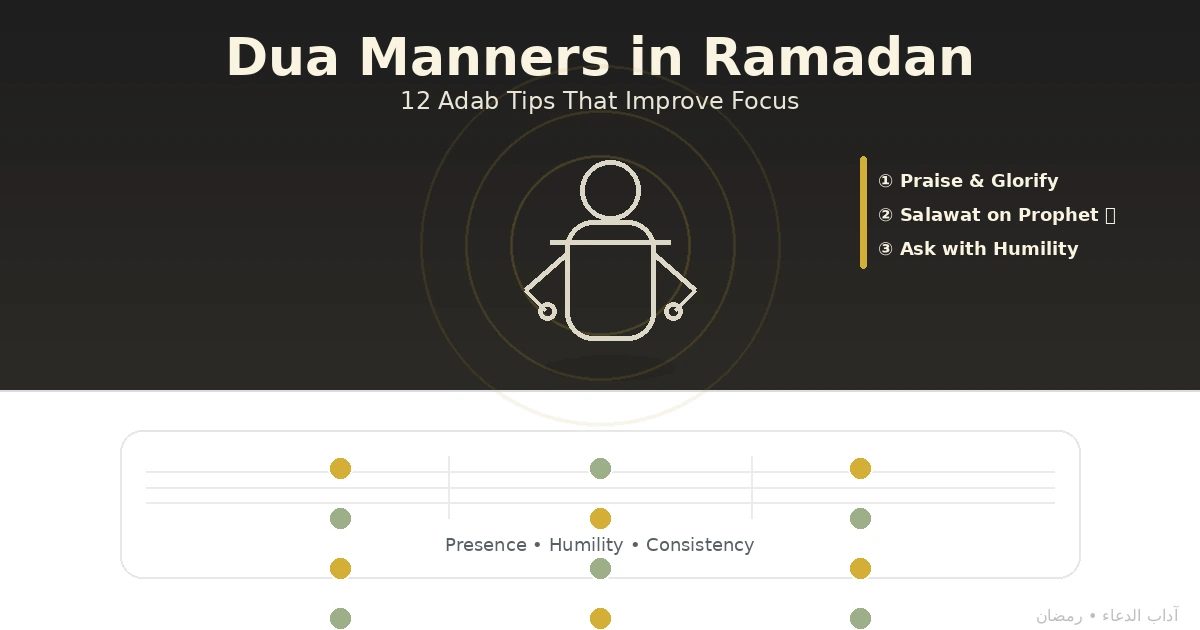
Dua Etiquette In Ramadan: 12 small things that improve focus
Ramadan changes the way you make du’a.
You’re hungrier, yes—but you’re also more honest. And that honesty can make du’a feel intense, even a little scary.
If you’ve ever whispered a du’a and thought, “I don’t even know if I’m doing this right,” this page is for you.
✅ TL;DR – dua etiquette in Ramadan
Start with praise, send salawat, ask simply, and end with trust. The biggest upgrade isn’t “more du’as”—it’s better presence. Use the 3-part structure below and practice 12 small adab habits at suhoor, before iftar, in sujood, and after salah.
What “adab” really means in du’a
Snippet answer: Adab in du’a means the “good manners of the heart.” It’s not fancy words. It’s how you show up—humble, hopeful, and present—like someone knocking on a door they truly believe will open.
Here’s my tea-time way of explaining it: du’a is like calling someone you love after a long silence.
You don’t start the call by yelling demands. You greet. You soften. You speak honestly. You listen to your own heart for a second. Then you ask.
That’s adab.
And yes, I used to rush du’a like a checklist when I was younger. My students always laugh when I admit that—because they do it too.
The simple 3-part du’a structure (easy to remember)
Snippet answer: A beginner-friendly du’a structure is: (1) praise Allah, (2) send blessings on the Prophet (salawat), (3) ask for what you need—then end with trust. This keeps your du’a grounded and stops the “blank mind” feeling.
When your brain goes empty, structure saves you.
- Praise: a short opening that reminds your heart who you’re speaking to.
- Salawat: send blessings (a simple, known line is enough).
- Ask: one clear request at a time—then end with hope.
One sentence paragraph, because it matters:
Don’t wait until you feel “perfect” to make du’a.
Salawat (a simple line you can use)
اللَّهُمَّ صَلِّ عَلَى مُحَمَّدٍ
Transliteration: Allāhumma ṣalli ʿalā Muḥammad.
Meaning: O Allah, send blessings upon Muhammad.
12 small things that improve focus (adab you can actually do)
Snippet answer: These 12 adab habits improve focus because they calm the heart and remove “du’a noise.” You’ll notice the shift fast: less rambling, less distraction, and more sincerity. Pick 3 today, then add more slowly—like building a clean prayer habit.
Don’t try to be a du’a superhero on Night 1. Start small.
- Start with presence, not speed. Pause one breath before you speak. That tiny pause changes the tone.
- Praise first. Even a short “Alhamdulillah” style opening (in your language is fine) helps your heart settle.
- Add salawat. It’s like sending respect before making a request.
- Ask for forgiveness early. Not because you’re “unworthy,” but because it clears the heart like wiping a foggy mirror.
- Make one request at a time. Beginners often make a “shopping cart du’a.” Try a single, clear ask.
- Use a soft voice. Whispering can reduce showing off and increase calm. (Also, it helps when kids are sleeping.)
- Repeat the same du’a daily. Repetition isn’t “boring.” It trains the heart to mean what it says.
- Don’t rush the answer. Avoid the hidden thought: “If it doesn’t happen fast, Allah said no.” That thought steals peace.
- Keep halal in mind. If you’re worried about income or food, make a sincere effort toward what’s clean. Then ask Allah for barakah.
- Choose your best moments. Sujood, before iftar, and after salah are calm windows. Pick two and stay steady.
- End with trust. Finish with hope, not drama. Like: “Allah, You know best—make it good for me.”
- Fix one relationship. Du’a and hearts go together. If you owe an apology, Ramadan is a gentle time to do it.
Micro-scenario: you’re making du’a before iftar and someone asks you to set the table. Don’t snap. Make du’a while you move. Real life worship counts.
Best Ramadan moments for du’a (without overthinking)
Snippet answer: In Ramadan, the most practical “high-focus” moments are: before iftar, in sujood, after fard prayers, and in the quiet of the night. You don’t need all of them daily. Pick two moments you can keep even when you’re tired.
Some people try to catch every moment, then burn out.
Better approach: choose a “home base.”
Before iftar: your heart is soft, you’re hungry, and you’re close to finishing an act of worship.
In sujood: it’s the most humble body position. The ego gets quieter there.
After salah: you’re already in worship mode—don’t break the mood too quickly.
At night: even five minutes can feel deep when the world is asleep.
Micro-scenario: you’re driving close to maghrib. Keep your eyes on the road. Make du’a quietly without lifting hands. Safety is also part of worship.
A tiny forgiveness du’a for any moment
رَبِّ اغْفِرْ لِي
Transliteration: Rabbighfir lī.
Meaning: My Lord, forgive me.
Why your du’a can feel “rejected” (without blaming yourself)
Snippet answer: Sometimes du’a feels rejected because we expect instant results, we’re distracted, or we’re asking in a scattered way. It can also be that Allah answers differently than we imagined. Your job is to ask with sincerity and keep coming back—not to read hidden messages into every delay.
This part needs gentleness.
Because a lot of people think: “If I’m not getting what I asked for, maybe Allah is angry with me.” And that thought can crush a person.
Here are a few simple possibilities that don’t require panic:
You’re asking like a rushed person. So the heart doesn’t “arrive.” Slow down.
You’re asking for 20 things at once. So your mind drifts. Ask for one thing clearly.
You’re watching the clock. “Did it happen yet?” That turns du’a into a transaction.
You’re being answered in a different form. Sometimes the gift is protection, not the exact thing you pictured.
And sometimes… you need to take one step. A real one. Even a small one.
Micro-scenario: you keep asking for protection from gossip, but you stay in the same group chat that fuels it. Make du’a, then mute the chat. That’s not “low faith.” That’s wisdom.
Five quirky beginner mistakes (and quick fixes)
Mistake 1: Only making du’a when you’re desperate. Quick fix: make short du’a even on “normal” days.
Mistake 2: Feeling guilty for repeating the same du’a daily. Quick fix: repetition builds sincerity.
Mistake 3: Thinking du’a must be in Arabic to “work.” Quick fix: ask in the language your heart understands.
Mistake 4: Turning du’a time into a performance. Quick fix: soften voice, hide your good deeds.
Mistake 5: Making du’a but never fixing harms to people. Quick fix: apologize, return rights, clean up what you can.
A short story (the night I saw du’a become simple)
A brother once told me after taraweeh, “I feel embarrassed making du’a. My words sound childish.”
He had memorized long lines, but his eyes looked tired.
I asked him to say one thing he truly wanted from Allah—just one.
He whispered it, then he went quiet and teared up.
Later he said, “That was the first time my du’a felt real.”
He didn’t need fancy words. He needed honesty.
Does du’a need Arabic? (and what about raising hands?)
Snippet answer: You can make personal du’a in any language. Arabic du’as are beautiful and many are well-known, but meaning and sincerity matter. As for raising hands, follow good manners and local practice—especially in congregation—without making it a fight.
If Arabic helps you stay consistent, use it.
If Arabic confuses you and kills your focus, use your language and keep going. Allah understands you better than you understand yourself.
About hands: sometimes hands are raised, sometimes not, depending on the moment and local practice. A beginner-safe rule is simple: don’t turn hand-position into a “who’s right” war. Keep the heart humble.
More Ramadan Du’as (to practice good adab)
If you want extra du’as to practice the structure and adab you learned here—short lines, clear meanings, and easy repetition—use the tool below as a simple library. It’s helpful on tired nights when your heart wants to ask Allah, but your brain doesn’t want to hunt through random screenshots.
Quick Copy
Dua etiquette in Ramadan: “moment + best adab move”
| Moment | Best focus habit | Keep it beginner-simple |
|---|---|---|
| Before iftar | Ask for one clear need + forgiveness | 30–60 seconds is enough |
| In sujood | Whisper short du’a with meaning | Repeat “Rabbighfir lī” slowly |
| After salah | Praise + salawat + one request | Don’t rush to your phone |
| Night prayer | Repeat a daily du’a theme | Same du’a nightly is okay |
📘 dua etiquette in Ramadan FAQs
how to make dua properly in Ramadan?
Show Answer
Use a simple structure: praise Allah, send salawat, then ask clearly and humbly. Keep it short enough to stay focused, and repeat the same du’a daily to build presence.
does dua need Arabic?
Show Answer
No. You can make personal du’a in any language. Arabic is beautiful and helpful for some, but sincerity and meaning matter.
دعاء آداب الدعاء في رمضان — what does “adab” mean?
Show Answer
Adab means good manners with Allah while making du’a: humility, calm confidence, and presence—without showing off or rushing.
why my dua feels rejected in Ramadan?
Show Answer
Often it’s because we expect instant results or we’re distracted. Keep asking with sincerity, simplify your requests, and keep doing the right steps in your life too.
should I raise hands in dua?
Show Answer
In congregation, follow the local practice to keep unity. When alone, keep your du’a humble and focused either way, without turning it into a debate.
what’s the best dua times Ramadan?
Show Answer
Practical high-focus moments are before iftar, in sujood, after fard prayers, and in the quiet part of the night. Pick two times you can keep consistently.
dua in sujood etiquette—what’s simplest?
Show Answer
Keep it short and present. Repeat a short du’a with meaning and add one personal request you truly need.
dua after salah etiquette—do I need a long script?
Show Answer
No. A short praise, a salawat line, and one clear request is enough. The goal is focus, not length.
dua before iftar etiquette—what should I ask for?
Show Answer
Ask for forgiveness first, then one real need: guidance, family well-being, strength to leave a habit, or barakah in your life. Keep it honest and short.
can I repeat the same dua daily?
Show Answer
Yes. Repeating the same du’a daily is often better for focus than switching every day. Repetition builds sincerity.
Related Articles
- Authentic Iftar Dua: What To Say When Breaking The Fast
- Ramadan Dua Routine: A Simple System From Moon Sighting To Eid
- Dua Before Iftar Accepted: Why it’s Special And What to Say
- Suhoor Dua Authentic: Is There An Authentic One (or just bismillah)?
- Niyyah For Fasting In Ramadan: What it is (and what it isn’t)
- Crescent Moon Dua Ramadan: What to Say When You See The Hilal
- Allahumma ballighna Ramadan: is it authentic (and what to say instead)?
- Dua For Forgiveness in Ramadan: 5 short duas to repeat daily

Farrukh Farooqi has been living in Sharaya, Makkah, Saudi Arabia since 2010. With over 14 years of firsthand experience witnessing the sacred journey of millions of pilgrims, Farrukh specializes in providing practical, insider tips for Hajj and Umrah travelers. His work blends real-world observations, the latest Saudi updates, and essential crowd management strategies — helping pilgrims and worshippers plan smarter, stay safer, and experience a spiritually fulfilling journey across the Holy Cities.


