
Dua After Witr Ramadan: what to say (short + common)
Some nights, you finish taraweeh and feel light.
Other nights, you feel rushed—shoes in hand, kids tugging sleeves, people flowing out of the masjid like a river.
And right there, a beginner question pops up: “What do I say after witr?”
You don’t need an endless script.
✅ TL;DR – dua after witr Ramadan
After witr in Ramadan, keep it simple: say the known post-witr dhikr (Subḥāna al-Maliki al-Quddūs), then make your personal du’a while you’re calm. If the imam does a long du’a in the masjid, follow with adab—then do your own short du’a later if you want. This page gives copy-ready Arabic, easy transliteration, and meanings.
What to say right after witr (the common short wording)
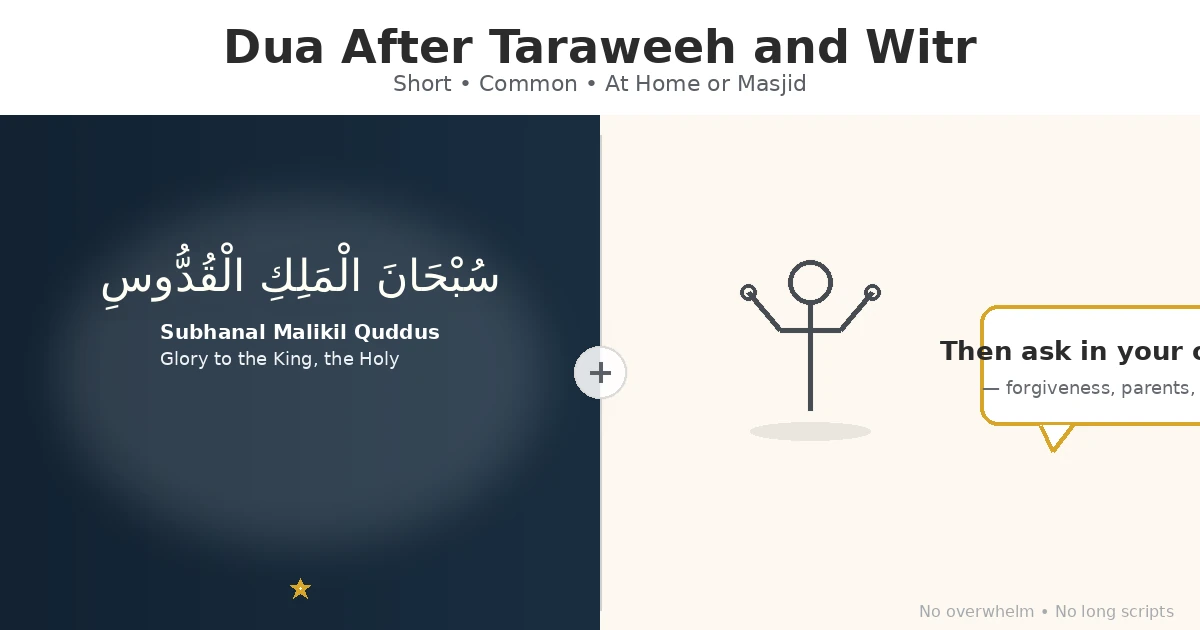
Snippet answer: The most common short wording after witr is the dhikr: “Subḥāna al-Maliki al-Quddūs” (Glory be to the King, the Most Pure). Many people repeat it a few times, then make personal du’a. If you only remember one line, remember this one.
It’s the “soft landing” after night prayer.
Post-witr dhikr
سُبْحَانَ الْمَلِكِ الْقُدُّوسِ
Transliteration: Subḥāna al-Maliki al-Quddūs.
Meaning: Glory be to the King, the Most Pure.
Micro-scenario: you’re praying at home and you’re half-asleep. Say this once with meaning. That’s already good.
Another micro-scenario: you’re in the masjid and people are pushing to leave. Say it quietly as you stand. No need to “announce” it.
Dua after taraweeh in the masjid
Snippet answer: In many masjids, the imam may make a longer du’a after taraweeh or after witr, and people say “Ameen.” If you’re in congregation, follow the imam respectfully. If you prefer shorter personal du’a, you can do it later—without judging others or turning it into an argument.
Some communities love the long du’a. Some people feel overwhelmed by it.
Both reactions exist in real life.
Neutral reminder (no fighting): different practices exist across places and teachers. A beginner doesn’t need to become the “du’a police.” Keep your heart soft and your manners clean.
Micro-scenario: the du’a gets long and your legs hurt. It’s okay to sit respectfully if needed. Don’t turn worship into a pain contest.
What to say after the short dhikr (your personal du’a)
Snippet answer: After the short dhikr, make a personal du’a in your own words—Arabic or your language. Pick one theme per night: forgiveness, guidance, family, or protection from a habit. Short and honest beats long and distracted.
Personal du’a is like talking to Allah without “stage lights.”
Quiet. Direct. Real.
Short personal du’a (easy to repeat)
رَبِّ اغْفِرْ لِي
Transliteration: Rabbighfir lī.
Meaning: My Lord, forgive me.
Another short one (when you feel stuck)
أَسْتَغْفِرُ اللَّهَ
Transliteration: Astaghfirullāh.
Meaning: I ask Allah to forgive me.
One sentence paragraph, because it matters:
Don’t wait for a “perfect mood” to make du’a.
A 30-second routine you can keep every night
Snippet answer: Do a tiny routine: say the post-witr dhikr, then make one personal du’a with a single request, then end. That’s it. The goal is consistency, not length.
Here’s an easy pattern you can actually repeat:
- Say: Subḥāna al-Maliki al-Quddūs (once or a few times).
- Ask: “Rabbighfir lī” (or your own words).
- Finish: one specific request (example: “Allah, fix my tongue,” “Allah, guide my child,” “Allah, protect my prayer”).
Micro-scenario: you’re leaving the masjid parking lot. Do it in the car before you start the engine. Thirty seconds. No guilt.
Five quirky beginner mistakes (and quick fixes)
Mistake 1: Thinking “If my du’a isn’t long, it doesn’t count.” Quick fix: short + focused is strong.
Mistake 2: Copying a long script you don’t understand. Quick fix: use 1–2 lines with meaning.
Mistake 3: Correcting others loudly in the masjid. Quick fix: keep adab; do your practice quietly.
Mistake 4: Getting stuck on pronunciation and giving up. Quick fix: say it gently; improve over time.
Mistake 5: Making du’a but never asking Allah to help you change a habit. Quick fix: add one honest line: “Allah, help me not go back.”
A short story (the “endless du’a” overwhelm)
A student once told me, “I love taraweeh, but the du’a after witr makes me panic.”
He thought he had to memorize everything the imam said.
I asked, “Do you understand even half?”
He said, “No… I just feel guilty.”
I told him: say the short dhikr, then ask Allah for one real need.
Next night he did that—and he said, “For the first time, I felt present instead of pressured.”
FAQs
📘 dua after witr Ramadan FAQs
what to say after witr?
Show Answer
Say the short post-witr dhikr “Subḥāna al-Maliki al-Quddūs,” then make your personal du’a in your own words. Keep it short and focused.
دعاء بعد الوتر في رمضان — is it only Arabic?
Show Answer
You can make personal du’a in any language. Arabic is beautiful, but sincerity and meaning matter. Use short Arabic lines if they help you stay consistent.
is long du’a after taraweeh sunnah?
Show Answer
Different practices exist in different communities. If your imam does a long du’a, follow respectfully. If you prefer short personal du’a, do it later without judging others.
can I make personal du’a after witr?
Show Answer
Yes. After witr is a calm moment for personal du’a. Ask for forgiveness, guidance, family needs, and strength to leave a habit.
how to keep it short when the masjid du’a is long?
Show Answer
Say “Ameen” with the imam, then do your own 30-second du’a later (walking out, in the car, or at home). Consistency beats pressure.
how do I pronounce “quddūs”?
Show Answer
Say it slowly as “qud-doos.” Don’t get stuck. Improve over time and focus on meaning.
is this the same as du’a in witr (qunūt)?
Show Answer
No. Qunūt is a du’a inside the witr prayer (when done). This page is about what people commonly say after finishing witr.
should I raise my hands after witr?
Show Answer
In the masjid, follow the local practice and the imam to keep unity. At home, keep your du’a calm and focused either way.
what’s a good du’a after taraweeh for parents?
Show Answer
Make it simple: ask Allah to forgive them, have mercy on them, and protect them. Even one honest sentence is enough.
does du’a have to be loud after taraweeh?
Show Answer
No. Quiet du’a is fine. The goal is sincerity and focus, not volume.
After-taraweeh and after-witr: what to do where
| Where you are | What to say first | Best “keep it short” move |
|---|---|---|
| Masjid (congregation) | Follow imam’s du’a with adab | Do a 30-second personal du’a later |
| Home (alone/family) | Subḥāna al-Maliki al-Quddūs | One focused request (forgiveness/guidance) |
| Leaving / in the car | A short istighfar | Don’t skip it—do it “on the move” |
More Ramadan Du’as (Quick Copy for Night Prayer)
If you want a small menu of short du’as you can use after taraweeh and witr—without scrolling random social posts—this tool gives you copy-ready Ramadan du’as in one place. It’s handy on nights when your brain is tired but your heart still wants to ask Allah.
Quick Copy
Related Articles
- Authentic Iftar Dua: What To Say When Breaking The Fast
- Ramadan Dua Routine: A Simple System From Moon Sighting To Eid
- Dua Before Iftar Accepted: Why it’s Special And What to Say
- Suhoor Dua Authentic: Is There An Authentic One (or just bismillah)?
- Niyyah For Fasting In Ramadan: What it is (and what it isn’t)
- Crescent Moon Dua Ramadan: What to Say When You See The Hilal
- Allahumma ballighna Ramadan: is it authentic (and what to say instead)?
- Dua For Forgiveness in Ramadan: 5 short duas to repeat daily


