
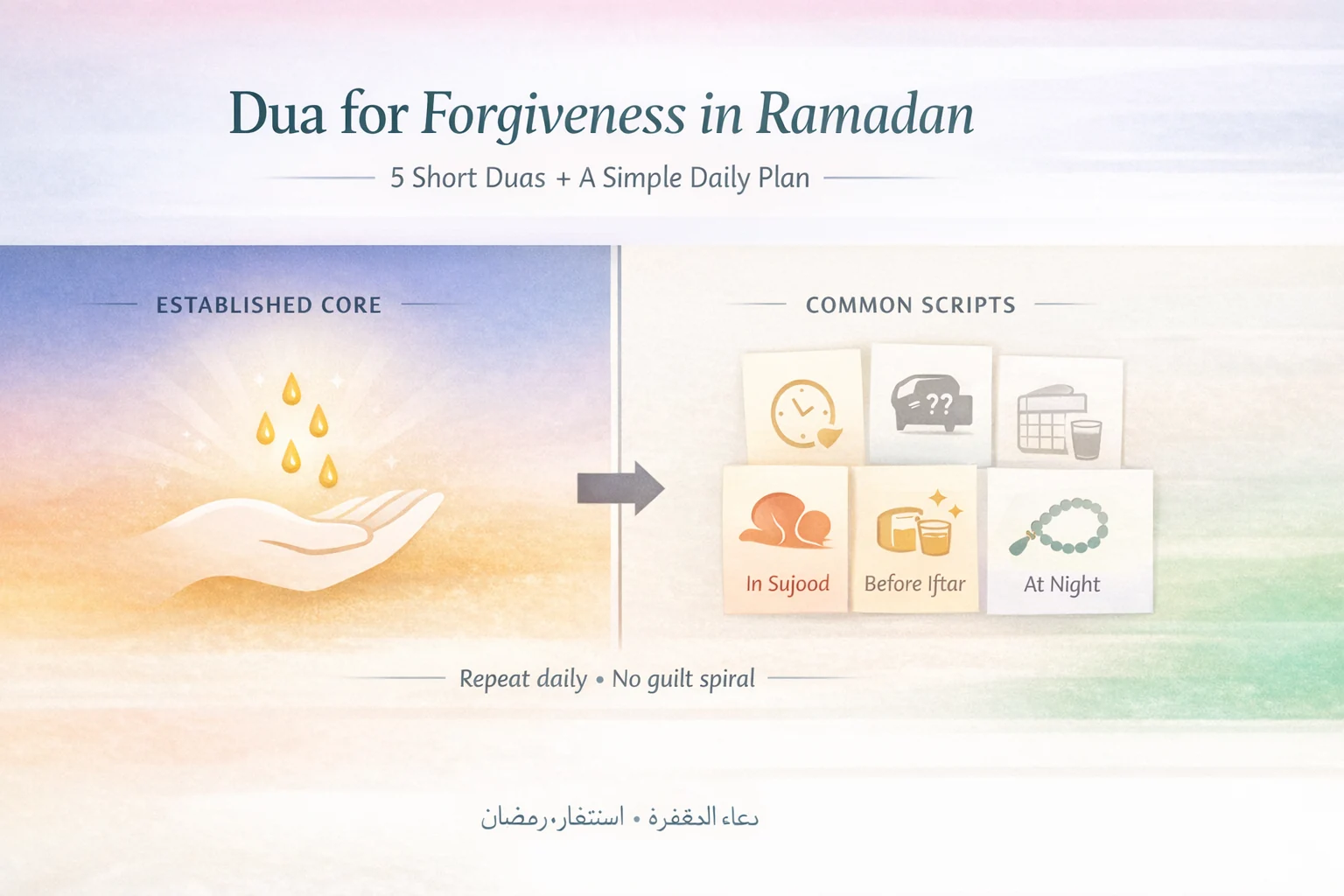
Dua For Forgiveness in Ramadan: 5 short duas to repeat daily
Ramadan does something funny to the conscience.
In the day, you’re trying to be good. At night, every old mistake shows up like a pop-up you didn’t invite.
If you’ve felt that “heavy chest” feeling, you’re not alone.
Here’s the relief: a dua for forgiveness in Ramadan doesn’t have to be long. Pick a few short du’as, repeat them daily, and let consistency do its quiet work. This page gives you five easy options (Arabic + transliteration + meaning) and a simple plan so you don’t spiral into guilt—you soften the heart, then you move forward.
One sincere sentence can change the whole night.
✅ TL;DR – dua for forgiveness in Ramadan
Choose 2–3 short forgiveness du’as and repeat them daily: after prayers, in sujood, before iftar, and at night. Don’t chase a huge list. Repeat the same words until your heart starts believing them again. Then add one personal request: “Allah, help me not return to this sin.”
Why forgiveness du’a hits differently in Ramadan
Snippet answer: Forgiveness du’a feels stronger in Ramadan because you’re already training self-control, your schedule includes more worship, and your heart is more alert. You’re hungry, yes—but you’re also more honest. That honesty makes tawbah (repentance) real, not just “religious talk.”
Think of the heart like a shirt that gets small stains during the year.
Ramadan is the month you finally soak it, scrub it, and stop pretending the stains aren’t there.
And no—this doesn’t mean you have to cry every night to be accepted. Some people cry. Some people don’t. Allah knows what’s inside.
Micro-scenario: you’re sitting after taraweeh and suddenly remember a sin from years ago. That memory isn’t always “Shaytan ruining your night.” Sometimes it’s your heart being invited to clean up.
The 5 short du’as to repeat daily
Snippet answer: These five du’as are short enough to repeat daily without burnout. Use them like “daily bread”: after salah, in sujood, before iftar, and at night. Read the meaning each time—because du’a without meaning can turn into background noise.
I used to chase long lists when I was learning. My notebook looked impressive… and my heart stayed the same.
What helped my students most was repetition with meaning. The same few lines, again and again.
Du’a #1 (simple istighfar)
أَسْتَغْفِرُ اللَّهَ
Transliteration: Astaghfirullāh.
Meaning: I ask Allah to forgive me.
Du’a #2 (short, powerful)
رَبِّ اغْفِرْ لِي
Transliteration: Rabbighfir lī.
Meaning: My Lord, forgive me.
Du’a #3 (for you and your parents)
اللَّهُمَّ اغْفِرْ لِي وَلِوَالِدَيَّ
Transliteration: Allāhumma’ghfir lī wa li-wālidayya.
Meaning: O Allah, forgive me and my parents.
Du’a #4 (a clean “we” du’a)
رَبَّنَا اغْفِرْ لَنَا
Transliteration: Rabbanā’ghfir lanā.
Meaning: Our Lord, forgive us.
Du’a #5 (the famous “ʿafw” du’a)
اللَّهُمَّ إِنَّكَ عَفُوٌّ تُحِبُّ الْعَفْوَ فَاعْفُ عَنِّي
Transliteration: Allāhumma innaka ʿafuwwun tuḥibbul-ʿafwa faʿfu ʿannī.
Meaning: O Allah, You are Most Pardoning and You love pardon, so pardon me.
Micro-scenario: you’re making du’a and you suddenly think, “I’ve said Astaghfirullah a thousand times… why am I still weak?”
Try this: say it slower. Then add one honest line: “Allah, I hate this habit. Help me stop.” That second line is often what people avoid.
A simple daily plan (no overwhelm)
Snippet answer: Use a repeatable “4-stop” plan: after salah, in sujood, before iftar, and at night. At each stop, repeat one short du’a 7–10 times, then make one personal request. This keeps forgiveness du’a part of your routine without turning it into a massive project.
Here’s a routine that actually fits real life—worker, student, parent, anyone.
- After any fard salah: repeat Du’a #1 or #2 (7 times), then ask for one specific forgiveness.
- In sujood (even for 10 seconds): repeat Du’a #2 (“Rabbighfir lī”) slowly.
- Before iftar: repeat Du’a #5 once or three times, then ask for what you truly need.
- At night (before sleep): repeat Du’a #1 (“Astaghfirullah”) until you feel calmer, then make one promise: “Allah, help me not return.”
Two minutes. That’s enough to start.
Quirky beginner mistake #1: making a “perfect Ramadan plan” on Day 1… then giving up on Day 3. Quick fix: pick one plan you can keep even when you’re tired.
What to ask for when you feel guilty
Snippet answer: When guilt hits, ask for (1) forgiveness, (2) protection from repeating the sin, and (3) a replacement habit. Guilt without direction can turn into despair. Du’a turns guilt into a door back to Allah.
Forgiveness du’a isn’t only “erase my past.” It’s also “change my future.”
If you don’t know what to say, keep it practical:
- “Forgive what I did.”
- “Hide my faults from people.”
- “Help me not go back to it.”
- “Give me a clean habit instead.”
Micro-scenario: you’re trying to quit gossip, but the moment you sit with friends, it starts again. Your du’a can be simple: “Allah, protect my tongue today.” Then… change seats if you need to. Du’a and effort belong together.
Quirky beginner mistake #2: asking forgiveness, then immediately doing the same sin “because Ramadan is forgiving anyway.” Quick fix: ask forgiveness and ask for strength to quit.
Tawbah (repentance) in plain words
Snippet answer: Tawbah is returning to Allah with regret, stopping the sin, and choosing not to go back. If you wronged someone, you also try to fix it. It’s not a dramatic speech—more like turning your car around when you realize you took the wrong exit.
Here’s the everyday analogy: tawbah is like spilling tea on someone’s carpet.
You don’t just say “sorry” and walk away while it’s soaking in.
You feel bad, you stop the mess, you try to clean it, and you don’t do it again. That’s tawbah—simple, honest, real.
Quirky beginner mistake #3: thinking “If my tears aren’t flowing, my tawbah isn’t real.” Quick fix: regret can be quiet. Allah sees the heart, not the performance.
The strongest moments to make forgiveness du’a in Ramadan
Snippet answer: The strongest everyday moments are: in sujood, right after fard salah, before iftar, and during the quiet part of the night. You don’t need all of them daily. Pick two moments and keep them steady.
This isn’t about hunting “rare bonus minutes.” It’s about showing up regularly.
Micro-scenario: you’re rushing before jama’ah. You don’t have time for a long du’a. Make it small: one “Rabbighfir lī” in sujood, and you’ve still planted something.
Quirky beginner mistake #4: spending 30 minutes on du’a and missing the fard prayer on time. Quick fix: protect the basics first. The heart loves order.
Five quirky beginner mistakes (and quick fixes)
Mistake 1: “I need 50 du’as or it doesn’t count.” Quick fix: repeat 2–3 du’as with meaning.
Mistake 2: Only asking forgiveness, never asking for change. Quick fix: add “help me not return.”
Mistake 3: Turning istighfar into background noise. Quick fix: slow it down and picture what you’re asking.
Mistake 4: Feeling unworthy, so you stop making du’a. Quick fix: keep asking—despair isn’t worship.
Mistake 5: Fixing “big sins” but ignoring tongue sins. Quick fix: ask forgiveness for gossip, sarcasm, and harming others too.
A short story (a beginner mistake and the simple fix)
A young man once told me, “I’m making du’a, but I keep feeling dirty.”
He said istighfar fast, like he was paying a bill.
I asked him to say one line slowly: “Rabbighfir lī.”
Then I asked, “What do you want Allah to fix in you?”
He paused, named one habit, and made one honest du’a about it.
Next week he said, “That one honest line felt heavier than a thousand rushed words.”
FAQs (English + Arabic keywords)
📘 dua for forgiveness in Ramadan FAQs
what is the best dua for forgiveness Ramadan?
Show Answer
Pick a short du’a you can repeat daily with meaning—like “Astaghfirullah,” “Rabbighfir lī,” and “Allāhumma innaka ʿafuww…” Consistency matters more than collecting a huge list.
دعاء المغفرة في رمضان — can I read it in English?
Show Answer
Yes. Ask Allah in your language. Arabic is beautiful, but sincerity and meaning are what make du’a real.
what should I say in sujood for forgiveness?
Show Answer
Keep it short: “Rabbighfir lī” repeated slowly is enough. Then add one personal request: “Help me stop returning to this.”
is saying “Astaghfirullah” enough?
Show Answer
Yes, if you say it with meaning. If it becomes automatic, slow it down and pair it with one honest personal du’a.
what if I keep repeating the same sin in Ramadan?
Show Answer
Don’t stop asking. Make tawbah again, then add one real change: remove a trigger, change a habit, or limit a situation that pulls you back.
is guilt a sign Allah rejected me?
Show Answer
Not necessarily. Guilt can be a wake-up call. Turn it into du’a and action, not despair.
dua after salah for forgiveness—what’s easiest?
Show Answer
Repeat “Astaghfirullah” a few times, then say “Allahumma’ghfir lī” or “Rabbighfir lī” and ask for one specific forgiveness.
can I make du’a for my parents’ forgiveness in Ramadan?
Show Answer
Yes. “Allāhumma’ghfir lī wa li-wālidayya” is a simple daily du’a you can repeat without effort.
forgiveness du’a before iftar—what should I say?
Show Answer
Say a short du’a like “Allāhumma innaka ʿafuww…” then make personal du’a: forgiveness, guidance, and strength to change.
how do I make tawbah in Ramadan in one minute?
Show Answer
Regret the sin, stop it, ask Allah to forgive you, and make a real choice not to return. Then take one small step to remove what pulls you back.
Forgiveness routine map (when to say what)
| Moment | Best short du’a | Keep it beginner-simple |
|---|---|---|
| After fard salah | Astaghfirullāh / Rabbighfir lī | 7 slow repeats + 1 personal request |
| In sujood | Rabbighfir lī | Even 10 seconds counts |
| Before iftar | Allāhumma innaka ʿafuww… | Say it once, then ask for your real needs |
| Before sleep | Astaghfirullāh | Turn regret into a calm plan for tomorrow |
More Ramadan Du’as You Can Copy
If you want more short du’as beyond forgiveness—du’as for suhoor, iftar, and the last ten nights—use the tool below as a simple “grab-and-go” library. It saves you from random screenshots and helps you stick to a small set you can repeat with meaning.
Quick Copy
Related Articles
- Authentic Iftar Dua: What To Say When Breaking The Fast
- Ramadan Dua Routine: A Simple System From Moon Sighting To Eid
- Dua Before Iftar Accepted: Why it’s Special And What to Say
- Suhoor Dua Authentic: Is There An Authentic One (or just bismillah)?
- Niyyah For Fasting In Ramadan: What it is (and what it isn’t)
- Crescent Moon Dua Ramadan: What to Say When You See The Hilal
- Allahumma ballighna Ramadan: is it authentic (and what to say instead)?


