
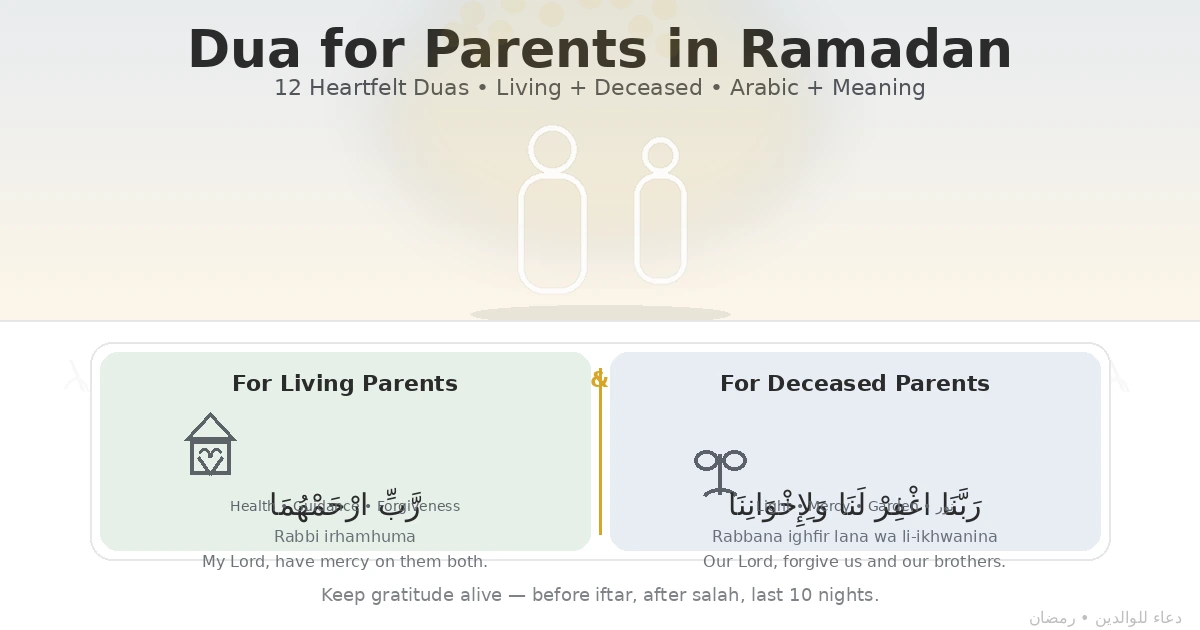
Dua for parents in Ramadan: 12 heartfelt duas (Arabic + meaning)
Ramadan has a way of softening the heart.
And when your heart softens, you start remembering people who carried you—quietly, daily, without applause.
Parents.
If you want one habit that feels “real” in Ramadan, make du’a for them every day.
✅ TL;DR – dua for parents in Ramadan
You don’t need complicated wording. Pick 2–3 short du’as and repeat them daily: before iftar, after salah, and in sujood. This page gives 12 heartfelt options (living + deceased parents) with Arabic, easy transliteration, and meaning—so you can stay consistent without overwhelm.
why du’a for parents hits differently in Ramadan
Snippet answer: Dua for parents in Ramadan feels powerful because fasting makes you more honest and more grateful. Your “busy” excuses get quieter. You notice sacrifices you used to ignore. Even a short daily du’a keeps love alive, repairs guilt, and turns gratitude into worship—especially when you repeat it at the same times each day.
Here’s a simple picture: making du’a for your parents is like paying back a debt you can never fully pay.
You’ll never match what they did. But the steady effort means something.
Also… it protects you from a very human mistake: only appreciating people after they’re gone.
best times to repeat these du’as (easy daily rhythm)
Snippet answer: The easiest times to make du’a for parents are moments you already have: before iftar, after fard prayers, and in sujood. In the last ten nights, add one extra minute for deeper du’a. You don’t need long sessions—consistency is the win.
Micro-scenario: you’re standing in the kitchen, waiting for maghrib, holding a date. That quiet minute is perfect. No speeches. Just love.
Micro-scenario: after salah, you usually reach for your phone. Hold it. Make one du’a for your mother, one for your father. Then continue your day.
Micro-scenario: in sujood, your heart is already humble. Add a short line for them. It’s simple, and it stays with you.
a 3-minute routine that families can actually keep
Snippet answer: Use a tiny routine: one du’a before iftar, one du’a after salah, and one du’a before sleep. That’s three minutes total. If you keep it daily, you’ll build a habit that survives busy workdays, school nights, and tired Ramadan evenings.
- Before iftar: choose one mercy du’a for both parents.
- After salah: choose one forgiveness du’a (living or deceased).
- Before sleep: choose one “good ending” du’a and add your personal words.
One sentence, because it saves people: Even one du’a a day is better than a perfect plan you quit.
12 heartfelt duas (living + deceased) with Arabic, transliteration, and meaning
Snippet answer: Below are 12 short du’as you can repeat for your parents in Ramadan. Some are Qur’anic supplications, and some are simple personal du’as in clear Arabic. Use the ones that match your situation: living parents, sick parents, elderly parents, or deceased parents. Keep it sincere and steady.
A gentle note: scholars may differ on some “extra” practices people attach to Ramadan for the deceased. Don’t fight about it. Keep your du’a sincere, avoid making big claims, and focus on what’s always good: mercy, forgiveness, and gratitude.
Du’a 1 (mercy for parents)
رَبِّ ارْحَمْهُمَا كَمَا رَبَّيَانِي صَغِيرًا
Transliteration: Rabbi irḥamhumā kamā rabbayānī ṣaghīrā.
Meaning: My Lord, have mercy on my parents as they raised me when I was small.
Du’a 2 (forgiveness for you + parents)
رَبَّنَا اغْفِرْ لِي وَلِوَالِدَيَّ وَلِلْمُؤْمِنِينَ يَوْمَ يَقُومُ الْحِسَابُ
Transliteration: Rabbanā ghfir lī wa li-wālidayya wa lil-mu’minīna yawma yaqūmul-ḥisāb.
Meaning: Our Lord, forgive me and my parents and the believers on the Day the account is established.
Du’a 3 (wide forgiveness)
رَبِّ اغْفِرْ لِي وَلِوَالِدَيَّ وَلِمَنْ دَخَلَ بَيْتِيَ مُؤْمِنًا وَلِلْمُؤْمِنِينَ وَالْمُؤْمِنَاتِ
Transliteration: Rabbi ghfir lī wa li-wālidayya wa liman dakhala baytiya mu’minā, wa lil-mu’minīna wal-mu’mināt.
Meaning: My Lord, forgive me and my parents and whoever enters my home as a believer, and forgive believing men and believing women.
Du’a 4 (health for parents)
اللَّهُمَّ اشْفِ أَبِي وَأُمِّي
Transliteration: Allāhumma ishfi abī wa ummī.
Meaning: O Allah, cure my father and my mother.
Du’a 5 (protection)
اللَّهُمَّ احْفَظْ أَبِي وَأُمِّي
Transliteration: Allāhumma iḥfaẓ abī wa ummī.
Meaning: O Allah, protect my father and my mother.
Du’a 6 (guidance)
اللَّهُمَّ اهْدِ أَبِي وَأُمِّي
Transliteration: Allāhumma ihdi abī wa ummī.
Meaning: O Allah, guide my father and my mother.
Du’a 7 (ease in old age)
اللَّهُمَّ يَسِّرْ أَمْرَهُمَا وَارْزُقْهُمَا السَّلَامَةَ
Transliteration: Allāhumma yassir amrahumā warzuqhumā as-salāmah.
Meaning: O Allah, make their affairs easy and grant them well-being.
Du’a 8 (barakah in rizq)
اللَّهُمَّ بَارِكْ لَهُمَا فِي رِزْقِهِمَا وَصِحَّتِهِمَا
Transliteration: Allāhumma bārik lahumā fī rizqihimā wa ṣiḥḥatihimā.
Meaning: O Allah, bless their provision and their health.
Du’a 9 (forgiveness for parents)
اللَّهُمَّ اغْفِرْ لِأَبِي وَأُمِّي
Transliteration: Allāhumma ghfir li-abī wa ummī.
Meaning: O Allah, forgive my father and my mother.
Du’a 10 (mercy for deceased parents)
اللَّهُمَّ ارْحَمْهُمَا وَعَافِهِمَا وَاعْفُ عَنْهُمَا
Transliteration: Allāhumma irḥamhumā wa ʿāfihimā waʿfu ʿanhumā.
Meaning: O Allah, have mercy on them, grant them well-being, and pardon them.
Du’a 11 (a good home in the next life)
اللَّهُمَّ اجْعَلْ مَثْوَاهُمَا الْجَنَّةَ
Transliteration: Allāhumma ijʿal mathwāhumā al-jannah.
Meaning: O Allah, make their abode Paradise.
Du’a 12 (reunion with parents)
اللَّهُمَّ اجْمَعْنِي بِهِمَا فِي الْفِرْدَوْسِ الْأَعْلَى
Transliteration: Allāhumma ijmaʿnī bihimā fil-firdawsil-aʿlā.
Meaning: O Allah, reunite me with them in the highest Paradise.
five quirky mistakes people make (and quick fixes)
Snippet answer: Most “mistakes” aren’t evil—they’re just human. People delay du’a until they’re emotional, they only remember one parent, or they turn du’a into guilt. The fix is simple: keep du’a short, repeat it daily, include both parents, and let love lead—especially before iftar and after salah.
Mistake 1: Only making du’a when you feel guilty. Quick fix: make du’a on calm days too.
Mistake 2: Remembering parents in Ramadan… and ignoring them the rest of the year. Quick fix: keep one du’a after salah even after Eid.
Mistake 3: Making du’a for your mother but forgetting your father (or the reverse). Quick fix: keep a “both parents” line as your default.
Mistake 4: Using du’a to avoid action. Quick fix: make du’a, then call them, visit them, or serve them in one small way.
Mistake 5: Turning du’a into a competition with long scripts. Quick fix: short and sincere wins.
a short story (the simplest parent-du’a habit i’ve seen)
Snippet answer: The easiest habit is pairing du’a with an existing daily moment. One person I taught used the “date in hand” minute before iftar: one du’a for mercy, one for forgiveness, then a quick message to his parents. It was small, but it stayed consistent—and it changed his Ramadan mood.
A student once told me, “I keep forgetting du’a for my parents.”
I asked, “When do you never forget something in Ramadan?”
He laughed and said, “Iftar.”
So I gave him a tiny rule: before the first bite, say Du’a 1, then Du’a 9.
Next week he said, “I also started calling my mother right after.”
Not a big speech. Just love, repeated.
More Ramadan du’as you can reuse (when you want variety)
If you want extra du’as to rotate—without hunting through random screenshots—use the tool below. It helps you keep your parent-du’a habit steady while adding new du’as slowly when your heart wants more words.
Quick Copy
When to make du’a for parents in Ramadan (simple plan)
| Moment | Best du’a choice | Why it works |
|---|---|---|
| Before iftar | Du’a 1 + Du’a 9 | Easy daily trigger + soft heart moment |
| After salah | Du’a 2 or Du’a 3 | Short, repeatable, keeps gratitude steady |
| In sujood | Du’a 6 + personal words | Private, humble, focused |
| Last ten nights | Du’a 10–12 (deceased) or 4–8 (living) | Adds depth without adding stress |
📘 dua for parents in Ramadan FAQs
what is the best dua for parents in Ramadan?
Show Answer
Use a short mercy du’a you can repeat daily—then stay consistent. A strong default is asking Allah to have mercy on them and forgive them, especially before iftar and after salah.
دعاء للوالدين في رمضان — هل هناك دعاء قصير وسهل؟
Show Answer
نعم. اختر دعاء واحدًا قصيرًا وكرره يوميًا، مثل دعاء الرحمة للوالدين. التكرار أهم من كثرة الكلمات.
can I make dua for parents in English?
Show Answer
Yes. Ask Allah in the language your heart understands. Arabic du’as are beautiful, but meaning and sincerity come first.
dua for living parents vs deceased parents—what changes?
Show Answer
For living parents, you often ask for health, protection, guidance, and ease. For deceased parents, you focus on mercy, forgiveness, pardon, and a good home in the next life.
dua for a sick mother in Ramadan—what should I say?
Show Answer
Keep it simple: ask Allah for shifā’ (healing), relief, and ease. Repeat a short line daily, especially before iftar and after salah.
dua for a deceased father in Ramadan—when is the best time?
Show Answer
Any time is good, but the easiest routine is before iftar and after prayers. In the last ten nights, add one extra minute for deeper du’a without rushing.
is it okay to repeat the same dua for parents every day?
Show Answer
Yes. Repeating the same du’a daily often builds more sincerity than switching every day. Consistency beats variety.
dua for parents forgiveness—should I feel guilty if I wasn’t a good child?
Show Answer
Don’t let guilt freeze you. Start now: make du’a, apologize if needed, and do one small act of service. Ramadan is a good time for soft repairs.
dua before iftar for parents—what’s a quick one?
Show Answer
Choose one mercy line and one forgiveness line. Keep it under 30 seconds so you can stay consistent daily.
how do I build a daily habit of dua for parents?
Show Answer
Attach it to a daily trigger: the date in your hand before iftar, the moment after salah, or bedtime. Use the same 2–3 du’as until it becomes automatic.
Related Articles
- Authentic Iftar Dua: What To Say When Breaking The Fast
- Ramadan Dua Routine: A Simple System From Moon Sighting To Eid
- Dua Before Iftar Accepted: Why it’s Special And What to Say
- Suhoor Dua Authentic: Is There An Authentic One (or just bismillah)?
- Niyyah For Fasting In Ramadan: What it is (and what it isn’t)
- Crescent Moon Dua Ramadan: What to Say When You See The Hilal
- Allahumma ballighna Ramadan: is it authentic (and what to say instead)?
- Dua For Forgiveness in Ramadan: 5 short duas to repeat daily
- Dua Etiquette In Ramadan: 12 small things that improve focus
- Ramadan duas for kids: 10 short duas (Arabic + easy English)

Farrukh Farooqi has been living in Sharaya, Makkah, Saudi Arabia since 2010. With over 14 years of firsthand experience witnessing the sacred journey of millions of pilgrims, Farrukh specializes in providing practical, insider tips for Hajj and Umrah travelers. His work blends real-world observations, the latest Saudi updates, and essential crowd management strategies — helping pilgrims and worshippers plan smarter, stay safer, and experience a spiritually fulfilling journey across the Holy Cities.


