
Dua for deceased in Ramadan: what to say (simple and sincere)
Grief doesn’t always come with tears.
Sometimes it comes quietly—right before iftar, when the table feels full but one chair feels missing.
If you’re here because you want to make du’a for someone who passed away, you’re already doing something beautiful.
And the good news is: you don’t need fancy wording. You need a real heart.
✅ TL;DR – dua for deceased in Ramadan
Keep it simple: ask Allah for mercy, forgiveness, and a higher rank for the deceased. Pick 2 short du’as and repeat them daily—after salah and before iftar. In the last ten nights, add one extra minute for deeper du’a. Arabic helps, but sincerity matters more than perfect pronunciation.
what to say for someone who died (the simplest wording)
Snippet answer: The simplest du’a for the deceased is asking Allah to forgive them and have mercy on them. You can say it in Arabic or in your own language. The core meanings are: maghfirah (forgiveness), rahmah (mercy), light and ease, and raising their rank.
I often tell students: think of du’a like sending a gift when you can’t visit.
Not flowers. Not noise. Something that reaches the soul.
And yes—if your Arabic is shaky, don’t freeze. Make du’a anyway.
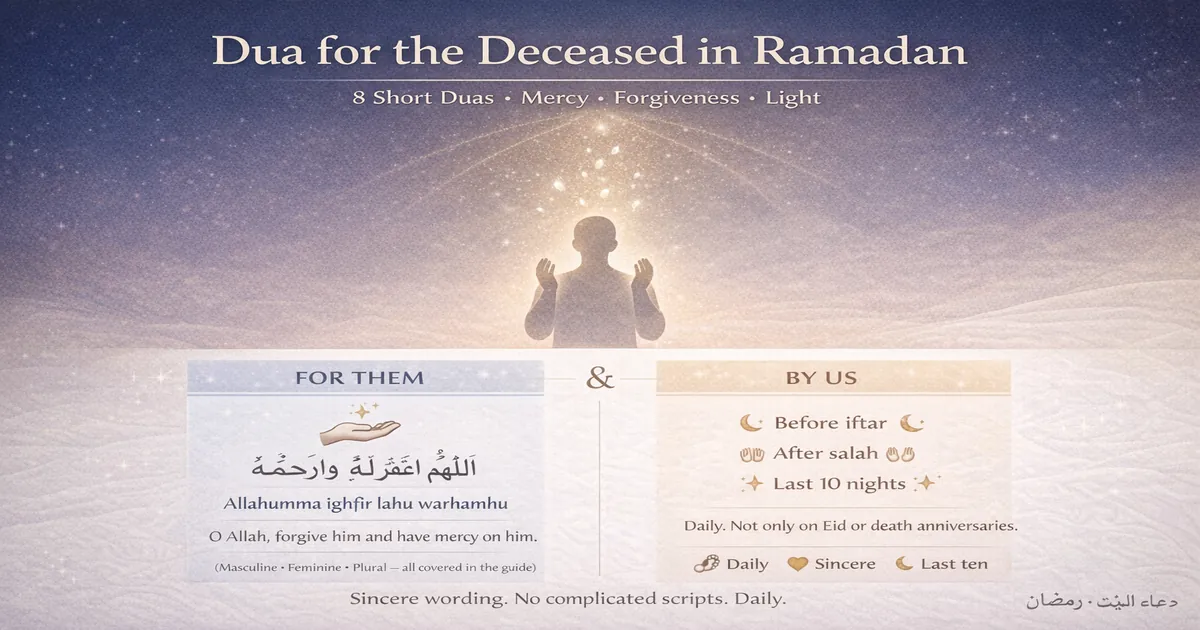
8 short duas for the deceased (Arabic + transliteration + meaning)
Snippet answer: These 8 du’as cover the most common needs we ask for the deceased: forgiveness, mercy, a spacious grave, light, and a higher rank. Choose 2–3 and repeat them daily. Add the person’s name in your personal du’a right after, in any language.
Du’a 1 (forgiveness + mercy)
اللَّهُمَّ اغْفِرْ لَهُ وَارْحَمْهُ
Transliteration: Allāhumma ighfir lahu warḥamhu.
Meaning: O Allah, forgive him and have mercy on him.
Du’a 2 (for a woman)
اللَّهُمَّ اغْفِرْ لَهَا وَارْحَمْهَا
Transliteration: Allāhumma ighfir lahā warḥamhā.
Meaning: O Allah, forgive her and have mercy on her.
Du’a 3 (spacious grave)
اللَّهُمَّ اجْعَلْ قَبْرَهُ رَوْضَةً مِنْ رِيَاضِ الْجَنَّةِ
Transliteration: Allāhumma ijʿal qabrahu rawḍatan min riyāḍil-jannah.
Meaning: O Allah, make his grave a garden from the gardens of Paradise.
Du’a 4 (light in the grave)
اللَّهُمَّ نَوِّرْ قَبْرَهُ
Transliteration: Allāhumma nawwir qabrahu.
Meaning: O Allah, fill his grave with light.
Du’a 5 (raise their rank)
اللَّهُمَّ ارْفَعْ دَرَجَتَهُ
Transliteration: Allāhumma irfaʿ darajatahu.
Meaning: O Allah, raise his rank.
Du’a 6 (cover their faults)
اللَّهُمَّ تَجَاوَزْ عَنْ سَيِّئَاتِهِ
Transliteration: Allāhumma tajāwaz ʿan sayyi’ātih.
Meaning: O Allah, overlook his sins.
Du’a 7 (make them among the forgiven)
اللَّهُمَّ اجْعَلْهُ مِنَ الْمَغْفُورِ لَهُمْ
Transliteration: Allāhumma ijʿalhu minal-maghfūr lahum.
Meaning: O Allah, make him among those You forgive.
Du’a 8 (du’a for parents who passed away)
اللَّهُمَّ اغْفِرْ لِوَالِدَيَّ وَارْحَمْهُمَا
Transliteration: Allāhumma ighfir li-wālidayya warḥamhumā.
Meaning: O Allah, forgive my parents and have mercy on them.
can I make du’a in English for the deceased?
Snippet answer: Yes. If you don’t know Arabic, make du’a in English (or your language). Allah understands every language. Arabic is a blessing when you know it, but sincerity is what carries the du’a. Don’t let embarrassment block you from making du’a at all.
One sentence for your heart: Allah isn’t impressed by accents. He loves truth.
your simple daily plan: before iftar + after salah + last ten nights
Snippet answer: A simple plan is: after each salah, say one short du’a for forgiveness. Before iftar, add mercy and light du’as. In the last ten nights, add one extra minute and mention names one by one. Keep it short enough to continue daily.
Here’s a calm routine you can keep:
- After salah (10 seconds): Du’a 1 or 8
- Before iftar (30 seconds): Du’a 4 + your personal words
- Last ten nights (1 minute): Du’a 3 + names + personal du’a
Micro-scenario: you’re at a crowded group iftar and you don’t want to cry in public. Whisper Du’a 1 quietly. That’s enough.
ramadan charity for the deceased (gentle and practical)
Snippet answer: Many people like to give charity in Ramadan and ask Allah to reward the deceased. Keep it sincere and simple: give what you can, then make du’a for them. Don’t turn it into guilt spending. Even small charity with sincere du’a can be meaningful.
Small aside: people sometimes feel they must do a “big donation” to prove love. That pressure can become ugly. Love doesn’t need drama.
five quirky mistakes people make (and quick fixes)
Snippet answer: The most common mistakes are overcomplicating du’a, treating grief like shame, and delaying du’a because Arabic feels hard. The fix is to keep a short script, repeat it daily, and add personal words. The best du’a is the one you actually say.
Mistake 1: Waiting for “the perfect night.” Quick fix: do it daily, even for 10 seconds.
Mistake 2: Feeling guilty for moving on. Quick fix: grief changes shape; du’a keeps love alive.
Mistake 3: Copying long scripts you can’t keep. Quick fix: pick 2 du’as and repeat them.
Mistake 4: Avoiding du’a because Arabic feels scary. Quick fix: use English, then learn one short Arabic line slowly.
Mistake 5: Turning grave visits into a “ritual show.” Quick fix: keep it respectful and du’a-focused.
a short story: the name list that healed the heart
Snippet answer: A simple “name list” can turn scattered grief into steady du’a. Write 3–10 names, and mention one name daily before iftar. It keeps you consistent without overwhelming you. Over time, the heart softens and du’a becomes a comforting habit, not a panic moment.
A young man once told me, “I want to make du’a for my father, but I freeze.”
He’d open his mouth and nothing would come out.
I said, “Write his name on your phone notes. That’s it.”
Before iftar, he said Du’a 8 and read the name. No speech. No performance.
He did it for ten days. Then he added his grandparents.
Later he said, “I finally feel like I’m doing something for them.”
More Ramadan du’as (to support your routine)
If you want extra Ramadan du’as to rotate—especially short ones you can repeat alongside your du’a for the deceased—use the tool below. Keep it to what helps your heart, not what overwhelms you.
Quick Copy
A simple “deceased du’a routine” (daily, doable)
| When | What to say | Keep it human |
|---|---|---|
| After salah | Du’a 1 or 8 | 10 seconds is fine |
| Before iftar | Du’a 4 + names | Whisper it quietly |
| Last ten nights | Du’a 3 + personal du’a | One extra minute only |
| When you remember them suddenly | Du’a 1 (anywhere) | Turn the memory into du’a |
📘 dua for deceased in Ramadan FAQs
what is the best dua for deceased in Ramadan?
Show Answer
The best one is short and repeated daily: ask Allah for forgiveness and mercy for them, then add your own words and their name.
دعاء للميت في رمضان — ماذا أقول باختصار؟
Show Answer
قل: اللهم اغفر له وارحمه. وكرره يوميًا خاصة قبل الإفطار وبعد الصلاة.
what to say for someone who died (when I’m in shock)?
Show Answer
Keep it simple: “O Allah, forgive them and have mercy on them.” Shock can block words, so short du’a is a mercy.
dua for deceased parents Ramadan—what should I focus on?
Show Answer
Ask for forgiveness, mercy, light, and raised rank. Repeat daily and mention their names before iftar or after salah.
can I make dua in English for deceased?
Show Answer
Yes. If you don’t know Arabic, use English (or your language). Don’t let language stop sincerity.
dua for mercy and light in the grave—what’s a short one?
Show Answer
Say: “O Allah, fill their grave with light,” and ask for forgiveness and ease along with it.
dua on Laylat al-Qadr for deceased—should I include them?
Show Answer
Yes. The last ten nights are a great time to remember them by name in your du’a without needing long scripts.
dua after salah for deceased—how long should it be?
Show Answer
10–20 seconds is enough. Short daily du’a is better than long du’a you stop after two days.
ramadan charity for deceased—how do I connect it with du’a?
Show Answer
Give what you can sincerely, then make du’a asking Allah to reward the deceased. Keep it calm—no guilt spending.
what if I don’t know Arabic at all?
Show Answer
Make du’a in your language. If you want, learn one short Arabic line slowly over time. Don’t wait for perfection.
Related Articles
- Dua for health in Ramadan: easy duas for strength, healing, and patience
- Dua for rizq in Ramadan: simple duas for barakah, work, and debt
- Dua for parents in Ramadan: 12 heartfelt duas (Arabic + meaning)

Farrukh Farooqi has been living in Sharaya, Makkah, Saudi Arabia since 2010. With over 14 years of firsthand experience witnessing the sacred journey of millions of pilgrims, Farrukh specializes in providing practical, insider tips for Hajj and Umrah travelers. His work blends real-world observations, the latest Saudi updates, and essential crowd management strategies — helping pilgrims and worshippers plan smarter, stay safer, and experience a spiritually fulfilling journey across the Holy Cities.


