
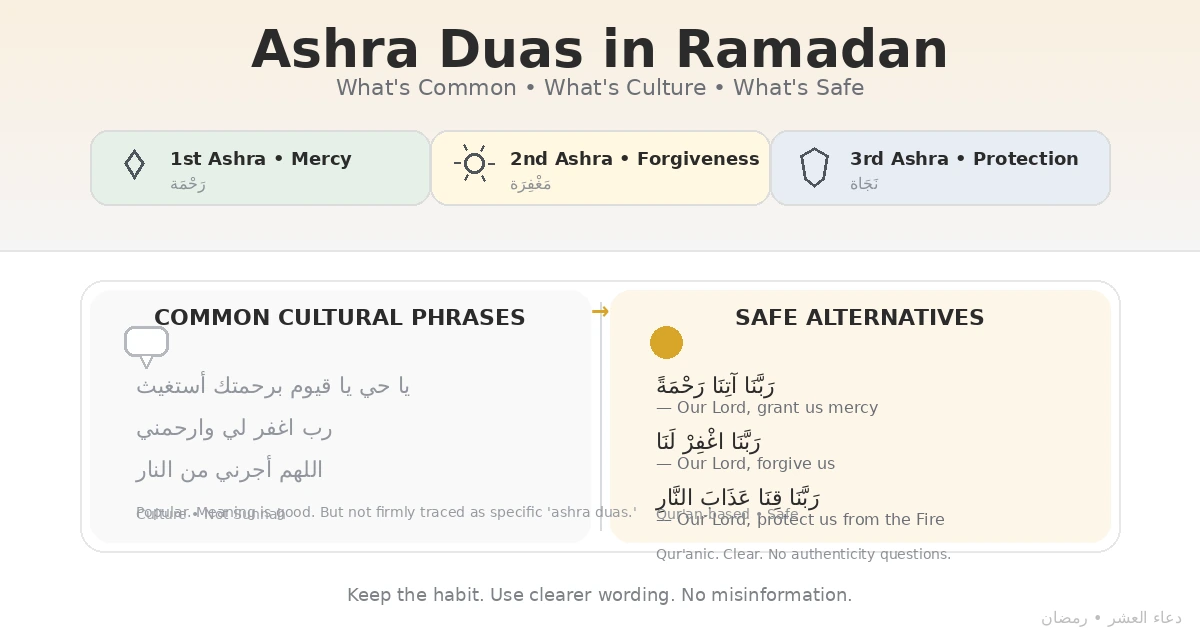
Ramadan duas from Quran: 12 short verses to use as du’a
Some nights you want “the right words.”
Not because your heart is fake—because your heart is tired.
That’s where Qur’an duas feel like a warm blanket. You’re not hunting random lines. You’re leaning on words Allah already taught us to say.
And in Ramadan, that matters. The days are long, the nights are deep, and your du’a needs to be steady—not complicated.
✅ TL;DR – Ramadan duas from Quran
Pick 3 Qur’an verse-duas and repeat them daily: after salah, before iftar, and at night. These 12 short verses cover forgiveness, guidance, mercy, parents, patience, and rizq. Use the Arabic if you can, but the meaning is the real fuel.
why Qur’an duas work (especially in Ramadan)
Snippet answer: Qur’an duas work because they’re “already-shaped” words: short, balanced, and full of meaning. When your mind is scattered, a verse-dua keeps you grounded. In Ramadan, they also help you stay consistent—because you’re repeating a small set instead of chasing a new list every night.
I explain it like this: making du’a from the Qur’an is like using a trusted recipe when you’re learning to cook.
You still bring your heart. The recipe just stops you from overthinking every ingredient.
Small aside: I used to feel guilty if my du’a wasn’t “creative.” Then I realized—sincere repetition is not laziness. It’s love.
12 short Qur’an verse-duas (Arabic + transliteration + meaning)
Snippet answer: Below are 12 short Qur’anic verse-duas you can use as du’a in Ramadan. Each one is “copy-ready” with Arabic, easy transliteration, and a clear meaning. Choose the ones that match your real needs: forgiveness, guidance, mercy, parents, patience, or rizq.
1) A du’a that covers this life + the next (2:201)
رَبَّنَا آتِنَا فِي الدُّنْيَا حَسَنَةً وَفِي الْآخِرَةِ حَسَنَةً وَقِنَا عَذَابَ النَّارِ
Transliteration: Rabbana atina fid-dunya hasanah wa fil-akhirati hasanah wa qina ‘adhaban-nar.
Meaning: Our Lord, give us good in this world and good in the Hereafter, and protect us from the punishment of the Fire.
2) When you fear your heart is drifting (3:8)
رَبَّنَا لَا تُزِغْ قُلُوبَنَا بَعْدَ إِذْ هَدَيْتَنَا وَهَبْ لَنَا مِنْ لَدُنْكَ رَحْمَةً إِنَّكَ أَنْتَ الْوَهَّابُ
Transliteration: Rabbana la tuzigh qulubana ba‘da idh hadaytana wa hab lana min ladunka rahmah innaka antal-Wahhab.
Meaning: Our Lord, don’t let our hearts deviate after You have guided us. Grant us mercy from You. You are the Bestower.
3) The “I messed up” du’a (7:23)
رَبَّنَا ظَلَمْنَا أَنْفُسَنَا وَإِنْ لَمْ تَغْفِرْ لَنَا وَتَرْحَمْنَا لَنَكُونَنَّ مِنَ الْخَاسِرِينَ
Transliteration: Rabbana zalamna anfusana wa in lam taghfir lana wa tarhamna lanakoonanna minal-khasirin.
Meaning: Our Lord, we have wronged ourselves. If You don’t forgive us and have mercy on us, we will surely be among the losers.
4) When you need clarity and confidence (20:25–28)
رَبِّ اشْرَحْ لِي صَدْرِي وَيَسِّرْ لِي أَمْرِي وَاحْلُلْ عُقْدَةً مِنْ لِسَانِي يَفْقَهُوا قَوْلِي
Transliteration: Rabbi ishrah li sadri wa yassir li amri wahlul ‘uqdatan min lisani yafqahu qawli.
Meaning: My Lord, expand my chest, make my task easy, loosen my tongue’s knot so they understand my speech.
5) The du’a for desperate moments (21:87)
لَا إِلَهَ إِلَّا أَنْتَ سُبْحَانَكَ إِنِّي كُنْتُ مِنَ الظَّالِمِينَ
Transliteration: La ilaha illa Anta subhanaka inni kuntu minaz-zalimin.
Meaning: There is no god but You. Glory be to You. I was truly among the wrongdoers.
6) For family and a home with peace (25:74)
رَبَّنَا هَبْ لَنَا مِنْ أَزْوَاجِنَا وَذُرِّيَّاتِنَا قُرَّةَ أَعْيُنٍ وَاجْعَلْنَا لِلْمُتَّقِينَ إِمَامًا
Transliteration: Rabbana hab lana min azwajina wa dhurriyyatina qurrata a‘yun waj‘alna lil-muttaqina imama.
Meaning: Our Lord, grant us comfort in our spouses and children, and make us leaders for the mindful.
7) For parents (17:24)
رَبِّ ارْحَمْهُمَا كَمَا رَبَّيَانِي صَغِيرًا
Transliteration: Rabbi irhamhuma kama rabbayani saghira.
Meaning: My Lord, have mercy on them as they raised me when I was small.
8) Forgiveness for you, parents, and believers (14:41)
رَبَّنَا اغْفِرْ لِي وَلِوَالِدَيَّ وَلِلْمُؤْمِنِينَ يَوْمَ يَقُومُ الْحِسَابُ
Transliteration: Rabbana ighfir li wa li-walidayya wa lil-mu’minina yawma yaqumul-hisab.
Meaning: Our Lord, forgive me, my parents, and the believers on the Day the حساب is established.
9) A clean forgiveness request (3:16)
رَبَّنَا إِنَّنَا آمَنَّا فَاغْفِرْ لَنَا ذُنُوبَنَا وَقِنَا عَذَابَ النَّارِ
Transliteration: Rabbana innana amanna faghfir lana dhunubana wa qina ‘adhaban-nar.
Meaning: Our Lord, we believe—so forgive our sins and protect us from the punishment of the Fire.
10) Two words that calm the guilty heart (23:118)
رَبِّ اغْفِرْ وَارْحَمْ وَأَنْتَ خَيْرُ الرَّاحِمِينَ
Transliteration: Rabbi ighfir warham wa Anta khayrur-rahimin.
Meaning: My Lord, forgive and have mercy. You are the best of those who show mercy.
11) When you want mercy + a wise path (18:10)
رَبَّنَا آتِنَا مِنْ لَدُنْكَ رَحْمَةً وَهَيِّئْ لَنَا مِنْ أَمْرِنَا رَشَدًا
Transliteration: Rabbana atina min ladunka rahmah wa hayyi’ lana min amrina rashada.
Meaning: Our Lord, grant us mercy from You and prepare for us right guidance in our affairs.
12) When you need rizq and help (28:24)
رَبِّ إِنِّي لِمَا أَنْزَلْتَ إِلَيَّ مِنْ خَيْرٍ فَقِيرٌ
Transliteration: Rabbi inni lima anzalta ilayya min khayrin faqir.
Meaning: My Lord, I’m truly in need of any good You send down to me.
how to use them daily (a routine you can actually keep)
Snippet answer: Don’t try to memorize all 12 at once. Pick 3 for your “daily set,” repeat them after salah, before iftar, and once at night. Then add one new verse per week. Consistency beats intensity, especially in Ramadan.
Micro-scenario: you’re rushing before jama’ah and your brain is blank. Say verse #10 once. That’s it.
Micro-scenario: you’re at iftar and emotions hit. Say verse #1 slowly, then add your personal words.
Here’s an easy “3-verse plan” you can start tonight:
- After salah: #10 (forgive + mercy)
- Before iftar: #1 (good in dunya + akhirah)
- At night: #2 (keep my heart guided)
One-sentence reminder: Meaning first, pronunciation later.
Also, don’t argue about “which verse is best.” If a verse makes your heart soft, it’s doing its job.
FAQs
📘 Ramadan duas from Quran FAQs
can I use Qur’an verses as du’a?
Show Answer
Yes. Many short verses are already phrased as supplication, and you can repeat them as du’a—then add your personal needs after.
دعاء من القرآن في رمضان — هل هو أفضل من أدعية أخرى؟
Show Answer
هو خيار قوي لأن ألفاظه عظيمة ومعانيه عميقة. ويمكنك أيضًا الدعاء بلغتك وبما تحتاجه.
which Quranic du’a is best for forgiveness?
Show Answer
Try #10 (23:118) for a short daily repeat, and #3 (7:23) when you want a deeper repentance tone.
what Quranic du’a is good before iftar?
Show Answer
#1 (2:201) is a strong all-rounder before iftar. After that, ask for your specific need in your own words.
do I need perfect Arabic to use these?
Show Answer
No. Do your best, go slowly, and focus on meaning. You can also make du’a in your language without shame.
how do I memorize Qur’an duas fast?
Show Answer
Pick one verse for a week and repeat it at the same time daily (like before iftar). Repetition at one “anchor moment” beats random practice.
Quranic duas for kids—what should I start with?
Show Answer
Start with #10 (short) and #7 (parents). Teach meaning first, then words. Kids remember what they understand.
common mistake: turning this into a huge list—what’s the fix?
Show Answer
Keep a “daily set” of 3. If you want more, add one new verse per week. You’re building a habit, not showing off a library.
More Ramadan du’as (if you want extra options)
If you want more short Ramadan du’as to rotate (without getting lost in random forwards), use the tool below. Keep it as support—not as pressure.
Quick Copy
Qur’an verse-duas by “need” (pick your daily set)
| Need | Best picks | When to repeat |
|---|---|---|
| Forgiveness | #10, #3, #9 | After salah + last ten nights |
| Guidance | #2, #11 | Night du’a + before iftar |
| Parents + family | #7, #8, #6 | After salah + sujood |
| Rizq + help | #12, #1 | Before iftar + after fajr |
Related Articles
- Dua for health in Ramadan: easy duas for strength, healing, and patience
- Dua for rizq in Ramadan: simple duas for barakah, work, and debt
- Dua for parents in Ramadan: 12 heartfelt duas (Arabic + meaning)
- Dua for deceased in Ramadan: what to say (simple and sincere)

Farrukh Farooqi has been living in Sharaya, Makkah, Saudi Arabia since 2010. With over 14 years of firsthand experience witnessing the sacred journey of millions of pilgrims, Farrukh specializes in providing practical, insider tips for Hajj and Umrah travelers. His work blends real-world observations, the latest Saudi updates, and essential crowd management strategies — helping pilgrims and worshippers plan smarter, stay safer, and experience a spiritually fulfilling journey across the Holy Cities.


