
Best time to make dua in Ramadan: 9 moments (with a simple plan)
Ramadan changes your day.
Your stomach feels it. Your sleep feels it. Your heart feels it.
So it makes sense that your du’a timing also changes. Not because Allah only listens at “special minutes”—but because you are softer, quieter, and more honest at certain moments.
And honestly… most people don’t need “more duas.” They need a small plan they can keep.
✅ TL;DR – best time to make dua in Ramadan
The best time to make dua in Ramadan includes before iftar, in sujood, after obligatory prayers, and the last third of the night—plus the last ten nights. You don’t need to hit every moment daily. Use a “choose 3” plan (busy/normal/intense) so you stay consistent without guilt.
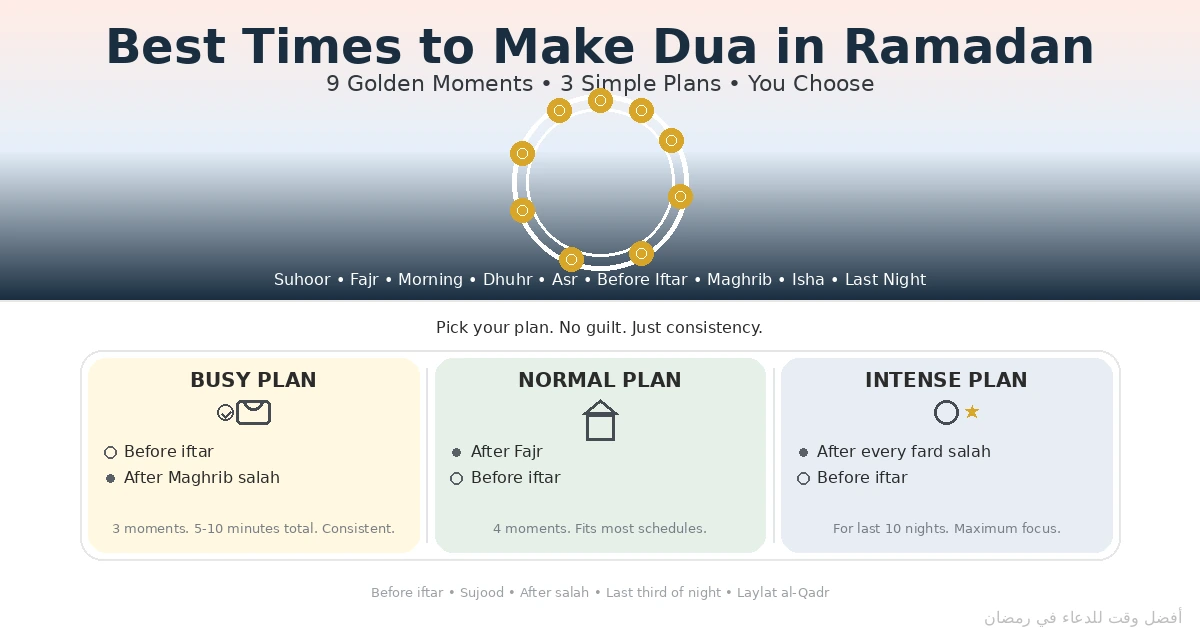
your “choose 3” Ramadan dua plan (no burnout)
Snippet answer: A realistic Ramadan du’a plan is choosing 3 moments you’ll stick to daily: one in the day (after salah), one near food (before iftar), and one in quiet time (night or suhoor). This keeps you steady. You’ll still make du’a anytime you want—but you’ll always have a reliable routine.
Think of du’a timing like watering a plant.
You can splash water randomly… or you can water at the same three times and watch it grow.
Small aside: my students always try to “do all nine moments” on day one. By day four, they’re tired and annoyed. The simple plan saves them.
- Busy plan: before iftar + one sujood + after Maghrib or Isha
- Normal plan: after two fard prayers + before iftar + last third of night (even 2 minutes)
- Intense plan: after most prayers + before iftar + night qiyam in the last ten nights
One sentence that fixes guilt: Missing a moment isn’t a sin. Quitting du’a is the real loss.
the 9 moments people aim for in Ramadan
Snippet answer: These 9 moments are commonly aimed for in Ramadan because they naturally create focus: hunger before iftar, humility in sujood, calm after salah, quiet in the last third of night, and the special atmosphere of the last ten nights. You can make du’a anytime—but these moments make it easier to be present.
Below, I’ll keep it simple: what the moment feels like, what to ask, and how to use it without turning life into a checklist.
moment 1: a few minutes before iftar (dua before iftar)
Snippet answer: The minutes before iftar are powerful because you’re fasting, focused, and about to break the fast. Keep it short: ask for forgiveness, guidance, and your real needs. Don’t rush to the food like the du’a is a “warm-up.” Give it even 60 seconds of calm.
Micro-scenario: you’re in the kitchen, kids are hungry, the adhan is close. Pause. Put the spoon down. One deep breath. One du’a.
moment 2: in sujood (dua in sujood)
Snippet answer: Sujood is one of the clearest moments for du’a because your body is already showing humility. Ask for big things here—especially heart change: patience, a clean tongue, a soft heart, and protection from repeating the same sins.
Quirky beginner mistake: people rush sujood like it’s “just a move.” Fix: add one extra breath and one real request.
moment 3: right after fard salah (dua after salah)
Snippet answer: After obligatory prayers, you’re already in worship mode. It’s a clean “landing spot” for du’a. Keep a tiny set of requests you repeat daily—then add one personal request that changes with your life.
Micro-scenario: you’re in the masjid and everyone stands up fast. You can still make du’a quietly while walking out.
moment 4: last third of the night (before fajr)
Snippet answer: The last third of the night is special because it’s quiet and private. Even if you can’t pray long, you can make du’a with honesty. Two minutes in the dark, with no audience, can reshape your Ramadan.
Don’t overthink the math. If you wake for suhoor, use a small slice of that time.
moment 5: suhoor time (not just eating)
Snippet answer: Suhoor isn’t only food. It’s a pre-dawn moment when distractions are low. After you eat, ask for strength to fast well, a clean day, and help avoiding the one sin you keep tripping on.
Quirky beginner mistake: scrolling reels until the last minute. Fix: phone down for 3 minutes. Du’a up.
moment 6: while fasting during the day (quiet personal dua)
Snippet answer: Daytime du’a in Ramadan is underrated. Short whispers during normal life—walking, driving, working—keep your heart awake. Use “mini-duas” for patience, halal earnings, and protection from anger.
Micro-scenario: someone annoys you at work. Instead of snapping, you say quietly: “Ya Allah, help me hold my tongue.” That’s worship.
moment 7: taraweeh and night prayer breaks (when the heart is soft)
Snippet answer: In Ramadan nights, emotions often rise during Qur’an recitation. Use that softness. Ask for forgiveness and guidance right there—short and sincere. Don’t wait for the “perfect long du’a” that never happens.
Quirky beginner mistake: trying to copy a long Arabic script you don’t understand. Fix: one short line + your own language.
moment 8: Fridays in Ramadan
Snippet answer: Friday is a blessed day in Islam, and many Muslims increase du’a on it—especially in the afternoon until Maghrib. Keep it calm: pick a short set of requests and repeat them. Don’t turn it into a stressful hunt for “the exact minute.”
One-sentence reminder: Barakah doesn’t need panic.
moment 9: the last ten nights (and Laylat al-Qadr effort)
Snippet answer: The last ten nights are when many people increase worship and du’a. You don’t have to do “everything.” Choose one extra du’a block nightly—after taraweeh, after witr, or before sleep—and keep it consistent. Steady effort beats a one-night sprint.
Quirky beginner mistake: staying up all night once… then sleeping through Fajr. Fix: protect your fard prayers first, then add extras.
what to actually say in those moments (simple structure)
Snippet answer: A simple du’a structure is three parts: (1) praise Allah, (2) ask forgiveness, (3) ask for your needs (dunya + akhirah). This works in any moment—before iftar, in sujood, after salah, or at night. You don’t need fancy wording. You need presence.
Here’s a beginner-safe “3-part” template you can repeat daily:
Part 1: “Ya Allah, You are Al-Rahman, Al-Raheem.”
Part 2: “Forgive me for what I’ve done and what I’ve delayed.”
Part 3: “Guide me, fix my family, and make my رزق halal and blessed.”
Another small aside: I used to skip the “forgive me” part and jump straight to requests. When I added repentance first, my du’a felt lighter.
how to remember to make du’a (without turning it into pressure)
Snippet answer: The easiest way to remember du’a is tying it to things you already do: wudu, salah, suhoor, and iftar. Write a short personal list in your phone notes. Keep it to 5–7 points. When life gets busy, you won’t be searching your brain—you’ll just read and ask.
Try these simple reminder habits:
Phone note: “My Ramadan du’a list” (forgiveness, parents, health, guidance, rizq, one personal need).
Habit stack: “After I say salam in salah, I’ll make du’a for 20 seconds.”
One-sentence reality check: Du’a isn’t a performance. It’s a return.
five quirky beginner mistakes (and quick fixes)
Snippet answer: Beginners often struggle with du’a timing because they try to do too much, copy long scripts, or wait for “perfect feelings.” The fix is small: choose 3 moments, keep a short list, understand what you say, and repeat calmly. Below are five very specific mistakes I see every Ramadan.
Mistake 1: Only making du’a when you’re emotional. Quick fix: make du’a when you’re calm too.
Mistake 2: Making du’a once before iftar… and never again. Quick fix: add one sujood du’a daily.
Mistake 3: A du’a list that’s 40 items long. Quick fix: shrink it to 7 real needs.
Mistake 4: Saying words you don’t understand at all. Quick fix: keep Arabic short and understand the meaning.
Mistake 5: Getting angry at “missed moments.” Quick fix: restart gently the next salah.
a short story of a beginner mistake (and the simple fix)
One Ramadan, a brother told me he was “failing at du’a.”
He had a long list, a timer, and a plan… and he still felt empty.
I asked, “When do you actually feel present?”
He said, “Right before iftar. For one minute.”
I said, “Good. That’s your anchor. Build around it.”
He chose three moments only. By the end of the week he said, “I’m finally talking to Allah, not chasing a schedule.”
tools that help you catch the moment (optional)
Snippet answer: If your biggest problem is simply missing the time—use a simple timer, not a complicated system. Knowing your suhoor and iftar times helps you show up for du’a before the rush. This tool is optional, but it’s helpful if you’re busy or traveling.
IFTAR
SUHOOR ENDS
📊 best time to make dua in Ramadan: the “choose 3” timing table
Use this table as a gentle guide. Pick three moments and repeat the same small set of du’as daily. That’s how consistency is born.
🌙 Show Ramadan Dua Timing Table
| Moment | Why it helps | Best for |
|---|---|---|
| Before iftar | Hunger + focus + quiet minute | Forgiveness, family, rizq, guidance |
| In sujood | Natural humility | Heart change, patience, protection |
| After fard salah | Worship “momentum” | Daily consistency and short repeats |
| Last third of night | Quiet + honesty | Deep personal du’a, tawbah, tears |
| Last ten nights | Extra worship atmosphere | Big asks, long-term goals, akhirah |
📘 best time to make dua in Ramadan FAQs
what is the best time for dua in Ramadan?
Show Answer
Many people focus on before iftar, in sujood, after fard prayers, and the last third of the night. You can make du’a anytime, but these moments make it easier to be present.
dua before iftar accepted—how long before iftar should I start?
Show Answer
Even 1–5 minutes helps. The goal isn’t a long speech. It’s showing up with a calm heart before the rush of food and family.
is dua in sujood better?
Show Answer
Sujood is a beautiful place for du’a because it naturally puts you in humility. Keep it simple: ask forgiveness, guidance, and protection from repeating sins.
last third of night dua Ramadan—what if I can’t wake up?
Show Answer
Don’t panic. Use suhoor time or make du’a before sleeping. A small consistent habit beats one “perfect” night that never repeats.
best time for dua after salah—right away or later?
Show Answer
Right after salah is a great “anchor.” If you can’t stay, you can still make du’a quietly while walking out. The main point is not dropping the habit.
أفضل وقت للدعاء في رمضان — هل الدعاء فقط في أوقات معينة؟
Show Answer
لا. الدعاء يجوز في كل وقت. لكن بعض الأوقات تساعد على الخشوع والتركيز مثل قبل الإفطار، وفي السجود، وبعد الصلاة، وفي آخر الليل.
can I make dua anytime in Ramadan?
Show Answer
Yes. Timing helps focus, but du’a isn’t locked to a schedule. The “best time” is also the time you actually show up with sincerity.
can I make dua in English?
Show Answer
Yes. Ask in the language that makes your heart honest. If you learn short Arabic du’as, that’s beautiful too—especially when you understand the meaning.
best time for dua on Laylat al-Qadr?
Show Answer
During night worship in the last ten nights, keep an extra du’a block: after taraweeh, after witr, or before sleep. The “best” time is the time you’re present and steady.
how to remember to make dua (busy people)?
Show Answer
Tie du’a to habits you already do: after salah, before iftar, and at suhoor. Keep a 7-point du’a note in your phone and read it daily.
common mistakes people make with Ramadan du’a timing?
Show Answer
Trying to do every moment daily, copying long scripts without meaning, and quitting after one “missed day.” The fix is a small “choose 3” routine you can keep.
Related Articles
- Dua for health in Ramadan: easy duas for strength, healing, and patience
- Dua for rizq in Ramadan: simple duas for barakah, work, and debt
- Dua for parents in Ramadan: 12 heartfelt duas (Arabic + meaning)
- Dua for deceased in Ramadan: what to say (simple and sincere)

Farrukh Farooqi has been living in Sharaya, Makkah, Saudi Arabia since 2010. With over 14 years of firsthand experience witnessing the sacred journey of millions of pilgrims, Farrukh specializes in providing practical, insider tips for Hajj and Umrah travelers. His work blends real-world observations, the latest Saudi updates, and essential crowd management strategies — helping pilgrims and worshippers plan smarter, stay safer, and experience a spiritually fulfilling journey across the Holy Cities.


