
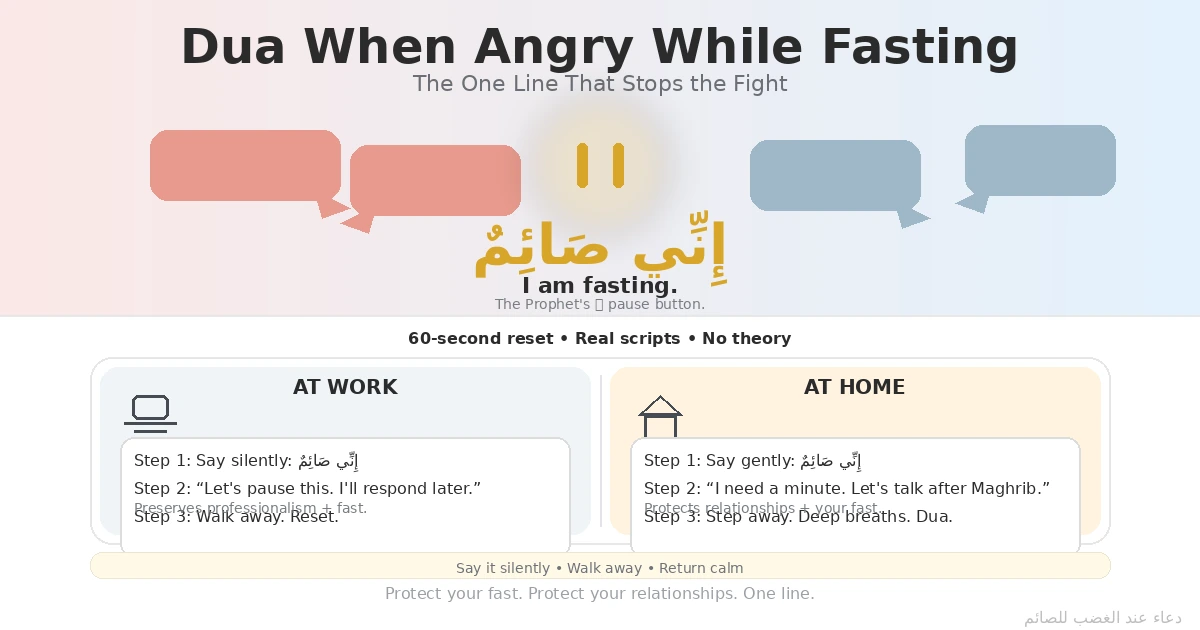
Dua When Angry While Fasting: the one line that stops the fight
Anger in Ramadan hits different.
You’re hungry. You’re tired. And somehow the smallest comment can feel like a personal attack.
But here’s the quiet win: fasting doesn’t only teach you to skip food. It teaches you to pause your mouth. To pause your hands. To pause your ego.
And when the argument is about to ignite, Islam gives you a simple “fire extinguisher” line.
✅ TL;DR – dua when angry while fasting
When you’re angry while fasting, the fastest Sunnah response is to stop the argument and say: “I’m fasting.” (إني صائم). It’s not magic—it’s a pause that protects your fast and your character. This page gives the Arabic + meaning, plus a 60-second reset routine you can use at work, at home, or online.
the one line that stops the fight
Snippet answer: When someone provokes you while fasting, a simple Sunnah phrase is: “I’m fasting”—in Arabic إني صائم. It’s a short reminder that you’re not here to win an argument. You’re here to protect your fast, your tongue, and your heart.
Say it and end the conversation.
Not because you’re weak—because you’re fasting.
Dua / phrase to say when angry while fasting
إِنِّي صَائِمٌ
Transliteration: Inni sa’im
Meaning: I am fasting.
Small aside: I used to think “I’m fasting” was something you only say to the other person. Then I realized it’s mostly for me. It cools my own engine.
why this line works (it’s a pause, not a spell)
Snippet answer: “I’m fasting” works because it interrupts the anger loop. Anger feeds on speed: quick reply, quick insult, quick regret. This line slows you down and reminds you what matters right now—your worship and your self-control.
Anger is like a pot on the stove.
If you keep the heat high, it boils over. If you lower the heat early, you save the kitchen.
This line is your “lower the heat” moment.
your 60-second reset routine (real life, not theory)
Snippet answer: A practical 60-second reset is: (1) stop talking, (2) say “I’m fasting,” (3) seek protection from Shaytan, (4) breathe slowly, (5) choose one clean exit line. This takes under a minute and prevents the “Ramadan regret” later.
Use this when your chest feels tight and your words are loading like bullets.
- Step 1 (5 seconds): Close your mouth. Literally.
- Step 2 (5 seconds): Say: Inni sa’im (out loud or quietly).
- Step 3 (10 seconds): Seek Allah’s protection.
- Step 4 (20 seconds): Breathe: in… hold… out… twice.
- Step 5 (20 seconds): Exit with a calm line: “Let’s talk later,” or “I don’t want to argue.”
Dhikr to cool anger quickly
أَعُوذُ بِاللَّهِ مِنَ الشَّيْطَانِ الرَّجِيمِ
Transliteration: A‘udhu billahi min ash-shaytan ir-rajim
Meaning: I seek refuge in Allah from Satan, the rejected.
Micro-scenario: you’re about to type a long reply on social media. Your fingers are ready. Say the dhikr. Close the app. Your fast just got stronger.
what if you already snapped or shouted?
Snippet answer: If you shouted while fasting, don’t drown in shame. Stop the argument, ask Allah’s forgiveness, and fix what you broke: apologize if needed, and make a small plan to avoid the same trigger tomorrow. Ramadan is training—people slip during training.
Regret can be useful… for about one minute.
After that, regret should turn into repentance and repair.
Short dua when you feel guilty after anger
رَبِّ اغْفِرْ لِي
Transliteration: Rabbighfir li
Meaning: My Lord, forgive me.
Micro-scenario: you snapped at your spouse five minutes before iftar. Don’t pretend it didn’t happen. Say sorry. Make du’a. Then break your fast with a calmer heart.
real-life scripts (work + family + online)
Snippet answer: Scripts help because anger steals your vocabulary. Prepare one clean sentence for each place: work, home, and online. Your goal isn’t “winning.” Your goal is leaving with your fast and your dignity intact.
Work: “I hear you. I don’t want to argue. Let’s continue after Maghrib.”
Family: “I’m fasting. I don’t want harsh words. Give me a minute.”
Online: “Not replying while fasting. Wishing you well.” Then log out.
One sentence that saves relationships: “I’ll talk when I’m calmer.”
common misconceptions (and a gentle correction)
Snippet answer: Some people think fasting means you must “stay silent no matter what” or that saying “I’m fasting” is only for big fights. In reality, the point is avoiding escalation and protecting your character. Use the phrase early—before the damage.
Misconception 1: “If I don’t argue back, I’m weak.” Truth: In Ramadan, strength often looks like restraint.
Misconception 2: “I should wait until I explode, then say ‘I’m fasting.’” Truth: Say it at the first heat, not at boiling point.
Misconception 3: “It only counts if I say it out loud.” Truth: Scholars mention details; the beginner-safe approach is: say it in a way that stops the fight—quietly or aloud—without showing off.
five quirky beginner mistakes (and quick fixes)
Snippet answer: Most anger blow-ups in Ramadan don’t start with “big evil.” They start with small habits: replying too fast, adding sarcasm, dragging old issues, or staying in the room too long. Fix the small habits and you’ll see big change.
Mistake 1: Waiting for the other person to calm you down. Quick fix: do your 60-second reset first.
Mistake 2: Thinking “I’m right” is worth your fast’s reward. Quick fix: choose peace over point-scoring.
Mistake 3: Arguing while hungry, then blaming hunger. Quick fix: step away when you feel low energy.
Mistake 4: Using sarcasm and calling it “just jokes.” Quick fix: keep your words clean—especially close to iftar.
Mistake 5: Staying in the comment section too long. Quick fix: exit early; don’t “camp” in conflict.
a short story of a beginner mistake (and the simple fix)
A young brother once told me, “Ramadan makes me angry. I thought fasting would make me calm.”
He wasn’t a bad person. He was just running on low sleep and high stress.
One day at work, a coworker teased him in front of others. He snapped.
Later he felt sick with regret—especially because it was close to Maghrib.
We practiced one thing only: he’d say “Inni sa’im,” breathe twice, and walk to get water.
The next week he messaged me: “I didn’t win the argument… but I won my fast.”
tools to keep your Ramadan du’a ready (optional)
Snippet answer: If you want more short, copy-ready duas for Ramadan (for patience, forgiveness, and family), keeping them in one place helps—especially when emotions run high. This tool is optional, but it’s useful when you want quick wording without searching during stress.
Quick Copy
📊 anger while fasting: trigger → one line → next move
Use this as a quick “cheat sheet” for the moments that usually blow up. Keep it simple and repeatable.
🧊 Show Anger Reset Table
| Trigger | Say (quick) | Do next (10–30 sec) |
|---|---|---|
| Someone insults you | Inni sa’im | Stop talking, breathe twice, exit politely |
| Family tension at home | Inni sa’im | Change room, drink water, return calmer |
| Online comments provoke you | A‘udhu billah… | Close the app, don’t type, make a short dua |
| You already snapped | Rabbighfir li | Apologize if needed, repair, restart your day |
📘 dua when angry while fasting FAQs
what to say when someone angers you while fasting?
Show Answer
Say: “I’m fasting” (إني صائم). Then stop the argument and step away. The phrase is meant to protect your fast and prevent escalation.
dua for anger in Ramadan—what is the short Arabic line?
Show Answer
A well-known short line is: إني صائم (Inni sa’im), meaning: “I am fasting.” It’s used to stop a fight, not to show off.
دعاء عند الغضب في رمضان: ماذا أقول بسرعة؟
Show Answer
قل: إني صائم، ثم اترك الجدال. وقل أيضًا: أعوذ بالله من الشيطان الرجيم إذا شعرت أن الغضب يزيد.
does saying “I’m fasting” have to be out loud?
Show Answer
You can say it in a way that stops the fight—quietly to yourself or calmly to the other person. The goal is ending the argument, not winning attention.
how to control anger while fasting (fast routine)?
Show Answer
Use the 60-second reset: stop talking, say “Inni sa’im,” seek refuge in Allah, breathe slowly, and exit with one calm sentence.
what if I shouted while fasting—did my fast break?
Show Answer
Shouting is a serious mistake for character, but it isn’t eating or drinking. Focus on repentance, repair, and doing better—especially by stopping arguments quickly.
is it okay to walk away from someone while fasting?
Show Answer
Yes. Walking away is often the cleanest option when anger is rising. Protecting your fast and avoiding harsh speech is a strong choice in Ramadan.
anger tips Ramadan at work—what do I say without sounding rude?
Show Answer
Try: “Let’s continue later,” or “I don’t want to argue.” Then step away. Short, polite, and firm is best.
anger tips Ramadan with family—what if they keep pushing?
Show Answer
Repeat your boundary calmly: “I’m fasting. I’ll talk later.” Then change the environment—different room, quick walk, or a glass of water.
does fasting reduce anger?
Show Answer
Fasting can increase self-control over time, but early days can feel harder because of hunger and low sleep. That’s why the “pause line” and exit habit matter.
how to stop backbiting Ramadan when I’m angry?
Show Answer
Don’t “debrief” in gossip. Cool down first, make a short du’a, and speak only to solve the issue—without dragging in people who weren’t part of it.
Related Articles
- Dua for health in Ramadan: easy duas for strength, healing, and patience
- Dua for rizq in Ramadan: simple duas for barakah, work, and debt
- Dua for parents in Ramadan: 12 heartfelt duas (Arabic + meaning)
- Dua for deceased in Ramadan: what to say (simple and sincere)
- Best time to make dua in Ramadan: 9 moments (with a simple plan)

Farrukh Farooqi has been living in Sharaya, Makkah, Saudi Arabia since 2010. With over 14 years of firsthand experience witnessing the sacred journey of millions of pilgrims, Farrukh specializes in providing practical, insider tips for Hajj and Umrah travelers. His work blends real-world observations, the latest Saudi updates, and essential crowd management strategies — helping pilgrims and worshippers plan smarter, stay safer, and experience a spiritually fulfilling journey across the Holy Cities.


