
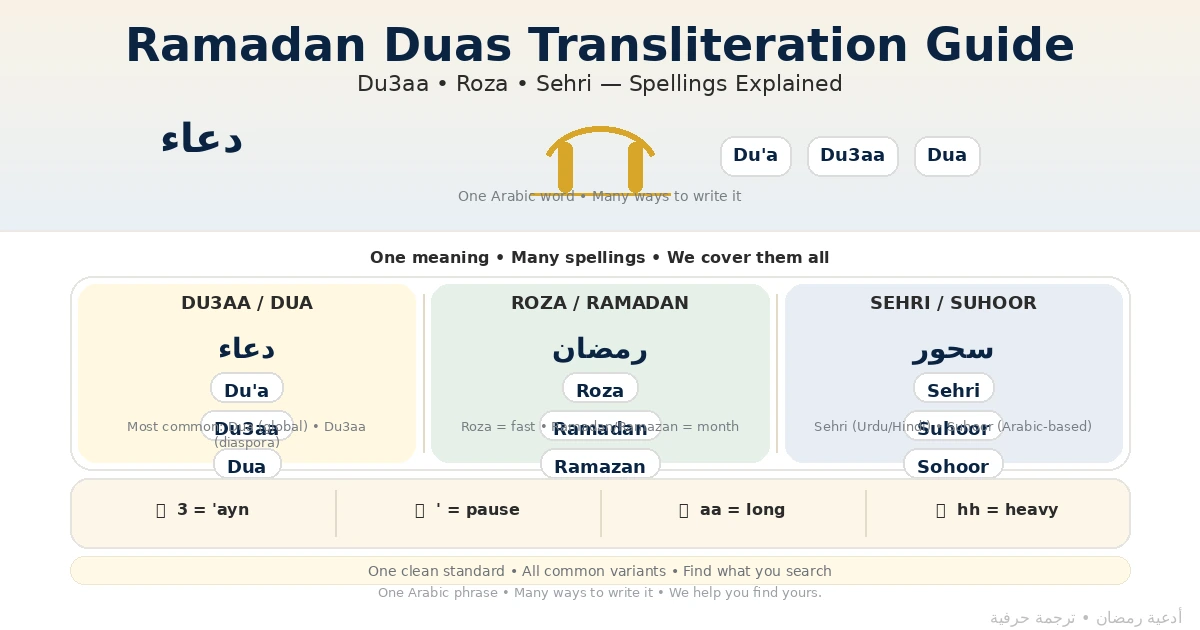
Ramadan duas transliteration guide: du3aa, roza, sehri spellings explained
Transliteration is a bridge.
It’s what you use when your heart wants du’a, but your eyes aren’t comfortable with Arabic script yet.
And then you meet the chaos: du3aa, dua, duaa… roza, rozaa… sehri, suhoor… ramazan, ramadan.
So let’s clean it up. Not with a grammar lecture—just with a clear “map” you can follow.
✅ TL;DR – Ramadan duas transliteration
Ramadan duas transliteration helps you pronounce du’a when you can’t read Arabic yet—but spellings differ by country and keyboard habits (du3aa, roza, sehri, ramazan). The safest move is choosing one clean style for your site, then listing common variants so people still find you. This guide explains the variants and gives simple pronunciation tips.
what “transliteration” really is (and what it isn’t)
Snippet answer: Transliteration is writing Arabic sounds using the Latin alphabet, so you can pronounce words you can’t read in Arabic script yet. It’s not a translation. Translation gives meaning; transliteration gives sound. Think of it like reading a name tag—you can say the name, but you still need the story to know the person.
One gives you the voice.
The other gives you the meaning.
Both matter, but they’re different tools.
why spellings change across countries (du3aa vs dua)
Snippet answer: Spellings vary because people “spell by ear,” and different regions hear and write Arabic sounds differently. South Asian users often write du3aa because “3” is used online to show the Arabic letter ‘ayn. Others write duaa to show a long vowel. None of this makes someone’s worship wrong—it’s just spelling habits.
Some spellings come from language habits.
Some come from old phone keyboards.
And some come from people trying to be helpful… but ending up confusing.
Small aside: my students always ask, “Which spelling is correct?” I tell them: “Correct is the one that helps you say it and remember it—without pretending it’s the only way.”
the “big 6” Ramadan spellings you’ll see (and what they usually mean)
Snippet answer: These are the most searched variants: du3aa/dua/duaa (du’a), roza (fast), iftar (breaking fast), sehri (pre-dawn meal), suhoor (same as sehri), and ramazan/ramadan (same month spelling). You can support all of them by listing variants beside your standard form.
Here’s the beginner-friendly meaning map:
du’a / dua / duaa / du3aa → supplication (دعاء)
roza → fasting (a South Asian word people use a lot)
iftar → breaking the fast (إفطار)
sehri → the pre-dawn meal (common South Asian spelling)
suhoor → the same pre-dawn meal (سحور) (another common spelling)
ramazan → Ramadan (a spelling used in some regions/languages)
Micro-scenario: someone searches “roza iftar ki dua” and lands on your “iftar dua” page. They don’t need you to correct their wording. They need you to help them make du’a.
a simple “one standard” rule that keeps your site clean
Snippet answer: For your main headings and URLs, pick one standard style and stick to it. Then list the variants inside the article so readers and search engines still connect the dots. This keeps your site consistent while still meeting real users where they are.
Here’s a practical standard most global readers understand:
Ramadan (not Ramazan) du’a (or dua) suhoor (and also mention sehri) iftar (and also mention roza/roza iftar)
But don’t be strict like a school teacher about it. Be helpful like a friend.
pronunciation tips without turning it into a lesson
Snippet answer: You don’t need perfect Arabic pronunciation to make du’a. Aim for “clear enough,” and focus on meaning and sincerity. The biggest transliteration helps are: double vowels often mean a longer sound (duaa), apostrophes may mark a throat sound (‘), and the number 3 is often used online for ‘ayn.
Keep these tiny rules in your pocket:
- aa usually means a longer “a” sound (duaa vs dua).
- ’ sometimes marks a throat sound, but many people skip it in casual writing.
- 3 is a common internet symbol for ‘ayn (so du3aa = du‘a).
One-sentence comfort: Allah understands your intention even when your tongue is still learning.
common transliteration mistakes beginners make (and quick fixes)
Snippet answer: The usual mistakes are not religious mistakes—they’re reading mistakes: mixing up sehri and suhoor as if they’re different actions, thinking du3aa is “a different word,” and copying long spellings you can’t pronounce. Fix it by choosing one short version you can say confidently.
Mistake 1: Thinking sehri and suhoor are two separate meals. Quick fix: they point to the same pre-dawn meal—just different spellings.
Mistake 2: Treating du3aa as a new word. Quick fix: it’s usually just “du’a” written with internet shorthand.
Mistake 3: Copying a 20-word transliteration you can’t actually say. Quick fix: use shorter lines and repeat them with meaning.
Mistake 4: Feeling ashamed because you “can’t read Arabic.” Quick fix: start with meaning + simple wording, then learn slowly.
Mistake 5: Mixing translation and transliteration in one line and getting lost. Quick fix: keep three clean parts: Arabic, transliteration, meaning.
a short story: the “du3aa confusion” moment
A young guy once asked me, “Is du3aa a different thing from dua?”
He looked genuinely worried, like he’d been missing something important.
I asked, “Where did you see it?” He said, “TikTok comments.”
I told him: “It’s the same du’a—some people type 3 to hint at a letter.”
He laughed, then sighed in relief.
After that, he stopped chasing spellings and started focusing on meaning.
quick tool (optional) for copy-ready Ramadan duas
Snippet answer: If you want ready Ramadan du’as you can copy (with meanings) so you’re not hunting around the internet, this tool keeps them in one place. Use it as your “library,” then pick a few lines to repeat daily.
Quick Copy
📊 transliteration “map”: one standard + common variants
Use this table to keep your pages consistent while still catching the real-world search spellings.
🧭 Show Transliteration Variant Table
| Use as your standard | Common variants people search | What it points to |
|---|---|---|
| du’a (or dua) | duaa, du3aa, du‘a, duaa Ramadan | supplication (دعاء) |
| suhoor | sehri, sehry, seheri, suhur | pre-dawn meal (سحور) |
| iftar | iftari, roza iftar, iftar dua | breaking the fast (إفطار) |
| Ramadan | Ramazan, Ramzan, Ramadhan | the same month name spelling variants |
📘 Ramadan duas transliteration FAQs
Ramadan duas transliteration for beginners—what is it?
Show Answer
It’s Arabic sounds written in English letters so you can pronounce du’as without reading Arabic script yet. It’s different from translation, which gives meaning.
what does du3aa mean?
Show Answer
Du3aa usually means “du’a” written with internet shorthand. The “3” often hints at the Arabic letter ‘ayn.
roza iftar dua—why do people write it like that?
Show Answer
“Roza” is a South Asian word used for fasting, so many people search using that phrase. They usually want the iftar du’a (dua for breaking the fast).
sehri vs suhoor—are they different?
Show Answer
They point to the same pre-dawn meal. Sehri is a common South Asian spelling; suhoor is closer to the Arabic term (سحور).
ramazan vs ramadan—why spellings differ?
Show Answer
Different languages and accents produce different spellings in Latin letters. Both are used to refer to Ramadan.
is transliteration better than Arabic text?
Show Answer
Arabic text is best when you can read it. Transliteration helps beginners pronounce. Many pages use both plus a clear meaning.
transliteration vs translation—what’s the difference?
Show Answer
Transliteration shows the sound in Latin letters. Translation shows the meaning in your language.
why spellings differ afuwwun/afu?
Show Answer
Some writers try to show a longer sound (like “ww”), while others keep it simple for readability. It’s usually a choice of style, not a different meaning.
how to copy Arabic dua on phone quickly?
Show Answer
Use pages that provide a copy-ready Arabic block. If your device supports it, long-press to copy the Arabic line, then paste into Notes or a message to yourself.
easiest transliteration for kids—what should it look like?
Show Answer
Keep it short, avoid symbols like ʿ and ’, and use clear vowels. Kids do better with “readable” than “academic.”
Related Articles
- Dua for health in Ramadan: easy duas for strength, healing, and patience
- Dua for rizq in Ramadan: simple duas for barakah, work, and debt
- Dua for parents in Ramadan: 12 heartfelt duas (Arabic + meaning)
- Dua for deceased in Ramadan: what to say (simple and sincere)
- Best time to make dua in Ramadan: 9 moments (with a simple plan)
- Dua When Angry While Fasting: the one line that stops the fight
- Umrah in Ramadan duas: what to say in tawaf, sa’i, and at the haram

Farrukh Farooqi has been living in Sharaya, Makkah, Saudi Arabia since 2010. With over 14 years of firsthand experience witnessing the sacred journey of millions of pilgrims, Farrukh specializes in providing practical, insider tips for Hajj and Umrah travelers. His work blends real-world observations, the latest Saudi updates, and essential crowd management strategies — helping pilgrims and worshippers plan smarter, stay safer, and experience a spiritually fulfilling journey across the Holy Cities.


