
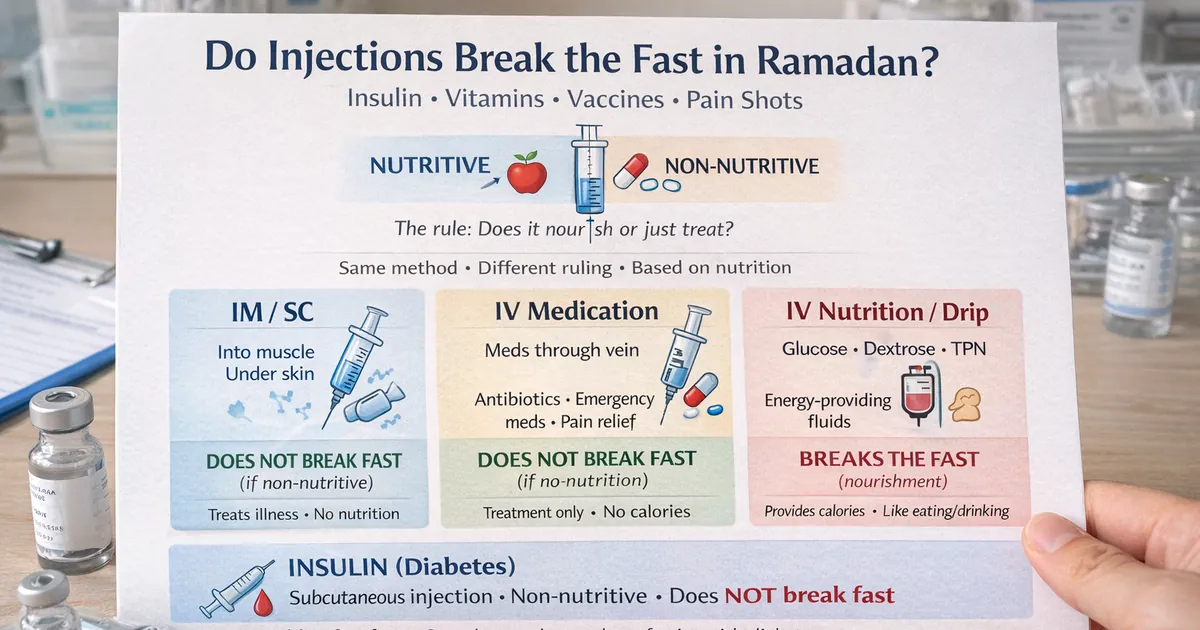
Does injection break fast Ramadan: Do Injections Break the Fast in Ramadan? Insulin, Vitamins, Vaccines, and Pain Shots
Injection questions in Ramadan don’t feel “theoretical.”
They feel like a nurse saying, “Roll up your sleeve,” while you’re thinking, “Wait… am I ruining my fast?”
I’ve seen this worry in teenagers, fathers, pregnant sisters, and older uncles who’ve been fasting longer than I’ve been alive. Same face. Same panic.
So let’s make this simple, calm, and honest. No drama. No overconfident claims. Just the clean principles scholars use, then real-life cases people actually face in clinics in Ramadan.
✅ TL;DR – does injection break fast Ramadan
Does injection break fast Ramadan? In many common discussions, injections that are medicine (not nourishment) are treated differently from eating and drinking, so many scholars say they don’t break the fast. The big “change point” is when an IV acts like feeding or hydration that replaces drinking. If you need an injection urgently, don’t risk your health—handle makeup days afterward.
The simple rule scholars use
Direct answer: scholars often look at two things: intent and what the treatment does inside the body. If something is basically “medicine” and not food or drink, many treat it differently from eating. If something nourishes you like food, or replaces drinking, many treat it more strictly.
Here’s an analogy I use with beginners. Imagine your fast as a “sealed day.” Food and drink are like opening the lid and pouring something in. Injections are more like giving medicine through a different door. It can still matter, but it’s not automatically the same as sitting down and eating.
One sentence that saves a lot of stress: not every “thing entering the body” is the same kind of entering.
Now, there’s a respectful reality: scholars can differ on some details (especially around IV fluids and anything that acts like nutrition). When you hear different answers, don’t turn it into a fight. Keep your worship simple, and when you can, choose the path that removes doubt (like scheduling after iftar).
Small aside—because I made this mistake myself as a student: I used to treat every medical item as “equal.” A bandage, a blood test, a vaccine… in my head it was one bucket. It’s not one bucket.
IM vs SC vs IV (what changes?)
Direct answer: IM (intramuscular) and SC (subcutaneous) injections are commonly discussed as medication delivery, not eating or drinking. IV (intravenous) is the one that can change the conversation, because some IVs can function like nutrition or hydration that replaces drinking. So the “route” matters mainly because it changes what the body is receiving.
Let’s translate the abbreviations into normal language:
IM (intramuscular): medicine goes into muscle (often vaccines, some pain injections, some vitamins).
SC (subcutaneous): medicine goes under the skin (commonly insulin and other long-term meds).
IV (intravenous): medicine or fluids go into the vein (can be small-dose medication, or can be drips that support the body more heavily).
So what changes with IV?
If it’s a small IV medication dose, many people treat it like “medicine delivery.” But if it’s a drip that is clearly replacing food or water for the body, many scholars treat it strictly because it starts to look like eating or drinking through a different route.
Micro-scenario: you’re fasting and a clinic says, “We’ll give you a quick injection and you can go.” That usually feels like an IM/SC type situation—short, medication, done.
Another micro-scenario: you’re dehydrated, weak, and they say, “You need fluids through a drip.” That’s not just “a needle.” That’s your body asking for water in a serious way.
Different situation. Different ruling discussion.
Insulin specifically (common Ramadan scenario)
Direct answer: insulin is a common Ramadan need, and it’s usually not taken as “food.” Still, diabetes is not one-size-fits-all. If fasting creates real risk (dangerous low sugar, dangerous high sugar, fainting, confusion), Islam does not ask you to gamble with your health. Many people need a personal plan with medical advice and a trusted scholar’s guidance.
This is the part where people want me to give one bold sentence that covers every diabetic. I won’t. It would be careless.
But I can give you a safe way to think.
Insulin is typically given to manage blood sugar, not to “feed” you. That’s why many discussions treat it differently from eating. The bigger issue is not “does the needle break the fast?” The bigger issue is: is fasting safe for you today?
Because if you’re forcing a dangerous fast, you’re not doing extra worship. You’re risking harm.
A longer example (because this is real life): I once spoke to a brother who was determined to fast “no matter what.” He skipped checking his sugar because he didn’t want to “see bad news.” By afternoon he was sweating, irritable, and confused, but he kept saying, “I’m fine.” His family took him to a clinic. He needed urgent treatment. The lesson wasn’t “you weren’t strong enough.” The lesson was “you didn’t plan.” He later told me the calmest Ramadan he ever had was when he got a proper schedule and stopped trying to be a hero.
If you’re diabetic, the most responsible Ramadan mindset is: plan early, check your body, and don’t treat warnings as weakness.
And yes—people also ask about insulin timing with suhoor and iftar. That’s a medical plan question first, not a social media question. Don’t change your routine on your own.
Vitamins, vaccines, pain shots
Direct answer: many common discussions treat vaccines, pain injections, and some vitamin shots as medication, not eating. Still, people often schedule them after iftar simply to avoid doubt and avoid arguments at home. If the shot is needed in daytime, don’t let fear push you into harm.
Let’s break down what people actually mean by “shots.”
Vaccines while fasting: vaccines are usually about prevention, not nutrition. That’s why many treat them like medication. If the clinic appointment is flexible, after iftar removes stress. If it’s not flexible, keep it calm and handle your worship responsibly.
Pain injection fasting: pain shots (like at a dentist, orthopedic clinic, or emergency care) are usually meant to reduce pain or inflammation, not to feed. Many discussions treat them as not the same as eating and drinking.
Vitamin shot Ramadan: vitamin shots make people nervous because they think “vitamin = food.” But a vitamin injection is still not the same as eating a meal. This is also where scholars may differ if the vitamin is used in a way that feels like “strengthening the body like nutrition.” When in doubt and it’s optional, do it at night.
One sentence you can use with family if they start panicking: “It’s medicine, not lunch.”
But don’t be rude about it. Ramadan doesn’t need arrogance.
IV drips vs IV medication (nutrition question)
Direct answer: IV medication is often discussed like “medicine delivery.” IV drips are where the nutrition question becomes serious. If an IV is functioning like feeding (or seriously replacing drinking), many scholars treat it strictly. In many real cases, needing an IV is already a sign you’re in illness or harm-risk territory, so making up the fast later becomes the main path.
This is the biggest confusion online because people call everything “IV.”
But two IVs can be completely different.
IV medication: a small dose through the vein to deliver medicine.
IV drip/infusion: a flow of fluids (and sometimes nutrition) that supports the body in a bigger way.
So when do people worry?
When the IV is clearly doing the job of food or water.
If you’re getting something that is meant to nourish you, many scholars treat it as breaking the fast because it’s like feeding by another route. If you’re getting hydration fluids because you can’t drink, many treat it strictly too, because it’s replacing drinking.
Micro-scenario: you’re fasting and you have a migraine. The doctor offers a quick IV medication dose or suggests a drip because you’re dehydrated. Those are not the same. One is “medicine help.” The other is “your body needs fluids.” Treat them differently.
And please don’t do this common mistake: “I’ll take the drip and still claim I’m fasting.” If you needed a drip, be honest with yourself. Your health situation is speaking loudly.
If you had to take it urgently
Direct answer: if an injection is urgent—like emergency pain relief, asthma crisis treatment, severe allergy treatment, diabetic danger signs—then your health comes first. Islam does not want you to harm yourself. Take the treatment, stay safe, and then sort out the missed fast afterward with a trusted scholar if you need personal guidance.
Some people freeze in emergencies because they’re scared of “breaking the fast.”
That fear can be dangerous.
If you’re in an urgent situation, get treatment. Then deal with the religious side after you’re stable. That order matters.
Now, here are five quirky beginner mistakes I keep seeing—small things, but they create big stress:
- Mistake 1: thinking “needle = fast broken” every time. Fix: ask what the injection is doing (medicine vs nourishment).
- Mistake 2: booking optional shots at 2 p.m. and then panicking. Fix: if optional, book after iftar and relax.
- Mistake 3: stopping necessary insulin “just for Ramadan.” Fix: don’t change medical plans without medical advice.
- Mistake 4: arguing with family using harsh words. Fix: stay respectful and keep your worship clean.
- Mistake 5: reading 20 random answers online and getting more confused. Fix: pick a trusted local scholar for your ongoing case.
A short story of a beginner mistake (and the simple fix):
A young man once told me, “I took a pain shot at the clinic and I think my Ramadan is ruined.”
He had spent the whole day angry, refusing to eat at iftar, as if hunger was a punishment he had to keep.
I asked him one calm question: “Was it medicine, or were you fed?”
He said, “Medicine.”
I told him, “Then stop treating yourself like an enemy. If you still feel unsure, schedule these things after iftar next time. Ramadan isn’t meant to turn you into a detective.”
He later said, “I wish someone had explained it like that from the start.”
If you ever forget you were fasting and take something in panic, don’t add lies on top of confusion. Be honest, learn, and move forward.
Quick FAQ
Direct answer: most people want quick yes/no answers, but the safest FAQs also show the “why”: medicine vs nourishment, IM/SC vs IV, and urgent need. Use these answers for common situations, and for complex medical plans (especially diabetes), get a personal answer from a trusted scholar with medical advice.
📘 does injection break fast Ramadan FAQs
does injection break fast Ramadan?
Show Answer
Many common discussions treat non-nourishing injections as medication, not eating or drinking. The bigger concern is when something functions like nutrition or seriously replaces drinking. If the injection is optional, booking it after iftar removes doubt.
does insulin break the fast?
Show Answer
Insulin is usually taken to manage blood sugar, not to feed the body. Still, diabetes is personal and fasting safety varies. If fasting puts you at risk, don’t gamble with health. Get a Ramadan plan with medical advice and a trusted scholar for your case.
vitamin shot Ramadan: does it break the fast?
Show Answer
Vitamin injections are often discussed as medication delivery, not a meal. If the shot is optional and you’re worried, schedule it after iftar. If it’s medically needed, don’t harm yourself by delaying unsafely.
vaccine while fasting: allowed or not?
Show Answer
Vaccines are generally for prevention, not nutrition. Many discussions treat them like medication, not eating or drinking. If the appointment is flexible, after iftar can remove worry.
pain injection fasting: does it break?
Show Answer
Many discussions treat pain shots as medication, not food or drink. If it’s urgent treatment, take it and stay safe. Then handle makeup days only if your situation truly required breaking the fast.
intramuscular injection fasting vs subcutaneous injection fasting: is there a difference?
Show Answer
IM and SC are both common routes for medication. Most confusion comes from what the injection does (medicine vs nourishment), not only the exact layer of skin or muscle. For repeated medical plans, get a consistent answer from a trusted scholar.
what about IV injections?
Show Answer
IV can mean a small medication dose or a drip/infusion. If it’s acting like nutrition or seriously replacing water, many treat it strictly. If it’s urgent medical treatment, don’t risk health—then sort out the religious ruling after you’re stable.
IV drips vs IV medication: which one is more likely to affect the fast?
Show Answer
Drips that function like feeding or strong hydration support are more likely to be treated strictly because they replace food or water. A small IV medication dose is often discussed differently, as medicine delivery.
can i take injections at a clinic Ramadan and still fast the same day?
Show Answer
Often yes for non-nourishing medication injections, based on many common discussions. If your case is complex (chronic illness, repeated IV needs, unstable diabetes), get a personal answer from a trusted scholar so you’re not guessing every year.
what if i forgot i was fasting and got an injection?
Show Answer
Forgetting happens. Stay calm and look at what the injection was. If it was medication, many people don’t treat it like eating. If it was an urgent situation, health comes first. If you’re still worried, ask a trusted scholar with the details.
traveler + injection: does travel change the ruling?
Show Answer
Travel can already be a reason to not fast and make up later. If you’re traveling and also need treatment, choose the safer path for health and worship. Don’t make Ramadan harder than it needs to be.
📊 injection types: medicine vs “feeds the body” (beginner map)
This table is a simple filter. It doesn’t replace a scholar for complex medical plans, but it stops the “every needle is the same” confusion.
💉 Show Injection Ruling Map Table
| Type | What it usually is | Beginner-safe note |
|---|---|---|
| IM injection | Medication (often vaccines/pain/vitamins) | Often discussed differently from eating; night scheduling removes doubt |
| SC injection | Medication (commonly insulin) | Main issue is safety plan for the condition, not the needle alone |
| IV medication (small dose) | Medicine delivered through vein | Often discussed as medicine delivery; details vary by case |
| IV drip/infusion | Fluids and sometimes nutrition support | If it replaces food/water, many treat it strictly; urgent need = health first |
Related Internal Link Ideas
Ramadan fasting hours calculator

Farrukh Farooqi has been living in Sharaya, Makkah, Saudi Arabia since 2010. With over 14 years of firsthand experience witnessing the sacred journey of millions of pilgrims, Farrukh specializes in providing practical, insider tips for Hajj and Umrah travelers. His work blends real-world observations, the latest Saudi updates, and essential crowd management strategies — helping pilgrims and worshippers plan smarter, stay safer, and experience a spiritually fulfilling journey across the Holy Cities.


